1/
🧵 Decoding-time safety methods improve LLM safety, but they rewrite *safe* generations too, an "alignment tax" on helpfulness.
Value-Filtered Decoding steers only when needed, with a calibrated bound on how often we touch safe outputs.
📄Accepted at AI4Good @ ICML 2026✨
@itayevron Backpacking in India years ago with some Bangalore engineers chatting between themselves in Hindi. They kept saying "matlab," so I asked why they were always talking about an algebra lib. A quick google search reveales why they couldn't stop laughing at me after that.
Two exciting events recently:
- best student paper in Mind-IL & an oral for "Selective Safety Steering via Value-Filtered Decoding".
- Jesus collage graduate scholarship.
Happy times! 🥳
Really excited to share these opportunities to join @CompSciOxford and work with us to shape the future of open AI!
We have 3 senior postdoc positions, and 2 research lead positions to build a group under you
Deadline is 27/11
https://t.co/9Ac6o5yTGw
https://t.co/30Evgr7khg
1/ Our paper “Selective Safety Steering via Value-Filtered Decoding” was accepted at #NeurIPS2026 🎉
Most safety interventions change every response, even though most responses were already safe. Value-Filtered Decoding only touches the ones heading somewhere unsafe.
1/
🧵 Decoding-time safety methods improve LLM safety, but they rewrite *safe* generations too, an "alignment tax" on helpfulness.
Value-Filtered Decoding steers only when needed, with a calibrated bound on how often we touch safe outputs.
📄Accepted at AI4Good @ ICML 2026✨
1/ Our paper “Selective Safety Steering via Value-Filtered Decoding” was accepted at #NeurIPS2026 🎉
Most safety interventions change every response, even though most responses were already safe. Value-Filtered Decoding only touches the ones heading somewhere unsafe.
4/ It ships: pip install value-steer plugs it into vLLM at up to 87% of base throughput, with the same cost at every safety setting.
📄 https://t.co/W7SDz3FfiZ
🛠️ https://t.co/Xm6pfcwJFE
3/ Our method significantly outperforms all other baselines in terms of similarity to the base model and achieves the best safety-similarity and reward score–similarity trade-offs.
@NeurIPSConf 2026, here we come! 🚀
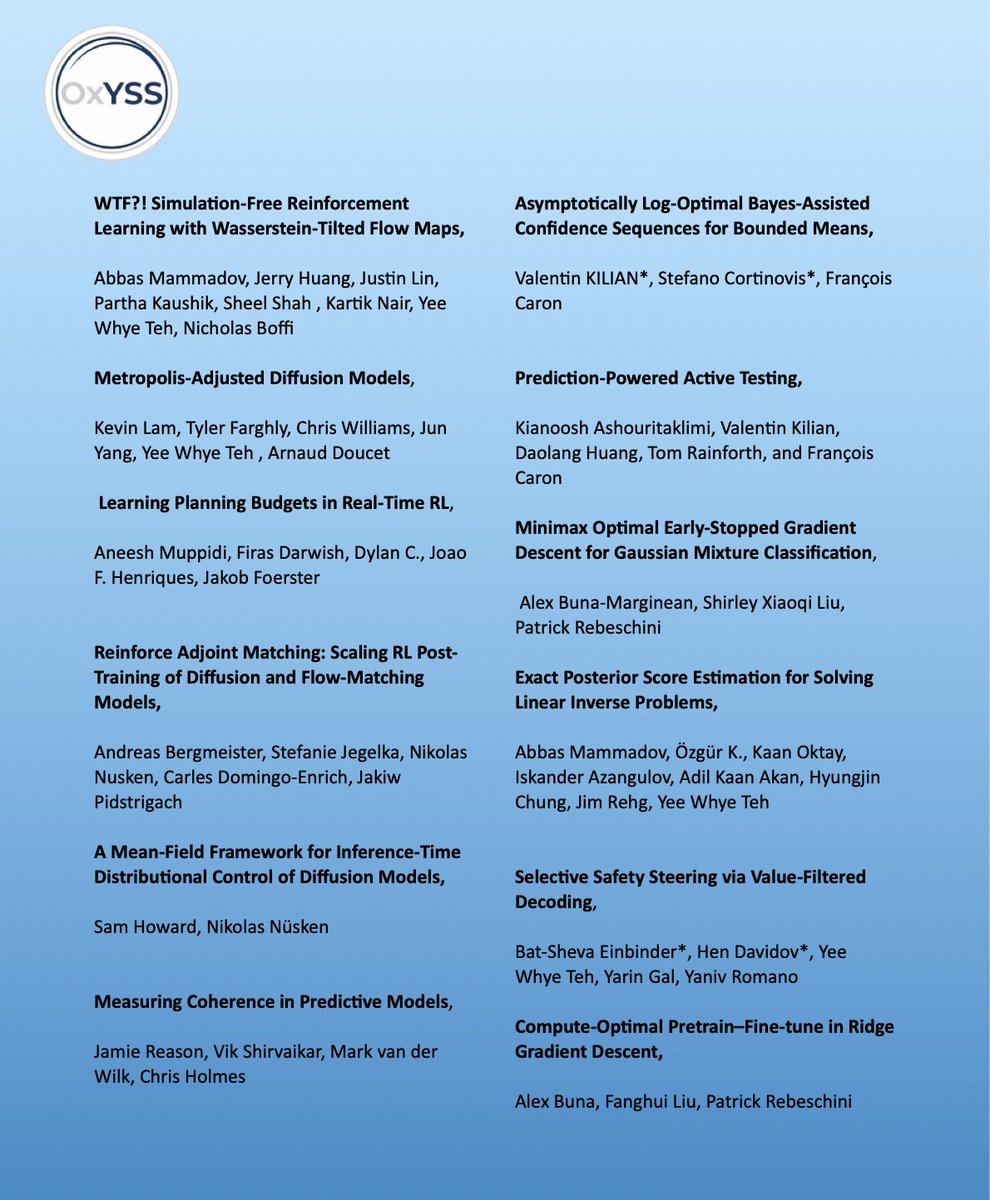
The @OxfordYss is thrilled to celebrate 12 main-track papers accepted from our members and their supervisors! 🎉
Many of us will be in Sydney 🇦🇺, Paris 🇫🇷 and Atlanta 🇺🇸 — come say hi!
AI has solved Navier-Stokes. What would it take for AI to make similar advances in life sciences?
In our latest preprint, led by @AdaFang_, we argue that, while fields like mathematics and programming can cheaply evaluate many AI-generated candidates at scale, "closing the loop" of hypothesis ➡️ experiment ➡️ revised hypothesis remains a central bottleneck in AI-driven biomedical discovery.
We outline a vision for autonomous AI scientists that:
🧠 Reason over scientific knowledge, multimodal data, competing hypotheses, and uncertainty across multi-loop campaigns lasting days to months.
🔬 Learn under sparse and delayed feedback, combining soft verifiers (e.g., simulations, predictive models, and biological world models) with hard verifiers such as wet lab assays, robotic experiments, organoids, and clinical studies.
🎯 Allocate limited experimental budgets to tests with the greatest expected information gain.
We suggest that achieving this vision will require advances in long-horizon reasoning, process-based evaluation, uncertainty-aware exploration, self-driving laboratories, and human-on-the-loop oversight.
Read our paper here: https://t.co/etrBRjXC4O
More details below from @marinkazitnik. 👇🏽
@AmitLeViAI לא מסכים. יש הרבה עבודה מחקרית בארץ, אבל היא יותר ישירות מול product והתאמה של טכניקות קיימות למקרי קצה של ביזנס. זה מאוד מעניין והשכר ביחס להנדסת תוכנה בארץ מאוד יפה. לרוב גם לא צריך דוקטורט.
לא כולם חולים בחיידק של ה-methods כמונו.
@bravo_abad Very interesting! Looks like the nn simulation is a bit smoothed, what would explain that effect? How similar is it to actual kernal smoothing?
@StephenLCasper Does this incident affect your claim that closed model safety is "solved"? Do you think that open weight models have any likelihood of producing an incident like this?