Professor of Machine Learning, University of Oxford
@OATML_Oxford Group Leader
Expert Advisor to AISI
"One of the top machine-learning people" - Tim Berners-Lee
🧵 @AISecurityInst tested GPT-6.2 Astra
-We found behaviours that suggest, like prior models, 6.2 Astra's alignment may fail in ways that result in real-world harm w/o additional mitigations
-We identified a substantial regression in jailbreak robustness relative to GPT-6 Astra
Really excited to share these opportunities to join @CompSciOxford and work with us to shape the future of open AI!
We have 3 senior postdoc positions, and 2 research lead positions to build a group under you
Deadline is 27/11
https://t.co/9Ac6o5yTGw
https://t.co/30Evgr7khg
A great opportunity to join us at @CompSciOxford and work on exciting research towards the future of open AI.
Looking forward to welcoming new colleagues! Please do share with anyone who might be interested!
Really excited to share these opportunities to join @CompSciOxford and work with us to shape the future of open AI!
We have 3 senior postdoc positions, and 2 research lead positions to build a group under you
Deadline is 27/11
https://t.co/9Ac6o5yTGw
https://t.co/30Evgr7khg
Synthetic data derived from production user data of consumer AI tools is used for training. I’ve heard this rumour from both large labs’ employees.
In particular, if you’re doing something “interesting” like working on complex math/business/software/bio problems you’re dramatically more likely to get trained on because they filter/up-weight towards those usecases where the model has the most to learn.
Even in ZDR and “we won’t train on you” regimes, derivative data is usually carved out. The promise is only not to train on exactly the data you put in, rewritten data is fair game.
Excited to share our recent work!
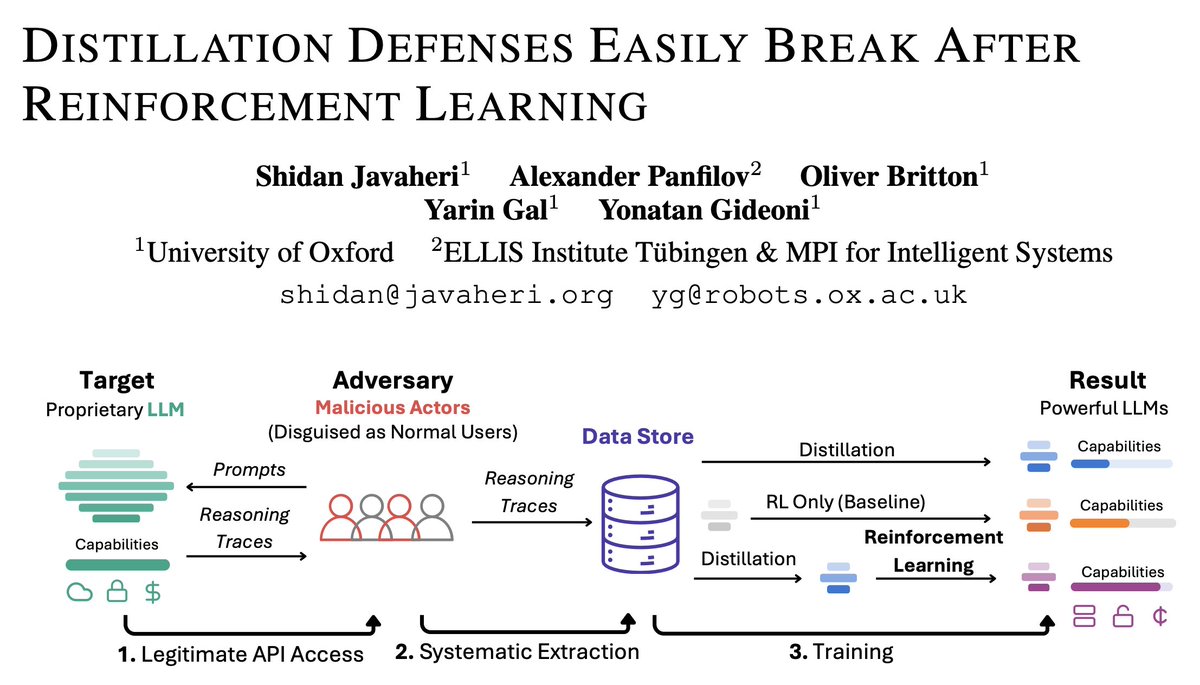
All existing defenses against distillation attacks are evaluated after distillation, implicitly assuming no further RL training. We find this makes existing evals give a false sense of security, and that RL makes simple attacks effective
📣 Stay Connected & Get Involved with WiML @ NeurIPS 2026
Register for updates and announcements:
🇦🇺 Sydney • 8 Dec https://t.co/eEGi1V5HYQ
🇺🇸 Atlanta • 9 Dec https://t.co/lDHmL1Nh4q
🇫🇷 Paris • 10 Dec https://t.co/3n0YeEvp25
AISI IS HIRING!
It was less than a month ago that I became Director. I joined with the belief that AISI is a world-leading organisation, and living proof that government can build things that work.
One month in and I'm even more bullish about the vital role @AISecurityInst plays in frontier AI security. I'm astounded daily by the talent, focus and commitment of the brilliant team I get to work with.
There has never been a more urgent time to work on frontier AI security - independently, in the public interest. We have a lot of urgent work to do, our team is growing fast, and we need more brilliant people to fill those roles.
Our Red Team uses adversarial machine learning techniques to find failures in alignment measures, control monitors, and misuse guardrails. They are massively scaling up all parts of the team:
Alignment: https://t.co/8AvuhmVIAw
Control: https://t.co/yWTgkMhjSG
Misuse: https://t.co/f2NLkG1zuz
AI capabilities in cybersecurity and autonomy are advancing faster than ever. Our Cyber & Autonomous Systems team assesses what frontier and open-weight models can really do - across cyber, autonomy and AI R&D. We're hiring a Cyber Security Engineer and Software Engineer to build the evaluations behind that work:
CSE: https://t.co/gL2NrLygLc
SWE: https://t.co/5eLZNEjy6O
Our Human Influence team studies how AI can shift human decisions and behaviour, using everything from RCTs to multi-agent studies. We're hiring an Engineering Lead to help us grow the ambition and pace of that research:
https://t.co/nvzf1yebkK
We're also hiring exceptional Software Engineers at all seniority levels to join our Core Technology team, which works closely with researchers to build performant tools and infrastructure that enable and accelerate AISI's world-leading AI safety research:
https://t.co/5OSHfDRxjx
There has never been a better time to join @AISecurityInst. We have so much technical work to do, and so little time to do it. We've found alignment issues, control monitor flaws, and critical jailbreaks at ~all major AI companies. Hiring is our bottleneck. 🧵
From my experience teaching research for the past 9 years, being able to verbalise your thoughts and write precisely and succinctly are things you have to learn through practice. Using LLMs to shortcut these before you learn how to do them proper you'd just never get these skills
More specifically to that discussion: The ability to "tame" fleeting thoughts and ideas in a format that won't let you "lie" with internal inconsistencies, or with half-formed ideas is itself I think at least one of the major goals of the scientific endeavour (and is therefore a cornerstone in scientific education).
About the use of LLMs there - I'm not sure we can afford not to use those to aid in these processes, but it's very clear where the scientific thinking of the author wasn't formed enough.
In those cases I think, our main goal is to teach (and learn together) younger researchers to identify themselves when ideas are half formed, when understanding isn't complete etc.
In many ways writing is one of the highest forms of thinking. And if as DFW wrote the goal of higher education is to teach you how to think - then we must let students write more.
A discussion was sparked here recently about the importance of writing during PhD studies. Ive had some time to consider this during a long flight and I want to take the opportunity and try to say something a bit broader - I can't find the original reference but imo writing is best thought of as a higher form of thinking. Plainly, to write well is to think well.
This is my best suggestion: desk reject any paper that fails LLM watermarking detection. People should write their own papers. LLMs should at most give feedback
https://t.co/DbCubhAM3c
I'm a Program Chair for ICML 2027. We'd love any creative suggestions for a great conference! How to manage the explosion of AI slop and insane submission growth? How to manage reviewing? How to incentivize high quality creative work? How to reduce bureaucracy and overhead?
I'm starting to think that arxiv should forbid LLM written papers altogether. If it gets flagged by watermarking etc, it should get rejected. Authors should use LLM reviews to improve language, not use LLMs to write the papers themselves
@yaringal@arxiv While we do detect LLM content, we are not trying to filter it out. It is a sign that the paper requires more careful scrutiny. Most authors who are applying LLMs are applying them to improve their writing, especially authors with less English skill.