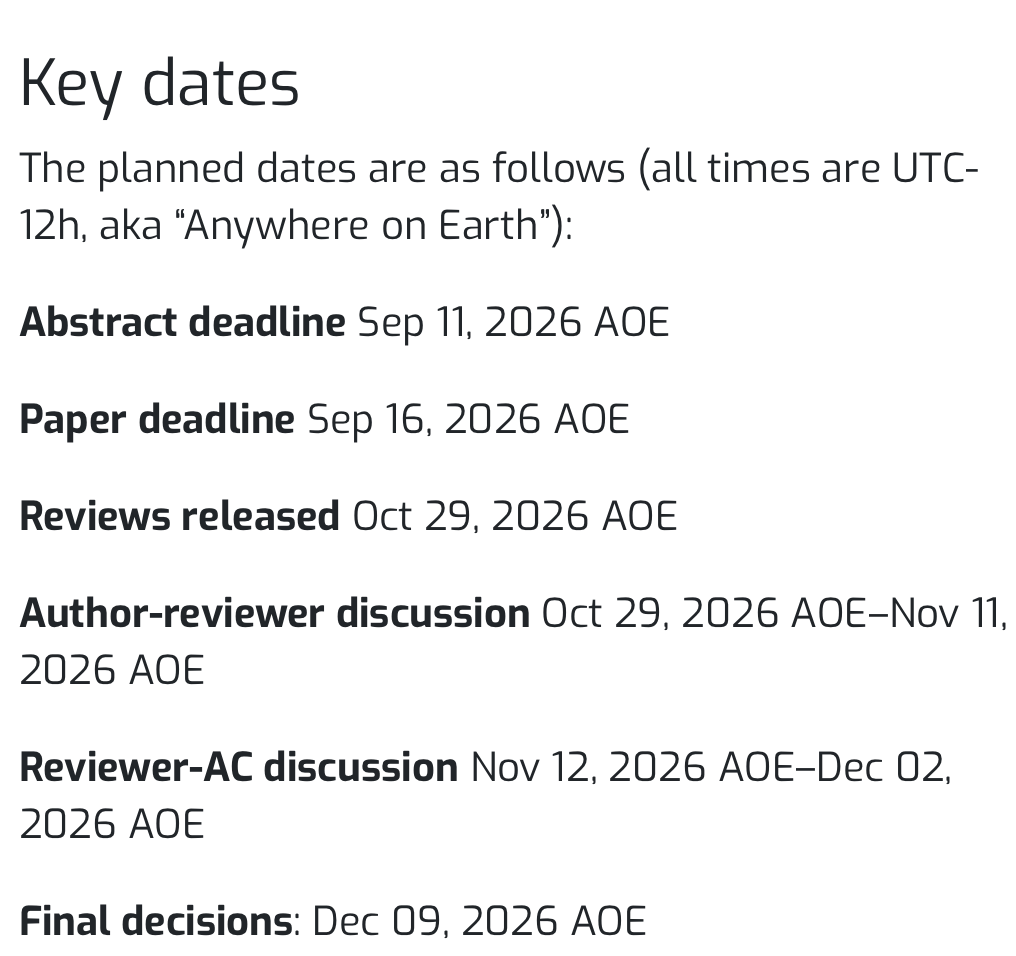
🚀 I’m hiring! We’re looking for a Research Assistant in AI Safety to join us at @OATML_Oxford and work with @yaringal and me on generative AI, safety & security.
📅 Apply by 11 September 2026
🔗 https://t.co/wTgf0v3zaV
Please share with anyone who might be interested!
Today, we are launching Tinker grants of up to $50,000 in credits for safety research on open-weight models. We share some project ideas that excite us below; if you’re working on a safety project that could be accelerated by additional Tinker credits, we want to hear from you!
@avramidou I clicked into the post trying to argue that AI safety roles do not receive inflated salaries, and then found that many already done so. I personally feel that the recent boom of AI safety is much due to the launch of many AI safety non-profits and AI safety "fellowships"
🚀 I’m hiring! We’re looking for a Research Assistant in AI Safety to join us at @OATML_Oxford and work with @yaringal and me on generative AI, safety & security.
📅 Apply by 11 September 2026
🔗 https://t.co/wTgf0v3zaV
Please share with anyone who might be interested!
@ItaiYanai (D) it can distort scientific incentives — AI-assisted peer review can incentivize authors to optimize manuscripts for AI judgment rather than scientific merit.
https://t.co/nskRZ7b8YA
@OrcaRouter So if any misuse or harm arises from this model, it’s not the responsibility of the authors, the uploaders, or Qwen. Then who is supposed to take responsibility? Hugging Face?
Can machine learning build reliable, intervention-aware World Models for high-stakes healthcare? 🩺🤖
We’re excited to introduce WMHS @ NeurIPS 2026: World Models for High-Stakes Health: Reliable Clinical Trial Simulation and Intervention-Aware Reasoning!
As generative models, sequence architectures, and causal inference converge, patient world models offer incredible potential—from clinical trial simulation and synthetic control arms to counterfactual treatment prediction. But ensuring reliability, temporal consistency, and clinical safety in high-stakes environments remains a critical open challenge.
📑 Submission Tracks:
• Full Papers: Up to 9 pages (main text)
• Extended Abstracts: Up to 4 pages
• Demo Track: Working tools & system prototypes
• Position Papers: Governance, regulation, & clinical evaluation standards
(Non-archival, double-blind review via OpenReview)
🏆 Awards: Best Paper Award & Best Clinical Impact Paper Award!
📅 Key Dates:
• Submission Deadline: September 1, 2026 (AoE)
• Notification: September 29, 2026
• Workshop Date: December 11–12, 2026 (Atlanta, USA)
🔗 Learn more & submit your work: https://t.co/R1s0aU2FNN
Looking forward to your submissions and seeing you in Atlanta!
#NeurIPS2026 #HealthcareAI #WorldModels #MachineLearning #ClinicalTrials #CausalInference #DigitalHealth #AIInMedicine
I was pleased to contribute expert commentary to The Verge with Robert Hart on the recent OpenAI–Hugging Face cybersecurity incident, discussing its implications for AI safety, security, and the governance of frontier AI systems.
Read the article here: https://t.co/2nbnHPuQkx
@peter_richtarik I also feel that AI review could complement human review and help curb the explosive submission numbers, but we must take seriously the new risks AI review could introduce, expecially its vulnerability to being gamed.
https://t.co/nskRZ7b8YA
One concern is that if AI reviews increasingly influence editorial decisions, authors will naturally start optimizing for AI judgment rather than scientific merit. We found that superficial abstract rewrites—without changing the underlying science—can significantly inflate AI review scores. https://t.co/nL3Hjo2xEB
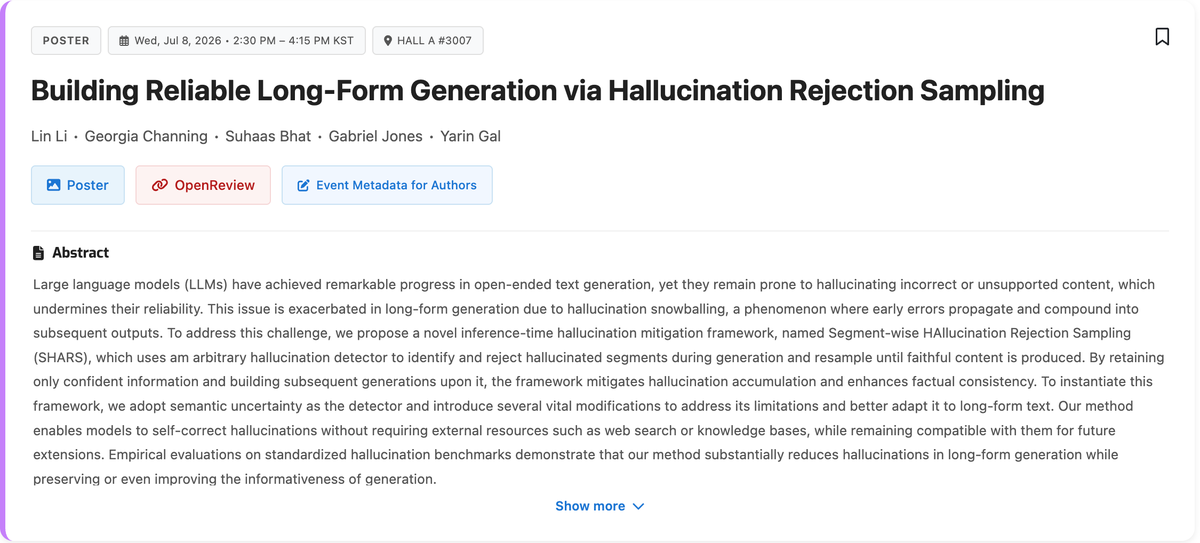
Excited to share our ICML 2026 paper!
LLMs often suffer from hallucination snowballing: early mistakes propagate into later generations. We propose SHARS, an inference-time framework that:
✅ detects hallucinated segments
✅ rejects & resamples them
✅ builds subsequent generation only on verified content
Together with HalluSE, our improved uncertainty-based detector, SHARS:
📈 improves factual precision by up to 26%
📝 preserves or even increases factual information
🔍 works without external retrieval or web search
⚡ reveals a promising inference-time scaling property for factuality
“Building Reliable Long-Form Generation via Hallucination Rejection Sampling”
📄 Paper: https://t.co/f6Jt5umGwv
💻 Code: https://t.co/LabfykxzqQ
I’ll be at ICML 2026 in Seoul (July 7–12). If you’re interested in this work, AI safety, or AI security, I’d love to chat!
📍 Poster: HALL A #3007
🗓️ Wed, Jul 8 | 2:30–4:15 PM KST
#ICML2026 #LLMs #AISafety #AISecurity #MachineLearning
@gneubig good point, it might not already since the paper released recently, and more importantly, white-box cannot be applied directly to the commercial LLMs.