Some of my perspective on where the @ethereumfndn is going.
First of all, this is only my own view. The board is not just me, and I have no extra special powers on the board that the other board members do not. @aerugoettinea is the one executing much of this transition. My input has been largely on technical questions. The board is in the process of expanding, and my own power within the org will continue to decrease, which is honestly what I want.
The 2025 era brought many important improvements to EF and its ability to execute. Many issues were resolved, and EF continues to benefit from its improved efficiency and greater focus on concrete goals to this day. And so with those problems resolved, early this year, the largest remaining hole that I perceived was something different nagging at me: I would regularly spot people saying things like "vitalik says these beautiful things about ethereum needing to be decentralized, and have privacy, and be a sanctuary technology, but why do the EF's actions not reflect that?"
Now, you may have been hearing something different. You may not have been sensing a feeling of crisis at all, and maybe were hearing people saying that finally we were taking execution and BD seriously and the main task for us is to keep going that way and be even better and faster. Then probably there is genuine difference between you and me, in what kinds of criticism I take most seriously, and what kinds of critics through their criticism are most able to make me feel pain.
As an analogy, let's briefly switch over to a different domain.
One belief you can have about Google is that it is a success story, and has brought a lot of good to humanity in organizing the world's information. Another belief you can have about Google is that they had a beautiful idealistic beginning, but at some point the corruption of mainstream corporate attitudes seeped in, and they slowly bit by bit completely abandoned the "don't be evil" slogan.
My belief on Google specifically is probably somewhere between the two. BUT, if you had taken me back in time to ~2008, and offered me a button to press to make Google one or two standard deviations more "dogmatic", eg. give Richard Stallman permanent veto power over some key policies, I would immediately press it.
Why? Because a choice for one company is not a choice for the world, or even one country. Google existed and exists in the context of a technology industry generally drifting away from early idealistic don't-be-evil roots and toward greed for financial gain, totalizing visions of accelerated superintelligence, infiltration by sociopaths, and craven capitulation to (or worse, active participation in) government pressure for ideological control, surveillance and war. And so *one company* doing something different, positioning itself to be what George Bernard Shaw calls the Unreasonable Man, resisting the trend of the times, would have been better for freedom, balance of power and stability of society as a whole, than *all* large companies bending to dominant trends. This is a part of my version of pluralism.
This line of thinking is not just mine, but I also is not too far off from what Aya and others had in mind with the Mandate.
Now how does this all get to the role of the EF?
EF is not a "center of Ethereum", rather EF is "one node, with a defined purpose, alongside other nodes". We've always said that the EF should be the latter, but many in the Ethereum ecosystem (and even within the EF) wanted us to be the former. Now, we are taking action to ensure that we will be the latter.
This is particularly important because EF is a limited organization, with limited resources and limited organizational capacity. The EF has only ~0.16% of all ETH (less than many other individual ETH holders), whereas among other blockchains it's common for "the central foundation" to have 10-50%. Fiscally, the EF was originally designed to fulfill a limited work scope defined in the token sale docs and other pre-launch materials (building the chain software; getting through Frontier, Homestead, Metropolis, Serenity), which was fully completed in 2022; it was not designed to be an eternal steward.
And so today, the EF is choosing to use its remaining resources to pursue longevity over breadth (yes, this means we sell less ETH). The EF focuses *specifically* on those activities critical to the success of ethereum as a censorship/capture-resistant, open, private and secure system, that would not happen otherwise. This means making hard choices, and in some cases even activities that we highly approve of and people that we highly respect becoming outside of the EF. People of great technical talent, public respect and even alignment with the mission and CROPS being outside of the EF is in fact necessary if we want important tasks to be able to attract outside capital. This also means the EF taking opinionated stands culturally.
This is all intended in cooperation with all other parts of ethereum. We recognize that many other parts of the ethereum world highly respect CROPS and related values. But highly respecting is not the same as choosing to specialize and totally dedicate to a domain (Compare in a different domain: I think reducing animal cruelty is important, and I like vegan food, but am not full unconditional vegan myself)
EF is still in a transition period, and we expect its new long-term form to stabilize over the next few months. What are the guiding principles of this new form? Again, I am only one person, but I can give my answer from a technical perspective (there are also critical non-technical aspects).
At the core, *Ethereum must be impressive*. We are living in an age of highly intelligent AI and all kinds of other technological acceleration. "Status quo EVM, with a hard fork or two a year to optimize for short-term needs of users" is not interesting.
To some, "impressive" means: 250ms latency and 1M TPS. I think Ethereum trying to go that route is a mistake. Being as fast and as scalable as possible, and only a small epsilon more decentralized than the others, is a route to mediocrity, and if we try it we will lose.
I think Ethereum should scale. But I think Ethereum should strive the hardest to be deeply impressive in a different dimension: the CROPS dimension. This means things like:
* Provably bug-free Ethereum. This is a goal that all cybersecurity researchers would have thought is absurd and impossible, up until roughly 6 months ago. Now, it's on the cusp of being possible, thanks to AI-assisted formal verification. So we should be frontrunners in doing this.
* Available chain consensus. Ethereum is, and with lean consensus will cotninue to be, the ONLY chain that has both (i) traditional-BFT style properties that it's safe under asynchrony up to a high level of fault tolerance, and (ii) the bitcoin PoW-style property that under synchrony it's safe up to 49% attackers. As far as I can tell, literally no other chain has this or is planning for it; bitcoin goes for (ii) only and most other chains go for (i) only. Some will remember I fought hard for this, Unreasonably insisting that it is not OK for ethereum to rely on social consensus and hard forks to rescue ethereum from 34% of nodes going offline. It's OK for chains like hyperledger, bnb, solana, tempo, etc. It's not OK for bitcoin or ethereum or eg. zcash.
* Intermediary minimization. The fact that smart contract wallets, protocols like railgun, etc have to send transactions through intermediaries to get included onchain is honestly embarrassing, and it's a constant point of fragility. Hence the work on FOCIL and EIP-8141 (and 7701 and years of work before) to make transaction sending intermediary-minimized with public mempool and strong inclusion properties, in a truly general-purpose way, that covers not just eg. secp256r1, but also privacy protocols and much more. Kohaku is pushing intermediary minimization at the user layer, pulling Ethereum away from the dystopian status quo world where our wallets don't even verify the chain, send our private data out to a dozen third-party servers, and toward a brighter CROPS future.
Some of these goals are Unreasonable - maybe Ethereum would be "fine" getting only 50% of the way - what if we depend on intermediaries, but make it easy to switch? But going 50% of the way would not make Ethereum Deeply Impressive in the CROPS way. So we push for 100%.
Fortunately all these goals are compatible with high TPS, this is a major focus of research (esp. on scaling the state). Well-designed L2s can also help, especially L2s optimized for specific applications (eg. high-volume trading, privacy...). These goals are even compatible with significantly lower slot times, thanks to Raul's work on erasure-coded P2P, and many other optimizations.
The most high-value "product" of the ethereum blockchain, financially speaking, is ETH the asset. Ethereum secures $250 billion of ETH. The types of properties of Ethereum that I mentioned above are very good for ETH the asset. Nearly 90% of my net worth is in ETH, and most of the remainder is ~$40m of onchain fiat of which every dollar has already been allocated for some open-source biotech or software or hardware initiative. That said, there are aspects of supporting ETH the asset - *necessary* aspects even - that are outside the scope of the EF. This is where we need other heroes (some of whom hold more ETH than the EF does) to step in and help. EF has been recently thinking more about how it will relate to other such organizations, and give them needed initial support.
EF will be a smaller ship than in previous years, a more opinionated one - in some cases more opinionated in ways that might be difficult to comprehend - but a longer-lasting one, and one suited to making sure that ethereum brings something meaningful to the world. We are grateful to all those inside and outside the EF who are helping to make this happen.
🚨 Du wachst morgen auf. Dein Wallet ist leer.
Kein Hack. Kein Phishing. Kein Seed-Leak. 12 Menschen haben in einer Telefonkonferenz entschieden, dass dein Geld jetzt jemand anderem gehört. Sie brauchten keinen Gerichtsbeschluss. Keinen richterlichen Befehl. Sie mussten nicht mal deinen Private Key kennen.
Sie haben einen Button gedrückt.
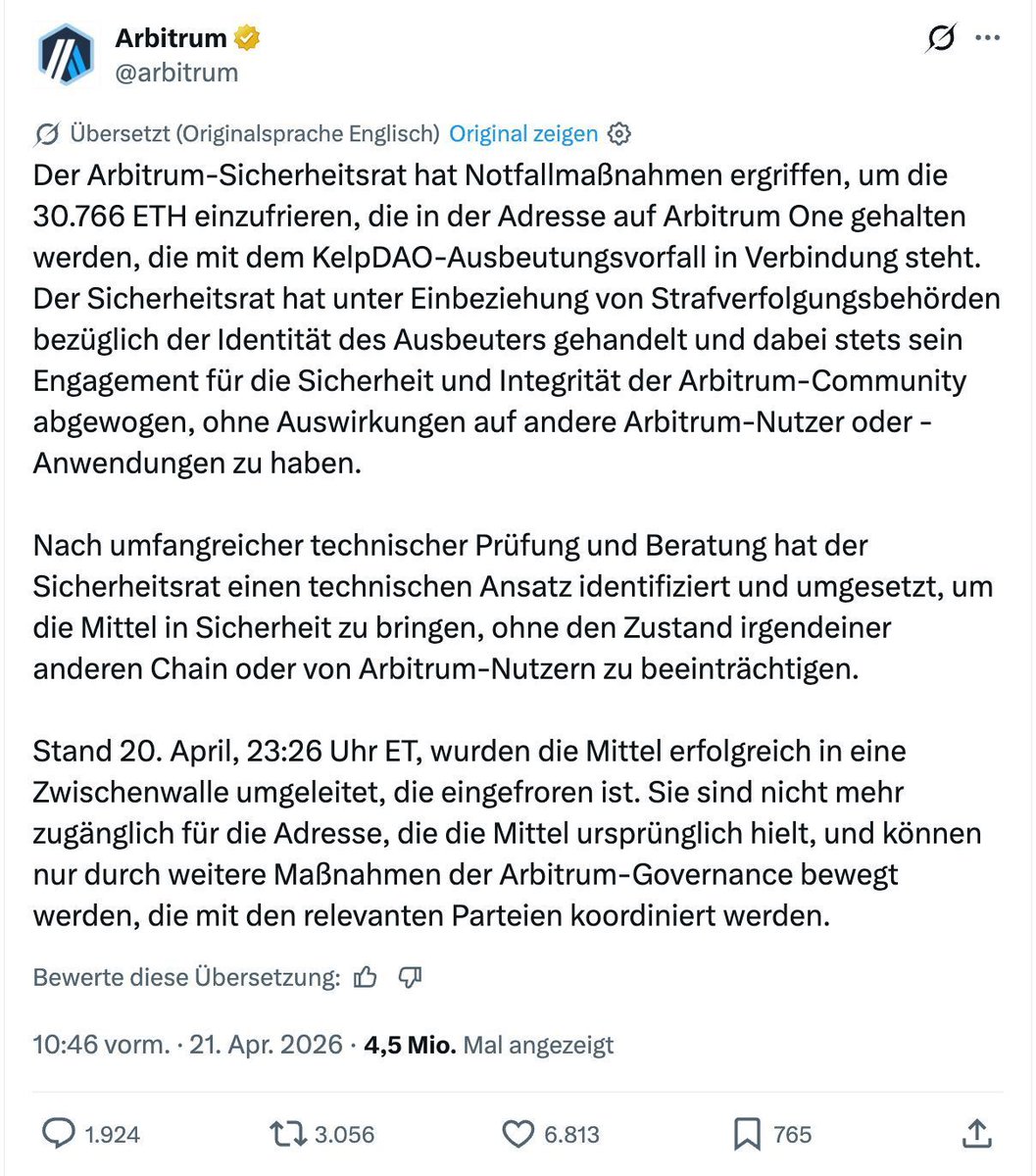
Das ist nicht Zukunft. Das ist gestern Nacht live gelaufen. Der #Arbitrum Security Council hat 30.766 ETH eingefroren. Rund 71 Mio. USD. Offizieller Grund: KelpDAO wurde exploitet, die Lazarus-Gruppe aus Nordkorea stand hinter dem Angriff. Der Council hat zum ersten Mal sein Notfall-Privileg produktiv genutzt. @arkham schreibt: "Nordkorea hat das Geld gestohlen, Arbitrum hat es zurückgestohlen." Die halbe Timeline klatscht Beifall.
Hier hören die meisten auf zu denken. Weil der Skandal nicht im WEN liegt, sondern im WIE.
Der Council hat keine einzelne Wallet gesperrt. Er hat auf #Ethereum den Inbox-Contract upgegradet und einen neuen Transaction-Type namens ArbitrumUnsignedTxType injiziert. Der braucht keinen Private Key. Keine Signatur. Er ist eine Übersteuer-Funktion auf Chain-Level. @0xyanshu nagelt es: Der Council hat nicht eine Wallet gefroren, sondern die Chain neu geschrieben.
Heute war es Nordkorea. Morgen ist es ein OFAC-Sanctions-Request. Übermorgen ein Aktivist, der "im öffentlichen Interesse" gestoppt werden soll. Die Tür ist jetzt offen. Die 12 Menschen wissen, dass ihr Button funktioniert. Der nächste Freeze wird einfacher.
Währenddessen streitet CT darüber, ob Arbitrum oder Tron zentraler ist. Justin Sun hat die Lücke genutzt, um Tron als dezentralste Chain zu positionieren. Niemand stellt die eigentliche Frage.
Die eigentliche Frage: Warum bauen wir überhaupt Chains, auf denen ein Button existiert?
#Bitcoin hat das nicht.
Kein Security Council. Keine 12 Signer in einem Google Doc. Keine Upgrade-Funktion, die Private Keys bypassen kann. Kein CEO, den du anrufst. Kein Notfall-Button. Nicht weil es vergessen wurde, sondern weil es das Design ist. Bitcoin wurde 2008 genau deshalb so gebaut: Damit niemand einen Button drücken kann. Weder gegen dich noch für dich.
Ethereums L2-Ökosystem hat diesen Ursprung vergessen. Optimism, Base, zkSync haben alle ähnliche Councils. Nur hat bei keinem der Button bis jetzt gezogen. Jetzt hat er gezogen. Er wird wieder ziehen.
Ich hab euch vor drei Wochen über Drift geschrieben. Security Council kompromittiert, 285 Mio. USD weg. Vor elf Tagen über Scroll. Single Sequencer manipuliert. Ich sagte damals, die Frage sei nicht ob, sondern bei wem als Nächstes. Die Antwort kam schneller als ich dachte.
$ARB steht bei $0.125. 95% unter seinem ATH. Der Markt hat längst abgestimmt.
Du hast die Wahl. Vertrauen in 12 Menschen, die du nie gesehen hast und deren Namen du nicht kennst. Oder Vertrauen in einen Code, der seit 17 Jahren keinen Button hat.
https://t.co/HSU67bxGec
Because we get asked a lot.
The Technological Republic, in brief.
1. Silicon Valley owes a moral debt to the country that made its rise possible. The engineering elite of Silicon Valley has an affirmative obligation to participate in the defense of the nation.
2. We must rebel against the tyranny of the apps. Is the iPhone our greatest creative if not crowning achievement as a civilization? The object has changed our lives, but it may also now be limiting and constraining our sense of the possible.
3. Free email is not enough. The decadence of a culture or civilization, and indeed its ruling class, will be forgiven only if that culture is capable of delivering economic growth and security for the public.
4. The limits of soft power, of soaring rhetoric alone, have been exposed. The ability of free and democratic societies to prevail requires something more than moral appeal. It requires hard power, and hard power in this century will be built on software.
5. The question is not whether A.I. weapons will be built; it is who will build them and for what purpose. Our adversaries will not pause to indulge in theatrical debates about the merits of developing technologies with critical military and national security applications. They will proceed.
6. National service should be a universal duty. We should, as a society, seriously consider moving away from an all-volunteer force and only fight the next war if everyone shares in the risk and the cost.
7. If a U.S. Marine asks for a better rifle, we should build it; and the same goes for software. We should as a country be capable of continuing a debate about the appropriateness of military action abroad while remaining unflinching in our commitment to those we have asked to step into harm’s way.
8. Public servants need not be our priests. Any business that compensated its employees in the way that the federal government compensates public servants would struggle to survive.
9. We should show far more grace towards those who have subjected themselves to public life. The eradication of any space for forgiveness—a jettisoning of any tolerance for the complexities and contradictions of the human psyche—may leave us with a cast of characters at the helm we will grow to regret.
10. The psychologization of modern politics is leading us astray. Those who look to the political arena to nourish their soul and sense of self, who rely too heavily on their internal life finding expression in people they may never meet, will be left disappointed.
11. Our society has grown too eager to hasten, and is often gleeful at, the demise of its enemies. The vanquishing of an opponent is a moment to pause, not rejoice.
12. The atomic age is ending. One age of deterrence, the atomic age, is ending, and a new era of deterrence built on A.I. is set to begin.
13. No other country in the history of the world has advanced progressive values more than this one. The United States is far from perfect. But it is easy to forget how much more opportunity exists in this country for those who are not hereditary elites than in any other nation on the planet.
14. American power has made possible an extraordinarily long peace. Too many have forgotten or perhaps take for granted that nearly a century of some version of peace has prevailed in the world without a great power military conflict. At least three generations — billions of people and their children and now grandchildren — have never known a world war.
15. The postwar neutering of Germany and Japan must be undone. The defanging of Germany was an overcorrection for which Europe is now paying a heavy price. A similar and highly theatrical commitment to Japanese pacifism will, if maintained, also threaten to shift the balance of power in Asia.
16. We should applaud those who attempt to build where the market has failed to act. The culture almost snickers at Musk’s interest in grand narrative, as if billionaires ought to simply stay in their lane of enriching themselves . . . . Any curiosity or genuine interest in the value of what he has created is essentially dismissed, or perhaps lurks from beneath a thinly veiled scorn.
17. Silicon Valley must play a role in addressing violent crime. Many politicians across the United States have essentially shrugged when it comes to violent crime, abandoning any serious efforts to address the problem or take on any risk with their constituencies or donors in coming up with solutions and experiments in what should be a desperate bid to save lives.
18. The ruthless exposure of the private lives of public figures drives far too much talent away from government service. The public arena—and the shallow and petty assaults against those who dare to do something other than enrich themselves—has become so unforgiving that the republic is left with a significant roster of ineffectual, empty vessels whose ambition one would forgive if there were any genuine belief structure lurking within.
19. The caution in public life that we unwittingly encourage is corrosive. Those who say nothing wrong often say nothing much at all.
20. The pervasive intolerance of religious belief in certain circles must be resisted. The elite’s intolerance of religious belief is perhaps one of the most telling signs that its political project constitutes a less open intellectual movement than many within it would claim.
21. Some cultures have produced vital advances; others remain dysfunctional and regressive. All cultures are now equal. Criticism and value judgments are forbidden. Yet this new dogma glosses over the fact that certain cultures and indeed subcultures . . . have produced wonders. Others have proven middling, and worse, regressive and harmful.
22. We must resist the shallow temptation of a vacant and hollow pluralism. We, in America and more broadly the West, have for the past half century resisted defining national cultures in the name of inclusivity. But inclusion into what?
Excerpts from the #1 New York Times Bestseller The Technological Republic: Hard Power, Soft Belief, and the Future of the West, by Alexander C. Karp & Nicholas W. Zamiska
https://t.co/8igjazz1On
361 PROJECTS AROUND THE GLOBE
124 Integrated after numerous selection rounds
60 in the Pitching Room
Who will rise to become the 13 Winners?
The final chapter of VietBUIDL Hackathon unfolds this Oct 19.
👉 https://t.co/ERGMRbYbMk
⭐Đây chính là chân dung của người em thân thiết LVL tên thật là Lê Văn Lương đã hi sinh thân mình để đứng ra tố cáo Shark Bình
- Chắc cũng vì quá cay bao nhiêu năm nay bị Shark Bình cứ đ�� hết trách nhiệm cho LVL úp bô, nên người em cay quá mới hi sinh để vạch trần sự thật của câu chuyện, nên hôm nay chúng ta mới thấy nhà nước lôi lũ chuột nhắt ra ánh sáng
- Chắc Shark không lường được nước đi này của thằng em đâu nghĩ nó dám lên tiếng, nếu nó lên tiếng là cả nó cũng bị tóm ai dè thằng em đi nước cờ mà Shark nằm mơ cũng không nghĩ nó dám chơi
- Vụ án này phá được và thu hồi được tài sản cũng góp công không nhỏ đến từ người em, LVL cứ khai báo thành khẩn tích cực là kiểu gì cũng sẽ được giảm nhẹ án... hoan hỉ... hoan hỉ...
🧐 TỐN BAO NHIÊU ĐỂ LIST TRÊN BINANCE?
[DRAMA] Binance - CZ - CJ - Limitless
📌 1/ Câu chuyện bắt nguồn từ một tweet của CJ Hetherington (@cjhtech - CEO Limitless Labs) liệt kê về chi phí để được lên Binance với nội dung sau:
> 1% airdrop ngay ngày đầu + niêm yết sớm (alpha listing)
> Thêm 3% airdrop trong 6 tháng tiếp theo
> 1% “marketing” - Binance toàn quyền chi tiêu
> Cung cấp 100% TVL cho pool token trên @PancakeSwap (hơn $1M)
> Ký quỹ bảo hiểm $250,000
> 3% cho chương trình BNB HODLer
> $200K token cho affiliate marketer của Binance
> Ký quỹ bảo hiểm $2M bằng $BNB để được list spot
Còn Coinbase thì chỉ nói:
“Hãy xây dựng điều gì đó thật ý nghĩa trên Base.”
=> Và đó là lý do CJ chọn build trên @base 😂
Binance lập tức phản ứng 👇
Kraken is known for its impeccable security record:
→ 14 years with zero security breaches
→ 95% of assets stored in cold wallets
→ Institutional-grade infrastructure
The platform has raised over $500M and is preparing for a $15B IPO, reinforcing its leadership in the global digital asset economy.
My thoughts on yesterday’s crypto crash:
TLDR: We’ll be fine. We always are.
I’ve been in this industry for 9 years now, and I’d say I’ve really seen it all. The COVID crash, the $LUNA meltdown, the FTX collapse, you name it.
But what we witnessed yesterday felt very different from most things I’ve experienced before. While many coins look completely wrecked on the charts, it didn’t feel as dramatic to me as some of the true black swan events we’ve seen in the past.
Don’t get me wrong, I’m not trying to downplay it. Yesterday was the largest liquidation event in crypto history, and my heart genuinely goes out to everyone - friends, colleagues, and beyond - who suffered massive losses that will take a long time to recover from. I wish this on no one.
However, while we still don’t fully understand what happened, the big difference this time is that there doesn’t seem to be a fundamental reason for such an extreme crash. Sure, Trump’s tariff threats against China might have started the dump, but that alone surely doesn’t justify -99% crashes across major caps.
It really feels like something went seriously wrong behind the scenes at Binance or a major market maker, triggering a one-of-a-kind liquidation cascade that wiped out liquidity across the board and sent some assets literally to zero.
As much as I criticize Binance at times, they’ve always had the most robust trading infrastructure in the industry. So seeing price action like this even happen on their platform felt very strange, and even stranger was the fact that Binance literally stopped working for 10–20 minutes when I tried to buy those -90% dips.
That suspicion grew even stronger when I switched to DEXs to buy. Prices there for assets like $PUMP or $JTO were around 25% higher than on Binance. Tokens like $CARDS, which aren’t listed on major exchanges, were affected significantly less. Normally, during fundamental market crashes, it’s exactly the other way around.
Rumors are already flying, and I’m sure we’ll get more clarity in the next few days. But from what I can judge and from almost a decade of living and breathing this industry: my gut says this was a massive technical issue, not a fundamental one.
And that, to me, is bullish.
For context, the COVID crash and FTX collapse hit me hard. Back then, I genuinely thought it might be over. I remember feeling anxious for days, even weeks, questioning my entire future in this space.
This time felt completely different. I bought immediately, and after reflecting for about 10 hours, I want to buy even more.
I know many of you are going through a tough time right now, and I’m deeply sorry for your losses. Nobody could have predicted this and trust me, even the biggest OGs and professionals in this space got hit badly.
But nothing fundamental has changed about this industry. The only question you should ask yourself right now is:
“How much do I truly believe in crypto long term?”
If you doubt that crypto as a whole can survive or thrive long term, I understand why you might be too afraid to buy right now. But in that case, you probably weren’t here for the right reasons to begin with.
As for me, I have zero doubt. This industry isn’t just here to stay, it’s on track to 10x from here and beyond. It’s only a matter of time.
So why would I panic over a technical glitch that caused prices to drop -99%? Of course, it’s painful, but rationally speaking, this might be one of the greatest opportunities you’ll ever get in your lifetime.
Don’t bury your head in the sand, not after everything we’ve survived over the past years. Events like this separate the wheat from the chaff, the winners from the losers.
If it’s even remotely possible for you right now, just survive. That’s all you need to do.
I promise you, you won’t regret it.
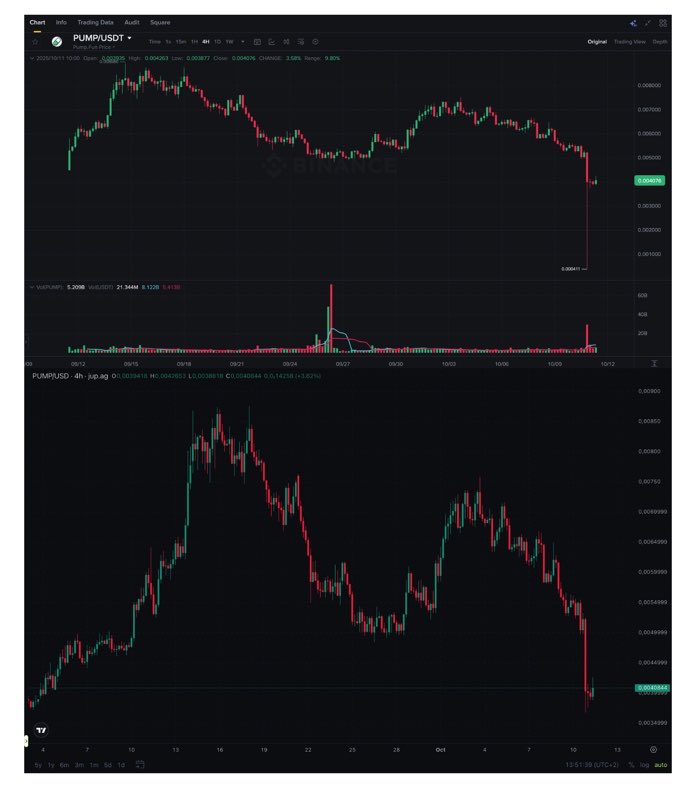
One is Jupiter, the other is Binance.
One looks like a painful dump, the other like an outright scam.
Take a wild guess which is which.
This $PUMP chart is just representative, the same pattern applies to most altcoin charts you’ll look at right now.
I’m genuinely curious to see what kind of story Binance and others will try to spin this time, because somehow, it’s never their fault. If we even get an explanation at all.
In my opinion, there are two simple lessons to take away from all this:
1) You simply can’t trust any CEX.
We all knew this already, but people tend to forget, everything’s fine until it suddenly isn’t. And then everyone starts crying about how unfair it is.
2) I’m amazed by how far DEXs have come.
Of course, I knew they’ve matured a lot, but seeing liquidity and underlying infrastructure hold up so well during an event like yesterday was genuinely impressive.
We’ve all seen those charts since Hyperliquid showing how DEXs are slowly eating into CEX market share, but it feels like yesterday's event could be the actual beginning of the flippening between the two.
In my opinion, this would be a much-needed event, one that might finally bring the crypto industry back into balance, and for the better.
You shouldn’t just support this shift for the industry’s sake. Yesterday proved again that your funds simply aren’t safe on centralized exchanges.
Avoid them at all cost.
Một cuộc truy vết và điều tra dữ liệu Onchain được ngắm thẳng vào $ANTEX. Dự án $ANTEX đã có dấu hiệu xả token, rút thanh khoản, Cash out stablecoin sang fiat gây ra thiệt hại hơn 30,000 nhà đầu tư
Lời cảm ơn đến @Hashwei_HWEI đơn vị hỗ trợ truy vết dòng tiền thông qua tính năng Money Flow và Knowledge Graph
1/ Dự án đã raised bao nhiêu?
2/ Số tiền raised đã đi đâu và làm gì? Liệu có sự gian dối còn tiếp tục?
3/ Khi $ANTEX niêm yết, dự án đã làm gì?
4/ Shark Bình và dự án tinh vi như thế n��o khi sử dụng chiêu trò slow rug pull?
5/ Kết lu���n
6/ Dưới đây là những bằng chứng và hành vi của dự án $ANTEX trong quá trình sai phạm 👇
🤯Q3 ENDED — WHERE’S THE LISTING? 🤯
🔔BIG NEWS: We’ve just signed a partnership agreement with OKX! Within the next week, we’re rolling out a major update with a referral program integration - a CRITICAL step for listing on OKX and other Tier-1 exchanges!
💡Why this matters: Without the referral integration, listing on Tier-1 exchanges would be technically impossible. This isn’t a delay - it’s a necessary evolution that makes the entire listing possible!
🖥The more active our community = better listing terms = bigger value for everyone!
ACTIVE USER STATISTICS:
📊First criterion completed: 60%
📊Second criterion completed: 0.2% (in progress - 14%)
😐These numbers show we can’t rush forward - hundreds of dedicated players would miss their airdrop through no fault of their own. That’s unacceptable to us!
🔥MORE OPPORTUNITIES TO COMPLETE THE SECOND CRITERION!
⛏Since only 0.2% of active users have completed the second criterion, we’re giving you MORE ways to qualify for the airdrop!
🗺Choose either Mostbet OR 1win to complete the second criterion! Open Trump's Empire and go to: Earn → Tasks → Partners.
⚠️IMPORTANT: Only completions from TODAY forward will count. Previous completions of these tasks are NOT retroactive.
⌨️After completing one of these partner tasks, the second criterion won’t be credited automatically yet - we’re currently in the implementation process.
We need additional time to:
🖥Process every support ticket you’ve sent
🛠Properly resolve all issues with task crediting in the playground
⏱Give affected users time to complete the second criterion fairly
🔗Launch and integrate the OKX referral program
🌟Implement the new Mostbet/1win partner tasks
📌Listing date will be announced ONLY after we successfully complete the OKX partnership integration and resolve the technical issues.
🪧We don’t chase dates - we chase quality and value. The OKX partnership + resolved technical issues + new partner task options = stronger listing with better conditions for YOU
Thank you for your patience, stay tuned for new updates and rewards!
@IAmNickDodson you guys are like kids who only know and think that you are good at coding and technical work, but you can't do anything more than other normal layer 2s except a new sway language but still can't popularize it for applications using it
@IAmNickDodson changes constantly, liquidity and dex are still far away from what you say, the community is getting bored and they don't bother to share their thoughts about the project anymore
@IAmNickDodson I say you will be offended but I have to say, you guys are a bunch of idiots, don't care about the community's opinion, you are not as good as you think, you consider yourself real people, real jobs, but the truth is your project is going nowhere, has no certain direction






![gm_upside's tweet photo. 🧐 TỐN BAO NHIÊU ĐỂ LIST TRÊN BINANCE?
[DRAMA] Binance - CZ - CJ - Limitless
📌 1/ Câu chuyện bắt nguồn từ một tweet của CJ Hetherington (@cjhtech - CEO Limitless Labs) liệt kê về chi phí để được lên Binance với nội dung sau:
> 1% airdrop ngay ngày đầu + niêm yết sớm (alpha listing)
> Thêm 3% airdrop trong 6 tháng tiếp theo
> 1% “marketing” - Binance toàn quyền chi tiêu
> Cung cấp 100% TVL cho pool token trên @PancakeSwap (hơn $1M)
> Ký quỹ bảo hiểm $250,000
> 3% cho chương trình BNB HODLer
> $200K token cho affiliate marketer của Binance
> Ký quỹ bảo hiểm $2M bằng $BNB để được list spot
Còn Coinbase thì chỉ nói:
“Hãy xây dựng điều gì đó thật ý nghĩa trên Base.”
=> Và đó là lý do CJ chọn build trên @base 😂
Binance lập tức phản ứng 👇](https://pbs.twimg.com/media/G3RnaOKakAACVW3.jpg)