El futuro será científico o no será.
@PerlaWahnon, Cristina Avendaño @facme_es y yo compartimos hoy en @el_pais nuestras reflexiones sobre el papel de la ciencia en la elaboración y evaluación de las políticas públicas.
https://t.co/5xF6XN4M4l
Hoy reflexiono sobre cómo transferir el conocimiento a la sociedad. Un paso esencial para que la ciudadanía se pueda beneficiar de todo el potencial de la ciencia.
https://t.co/gEXE6F3euB
El Consejo de Gobierno de la UCLM aprueba más de un centenar de plazas de personal docente e investigador.
El órgano colegial ha celebrado sesión ordinaria en el Campus de Ciudad Real.
https://t.co/uQetF8KDYc
He desarrollado SexeniosAPP, una herramienta para estimar las posibilidades de obtener una evaluación favorable de tu sexenio de investigación según el baremo CNEAI 2025.
Evaluación orientativa e informe PDF.
👇
https://t.co/BMACKrMH55
@OIntegridadEsp
⏳ ¡Últimos días para participar en «Divulga tu TFG»! 🧪🔬
📢 Desde la RSEQ-CLM te animamos a dar visibilidad a tu TFG y compartir tu pasión por la Química.
📅 Plazo abierto hasta el 1 de noviembre. https://t.co/Px8nqRZnk3
¡No dejes pasar esta oportunidad! 🚀
#DivulgaTuTFG
Comunicado de condena de Crue por las cargas policiales en la Facultad de Ciencias Químicas de la Universidad Complutense de Madrid
https://t.co/DDUx4kwGuZ
Nobel de Química | Henri Kagan y Kenso Soai han demostrado cómo funciona la quiralidad, ese fenómeno por el que una molécula no es superponible con su imagen en el espejo.
✍️ @AnthonyKBond, @EnriqueDiez12 y Antonio de la Hoz, @FCTQ_uclm
https://t.co/CIb3XrUOBq
¿Has terminado el Grado y quieres iniciar tu carrera en investigación en el mundo de los nanomateriales? 🧬🔬
En el grupo MSOC Nanochemistry (@IRICA_UCLM - @uclm_es) buscamos candidato/a para un contrato del Programa Investigo. Más info 📧 @AnthonyKBond
La @uclm_es ha comenzado el curso con muy buenas expectativas: crecimiento de alumnos y un contrato programa dotado de más de 1300 millones de euros
Así valora estos datos su rector @GardeJulian, este lunes en CMM
https://t.co/AEktclAIIf
Julián Garde, desde la presidencia de CRUE: "La Universidad es una institución esencial para el progreso de la sociedad" #CastillaLaMancha#Noticias
https://t.co/mHYVq0DwTe
El profesor de la UCLM José Sánchez Santamaría participa en una publicación de la Unesco sobre inteligencia artificial e integridad académica.
https://t.co/9Jf7tJV4kP
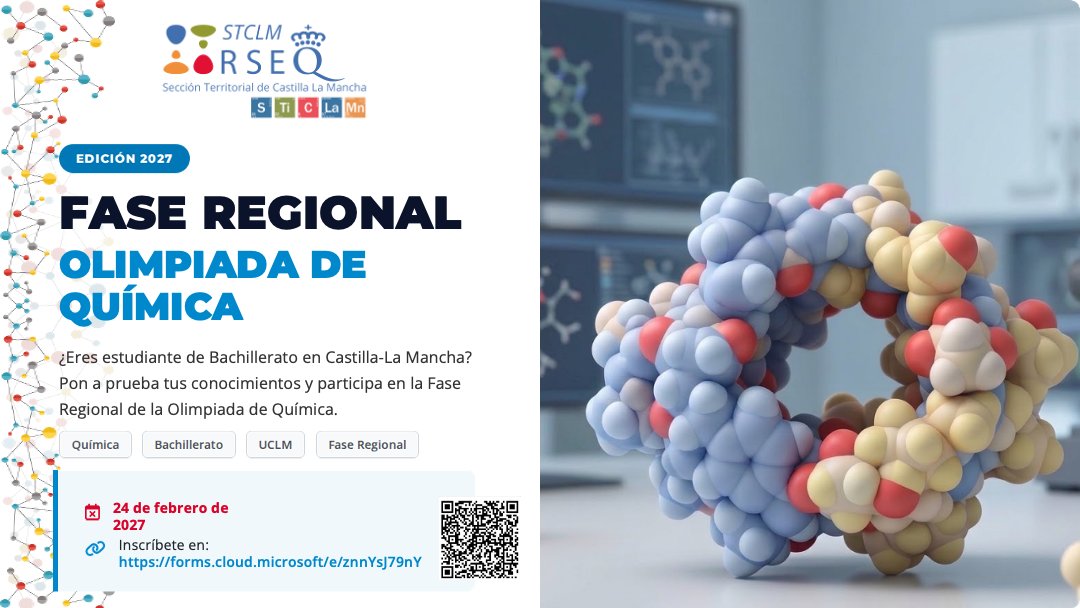
🧪🏆 ¡Llega la Fase Regional de la Olimpiada de Química 2027!
¿Estudias Bachillerato en Castilla-La Mancha y te apasiona la Química? ⚗️🧬
¡Pon a prueba tus conocimientos y participa!
📅 24 de febrero de 2027
🎓 Organiza: STCLM-RSEQ
📝 Inscripción abierta: https://t.co/OaqR4NgPuO
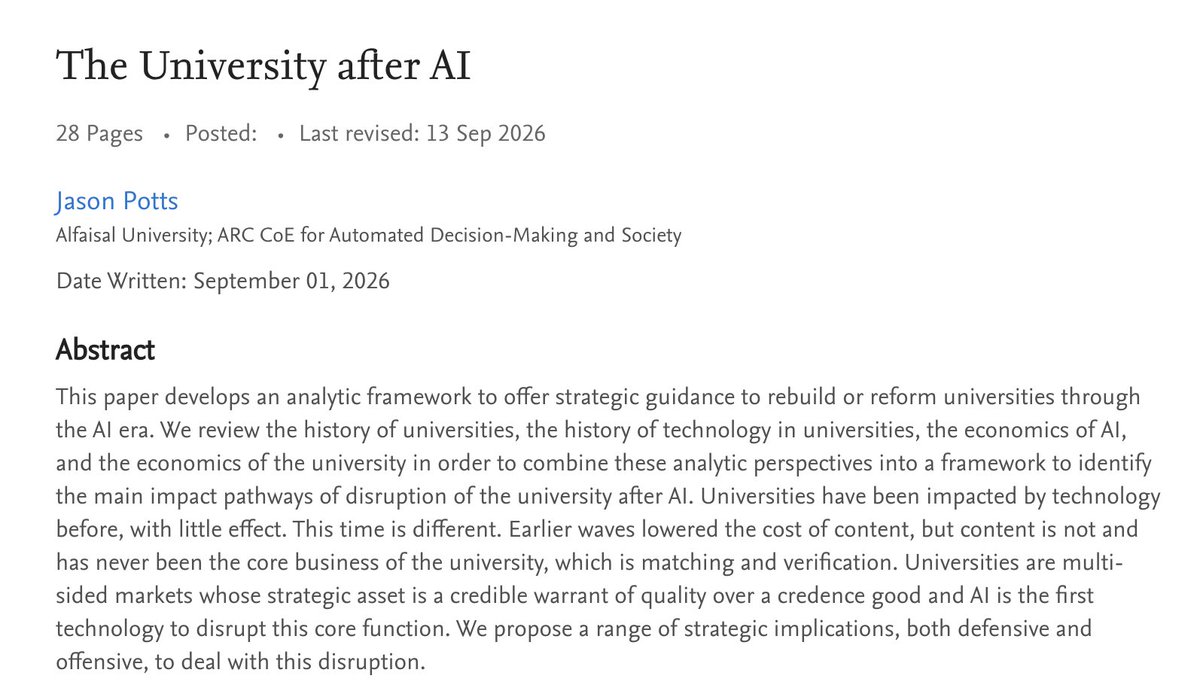
Academia often justifies its inertia with the classic "piano, piano" approach. AI shows a frightening reality if we don't move forward. The future of education won't depend on bureaucracy, but on us professors stepping up to lead this transformation.
Researchers argue AI has deleted every reason universities exist.
researchers from Boston University published a paper called “How AI Destroys Institutions" and it is the most alarming research i have read this year..
they argue that generative ai is a literal "death sentence" for civic institutions like higher education, journalism, and the rule of law..
and the scariest part? these aren't bugs that can be fixed with safety guardrails. they are features baked right into the core design of the technology..
here is why universities are officially obsolete according to the paper:
1. the destruction of expertise.. ai invites everyone to just offload their judgment to systems that simulate competence without actually possessing it.. universities used to be the trusted gatekeepers of credentials and expertise.. but when an llm can cheaply replicate key university functions like generating essays, summarizing complex research, and providing personalized instruction at scale.. that authority completely vanishes.. students and employers can just turn to ai instead..
2. short-circuiting how we think.. institutions survive on structured deliberation, human friction, and moral reasoning.. ai flattens all of that.. it automates choices and replaces human judgment with pure optimization logic.. you don't need a university to teach you how to think critically when the machine just feeds you the optimized answer instantly.
3. the erosion of trust.. as ai floods our ecosystem with synthetic analysis and scholarly text, society stops relying on traditional institutions to verify what is real.. it makes the traditional university incredibly easy to bypass and discredit..
the authors are blunt.. we can't just ban ai or slap a technical fix on it to save these institutions.. the very foundation of how we establish trust, verify information, and maintain social authority has to be redesigned from the ground up..
what do you guys think.. will universities survive this or are they just going to turn into overpriced ai-certifications?