@DocPriyamMD Would the results be different if the person took mineral supplements (such as electrolyte, or a bit of himlaya salt with water) as part of their prolonged water fast?
Wrestling with the Devil (2018) - Recently, prison related stories have been in the national press more than at any other time in my adult life and I am curious about how these stories compare with Ngugi's prison ordeal.
(6/6)
@cobbo3 thank you for this post. Was surprised by my lack of awareness of Ngugi's later works.
You made me realize that when my peers and I read Ngugi's books in secondary school, it was a whole 30+ years after the 'selected' books had been published. (1/6)
Ngũgĩ wa Thiong’o: The Old Lion is Gone, But The Roar Remains
Kenyan author Ngũgĩ wa Thiong’o (January 1938 – 28 May 2025) was one of Africa’s most celebrated literary figures. He never just wrote books. He staged revolts, each title a well-aimed molotov hurled at the colonial cannon, the neocolonial bureaucrat, and the post-independence sell-out.
His books often explore themes of colonialism, post-independence struggles, and the importance of African languages in literature. Over a career spanning six decades, Ngũgĩ went from the polite English-speaking literary salons of the 1960s to the defiant, Gikuyu-voiced resistance trenches of African letters, shaping African literature and post-colonial thought worldwide.
He authored more than 30 works—novels, plays, memoirs, and essays. Here is a distilled list of Ngũgĩ's major works in English, written or translated by him:
1. Weep Not, Child (1964)
His debut novel, and the first in English by an East African. A poignant tale of young Njoroge whose dreams crumble amid the flames of the Mau Mau Uprising.
2. The River Between (1965)
A lyrical examination of cultural fracture. Missionary Christianity battles traditional Gikuyu beliefs as two villages stand divided by both a literal and metaphorical valley.
3. A Grain of Wheat (1967)
Ngũgĩ’s first masterpiece. A morally tangled story of betrayal and sacrifice on the eve of Kenyan independence, told through multiple voices.
4. This Time Tomorrow (1970)
A play originally written while Ngũgĩ was at Makerere. It explores generational tensions and the conflicting aspirations of postcolonial youth.
5. The Black Hermit (1963)
Ngũgĩ’s first play, performed in 1962 during Kenya’s independence celebrations. A young man returns home to find tradition and modernity in open war.
6. Petals of Blood (1977)
A furious indictment of betrayal by the post-independence elite. Four villagers find themselves entangled in a murder mystery that exposes capitalist greed and broken promises.
7. Devil on the Cross (1980)
Written on prison toilet paper in Kamiti Maximum Security Prison. A satire of neocolonial exploitation told through a woman’s surreal journey to a “Devil’s Feast.”
8. Detained: A Writer’s Prison Diary (1981)
The harrowing memoir of his 1977 detention without trial. A personal and political record of a regime’s paranoia.
9. Barrel of a Pen (1983)
A collection of essays laying out his belief in the revolutionary potential of literature—and why language choice is a political act.
10. I Will Marry When I Want (1982, co-authored with Ngũgĩ wa Mirii)
A Gikuyu play banned by the Moi regime. Its staging led directly to Ngũgĩ’s arrest. A searing critique of land grabbing, capitalism, and hypocritical religiosity.
11. Matigari (1986)
A Gikuyu fable turned political nightmare. A freedom fighter returns to a corrupt, capitalist Kenya and finds the struggle has only changed clothes.
12. Decolonising the Mind (1986)
Possibly his most influential non-fiction work. A series of essays that explain his radical shift to African languages—and why writers must reclaim linguistic sovereignty.
13. Moving the Centre (1993)
Essays advocating the broadening of spaces for marginalised voices—geographically, culturally, and linguistically.
14. Penpoints, Gunpoints and Dreams (1998)
A collection of lectures analysing the intersection of culture, politics, and resistance in African societies.
15. Ngũgĩ wa Thiong’o Speaks (2006)
Interviews that chart his intellectual evolution and his reflections on the function of the writer in society.
16. Wizard of the Crow (2006)
A 768-page epic written in Gikuyu and translated by the author. A magical-realist tour de force lampooning dictatorship, greed, and the grotesqueries of global aid.
17. Something Torn and New: An African Renaissance (2009)
Non-fiction essays examining the future of African culture in a globalised, often unthinking world.
18. Dreams in a Time of War (2010)
Memoir of his boyhood under colonial rule—a story of survival, hope, and the roots of his ideological awakening.
19. In the House of the Interpreter (2012)
Covers his time at Alliance High School, where the colonial contradictions sharpened, and his political consciousness deepened.
20. Birth of a Dream Weaver (2016)
Chronicles his university years at Makerere, where he metamorphosed from student to writer—and discovered his continent’s wounded soul.
21. Wrestling with the Devil (2018)
A hybrid memoir tracing his prison ordeal, the power of storytelling, and the rise of authoritarian rule in independent Africa.
22. The Perfect Nine (2020)
A verse novel retelling the Gikuyu creation myth with a feminist twist. A rare fusion of oral storytelling, poetry, and African myth.
23. Minutes of Glory and Other Stories (2019)
A collection of short stories written over five decades. The everyday and the extraordinary clash and dance in postcolonial Kenya.
24. Secret Lives and Other Stories (1975)
Early fiction that showcases Ngũgĩ’s developing voice—personal stories with deep political undercurrents.
Ngũgĩ’s literary rebellion was never just about fiction. It was about freeing the tongue. While many African intellectuals juggled identity with discomfort, Ngũgĩ dropped the colonial mask and picked up the ancestral drum. His life’s work was not simply to write, but to re-write—the rules, the stories, the language, and the imagination of Africa.
The old lion is gone. But the roar echoes.
Wizard of the Crow (2006) - any similarities with how Uganda may be impacted by the changing donor approaches & geopolitics
Birth of a dream weaver (2016) – Eager to dive into a journey with the author's experience of Makerere University, an icon of the city I call home (5/6)
@TimIsiko At 4-2 down, I had written United off.
How they got the last three decisive goals is partly why we continue staying up late to watch these games. It was proper Fergie time!
And possibly why those before us called football 'the beautiful game'
‼️A Personal Journey into the Future‼️
Folks, it is time for a fresh start. Me, with 3 remarkable Africans from the media world; Adesuwa Giwa-Osagie @Adesuwa_G, Ferial Haffajee @ferialhaffajee & Charles Onyango Obbo @cobbo3 will host conversations about Africa on the #BADNATIVES Podcast. And the time couldn’t be better. With the order of things changing so fundamentally around the world, Africans must speak for themselves & we will give them the voice. Two of the big names in new age media @juliuskyazze & the team at @Swangz_Avenue, @alemuemuron & the team at the @Quollective will take us to the audiences of the future. But we are going to need you. For this to work, work with us. Spread the word & join the conversation. Together, we will shape our own narrative. Let’s do this. We will be proud we did it!
Looking to stay on track with your 2025 resolutions? Whether it’s improving public speaking, building confidence, or sharpening leadership skills… Join us at our next meeting & take a step toward your goals in a fun, supportive environment.
Uganda Parliament is set to begin hosting Regional parliamentary sittings, costing taxpayers UGX 20,000,000,000 in total.
Each sitting will cost UGX 5,000,000,000.
The sittings will take place in:
- Eastern (Mbale)
- Central (Masaka)
- Western (Mbarara)
- Northern (Gulu)
Many Ugandans view this as a waste of resources. We will be sharing how this money could be better utilized to benefit Ugandans.
#ParliamentWastageUg
"The journey of a thousand miles begins with a single step." 🌟👣
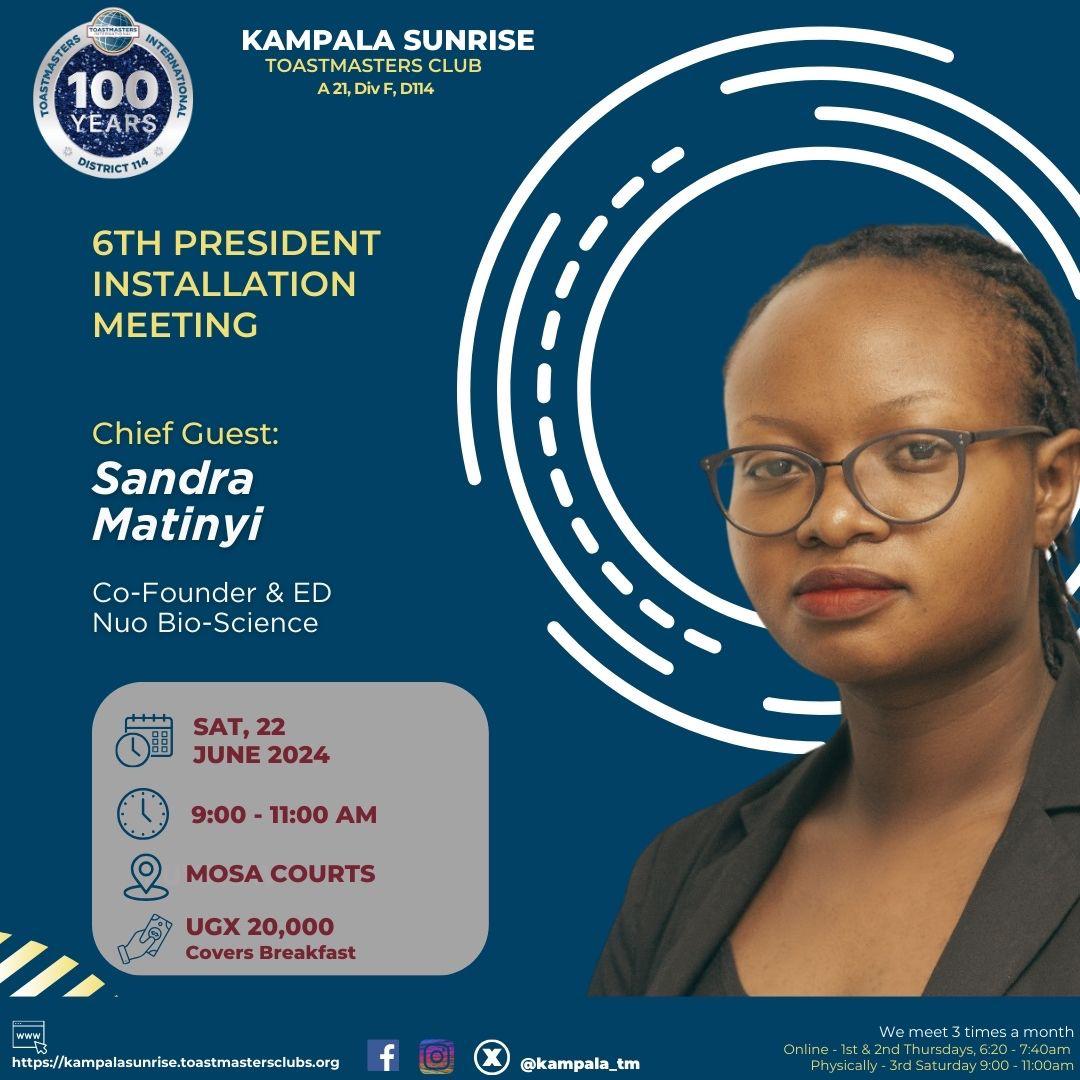
Join us in celebrating a new beginning at our 6th Installation Meeting! 🎉 In just 3 days, witness the passing of the torch 🔥 & the dawn of a new era 🌅 in our club's leadership.
#Toastmasters#NewBeginnings
"The journey of a thousand miles begins with a single step." 🌟👣
Join us in celebrating a new beginning at our 6th Installation Meeting! 🎉 In just 4 days, witness the passing of the torch 🔥 & the dawn of a new era 🌅 in our club's leadership.
#Toastmasters#NewBeginnings
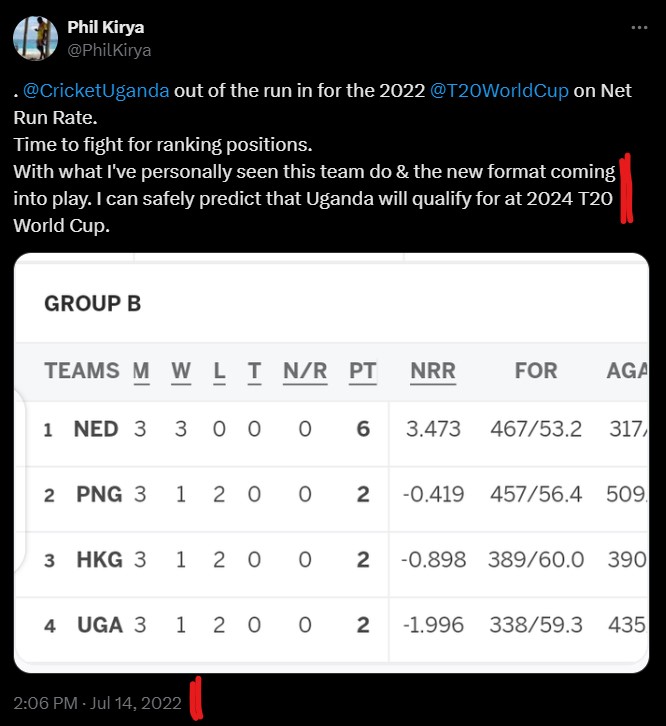
@Ed_Igambirine@PhilKirya In July 2022, on the day the team failed to qualify for the 2022 World Cup, Phil predicted the team would qualify for the 2024 World Cup.
When asked why, all he said is
"This team is special. I have looked at them long time. They are a special group! They are extremely good."
@Ed_Igambirine Thanks for this tribute to @PhilKirya & his love for Uganda Cricket for 25+ years (yes, he started early)
His love shows in how he always looks for and talks with the players, coaches, & stakeholders
For Phil, covering cricket isn't just journalism. It's a big part of his life