Google's latest core update finished rolling out yesterday (2nd June).
The only sites I saw get affected were ones pumping out shit loads of AI content.
All the client sites we work on have been stable or seen growth - due in part to us not pumping out shit loads of content for the sake of it.
Good content, not commodity content.
This is a real screenshot from Google's new Search Generative AI performance report in Search Console
Importantly, they didn't include "Clicks" because—presumably—they don't want you to see how little traffic they send
Backlinks used to be enough. They're not anymore. AI models factor in content freshness. Pages older than 18 months without updates are getting passed over in citations, no matter how well they used to perform. A quarterly refresh calendar is one of the cheapest fixes in your marketing stack right now.
#SEO #AISearch #DigitalMarketing #ContentStrategy
The Google May 2026 core update hits big time yesterday, Saturday, May 30th - this is turning out to be a big Google algorithm update https://t.co/PpyIUxOoGK
I've been watching organic traffic drop across hundreds of client accounts while rankings stay perfectly stable, and I need to tell you exactly what's happening and why it won't reverse.
Google is not broken. Google is doing this on purpose because ChatGPT and other AI systems forced them to keep users on the search results page instead of sending them to yours.
The new game is not about ranking number one. It's about being cited inside AI-generated answers on Google, ChatGPT, Perplexity, and Gemini, and the brands winning that game built their presence across the entire internet, not just their own website.
If you are still reporting keyword rankings to your executive team, you are measuring a game that already ended.
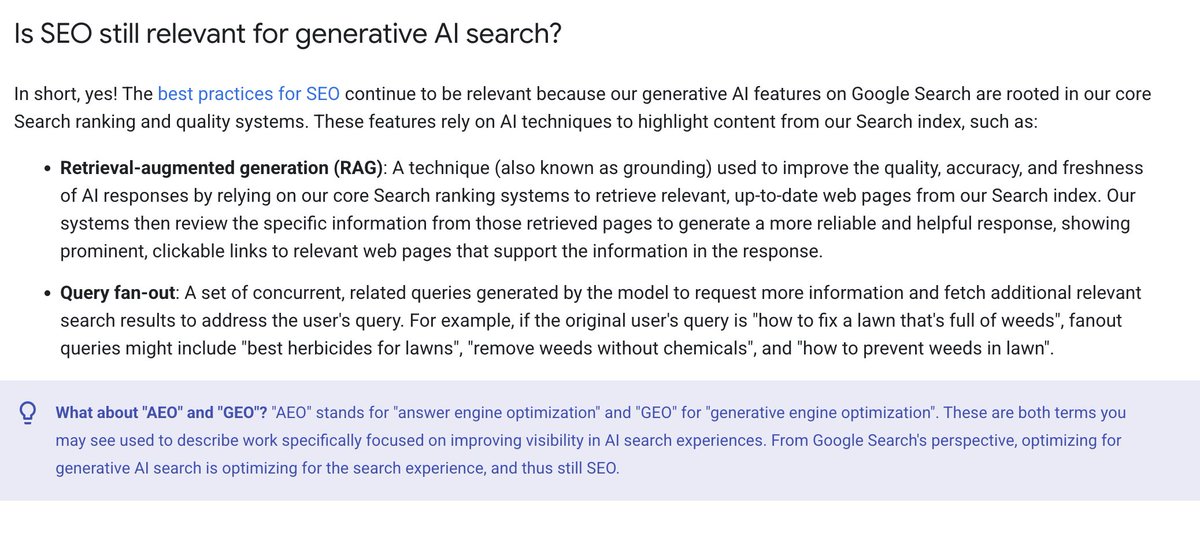
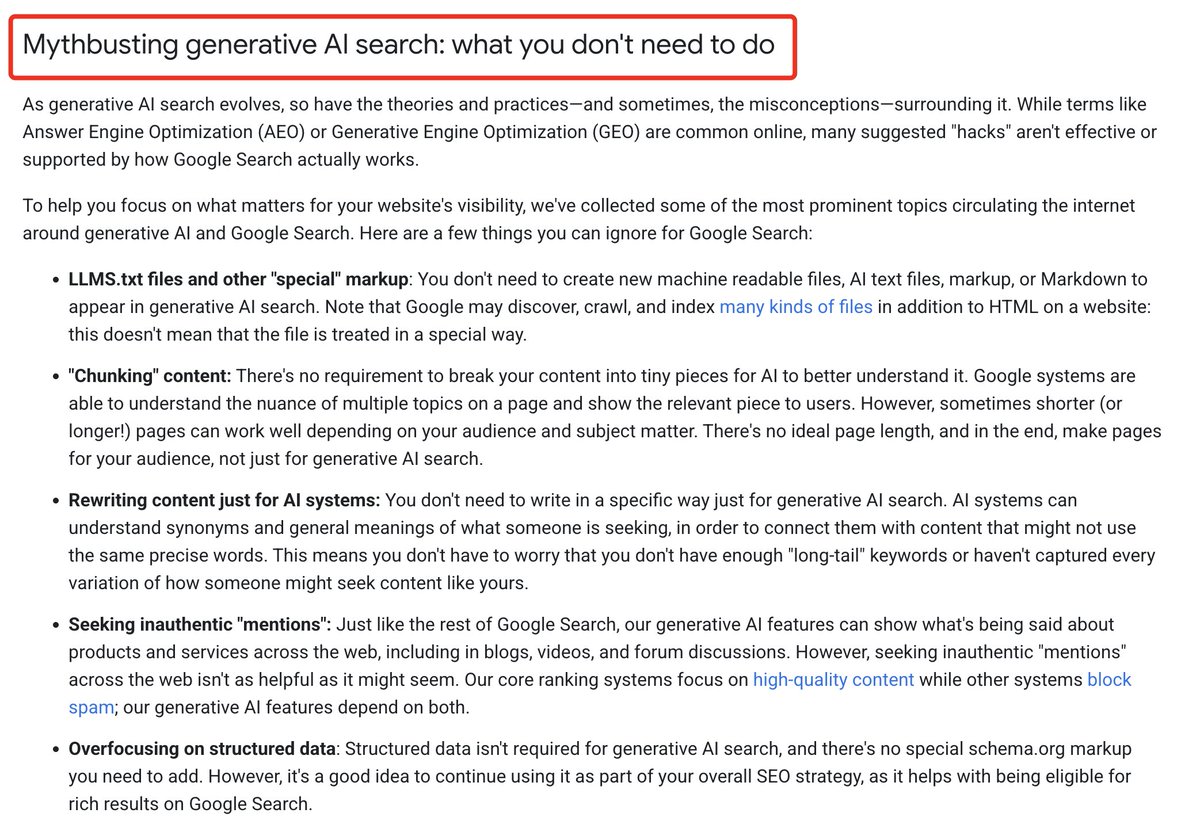
Google has updated its guidelines for AI Search by making one thing clearer:
AEO, GEO, SXO, or whatever people choose to call it, is technically the same discipline as SEO.
If your web document cannot rank, your passages cannot rank.
If your passages cannot rank, generated AI answers are less likely to cite you.
The “query fan-out” definitions in the documentation also show that this is simply query augmentation, as we have been saying from day one.
Google’s Search Relations team is now trying to clarify these concepts. But in my opinion, they gave hype-marketers this opportunity in the first place by using unclear and irresponsible terminology.
RAG is basically an aggregated index curator that generates an answer for a specific, explicit question-query.
When the query is implicit or incomplete, augmentation becomes more diverse, and the number of retrieved documents increases.
PageRank, Topical Authority, and consensus are always part of RAG in terms of result filtering, trust, and source selection.
There is one research paper I suggest you read: “Corroboration of Web Answers.”
It helped inspire the logic behind featured snippets. If you check the sections on “prominence of an answer” and “answer scoring,” you can see that the same principles still reflect what we discuss today.
With that said, many hype-marketers are trying to push AEO, GEO, and similar terms as separate services.
In reality, good SEO, especially Semantic SEO, already communicates with LLMs in the best possible way.
You do not need a completely separate discipline only for LLMs.
In some cases, to impact consensus or convince LLMs, we can create specific domains. I usually call them “wasteful domains,” because we do not create these web documents to rank for a query directly, but to influence consensus as an objective third-party source.
In other cases, we can open different domains with EMD or PMD characteristics to impact the rankings of certain terms. We call these “extension domains.”
But none of these are beyond SEO.
They are all just different SEO implementations.
Since day one, we have defended this idea.
To join us: https://t.co/pbnF18gPmh
Used correctly REGEX in Google Search Console can be insanely helpful.
I've written a guide on all the RE2 Regex Syntax options you can use in Search Console to filter data:
https://t.co/LOuDJKZDvb
Here are some key things you can use, simply copy + paste.
❓ Informational Intent
Users looking to learn or understand something:
(?i)^(what|how|why|when|where|who|which|does|do|is|are|can|should|guide|tutorial|learn|explain|definition|meaning|example)
💵 Transactional / Commercial Intent
Users ready to buy or compare products:
(?i)(buy|price|pricing|cost|cheap|affordable|deal|discount|coupon|purchase|order|subscribe|trial|demo|free\s+trial|vs\s|versus|compare|comparison|review|best|top\s+\d+|alternative)
🔎 Navigational Intent
Users looking for a specific website or page:
(?i)(login|log\s?in|sign\s?in|dashboard|account|support|contact|help\s+center|documentation|docs)
🗺️ Local Intent
Users with location-based queries:
(?i)(near\s+me|in\s+(london|manchester|new\s+york|los\s+angeles|sydney)|local|nearby|directions|open\s+now|hours)
Customise the city names to match your target markets.
-----------------------------------------------------------------
Filtering by Question Type
Question-based queries are goldmines for featured snippets and People Also Ask boxes. Filter by specific question types:
❓ All Questions
(?i)^(who|what|when|where|why|how|which|does|do|is|are|can|could|should|would|will|did|has|have|was|were)
❓ "How to" Queries Only
(?i)^how\s+(to|do|does|can|should|would|much|many|long|often|far)
❓ "What is" Queries Only
(?i)^what\s+(is|are|does|do|was|were|should|can|would)
❓ "Why" Queries
(?i)^why\s+(is|are|does|do|did|can|should|would|won)
❓ "Best" and Comparison Queries
(?i)(^best\s|\sbest\s|vs\s|versus|compared\s+to|comparison|\svs$)
---------------------------------------------------
Filtering by Query Length
Query length is a strong indicator of specificity and intent. Long-tail queries typically have higher conversion rates and lower competition.
🪡 Short-Tail Queries (1-2 Words)
^[^\s]+\s?[^\s]*$
This matches queries with at most one space (1-2 words). These are your head terms - high volume, high competition.
🪡 Medium-Tail Queries (3-4 Words)
^\S+\s\S+\s\S+(\s\S+)?$
Matches queries with exactly 2 or 3 spaces (3-4 words).
🪡 Long-Tail Queries (5+ Words)
^\S+\s\S+\s\S+\s\S+\s\S+
Matches queries with 4 or more spaces (5+ words). These are your long-tail opportunities - typically lower volume but higher intent and easier to rank for.
🪡 Very Long Queries (8+ Words)
(\S+\s){7,}\S+
Matches queries with 8 or more words. These often reveal very specific user needs and can highlight content gap opportunities.
Of course, you can do ALL of the above without using REGEX for free in SEO stack.
Try for FREE for 30 days! no credit card required.
https://t.co/t8L5ZIcJYG
Top 100 Most Exposed Jobs to AI - These are the 100 roles where AI tooling can already substitute the largest share of the day-to-day workflow. #AICareerRisk#AIJobRisk
https://t.co/fnFgQcW7ig
Google removed support for FAQ schema rich snippets almost three years ago, with a few exceptions like wellknown, government or health sites.
If you are not one of the above, then you havent had access to FAQ snippets in Google since august 2023.
To be clear: Google removed support for rich results from FAQ schema. They did NOT remove support article schema, Q&A schema, Local Business schema, or any other of the MANY schema types, they use a lot of room to describe on their Google Search central.
Can you rank without schema? Yes. Can you rank without backlinks? Sure. Can you even rank without quality content? Absolutely.
That doesnt make schema, backlinks or quality content redundant. It means, there are many ways to rank a page....
So go ahead and keep adding structured data to your pages/websites. I know I will..
#schemawriter #jespernissenseo
Google started this weekend with the "Great Deindexing" update roll out. You have non valuable content? No credentials to back it up? You're out. Google won't waste time and resources on it anymore.
SEO is different in 2026. Here's how & what you MUST know:
Old SEO: E-E-A-T is a Nice to Have
New SEO: E-E-A-T Is Non-Negotiable
- You need experience, not just keywords
- Share stories, real examples, screenshots
- Google wants experts, not content farms
Old SEO: Abuse AI to Publish Fast
New SEO: AI Is a Tool, Not a Strategy
- Use AI for research, outlines, metadata
- NEVER publish raw AI output
- Blend human insight with AI speed
Old SEO: What's Search Intent?
New SEO: Search Intent Is the New Keyword Match
- Map every keyword to high, medium, or low intent
- Focus content around what the user wants, not just words
- Start with high intent (buying) content and build from there
Old SEO: Broad TOFU for the Win
New SEO: Topical Authority Beats Volume
- Own a niche deeply instead of going broad
- Interlink blog clusters and build content libraries
- Google now ranks "who knows it best", not "who wrote it first"
Old SEO: Single Channel Blog Publishing
New SEO: Repurposing Content Is the New Multiplier
- 1 blog = 1 LinkedIn post, 1 YouTube, 1 email, 1 infographic
- SEO is omnichannel — show up everywhere with less effort
- Multiply reach without burning out your team
Old SEO: Get As Many Backlinks (Quality Doesn't Matter)
New SEO: Backlinks Still Matter (But They’ve Evolved)
- Focus on relevant, high-trust sources
- Get featured through partnerships, podcasts, case studies
- Internal linking structure is just as critical
Old SEO: It's Google & Google Only
New SEO: ChatGPT & LLMs Grow the Game
- People now “search” in ChatGPT, not just Google
- Write structured, expert-backed content LLMs can cite
- Optimize for AI visibility with clean formatting and clear answers
---
SEO in 2026 rewards depth, not volume.
It’s about trust, not tricks.
Your experience is your biggest SEO weapon.
AI won’t replace you, but marketers using it will.
System > hustle. Play the long game.
---
Agree or disagree?
Repost ♻️ to help others stay ahead of SEO in 2026.
P.S. Join 7,000+ SEOs & Marketers on my Savvy SEO newsletter: https://t.co/5W8RMmTwNx
Most ecommerce brands treat SEO like an afterthought.
A few blog posts. Some product descriptions. Maybe a backlink or two.
Then they wonder why Shopify stores with half their catalog are outranking them.
Here's the ecommerce SEO strategy I'd run from Day 1:
---
1/ Nail Your Site Architecture
- Categories and subcategories should mirror how people search.
- Every product page needs a unique title tag and meta description.
- Keep URLs clean and keyword-rich. No random strings of numbers.
- Flat structure wins. 3 clicks max from homepage to any product.
2/ Prioritize Collection Pages Over Blog Posts
- Your category pages are your money pages. Optimize them first.
- Add 200-400 words of keyword-rich copy above or below the product grid.
- Target BOFU keywords like "buy [product] online" and "best [product] for [use case]."
- Add FAQs at the bottom of the page to keep more users on the page learning.
3/ Fix Technical SEO Before You Write a Single Blog
- Crawl your site for duplicate content. Ecommerce stores are notorious for it.
- Canonical tags on product variants. Non-negotiable.
- Page speed matters more in ecommerce than anywhere else. Slow site = lost sales.
- Schema markup on every product page. Price, reviews, availability.
4/ Build Content Around Buyer Intent
- "Best [product] for [audience]" comparison posts convert like crazy.
- Buying guides that link directly to your collection pages.
- Skip the generic TOFU content. Go BOFU and MOFU first.
5/ Backlinks With Purpose
- Get listed on "best of" roundups in your niche.
- Partner with complementary brands for content swaps.
- Digital PR around new product launches or data you own.
6/ Track What Matters
- Revenue from organic. Not just traffic.
- Keyword rankings on collection and product pages specifically.
- Conversion rate by landing page. Find what's working and double down.
---
Ecommerce SEO isn't about publishing 50 blog posts and praying.
It's about treating your store like a search engine magnet.
Architecture. Technical foundation. Buyer intent content. Strategic links.
Get those right and organic becomes your best sales channel.
---
What's your biggest ecommerce SEO challenge right now?
♻️ Repost if you know someone running an ecommerce brand that needs this.
P.S. My team at TrioSEO runs ecommerce SEO for brands selling on Shopify, Amazon, and beyond. DM me and let's talk strategy.
99% of SEOs and Web Devs refuse point blank, at the pain of death - to read the SEO starter guide.
It resolves 90% of SEO "debates"
1) EEAT is not real - Google Jokes about it
2) H headers can be used in any order
3) You do not need ANY words - 0 words is fine; ergo: there is NO problem with THIN CONTENT
4) PageRank is fundamental
Its all in one page - go print this, laminate it and staple it to people's heads
Built 500 backlinks in 30 days.
Google penalized the site within 48 hours.
Rebuilt with 370 links over 8 months.
Rankings exploded.
Here's what I learned about link velocity that looks natural: 🧵👇













![foley_seo's tweet photo. Used correctly REGEX in Google Search Console can be insanely helpful.
I've written a guide on all the RE2 Regex Syntax options you can use in Search Console to filter data:
https://t.co/LOuDJKZDvb
Here are some key things you can use, simply copy + paste.
❓ Informational Intent
Users looking to learn or understand something:
(?i)^(what|how|why|when|where|who|which|does|do|is|are|can|should|guide|tutorial|learn|explain|definition|meaning|example)
💵 Transactional / Commercial Intent
Users ready to buy or compare products:
(?i)(buy|price|pricing|cost|cheap|affordable|deal|discount|coupon|purchase|order|subscribe|trial|demo|free\s+trial|vs\s|versus|compare|comparison|review|best|top\s+\d+|alternative)
🔎 Navigational Intent
Users looking for a specific website or page:
(?i)(login|log\s?in|sign\s?in|dashboard|account|support|contact|help\s+center|documentation|docs)
🗺️ Local Intent
Users with location-based queries:
(?i)(near\s+me|in\s+(london|manchester|new\s+york|los\s+angeles|sydney)|local|nearby|directions|open\s+now|hours)
Customise the city names to match your target markets.
-----------------------------------------------------------------
Filtering by Question Type
Question-based queries are goldmines for featured snippets and People Also Ask boxes. Filter by specific question types:
❓ All Questions
(?i)^(who|what|when|where|why|how|which|does|do|is|are|can|could|should|would|will|did|has|have|was|were)
❓ "How to" Queries Only
(?i)^how\s+(to|do|does|can|should|would|much|many|long|often|far)
❓ "What is" Queries Only
(?i)^what\s+(is|are|does|do|was|were|should|can|would)
❓ "Why" Queries
(?i)^why\s+(is|are|does|do|did|can|should|would|won)
❓ "Best" and Comparison Queries
(?i)(^best\s|\sbest\s|vs\s|versus|compared\s+to|comparison|\svs$)
---------------------------------------------------
Filtering by Query Length
Query length is a strong indicator of specificity and intent. Long-tail queries typically have higher conversion rates and lower competition.
🪡 Short-Tail Queries (1-2 Words)
^[^\s]+\s?[^\s]*$
This matches queries with at most one space (1-2 words). These are your head terms - high volume, high competition.
🪡 Medium-Tail Queries (3-4 Words)
^\S+\s\S+\s\S+(\s\S+)?$
Matches queries with exactly 2 or 3 spaces (3-4 words).
🪡 Long-Tail Queries (5+ Words)
^\S+\s\S+\s\S+\s\S+\s\S+
Matches queries with 4 or more spaces (5+ words). These are your long-tail opportunities - typically lower volume but higher intent and easier to rank for.
🪡 Very Long Queries (8+ Words)
(\S+\s){7,}\S+
Matches queries with 8 or more words. These often reveal very specific user needs and can highlight content gap opportunities.
Of course, you can do ALL of the above without using REGEX for free in SEO stack.
Try for FREE for 30 days! no credit card required.
https://t.co/t8L5ZIcJYG](https://pbs.twimg.com/media/HIhVWYOWMAAM-Bb.jpg)


![ConnorGillivan's tweet photo. Most ecommerce brands treat SEO like an afterthought.
A few blog posts. Some product descriptions. Maybe a backlink or two.
Then they wonder why Shopify stores with half their catalog are outranking them.
Here's the ecommerce SEO strategy I'd run from Day 1:
---
1/ Nail Your Site Architecture
- Categories and subcategories should mirror how people search.
- Every product page needs a unique title tag and meta description.
- Keep URLs clean and keyword-rich. No random strings of numbers.
- Flat structure wins. 3 clicks max from homepage to any product.
2/ Prioritize Collection Pages Over Blog Posts
- Your category pages are your money pages. Optimize them first.
- Add 200-400 words of keyword-rich copy above or below the product grid.
- Target BOFU keywords like "buy [product] online" and "best [product] for [use case]."
- Add FAQs at the bottom of the page to keep more users on the page learning.
3/ Fix Technical SEO Before You Write a Single Blog
- Crawl your site for duplicate content. Ecommerce stores are notorious for it.
- Canonical tags on product variants. Non-negotiable.
- Page speed matters more in ecommerce than anywhere else. Slow site = lost sales.
- Schema markup on every product page. Price, reviews, availability.
4/ Build Content Around Buyer Intent
- "Best [product] for [audience]" comparison posts convert like crazy.
- Buying guides that link directly to your collection pages.
- Skip the generic TOFU content. Go BOFU and MOFU first.
5/ Backlinks With Purpose
- Get listed on "best of" roundups in your niche.
- Partner with complementary brands for content swaps.
- Digital PR around new product launches or data you own.
6/ Track What Matters
- Revenue from organic. Not just traffic.
- Keyword rankings on collection and product pages specifically.
- Conversion rate by landing page. Find what's working and double down.
---
Ecommerce SEO isn't about publishing 50 blog posts and praying.
It's about treating your store like a search engine magnet.
Architecture. Technical foundation. Buyer intent content. Strategic links.
Get those right and organic becomes your best sales channel.
---
What's your biggest ecommerce SEO challenge right now?
♻️ Repost if you know someone running an ecommerce brand that needs this.
P.S. My team at TrioSEO runs ecommerce SEO for brands selling on Shopify, Amazon, and beyond. DM me and let's talk strategy.](https://pbs.twimg.com/media/HHjqmqzXEAIvz-L.jpg)


