688 Attack Sub: Classic vs Enhanced | Trailer 2 "Then and Now" (fan remake) https://t.co/Hk4Vs55Iii via @YouTube
1989 versus today.
The second trailer of "688 Attack Sub - Enhanced Edition", a non-commercial fan remake of the 1989 submarine simulator, compares the two sides of the project: the classic level, true to the original in its 22 scenarios, rules and panels, and the Enhanced level, rebuilt on research dossiers.
Every comparison is like for like: same mission, same moment, same station, first in the classic and then in Enhanced. Every image comes from the game engine, in 256-colour VGA graphics.
THE OPENING
A 688's emergency blow in a storm, seen through the periscope of the Alfa that is shadowing it: rendered with the engine's own code (surfacing pose, water and spray, periscope eyepiece) at 24 frames per second.
1989 / ENHANCED
- Sonar: listening in the bow sector only / 72-beam SDR waterfall, LOFAR, DEMON, sonar equation and ray tracing
- Chart: flat-colour seabed / period charts (NATO 1988 and Soviet 1987), isobaths, ruler, TMA, Ekelund ranging
- Status: six systems, one random failure with no repairs / twelve systems with repairs, cutaway with leaks, fire and bulkheads
- Radio: an archive of onboard messages / VLF, HF and satellite depending on the mast, broadcasts, ROE, authentication
- Periscope: a rectangular view / Type 2 and Type 18 with the eyepiece, elevation, stadimeter, exposure seconds
- Manoeuvring: a 7-position telegraph / real dynamics, rudder in degrees, 9 bells, cavitation
- Weapons: 20 seconds to ready any weapon / seeker, RTE, ceiling and floor, five-minute manual reload
- Explosions: four hand-drawn frames / bubble, column and breaking hull girder, from the damage physics
- Ships: five drawings per ship / 74 views from the 3D kit model, plus the model for damage
- Outcome: a code and one sentence / an itemised patrol report, judgement, decorations
NEW IN ENHANCED
Briefing room, torpedo room with a 1989 loadout, mines, TMA with the MATE tool, ESM with 26 radars, debriefing with mini-postcards, ceremonies and careers for the US Navy and the Soviet Navy.
In development: airborne ASW in the mission view, weather in missions (the opening storm is rendered by the kit), Soviet-style stations for the Alfa. The explosions on ships were filmed in the engine's test scene. The "1989" side is the remake's classic level; the original sprites appear only as quotations in the comparison.
And the classic stays, true to the original.
CHAPTERS
0:00 Emergency blow
0:11 1989 / today
0:17 Sonar, chart, status, radio
0:40 What's new
1:03 Then and now
1:26 Enhanced in action
1:51 The classic stays
MUSIC
"Togda i seychas" (Then and Now), an original theme for male choir in Russian, written for this trailer: the theme first plays like a 1989 computer and the choir answers. It uses no music from the original game or from any film. Sounds: MuseScore General soundfont (MIT licence) - adaptation by S. Christian Collins (c) 2018-19; FluidR3 by Frank Wen (c) 2000-02; FluidR3Mono by Michael Cowgill (c) 2014-17; Temple Blocks by Ethan Winer (c) 2002; Drumline Cymbals by Michael Schorsch (c) 2016.
DISCLAIMER
Non-commercial fan project, not affiliated with Electronic Arts or the rights holders. "688 Attack Sub" (1989) is a trademark of its respective owners and is mentioned only as the work this remake pays tribute to. The remake does not distribute the original game's files.
#688AttackSub #ClassicVsEnhanced #RetroGaming #SubmarineSimulator #ColdWar #VGA #DOSgames #FanRemake
688 Attack Sub Reborn: 22 new missions
The remake of EA's 1989 sub sim is getting a library of ready-made missions, built with the game's own mission editor: half for the 688, half for the Soviet Alfa. Ten are original stories, twelve are inspired by real Cold War episodes. Boats and crews are always fictional, no death is ever an objective, and where the real place isn't in the game, one of its seven theatres stands in.
15 are playable today. The other 7 arrive as the engine gains the pieces they need.
ORIGINAL STORIES
The Iron Whale (688 · Iceland–Faroes ridge · peace · playable)
SOSUS has a quiet seven-bladed screw that matches nothing in the archive. Find it, record 40 minutes of its signature, stay unseen. Then it does a Crazy Ivan, and you learn there were two boats all along: the noisy one was bait, and now you're the one being followed.
The Teriberka Fisherman (Alfa · Barents, polar night · crisis · playable)
A Typhoon comes home after 90 days under the ice, and a "Norwegian" trawler keeps fishing right on its route into the bastion. Escort the Typhoon in, find the American sub hiding nearby, and check every order you receive: one of them is fake.
Shallow Water, Short Nerves (688 · Baltic · peace, then crisis · coming)
Shadow a Soviet and East German exercise in 25 m of water, in a boat whose sail alone is 9 m tall. An hour in, a Kilo's practice torpedo loses its target and locks onto you. Dodge it like a real one and you give yourself away. Or trust that it's inert.
The Gate of Hercules (Alfa · Strait of Gibraltar · war · coming)
The war is 36 hours old and the Mediterranean is a trap. The fastest sub afloat has to slip into the Atlantic slowly, hiding under the screws of a 100,000-ton container ship. Halfway through the strait, the sonarman hears the hydrophones of a NATO minefield.
The Defector (688 · Strait of Otranto · crisis · coming)
A Soviet survey ship asks for asylum on the open radio and runs for Brindisi, a Krivak behind her. Get her into Italian waters without starting a war. The Krivak isn't the real threat: a Kilo waits on her route, with orders to make it look like an accident.
The Ekaterina Bridge (Alfa · Kurils · war · playable)
Two Los Angeles boats try to force the strait into the Sea of Okhotsk, the Soviet Pacific bastion. Hold the door, knowing that whoever holds a door can't chase whoever runs. Then a US carrier group appears to the south-east.
Wounded Wolf (688 · Celtic Shelf · war · coming)
You sank a Victor III, but its last torpedo flooded your engine room. Twelve knots at most, 240 miles to Brest, a Krivak barrier in between and an autumn gale overhead. Then an Oscar opens its missile doors, aimed at a convoy. You have two torpedoes left.
Long Shadow (Alfa · north of the Faroes · peace · playable)
The longest day of the year, a flat calm, and a NATO carrier group on exercise. Slip inside the screen, record the Nimitz's screws from under five miles, photograph her and get home unseen. In a sea like this a periscope shows from ten miles away.
Under the Bastion (688 · Barents, polar night · peace · playable)
A satellite has spotted a new ship at Zapadnaya Litsa with a bow dome no analyst can read. Go where no American sub should be, identify her on her sea trials and get out unseen. Her new sonar may hear you from thirty miles.
Race to the Wreck (Alfa · Celtic Shelf · peace · playable)
A Soviet sub lies sunk on the edge of the Celtic Shelf, codes aboard. Guard it until the rescue ship comes, against an American sub and a "research" ship. No weapons: only active sonar, speed and the nerve to pass under someone's keel.
INSPIRED BY REAL COLD WAR EPISODES
Vestfjord (688 · a Faroese fjord · exercise · playable)
NATO wants to hide a carrier in a fjord, and someone has to clear it first. A Trafalgar plays the Soviet sub, waiting at the mouth. Steep walls, a rising bottom, and the carrier arrives early. The easiest mission of the library. Inspired by NATO's fjord tactics of the 1980s.
Mining Ship (688 · Kurils · peace · playable)
A ship has been "mining manganese nodules" over the deepest basin for nine days. Guard her without being told from what, while a Soviet tug parks two hundred yards away. You win by staying silent. Inspired by Project Azorian.
Quarantine (688 · Celtic Shelf · crisis · coming)
A blockade, and Soviet diesel boats heading south. Washington doesn't want them sunk: it wants them on the surface, flag and all. Hold contact until the battery runs out, without firing a shot. Inspired by the Foxtrots of 1962.
Ivy Bells (688 · Kurils and the Sea of Okhotsk · peace · playable)
Slip through the Kurils into the Sea of Okhotsk, settle over a Soviet cable on the bottom and stay still for two hours while the divers swap the tapes. Then a Soviet ship stops right overhead. One of the four hardest in the library. Inspired by Operation Ivy Bells.
The Cable Keeper (Alfa · Sea of Okhotsk · peace, then crisis · playable)
Ivy Bells from the other side: something is on the Okhotsk cable. Escort the rescue ship and find the intruder, an American boat resting on the bottom, silent to any passive sonar. Only a ping finds it, and then the radio changes your orders.
Tankers (688 · Strait of Gibraltar · crisis · coming)
Escort three reflagged tankers through a strait at night, from below. A darkened "merchant" crosses the convoy, stops, starts, stops again. Nobody admits to laying mines. Then the first tanker hits one. Inspired by the Tanker War of 1987–88.
The Cork (688 · Barents · war · playable)
The war starts at dawn. Lay ten Mk 67 mines along the exit channel of the Kola Gulf and leave before they arm and the Northern Fleet wakes up. While your tubes reload, an Akula comes out of the channel. Let it pass, or wake the Krivaks?
Valona (Alfa · Vlorë Bay · crisis · playable)
The host country has broken with Moscow. Lead a support ship and four Foxtrots out of the bay, while four more are "detained" at the piers and NATO watches from outside. Nobody wants to shoot. Inspired by the Soviet withdrawal from Vlorë in 1961.
Aport (Alfa · Iceland–Faroes gap · peace · playable)
Cross the gap under SOSUS. Every sprint over twenty knots is a report to Keflavík and an Orion overhead an hour later. Sprint, drift under the layer and let the datum go stale. Inspired by Operation Aport, 1985.
The Frigate's Cable (Alfa · Celtic Shelf · peace · coming)
Tuck into the deaf cone astern of a Perry towing a new sonar array and record it for thirty minutes. Not too close: a kilometre of steel cable trails behind her. Then she turns hard. Inspired by K-324 and USS McCloy, 1983.
Hold the Border (Alfa · Baltic · crisis · playable)
A Soviet diesel sub has run aground inside a neutral country's waters. Wait just outside the 12-mile line, unseen, and cover her home once she's towed out. One step over the line and the crisis becomes something else. Inspired by U-137, 1981.
The Hunter Group (Alfa · Strait of Otranto · war · playable)
Two frigates and a helicopter have hunted you for six hours. Then one slows to twelve knots to test her new sonar, and for a few minutes she's the prey. Opportunity or bait? Inspired, as doctrine only, by the 1971 Hangor and Khukri.
Every mission is tested to a win and to a loss, and each can be opened in the editor to see how it's made.
What do you think? Which of these could be your favourite/most interesting one? @ARRGETSTUFFED@ChrisSPITZER7@Mountain_Navy@RewindStephan@ringohrani@jwestonharvey@oldyzach
#688AttackSub #gamedev #retrogaming
688 Attack Sub Reborn #108: Orders by Radio, and Batteries That Run Down
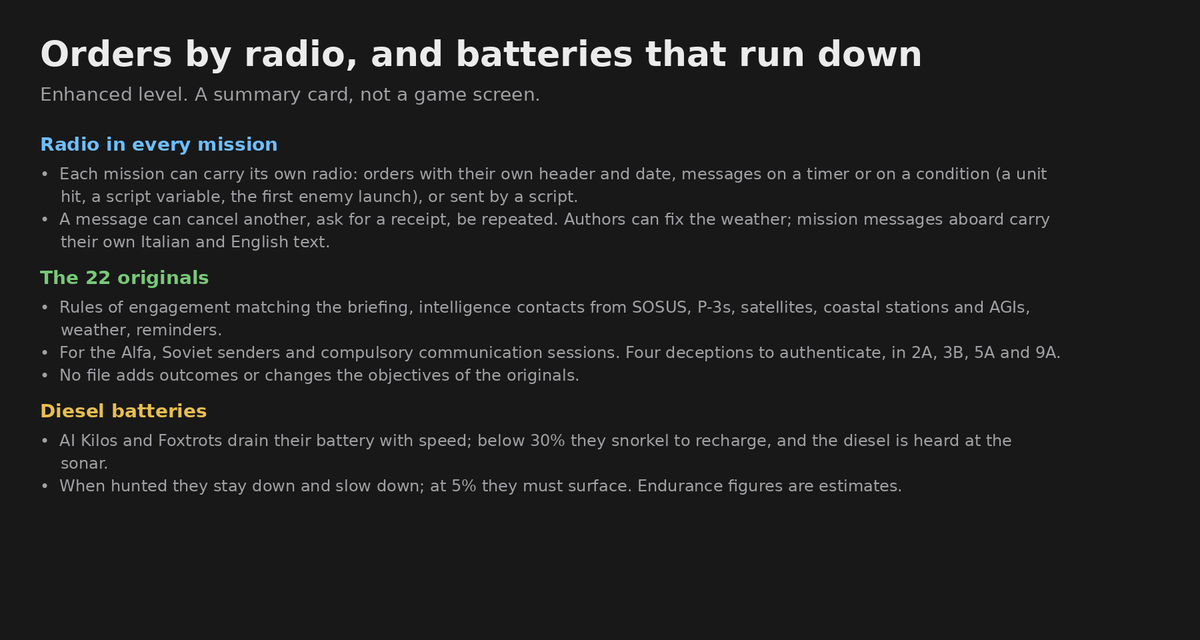
The radio room of post #39 had the broadcast, the schedule and the risks of transmitting, but few messages written for each mission. Several library missions also waited for radio orders that change the situation. The runtime session has now built the radio inside the mission, and the editor session has written the traffic for the 22 original missions.
The radio of a mission
- Each mission can carry its own radio: the mission orders with their own header and date-time group, and messages on a timer.
- Messages on a condition go on the air the first time it's true: a unit hit or out of the game, a script variable, a transmission, an event in the mission log such as the first enemy launch.
- Scripts can send a message with https://t.co/UjvKEEmJVL(u, "ID").
- A message can cancel another, ask for a receipt (missed receipts show in the radio debriefing) and be repeated.
- The author can fix the weather, and it holds even with simplified weather in the options.
- Messages aboard written for the mission have codes from 1000 up, with Italian and English text in the file itself. They don't touch the game's shared table and never end the mission.
The 22 originals
- Every file has rules of engagement matching the briefing, with neutral units named, and intelligence contacts on the real units: SOSUS, P-3s, LAMPS and satellites for the 688; coastal stations, AGIs, Il-38s and Tu-95s for the Alfa.
- Also the theatre's weather, a few reminders about the rules of engagement and, for the Alfa, Soviet senders and compulsory communication sessions every 5 or 10 minutes, which count in the debriefing.
- Four deceptions to authenticate, in 2A, 3B, 5A and 9A. They do nothing by themselves: whoever believes one harms only themselves. In SHAKE 'EM a false FLASH says the Alfa has broken off the trail and orders a flank-speed transit: whoever doesn't check the authentication runs, and gets heard.
- No file adds outcomes or changes the objectives of the originals.
- In TORPEX an IMMEDIATE from CINCLANTFLT warns of a possible Soviet submarine near the range: not an exercise target, do not engage.
- More messages tied to events are being added now that the loader reads conditions, such as the Konis attacking after the first shot in 4A, or weapons free at the first Soviet launch.
Diesel batteries
- The AI's Kilos and Foxtrots now drain their battery according to speed.
- Below 30% they come up to periscope depth to recharge with the diesel, and the diesel can be heard at the sonar.
- When hunted they stay down and slow down to save power; at 5% they are forced to surface, and the mission log records it.
- The endurance figures are estimates, and a mission can set each boat's initial charge.
This opens the library's historical «Quarantena»: holding contact with a Foxtrot until its battery forces it up.
All 571 tests pass and the classic level is identical (0 games out of 110).
Next: achievements and a hall of fame.
#688AttackSub #gamedev #submarine
688 Attack Sub Reborn #107: Collisions
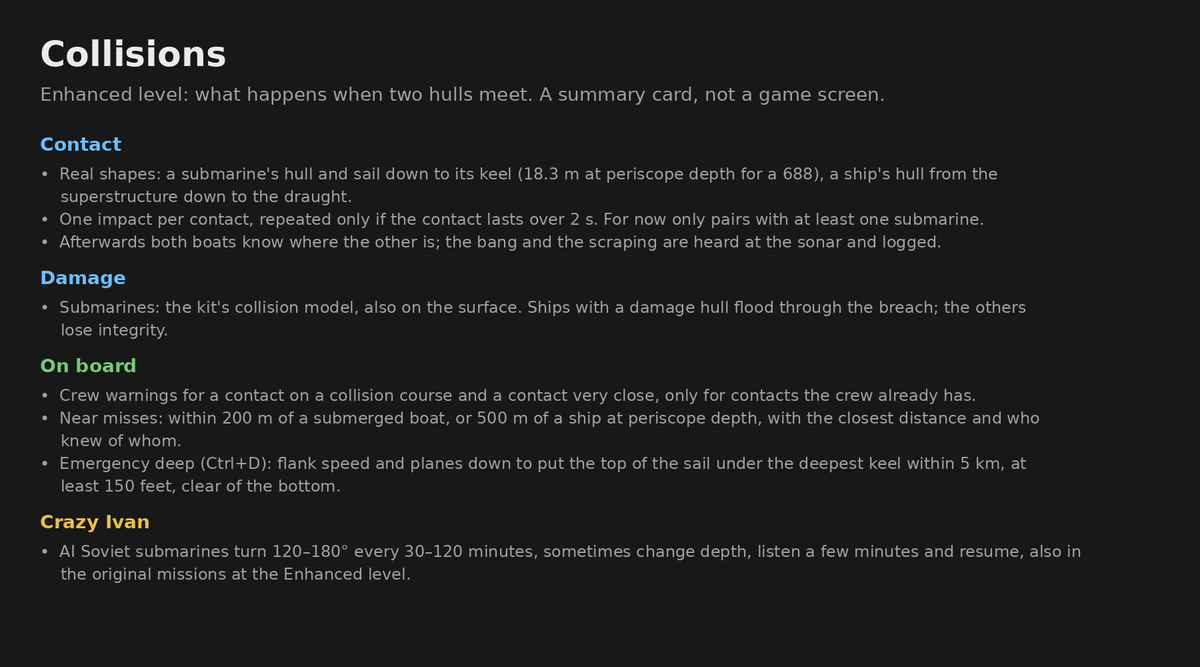
The kit session had already written the damage of a collision, tested on twelve historical cases, and the disassembler session its sounds. Now the runtime session has wired it all into the mission, and the main session into the player's stations. Enhanced level only; the classic level is identical.
The impact
- The mission detects the contact with the classes' real shapes:
- for submarines the hull and the sail, down to the real keel (at periscope depth, 18.3 m for a 688);
- for ships the hull, from the superstructure down to the draught.
- One impact per contact, repeated only if the contact lasts more than 2 s, and judged with the kit's damage model.
- After the impact both boats know where the other is. The bang and the scraping are heard at the sonar, and the mission log records the collision.
- For now only pairs with at least one submarine count: ships don't collide with each other yet.
The damage
- Submarines take the kit's collision damage, also on the surface. A surfaced, damaged boat floods through its breach like a ship.
- Ships with a damage hull take the impact in their compartments; the others lose integrity in proportion and are destroyed if it reaches zero.
Near misses
The player's near misses are recorded: passing within 200 m of another submerged boat, or within 500 m of a ship at periscope depth. For the debriefing the log keeps the closest distance and whether each of the two knew of the other.
On board
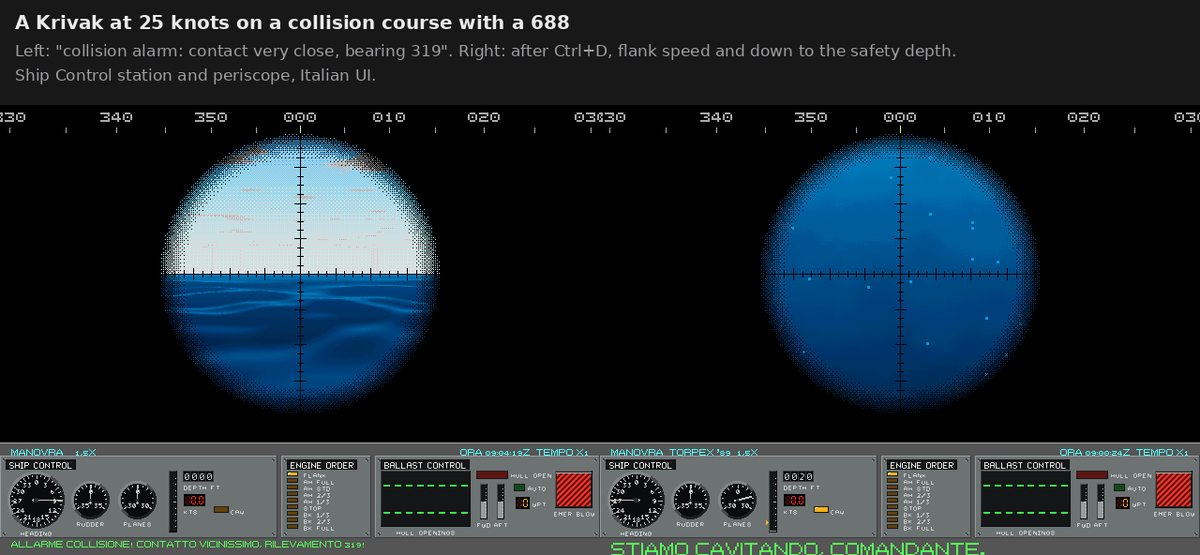
- Crew warnings: a contact on a collision course, and a contact very close, only for contacts the crew already holds. Then the near misses, telling apart those with a unit nobody had heard.
- Emergency deep, Ctrl+D: flank speed and planes down to a safety depth that puts the top of the sail under the keel of the deepest ship within 5 km, at least 150 feet, without going too close to the bottom. The depth shows on the Ship Control panel. It's an order like the others, so it goes in the history and in the replay, and it works in the original missions and in those without the dynamic model.
Crazy Ivan
The AI's Soviet submarines now clear their baffles: every 30–120 minutes, more often after a turn, they swing 120–180°, sometimes change depth, listen for a few minutes and resume their course. This changes how they behave in the original missions too, when played at the Enhanced level.
All tests pass. Still open: the AI avoiding collisions with what it knows; the outcome of the mission, the career and a political incident after a collision; and torpedoes, trawl nets and towed array cables as things to run into.
Next: radio traffic for every mission.
#688AttackSub #gamedev #submarine
688 Attack Sub Reborn #106: Gunfire, in the Game
Post #87 was the research on naval gunfire against submarines and a plan in eight pieces, G0 to G7. Seven are done: enemy ships now fire their guns at a boat they can see, at the Enhanced level only. The classic level is identical.
The guns and the fire model
- Ten guns from the research dossier, each with a source and a confidence: the Mk 75, the Mk 45, the Iowa's guns, the AK-100, AK-130, AK-726, AK-725, AK-630 and AK-230. For each one its range table and reaction times, plus the ten armed classes and the shape each submarine shows above the water.
- Every round is aimed with a lead, gets its own error, and is checked against the part of the boat above the water. It can be a direct hit, a ricochet, splinters, a burst of fire or an air burst.
- Measured in the tests: a periscope head is hit, directly or by splinters, by 24% of the rounds at 1 km and 6.7% at 3 km, against 30–50% and 5–12% in the dossier. To get there, splinters from a grazing burst carry up to 50 m forward along the trajectory: an estimate of the runtime session, still to be calibrated.
- One difference from the dossier: at 3 km a surfaced 688 is hit by 72% of the rounds even bows-on, where the dossier estimated 25–40%. With fire almost horizontal, the 110 m of hull soak up the error in range.
When ships fire
- In peace, never.
- In a crisis, only warning shots, three every two minutes. If the player launches, the crisis becomes a war.
- In war, at a boat they can see by radar or by eye: on the surface, or showing its periscope, a mast or the top of the sail.
- Also counted: the ship's reaction time, the gun's range and minimum range, no round if a friendly ship is close to the line of fire, a cease-fire 5 s after the target disappears, ammunition, and star shells at night.
- The difficulty is the same as for ASW aircraft: the menu option is now called "Enemies (ASW, guns)". At the easiest level no ship fires at a periscope.
What gets damaged
The kit session applies the hits to the boat, following the dossier:
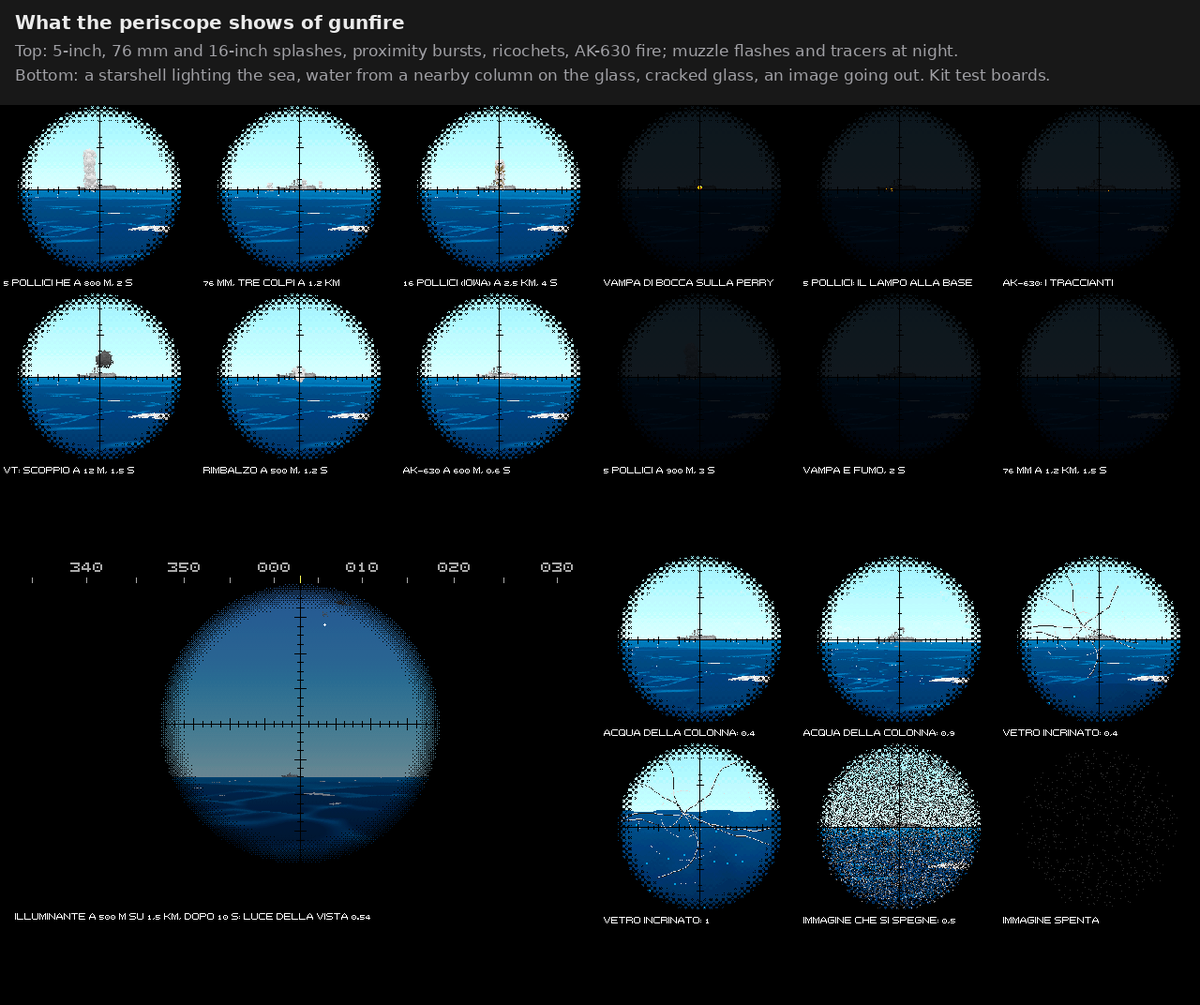
- A direct hit on a periscope head: blind in half the cases (broken glass, a tube that floods), jammed in 30% (a bent head), scratched in 20%.
- Splinters hit more rarely the further away they burst, within about 4 m for a 5-inch shell, 2 m for 76 mm and 1 m for 30 mm, and usually only scratch.
- A head can only get worse. On the 688 the Type 18 also takes the ESM with it.
- A jammed periscope no longer goes up or down. A blind one with a broken tube lets water into the control room, about 18 m³ an hour (an estimate), until it's lowered.
What the player sees and hears
- Crew warnings, spaced so they don't repeat at every round:
- the lookout reports gun flashes and water columns close by;
- submerged, the sonarman hears the bursts;
- then hits on the periscope, the masts and the sail, warning shots and star shells.
- At the periscope: columns, flashes, ricochets and tracers; water from a nearby column runs down the glass; a hit head cracks the glass or makes the image go out; at night star shells light up the sea.
- On the chart, the splashes seen become small crosses, kept apart from the player's own marks.
- The sound is heard at the sonar, through the hull and in full on the bridge, with the delay of sound in air.
All tests pass. Still to come: the calibration (G7); at the expert level, fire at a periscope's feather when the head itself can't be seen; territorial waters declared by a mission; ships firing at AI submarines, and battles between ships.
Next: collisions.
#688AttackSub #gamedev #submarine
688 Attack Sub Reborn #105: Decoys for the Player
Post #101 gave mobile decoys to the AI's Soviet submarines, and left one question open: should the player have them too? I decided it the way the game already treats things that weren't aboard in 1989, era by era.
Who gets what
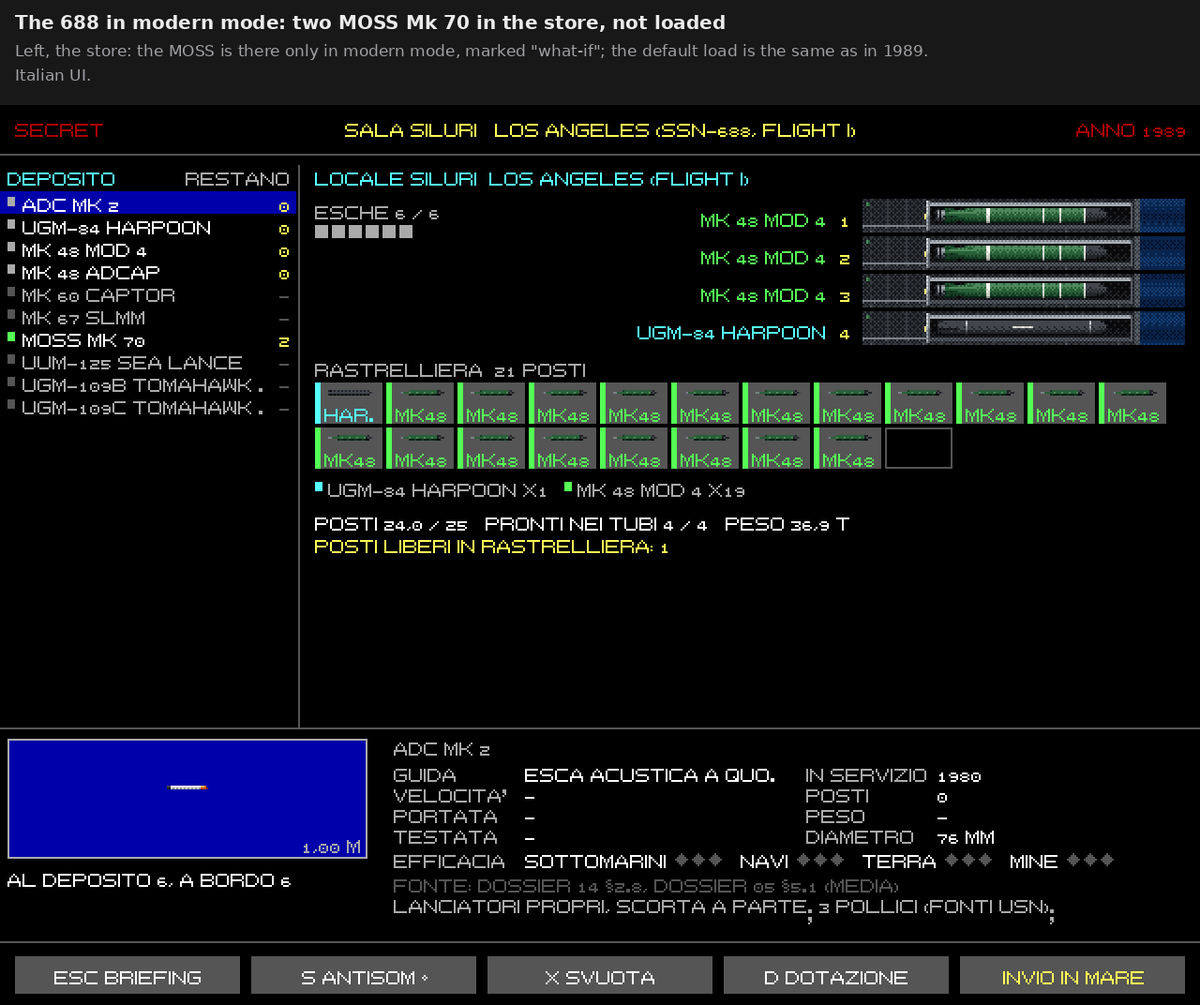
- The 688 in 1989 mode: no MOSS, only the stationary ADC Mk 2s, as in reality. In the 1980s the MOSS went to ballistic missile submarines, not to the 688s, so with a torpedo on its tail the American player stays more exposed. The torpedo room shows it as "not available: what-if".
- The 688 in modern mode: two MOSS Mk 70s in the store, marked "what-if". The player loads them if they want them; the default load is the same as in 1989, so the Harpoon stays aboard. It's the same rule as the Alfa's sonar recording slots, available only in modern mode.
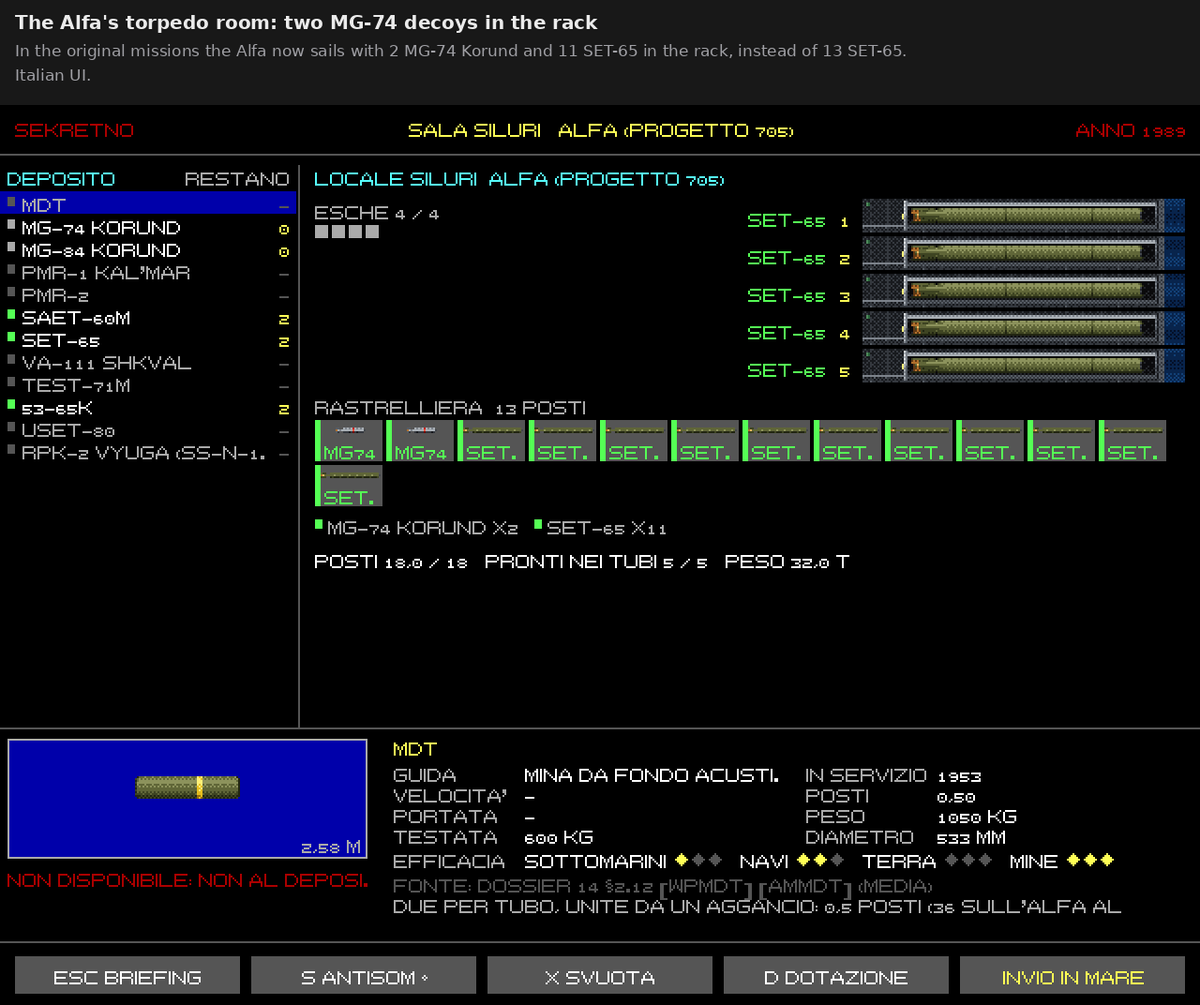
- The Alfa, in both modes: the MG-74, launched from a 533 mm tube in place of a torpedo. It's historical, so in the original missions the Alfa now sails with two MG-74s and eleven SET-65s instead of thirteen SET-65s.
- Editor and library missions: decoys come only if the mission declares them. The editor has a new line on the Mission tab for 0, 2 or 4 decoys; the eight Alfa missions of the library carry two MG-74s, and the 688 missions, all set in 1989, carry no MOSS.
Four sessions, one decoy
- The disassembler session did the load and the tubes: in the Weapons station a mobile decoy reloads from the rack like a torpedo and shows "decoy ready" when armed.
- The runtime session did the launch: when a tube fires a mobile decoy, the mission launches it instead of a torpedo, on the course and depth set on the tube, or on the boat's own. A test runs the whole chain on the Alfa, from the rack to the water.
- The kit session drew them: the MG-74 Korund, a short 3.9 m electric torpedo in grey with a red band, and the MOSS, the slim 10-inch body of a Mk 37 inside the sleeve that holds it in a 533 mm tube. Both colours are estimates, because no photo shows them. Encyclopedia entries in Italian and English came with them.
- The main session wired modern mode into the torpedo room, with "ESCA MOB." (mobile decoy) and "(WHAT-IF)" in the Weapons station.
A fuze that measures the hull
At the Enhanced level a torpedo now goes off by its distance from the target's real hull, using the class's length and beam, down to the draught for ships, and no longer from the target's centre. So it also goes off passing under the bow or along the side of a 100 m boat.
The old fuze radii had been tuned on the centre plus a margin. Measured from the hull with 5 m for every torpedo, kills dropped from 0.10 to 0.025, so each torpedo got its own value, all estimates consistent with the damage model:
- 1 m for contact torpedoes: the light ones and the Soviet 533 mm;
- 5 m for the Mk 48 and the Spearfish, which go off under the hull;
- 3 m for the wake-homing 53-65K.
On 200 calibration games against the evading Victor of post #101, with its MG-74s, the Mk 46 still hits 35% of the time and kills 8%, in line with the 33% and 10% before.
All 550 tests pass and the classic level is identical (0 games out of 110, 142 hits, 79 units destroyed).
Next: naval gunfire.
#688AttackSub #gamedev #submarine
688 Attack Sub Reborn #104: Four More Missions
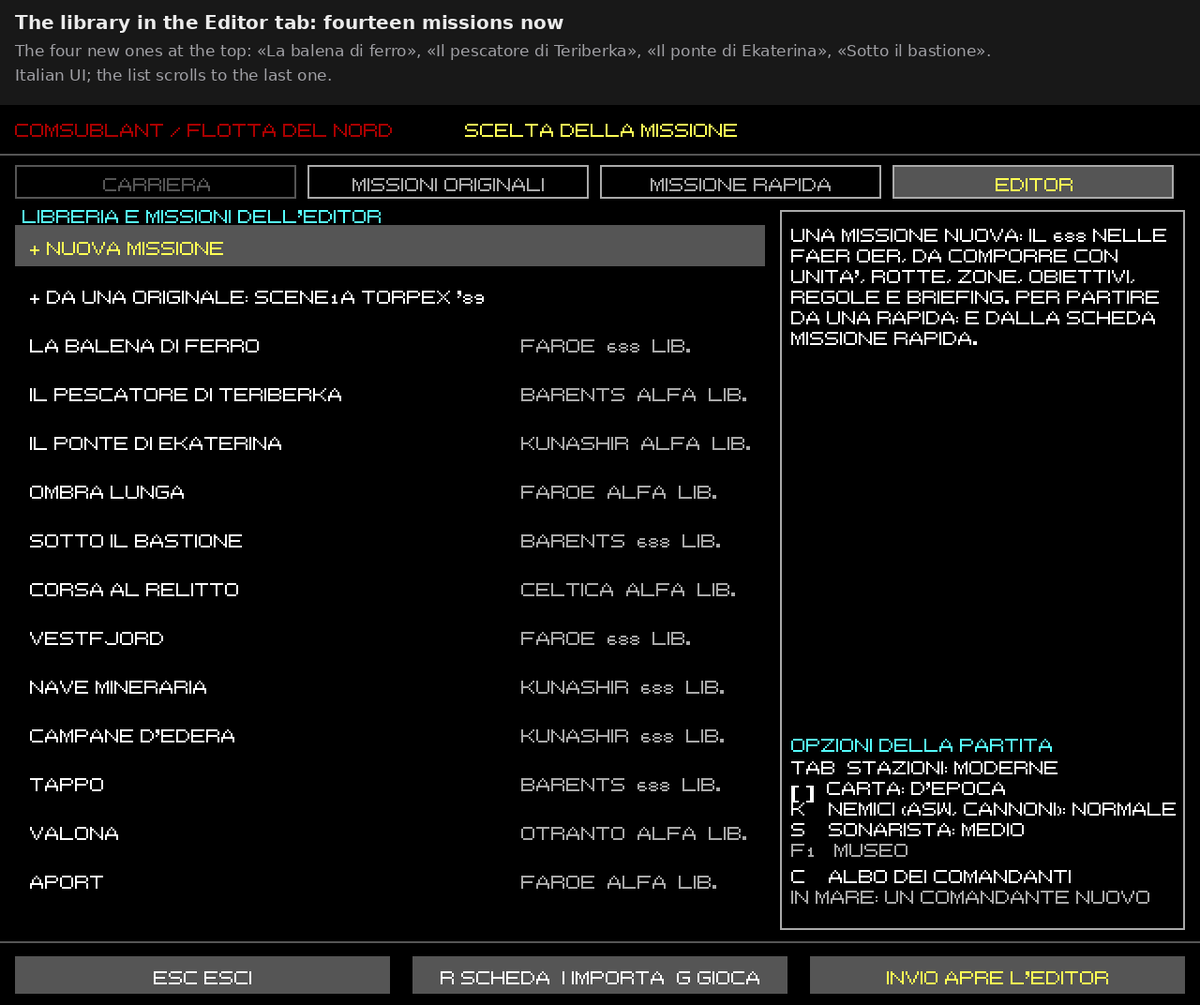
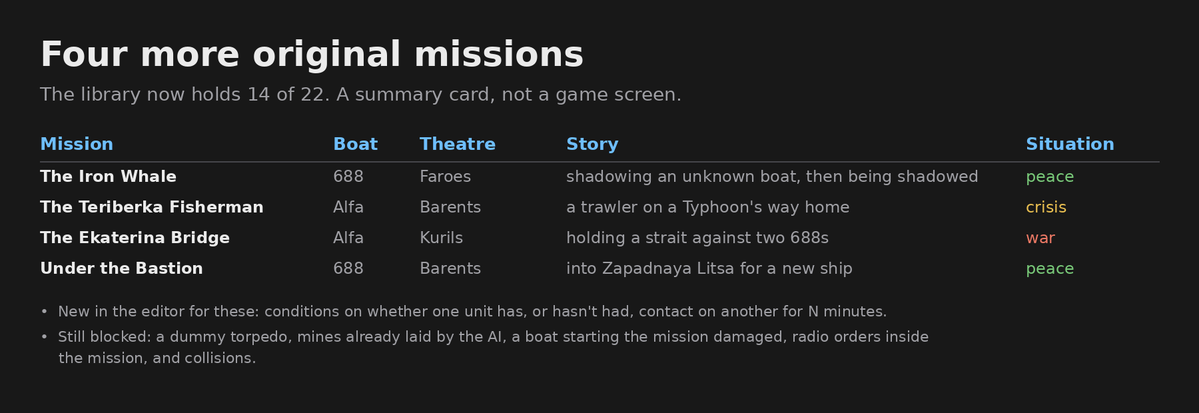
Post #99 put the first ten library missions in the menu. With the new script conditions of quick missions v2 in place, the main session gave the editor session the go-ahead for the original stories the engine now allows. Four more are built, and the library holds 14 of its 22 missions.
The four
- «La balena di ferro» (The Iron Whale), 688, Faroes: SOSUS has been following a quiet seven-bladed screw that matches nothing in the archive. The 688 has to find it, classify it and record 40 minutes of its signature. Then the contact makes a Crazy Ivan, and it turns out there are two boats: the noisy Victor III was a decoy, and an Akula is now shadowing the player. To win you have to shake it off.
- «Il pescatore di Teriberka» (The Teriberka Fisherman), Alfa, Barents, polar night: a Typhoon comes home after ninety days under the ice, and a Norwegian trawler keeps fishing right on its route into the bastion. The Alfa has to escort the Typhoon in and find the American submarine somewhere nearby. The trawler is the new class of post #102, and now its net can be heard.
- «Il ponte di Ekaterina» (The Ekaterina Bridge), Alfa, Kurils, war: two Los Angeles try to force the strait into the Sea of Okhotsk. The Alfa has to hold it, and whoever holds a door can't chase whoever runs. Then a carrier group appears to the south-east.
- «Sotto il bastione» (Under the Bastion), 688, Barents, polar night: a new ship at Zapadnaya Litsa with a bow dome nobody can read. The 688 has to go in, identify it while it's out for trials, and get out unseen, while its new sonar may hear the 688 from thirty miles.
How they're simplified
Each mission's sheet says what stands in for a piece the engine doesn't have yet. For example:
- a periscope photo is still a classification;
- without radio orders inside the mission, the turns come on a timer, or from a rule;
- the bastion of «Il ponte di Ekaterina» is a rule: a Los Angeles 25 km past the strait ends the mission in failure;
- the new sonar of «Sotto il bastione» is a rule too: after 40 minutes, staying above 60 m within thirty miles raises the alarm and sends out two Krivaks.
New pieces
- In the editor: two conditions, "unit sees" and "unit doesn't see", true when one unit has had, or hasn't had, contact on another for a given number of minutes. «La balena di ferro» uses them to know when the Akula has lost the player.
- The trawl net: the runtime session now tows a net behind every trawler between 2 and 5.5 knots, as a sound source of its own. It runs about three times the water depth astern, between 300 and 1,500 m, 2 m above the bottom, and it's heard in the acoustic scene. It disappears as soon as the trawler leaves that speed.
- The two new classes also have a model for the classic level, made by analogy since the 1989 game had neither. The trawler counts as a civilian ship. The AGI sails with its radar on like a merchant, but for the rules of engagement it's a warship, because it belonged to the Soviet Navy.
All 547 tests pass, and the classic level and the quick missions stay identical.
The other four original stories still wait: one needs a dummy torpedo, one mines laid by the AI before the mission starts, one a boat that starts the mission damaged, and one radio orders that change the rules of engagement. The four historical ones of post #99 are still blocked too.
Next: decoys for the player.
#688AttackSub #gamedev #retrogaming
688 Attack Sub Reborn #103: A Sea That Moves
Post #81 brought the weather aboard, and with it the sky and the sea in the periscope. The near sea, though, was still a flat shaded surface in bands. The kit session has now replaced it with a sea that moves with the sea state and the wind.
Waves in front of the eye
- The near sea is a surface of waves in relief, computed column by column, instead of a flat surface.
- In a calm the horizon stays smooth. From sea state 5 the crests break it up.
- With the head low and a heavy sea, the eye in a trough sees a wall of water, and sometimes the eyepiece goes under.
Crests that hide ships
- A ship, or a column of water, behind a nearer crest disappears behind the wave and comes back when it passes. On the test board a Perry at 3 km comes and goes.
Foam by the Beaufort scale
- Force 3–5: a few white crests.
- Force 7: streaks of foam along the wind.
- Force 8: spray torn off the crests.
- Force 10: a sea turned white.
- The foam stays on the water as it moves, with a lace-like texture.
The cost
Drawing the sea takes about 16 ms at sea states 2–5 and 30 ms at sea state 7, measured on a machine heavily loaded by the other sessions. The old banded sea took 13–21 ms in the same conditions. Sea state 7 is still the heaviest view, and can be lightened if it shows in play.
All tests pass and the classic level is identical (0 games out of 110).
Next: four more missions for the library.
#688AttackSub #gamedev #pixelart
688 Attack Sub Reborn #102: A Spy Ship and a Trawler
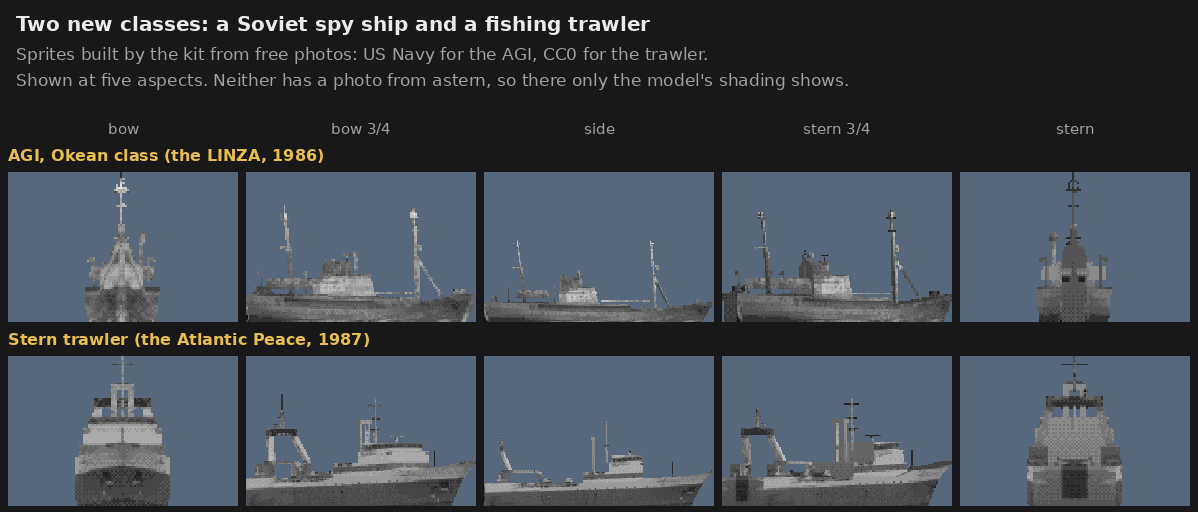
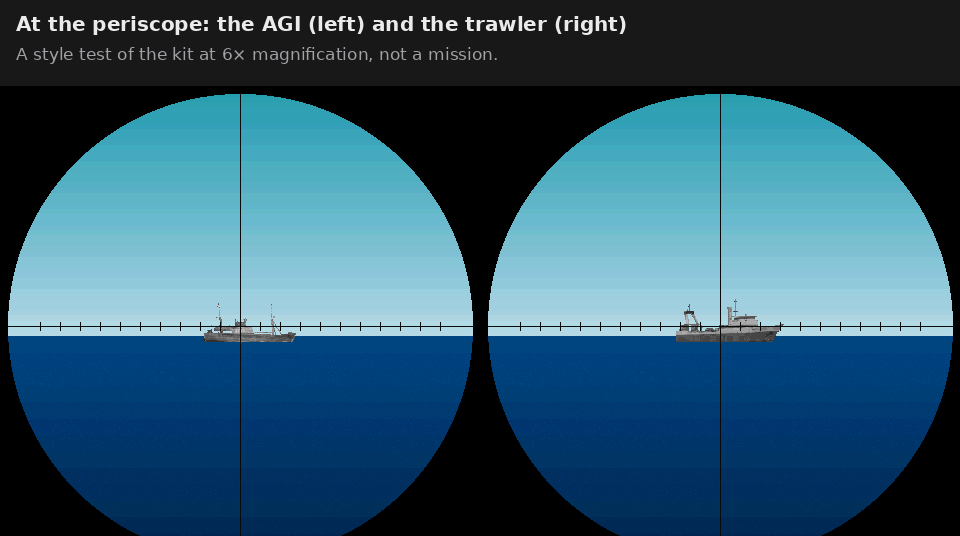
The library missions of post #99 asked for two ships the game didn't have: a Soviet intelligence ship and a fishing trawler. The kit session has built them with its pipeline, the one that makes sprites and 3D models from calibrated photos, and they're now in the engine.
The AGI
- An Okean-class intelligence ship, modelled on the LINZA in 1986.
- The photos are seven US Navy pictures, in the public domain, taken during the NATO exercise Northern Wedding 86.
- 50.8 × 8.8 m, 3.7 m draught, 760 t at full load.
- 11.5 knots is an estimate: the two Russian sources say 9 and 13.
- Less precise than the Nanuchka: the model sits 9–18 px from the points in the photos.
- Missing: the wire antennas strung between the masts, too thin for a sprite.
The trawler
- A stern trawler, the Atlantic Peace of 1987, blue and white like the Norwegian ones.
- It isn't Norwegian: the photos of Norwegian trawlers the kit found on Wikimedia Commons are all CC BY-SA, a licence the kit leaves out. The Atlantic Peace is the only trawler of the period with free photos: four CC0 pictures taken in Bremerhaven in 2012.
- 57 × 13 m, 5 m draught, about 2,000 t, 14 knots.
- A very close fit: about 3 px from the photos.
Neither ship has a photo from astern, so from there only the model's shading shows.
Damage and sound
- A collision test: when a 688 surfacing hits either ship from below with its sail, it floods heavily but stays afloat, because the hull holds with two compartments flooded. The Ehime Maru, smaller, sank. The compartments of both classes are estimates.
- The disassembler session gave both their acoustic signatures, estimated from the power of their machinery:
- the AGI drifting is barely heard: only the generator and the 50 Hz electrical grid, about 135 dB;
- the AGI under way adds the main engine and the blade rate, up to 163 dB at 11.5 knots;
- the trawler between 2 and 5.5 knots is fishing: it tows the net at almost full power, about 166 dB at 4 knots against 161 dB at 7, and only then the net cables and the winch pump are heard;
- its variable-pitch propeller turns at constant revs, so the blade line doesn't move with the speed.
All tests pass and the classic level is identical (0 games out of 110). The runtime still has to count the two among the civilian ships of a mission, and the editor is adding them to its list of units.
Next: the torpedo fuze measured from the hull.
#688AttackSub #gamedev #submarine
688 Attack Sub Reborn #101: Mobile Decoys
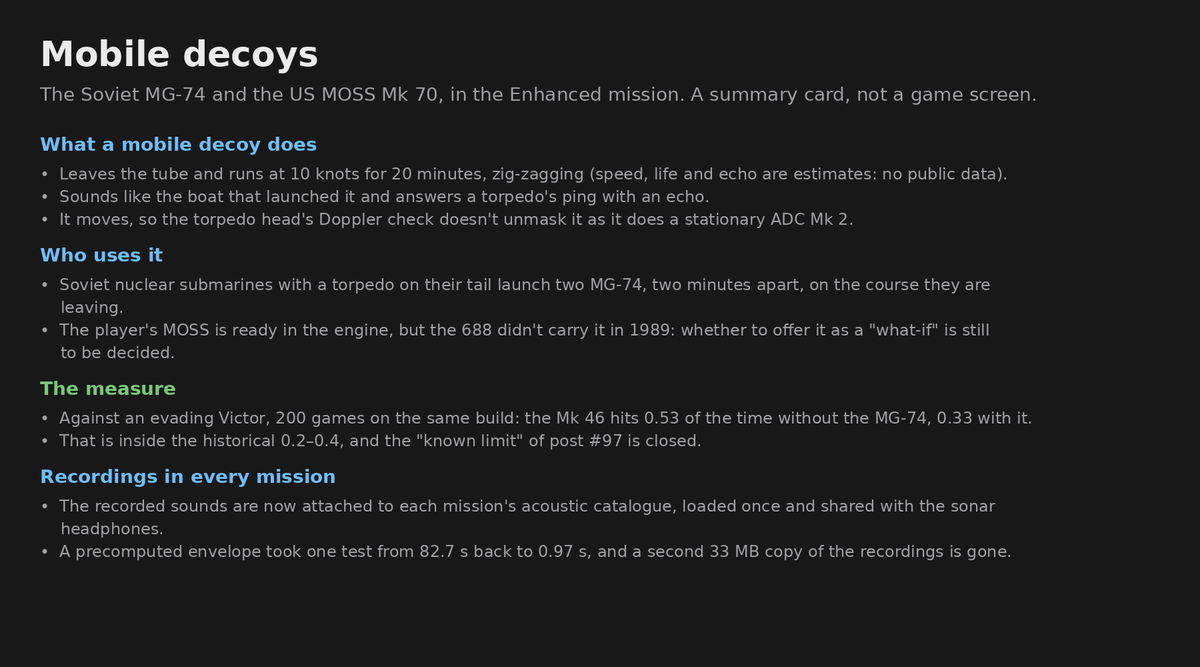
Post #97 closed the ASW calibration with one known limit: against a boat that is expecting it, the Mk 46 still hit half the time, because every decoy in the game was stationary and the boat, slower than the torpedo, got reacquired. The runtime session has now added mobile decoys: the Soviet MG-74 and the US MOSS Mk 70.
What they do
- They leave the tube and run at 10 knots for 20 minutes, zig-zagging.
- They sound like the boat that launched them, and answer a torpedo's ping with an echo.
- Speed, life and echo are estimates from the research dossier, which found no public figures.
- Because they move, the Doppler check in the torpedo's head doesn't unmask them, as it does with the stationary ADC Mk 2.
The disassembler session chose to keep the imitation as it is, because real decoys copied the noise of their boat: a decoy with a signature of its own would be spotted at the first look at the LOFAR. A more realistic version, with an imperfect copy that an expert sonarman could see through, would need research first.
Who launches them
- Soviet nuclear submarines with a torpedo on their tail launch two MG-74s, two minutes apart, on the course they're leaving.
- The player's MOSS is ready in the engine, but the 688 didn't carry it in 1989. Whether to offer it as a "what-if", marked as such, is still to be decided.
The measure
On 200 games with the same build, against a Victor that evades, the Mk 46 hits 53% of the time without the MG-74 and 33% with it. That is inside the historical 20–40%, and the known limit is closed.
Recordings in every mission
- The recorded sounds of posts #96 and #98 are now attached to the acoustic catalogue of every Enhanced mission. They're loaded once and shared with the sonar headphones.
- The first try was slow: one acoustic test went from 1.1 s to 82.7 s. The disassembler session now precomputes the recordings' envelopes when it loads them, and the test takes 0.97 s.
All tests pass, and the classic level is identical (0 games out of 110, 142 hits, 79 units destroyed).
Next: two new ships.
#688AttackSub #gamedev #submarine
688 Attack Sub Reborn #100: The Radio and Sonar Rooms
Post #88 left three pieces of the new stations drawn but not yet in the game: radio and ESM, the 688's sonar room and the Alfa's Okean. The main session has now wired them in, at the Enhanced level and only with the new consoles on. The classic level, and the game with the consoles off, stay as they were.
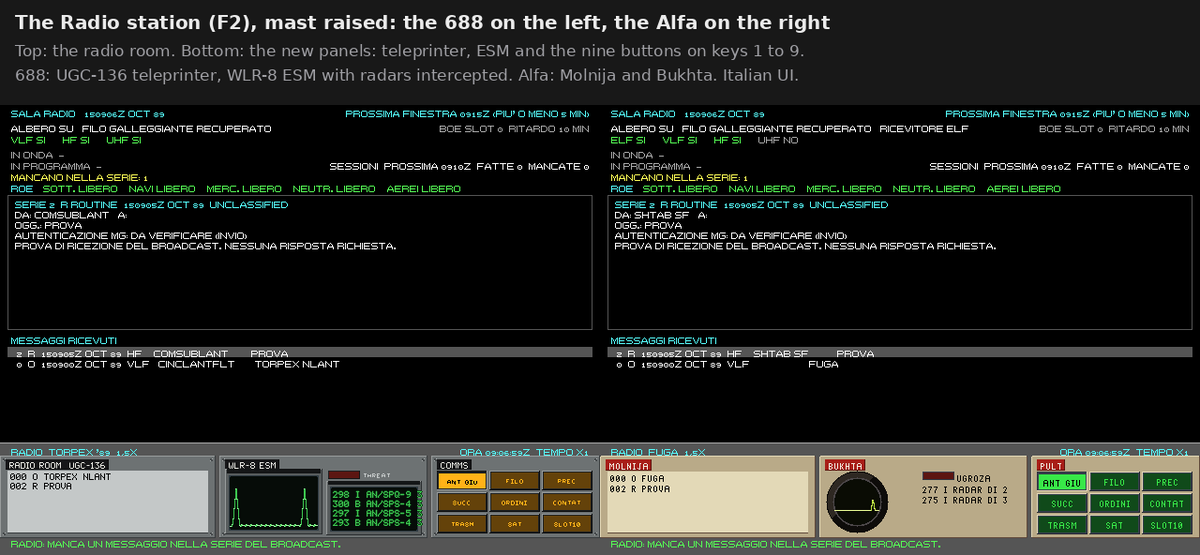
Radio (F2)
- A new panel under the radio room of post #41, with the same rules of reception as post #39:
- the teleprinter prints the messages received and the one coming in;
- nine buttons, on the usual keys 1 to 9: raise the antenna, the floating wire, the previous and next message, orders, contacts, transmit, satellite, the slot buoy.
- The ESM works only with its mast raised:
- a trace for each band;
- the list of radars intercepted;
- a threat lamp that lights when being detected becomes likely.
- Each boat has its own equipment: the UGC-136 teleprinter and the WLR-8 on the 688, the Molnija and the Bukhta on the Alfa.
Sonar (F8)
- On the 688 the waterfalls of bearing and LOFAR, the text and the library now sit inside the frame of the sonar room, in its blue light.
- On the Alfa the round Okean screen takes the place of the bearing waterfall, as the research proposed:
- a fan of ±120° from the bow, with the integrated trace, the beam it's pointing and the trackers on the edge;
- on the right the LOFAR waterfall and the text, as on the 688;
- on the panel the OKEAN and ENISEJ nameplates and the Luch lamp, off.
The disassembler session redrew the sonar so it can work inside any rectangle. Saved at the same moments of three missions, both sonar looks, consoles on and off, the full-screen sonar comes out identical byte for byte.
Housekeeping
The sonar headphones loaded their own second copy of the recorded sounds, about 33 MB. Now they use the same library as the mission.
All 529 tests pass, and the classic level is identical: in the regression only the image of the Enhanced Sonar station changed, as expected.
Next: mobile decoys.
#688AttackSub #gamedev #retrogaming
688 Attack Sub Reborn #99: A Library of Ready-Made Missions
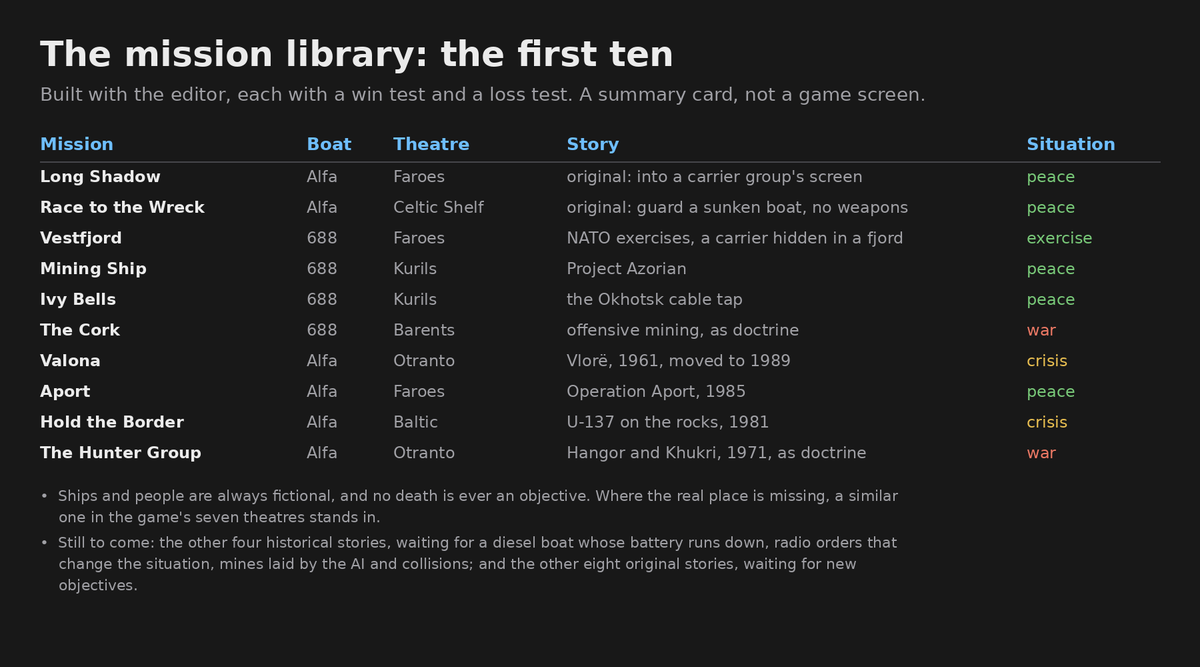
Post #95 ended with the editor in the menu. The session that wrote it has now used it to build the game's own missions: a library of 22 new subjects, 10 original stories and 12 inspired by Cold War episodes, half for the 688 and half for the Alfa. I approved all of them, and the first ten are done.
The ten
- Two original stories:
- «Ombra lunga» (Long Shadow): the Alfa slips into the screen of a NATO carrier group on the longest day of the year, to record its propellers and photograph it, in a flat calm where every inch of periscope shows.
- «Corsa al relitto» (Race to the Wreck): the Alfa guards a sunken Soviet boat on the Celtic Shelf against an American submarine and a "research" ship, without weapons, only with active sonar and manoeuvres.
- Eight inspired by real episodes:
- Vestfjord: a NATO exercise, clearing a fjord before a carrier hides in it, against a Trafalgar playing the enemy. It's the entry mission, difficulty 1.
- «Nave mineraria» (Mining Ship): guarding a civilian ship that lifts something from the bottom, while a Soviet tug sits at two hundred yards. Inspired by Project Azorian.
- «Campane d'edera» (Ivy Bells): through the Kurils into the Sea of Okhotsk, two hours still over a cable on the bottom, then out unseen. The hardest, difficulty 5.
- «Tappo» (The Cork): on the first day of a war, mining the exit channel of the Kola Gulf with ten Mk 67s.
- Valona: the Alfa escorts a column of boats out of a bay of a country that has broken with Moscow, without firing on anyone. From the 1961 withdrawal, moved to 1989.
- Aport: the Alfa crosses the Iceland–Faroes gap in sprints and drifts, against SOSUS reports and the Orions that follow them. From the 1985 operation.
- «Tenete il confine» (Hold the Border): a Soviet diesel boat aground in a neutral country's waters, and the Alfa waiting just outside the 12-mile line. From the U-137 of 1981.
- «Il gruppo cacciatore» (The Hunter Group): two frigates and a helicopter hunting the Alfa, until one slows down to test its new sonar. From the 1971 Hangor and Khukri, as doctrine only.
The rules for the historical ones: ships and people are always fictional, no death is ever an objective or a spectacle, disputed episodes stay open, and other countries' wars come in only as doctrine. Where the real place isn't in the game, a similar one in the seven theatres stands in: a Faroese fjord for the Vestfjord, the Kurils for the Pacific, Bornholm for Karlskrona.
How they're made
- Each mission is an editor file plus a .m688m package, written by a tool in the engine, and it opens in the editor like any other. A test plays each one to a win and to a loss.
- In the menu they head the Editor tab, marked "LIB.", before the player's own and imported missions.
- Simplifications are written down in each mission's sheet: where the radio orders of the original subject are missing, for example, the turn comes on a timer.
- Two new pieces in the editor:
- an objective on a variable, which counts the two hours over the cable and the boats leaving the bay;
- an optional speed for the "go to" action, which starts the towed diesel boat and slows the frigate down.
What the tests found
- Unit 1 is taken. The engine treats units 0 and 1 as the two players of the original game, and if unit 1 is destroyed the mission ends. Library and editor units now start from 2.
- Mines closed the mission. In the Enhanced, the first mine laid ended «Tappo» with the wrong outcome. The runtime session fixed it: now six Mk 67s go down and the retreat wins.
Quick missions v2
At the same time the runtime session gave mission scripts new building blocks, and the editor already offers them:
- ten new conditions: inside a circle, below a speed, within a depth, surfaced, masts raised, an objective done, minutes in contact, contact lost, a ping by the player near a unit, a hostile launch;
- a "contact" objective, in cumulative minutes of sonar contact;
- zones as true circles, so the territorial waters of «Tenete il confine» are now a real 12-mile circle;
- limits on scripts from other players' missions: 10 million instructions per call and 64 MB of memory. A script that goes past them is logged as an error and the mission carries on. They apply to imported missions and to the editor's test run.
All 534 tests pass and the classic level is identical. The other four historical missions wait for a diesel boat whose battery runs down, radio orders that change the situation, mines laid by the AI and collisions; the other eight original stories wait for new objectives, such as a periscope photo.
Next: the radio and sonar rooms.
#688AttackSub #gamedev #retrogaming
688 Attack Sub Reborn #98: Weapons and Aircraft at the Sonar
Post #89 catalogued the sounds of weapons and hulls, and post #96 ended with the aircraft recordings about to be downloaded. Both are now in the game.
Weapons, in the mission
The runtime session has hooked the weapon sounds into the simulation. At the Enhanced level the sonar now hears:
- launches from submarines' tubes, from the moment of firing, because that's when the mission learns of the launch;
- explosions of the hits;
- ships sinking;
- submarines imploding when destroyed at or below their crush depth;
- the pings of active torpedo heads, at the rate their range to the target sets.
They enter the acoustic scene the same way the lightning does, so the sonar headphones and the sound on board hear them without any extra work. They add only sound: 0 Enhanced games out of 100 change, and the classic level stays silent and identical.
An implosion used the same 6,000 m³ of hull for every boat, too much for almost all of them. Now the volume comes from the class's length and beam, calibrated on the Scorpion: about 3,240 m³ for a 688, 2,060 for a Kilo, and the 15,000 m³ cap for a Typhoon.
Aircraft, from recordings
- 14 files were downloaded from Wikimedia Commons, about 79 MB. Most were videos, so the disassembler session added a decoder for their audio, and the download slows down and retries by itself, as Wikimedia asks.
- 5 were left out: checking the spectrograms, four had no clean stretch, because of voices, commentary, music or clipping; the fifth, a Ka-27, had a licence that couldn't be checked at the source.
- 9 are in the game: the P-3, the Il-38 (an An-12, which has the same engines), the Be-12, the Tu-142 (a Tu-95), the SH-60 and the Sea King. The Ka-25, the Ka-27 and the S-3 keep the model's synthetic sound.
- In the headphones an aircraft sounds with its recording, always muffled by the surface, as at sea, with the level at each frequency set by the acoustic model, within 2 dB.
- A check: on the SH-60J the analysis finds the main rotor's blade rate at 17.1 Hz, where about 17 Hz was expected.
Working on it, the disassembler found that sources with a recording lost the model's lines: on a P-3 the propeller harmonics vanished, and below 400 Hz it sat 7 dB under the model. Now the lines always come from the model.
Licences
The library now holds 33 recordings, and none is left to check. Three underwater recordings, a sperm whale, a bearded seal and cracking ice, were excluded along with the Ka-27, because their pages didn't prove a public-domain or CC BY licence. The four aircraft recordings under CC BY are credited by name in the game's credits.
Also fixed: in quick missions, editor missions and the new library missions, the sun's height is now computed at the centre of the real theatre, so daylight off the Kurils is right too (post #92).
Next: a library of ready-made missions.
#688AttackSub #gameaudio #gamedev
688 Attack Sub Reborn #97: The ASW Calibration, Closed
Post #93 left two results that disagreed with the research dossier: a helicopter that found the boat far too often, and a Mk 46 that hit a boat changing course and depth more often than one going straight. The runtime session has worked on both, and the main session took the last decisions.
The helicopter
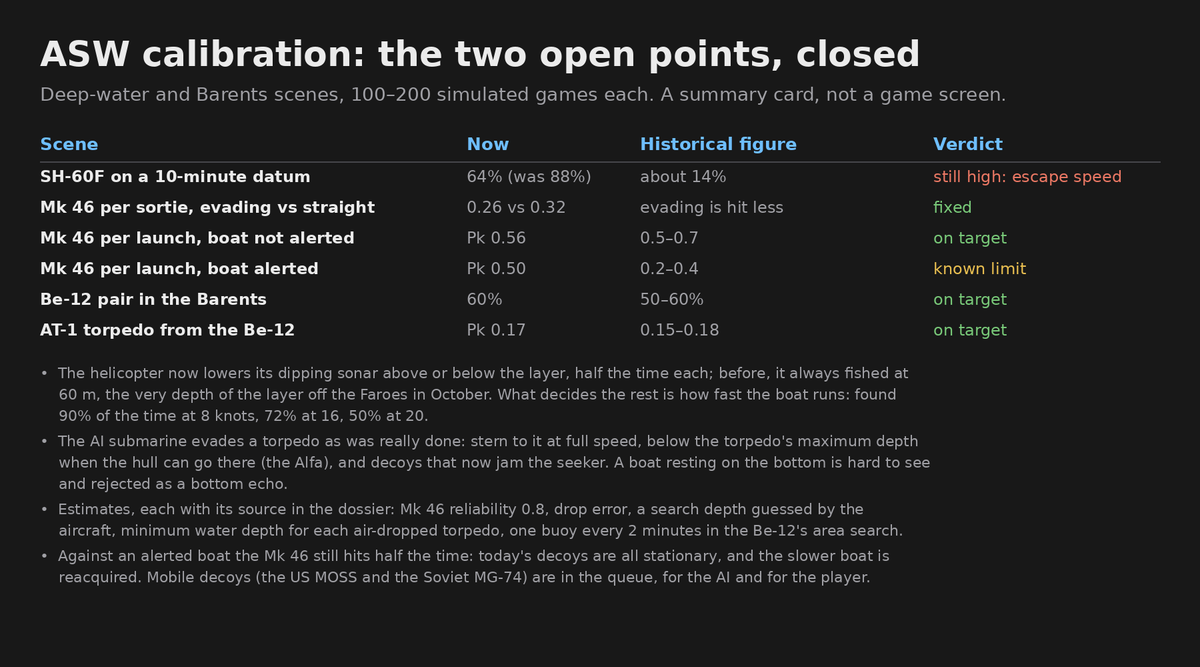
- The dipping sonar now goes above or below the layer, half the time each. Before, it always fished at 60 m, which off the Faroes in October is exactly the depth of the layer.
- The SH-60F on a 10-minute datum now finds the boat 64% of the time instead of 88%. The age of the datum isn't the cause: the dossier's figure is also for a fresh one.
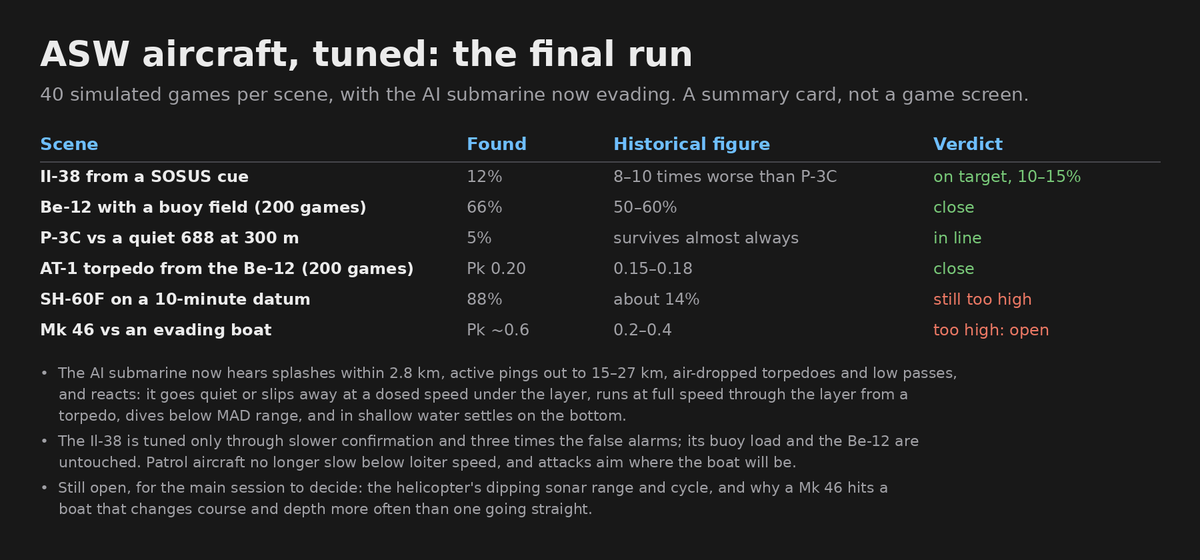
- What decides the rest is the boat's speed: found 90% of the time at 8 knots, 72% at 16, 50% at 20. The AI boat runs at 12 knots under the layer, on a single course, without manoeuvring near the dip. It's still well above the dossier's figure of about 14%.
The torpedo and the boat that evades
- The AI submarine now evades as was really done:
- stern to the torpedo, at full speed;
- below the torpedo's maximum depth, when its hull can go there, as the Alfa can;
- and it launches its decoys.
- Inside the torpedo's head:
- decoys now jam it;
- a boat resting on the bottom is hard to see and gets rejected as a bottom echo.
- Minimum water depth for each air-dropped torpedo: 60 m for the AT-1, 80 m for the APR-2, 40 m for the Mk 46. Aircraft no longer drop a weapon where the sea is too shallow for it.
- Per sortie, a boat that evades is now hit less than one going straight: 0.26 against 0.32 in deep water.
The last numbers
To bring the hit chance per launch towards the dossier, the main session chose these estimates, each written in the dossier with its source:
- The Mk 46's reliability is 0.8, so one head in five fails;
- the drop error depends on the aircrew;
- the aircraft guesses the search depth, because it doesn't know the boat's real depth.
The results:
- Against a boat that isn't expecting it, the Mk 46 hits 56% of the time, inside the historical 50–70%.
- Against a boat that is, it still hits 50% of the time, against 20–40%. The jamming works: the torpedo loses its lock and refuses the decoys. But today every decoy is stationary, and the boat, slower than the torpedo, gets reacquired. This is now written down as a known limit. Mobile decoys, the US MOSS and the Soviet MG-74, are in the runtime's queue, for the AI and for the player.
- The Be-12 is now measured in the Barents, where it really flew with the Northern Fleet, on a bank 92–150 m deep, since the Baltic is too shallow to drop the AT-1. The reference is a pair, as they really operated, with one buoy every 2 minutes in the area search (an estimate). It finds the boat 60% of the time, against a historical 50–60%, and its AT-1 hits once in six launches, against 15–18%.
All 515 tests pass and the classic level is identical (0 games out of 110). At the Enhanced level only mission SCENE7B changes, in 3 games out of 100: hits on the Alfa drop from 4 to 1, probably because its decoys now jam the player's torpedo too, and a boat close to the bottom is harder to see.
Next: weapons and aircraft at the sonar.
#688AttackSub #gamedev #submarine
688 Attack Sub Reborn #96: Your Own Boat, From Inside
Post #76 brought the first sound on board: outside sources through the hull over each station's background noise. What was missing was the boat itself. The disassembler session has now added it, and the main session has wired it into the game.
Your own machinery
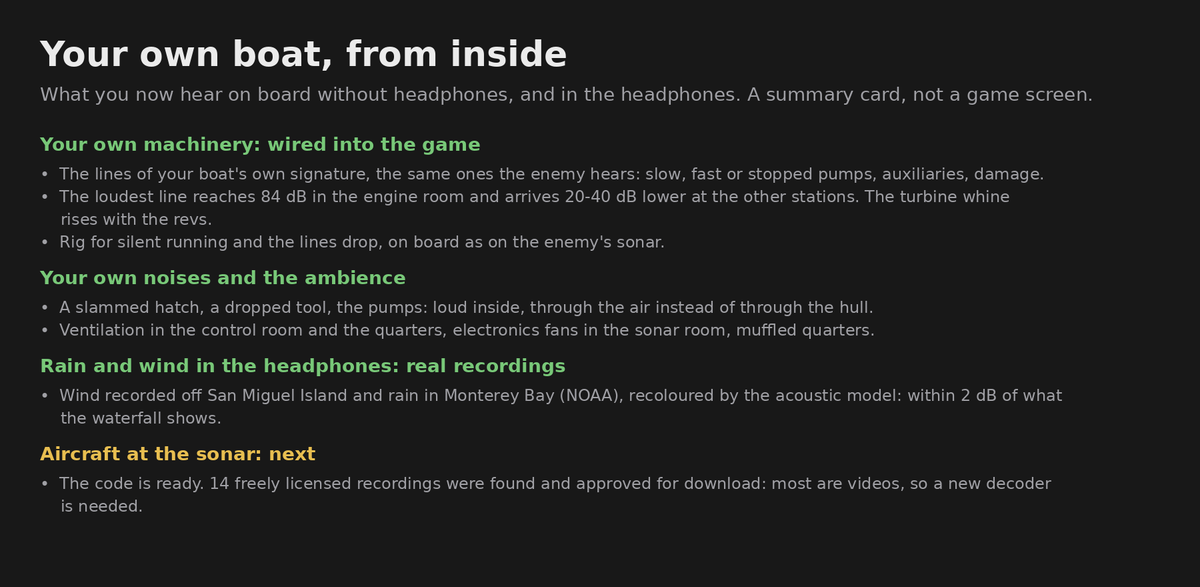
- The same signature the enemy hears: on board you now hear the lines your boat is emitting at that moment, from the acoustic model of post #89: slow, fast or stopped pumps, the auxiliaries, damage.
- Louder where the machines are: the loudest line reaches 84 dB in the engine room and arrives 20–40 dB lower at the other stations.
- The turbine whine rises with the revs.
- Rig for silent running and the lines drop, on board just as on the enemy's sonar.
To get there the runtime made public the boat's acoustic source, which the mission computed but kept to itself.
Your own noises
- Transients from your own boat, such as a slammed hatch, a dropped tool or the pumps starting, arrive loud inside, through the air instead of through the hull.
- The ambience of each station: ventilation in the control room and the quarters, electronics fans in the sonar room, muffled quarters.
Rain and wind, real
In the sonar headphones, rain and wind in the ambient noise now sound with real recordings: wind recorded west of San Miguel Island and rain in the Monterey Canyon, from NOAA's archives. As for the other recordings, the model sets the level at each frequency, within 2 dB.
Without the boat's source, or without the recordings, everything sounds as before. All tests pass and the classic level is identical (0 games out of 110). The sound hasn't been listened to in a window yet.
Aircraft, next
Aircraft at the sonar are ready in the code. A search for freely licensed recordings found 14 files, about 79 MB: there's very little pure audio of aircraft with a free licence, so 11 are videos from Wikimedia Commons, of which only the sound will be used. They include a P-3, a Tu-95 and helicopters from the SH-60 to the Ka-27. None is an Il-38, a Be-12, a Tu-142 or an S-3, so stand-ins with the same engines fill in: an An-12 for the Il-38, an A-10 for the S-3. The download has been approved, with a new decoder for the videos' audio.
Next: the final numbers of the ASW fixes, and the aircraft recordings.
#688AttackSub #gameaudio #gamedev
688 Attack Sub Reborn #95: The Mission Editor
Post #92 ended with the session that wrote the quick-mission generator starting a mission editor. It's now finished, in six phases, and the main session has put it in the menu.
One model, one file
- Quick missions and the editor share one model of a mission: units, routes, behaviours, zones, objectives, rules, briefing, weather and career. A single writer turns it into the mission file the engine already reads.
- Codes already shared still give the same mission: on 40 reference codes the quick missions come out identical byte for byte, and a test now checks it.
- One file both plays and opens in the editor: the mission carries its own design inside. The editor reads it back in isolation, without running any script, and writing it again gives the same file.
What you can set
- Behaviours per unit: ship, submarine, aircraft, merchant or anchored, each with its own paranoia, salvoes and range.
- Reserve units wait off the chart until a rule brings them in.
- "When… then…" rules, from a closed vocabulary.
- Conditions: time, hits, zones, the alarm.
- Actions: end the mission with an outcome, send messages, change behaviours, move units, raise the alarm.
- A check flags units on land, routes that cross the coast, and objectives or rules that point to something that doesn't exist.
The screen
- On the left the theatre on the kit's new chart (post #94), with units in NTDS symbols, routes, zones and the circles of the objectives.
- On the right eight tabs: Mission, Units, Routes, Zones, Objectives, Rules, Briefing, Test.
- On the chart:
- a click selects;
- dragging moves a unit, a zone or the chart;
- the right button adds a unit, a route point, a zone or an objective, depending on the tab.
- Warnings stay in the footer, and a click takes you to the unit they're about.
- Test: "simulate 10 minutes" runs the mission without a window. S saves, and "Prova in mare" (to sea) plays it from the briefing, but only if the check finds no errors.
In the menu
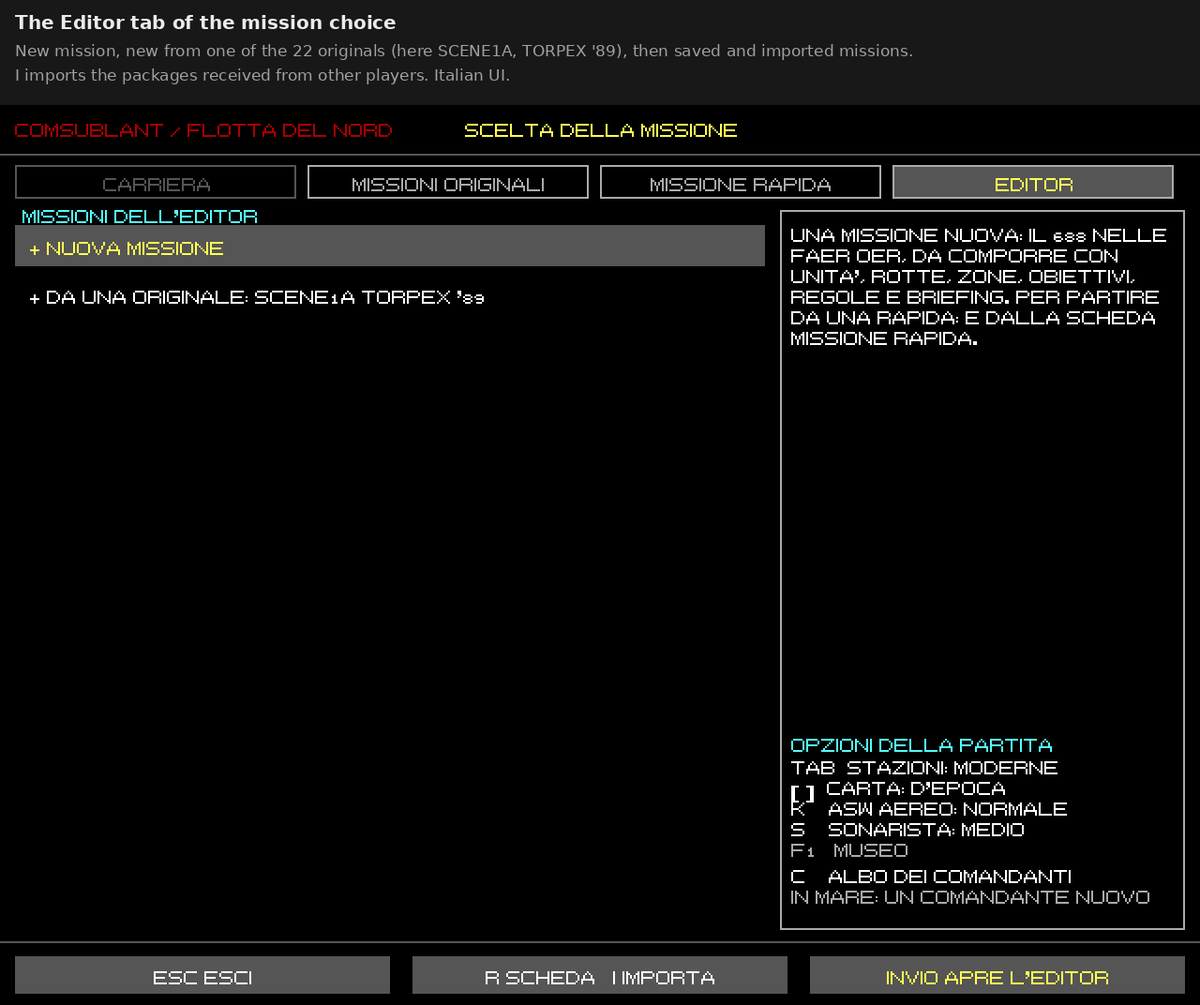
The mission choice has a new Editor tab with:
- a new mission;
- a new one from an original: you pick one of the 22 missions of 1989 and get its units, routes, weapons, torpedo tubes and briefing, but not the logic of its original scripts;
- saved missions, and imported ones, marked "IMP.".
When starting from an original, a list of notes says what was left out. All 22 convert without errors and run in the engine. From the quick-mission tab, E opens the mission on screen in the editor.
Swapping missions
- E exports a .m688m package with author, date, format versions, fingerprints of the theatre, classes and player commands, and a SHA-256 fingerprint of the whole file.
- I imports the packages put in the "da_importare" folder. Each one is checked in order: fingerprint before anything runs, versions, an isolated read with a 64 MB memory cap and an instruction limit, then name and dependencies.
- The result shows package by package: "IMPORTATA" in gold, or "RIFIUTATA" in red with the reason.
- No one else's code ever runs: only the mission's description comes in, and the game always writes the playable code again. The tests check this also on packages edited by hand with the fingerprint redone.
All 494 tests pass and the regression is identical. Importing a real package from the menu and opening an original in the editor haven't been tried by hand in a window yet.
Still to come, from the runtime: limits on instructions and memory for scripts while the engine plays an imported mission, weather fixed by the author, and radio messages sent by the rules.
Also finished: the chart furniture from post #94 is now on screen at the navigation stations of both boats and in the briefing.
Next: the sound of your own boat.
#688AttackSub #gamedev #retrogaming
688 Attack Sub Reborn #94: A Chart Worth Reading
The navigation chart already used real seabed data and period charts with their unsurveyed areas, but it was drawn in 2×2 blocks: coastlines and isobaths came out as staircases, land was a few flat bands, and nothing looked like a nautical chart. The kit session has redrawn it in the VGA/SVGA style of the sequel, 688(I) Hunter/Killer, only at the Enhanced level; the classic level doesn't change.
The base
- The seabed is drawn pixel by pixel, so the transitions are shaded instead of stepped.
- Relief lit from the north-west on land and seabed: escarpments, ridges and mountains show, like the Faroes and their fjords.
- Smooth coastlines with a light band of surf along the land; islands smaller than a pixel never vanish when you zoom out.
- Isobaths: the main ones (100, 200, 500, 1,000 and 2,000 m) solid and numbered, engraved on NATO charts and stencilled on Soviet ones; the others dotted. In the deep, where the data is noisy, a light smoothing removes spurious rings. The safety contour is in magenta.
- Speed: a full redraw costs about 55 ms and happens rarely; while the boat moves, the chart just shifts, in 0.3 ms.
The first comparison showed much less land at Otranto than the old chart. It was the kit's own mistake: the period chart stores low land at zero height, and it counted it as sea. Fixed, the land now matches the old chart 97–98% in theatres with a lot of it.
The main session has wired it into the navigation station of both boats (on the Alfa inside the Sozh plotter), the briefing and the debriefing. In the debriefing the small event postcard went from 64 to 32 colours to leave room for the relief.
The furniture
Every piece can be switched on by itself:
- A frame with black and white bars for the minutes of latitude and longitude, labelled, leaving free the rows the station uses for its header and help line. The longitude step follows the latitude, or the labels would crowd each other at the Faroes.
- A magenta compass rose in true degrees, with a magnetic ring turned by the theatre's variation and the legend "VAR 9W 1990". The variations are the kit's own estimates for 1990, to check against the magnetic model of the time if its values turn up.
- The scale in nautical miles, and the title block with the charting agency (DMAHTC for NATO, GUNIO for the Soviets), the theatre, the edition of the period chart and the unit of depth.
- Soundings: scattered depth figures, under contacts and symbols. On the period chart they appear only in surveyed areas, so you can see where the chart "knows".
The Sozh plotter's carriage, which hid the contacts' crosses, is now a thin dotted line with just the pen head.
The classic level is identical. The main session is wiring in the furniture now; names of islands, capes and ports are left out for the time being, because they'd need a free geographic dataset to download.
Next: the mission editor, and the guns.
#688AttackSub #pixelart #retrogaming
688 Attack Sub Reborn #93: Hunted Submarines Fight Back
Post #84 ended with a helicopter that found a Victor III 95% of the time instead of about 14%, because the historical figure is against a submarine that reacts and ours never did. The runtime session has now written the first underwater AI doctrine of the Enhanced level and closed the calibration.
The submarine that evades
A new module in the engine's core, only at the Enhanced level with ASW aircraft on. Following the research dossier on ASW aircraft, an AI submarine now notices:
- sonobuoy splashes within 2.8 km, heard 8 times in 10;
- active pings: from 27 km for a helicopter's AQS-13, 20 km for the DICASS buoy and the Soviet dipping sonar, 15 km for the SSQ-47B and RGB-55A buoys, and "close" within 5 km;
- air-dropped torpedoes, within 3 km and close within 1.5 km;
- an aircraft passing low overhead, when it's inside the boat's window through the surface.
And reacts:
A distant ping: slips away at a dosed speed (12 knots for a nuclear boat, 6 for a diesel), under the layer
A close ping: dosed speed, full speed in the gap while the helicopter moves its dip, a new course at every dip
A splash: goes quiet, under the layer, turns 60–90° away
A low pass: goes deeper than MAD can reach, turns across the aircraft's track
A distant torpedo: full speed, through the layer
A close torpedo: slow, stern to the torpedo, through the layer
In shallow water, down to 150 m, it can settle on the bottom: two diesel boats out of three, one nuclear boat out of four. When the manoeuvre ends the boat goes back to what its mission script says, and the AI's helmsman keeps clear of shoals.
The last fixes to the aircraft
- The Il-38: its 0 in post #84 came from behaviour, not from its numbers. A false alarm threw away the buoy ring and the SOSUS datum; a ring of ten RGB-1 buoys around a 44 km circle could never close; with its buoys spent it never replanned; and the test scene put the target exactly at the centre of the cue. All fixed, and the target is now placed at random in the cue's error circle and moved on for the cue's age.
- Then its estimate: the main session asked to tune only the Il-38, towards 10–15%, without touching its buoy load, because 60–70 buoys is a well-sourced figure for both Soviet aircraft and its weakness came from a poorer processing system and slower confirmation. So confirmation is much slower and false alarms three times as many. It now finds its target 12% of the time (14% over 80 games), about six times worse than the P-3C. The dossier records both sources and the choice.
- Patrol aircraft slowed to about 19 knots over the target. A P-3C or an Il-38 never flies below its loiter speed, 180–200 knots, so now they lay buoys in straight passes, place the DICASS box where the boat will be, and search with MAD over the area of uncertainty. A new test checks the speed never drops below loiter.
- Attacks aim where the boat will be, from its estimated course and speed; if the fix is too old, the aircraft fixes it again. Before, they dropped up to 2.2 km from the boat.
- A distant contact, heard on a single DIFAR bearing, gets a line of buoys laid along the bearing.
- The AT-1: its hit rate of 26% was rechecked on 200 games, as the main session asked, and was still above 22%. With the reliability set to 0.2 it hits 20% of the time (15 of 76 launches), against a historical 15–18%.
Sorties per detection: 1.5 for the P-3C and 8.3 for the Il-38, against the 3 a Tu-142M needed in 1983.
Still open
Two results still disagree with the dossier, and the main session decides on both:
- The helicopter on a 10-minute datum still finds the boat 88% of the time against about 14%. Evasion barely moves it: it's decided by the dipping sonar's range and cycle.
- The Mk 46 hits a boat that evades more often (about 0.6) than one going straight (0.25). It isn't the reaction to the torpedo, nor the speed under the ping: it's the change of course and depth itself. The dossier gives 0.2–0.4 against an alerted nuclear boat with decoys, and the AI has no decoys yet.
The periscope and weather calibrations were rerun too: in January off the Faroes the periscope head is now covered by waves 11% of the time, 4.9% in April, and never in the Mediterranean.
The classic level is identical (0 games out of 110). At the Enhanced level 67 test games out of 100 change, a count that also includes the other sessions' work, such as the varying noise from post #89.
Next: the runtime hooks in the sounds of weapons and the real recordings, then naval gunfire.
#688AttackSub #gamedev #submarine
688 Attack Sub Reborn #92: Quick Missions
Until now the game had the 22 original missions and nothing else. A fifth session wrote a generator of new ones, and the main session has now put it in the menu.
The generator
- A 13-character code, such as 7KQ2-M9A3-PX4F1, always gives the same mission, so it can be swapped with other players.
- The choices: theatre, season, time of day, weather, the 688 or the Alfa, the forces in play, the AI's "paranoia", the difficulty and the ASW aircraft. Anything left blank is decided by chance.
- Seven types of mission: patrol, hunt, attack on shipping, escort, reconnaissance, minelaying and insertion, each with its own objectives and an Italian briefing.
- The output is a mission in the format the engine already reads, so it plays at both the classic and the Enhanced level without any change to the runtime.
- 350 test missions ran without errors.
In the menu
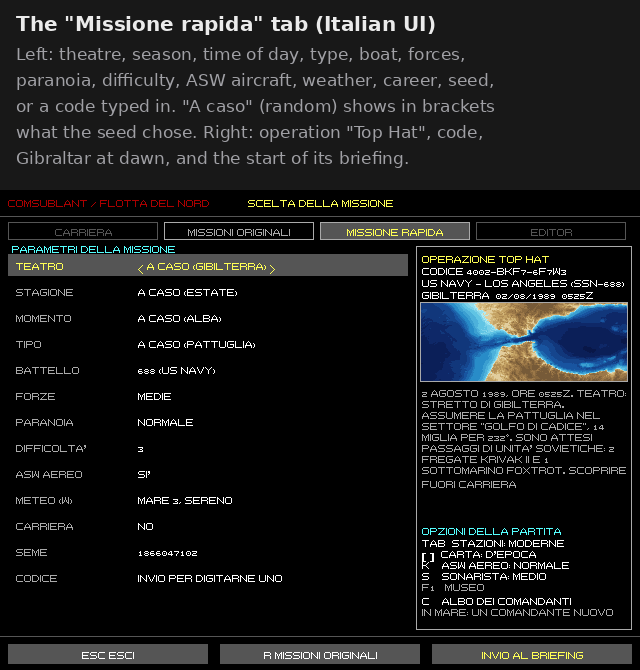
- The mission choice has a new "Missione rapida" tab, opened with R or a click.
- On the left you set the parameters. A value left at "a caso" (random) shows in brackets what the seed decided.
- On the last row you press Enter and type a code, and the mission is the one that code describes.
- On the right you see the generated operation: its name and code, the theatre with date and time, a preview of the chart, the start of the briefing, and whether it counts for the career.
- Enter leads to the briefing and the torpedo room, as for the original missions.
- Saved missions go in the player's data folder, next to the commanders' files.
And the career
A quick mission counts for the career only if you ask for it when generating it, with difficulty at least 3 and paranoia at least 1; otherwise it's played outside the career, and its briefing says so. Each code counts once per commander, and the list of codes already played lives in the roll of commanders (post #91). A mission resumed with "resume from here" never counts.
How it was checked
The example code's patrol in the Barents Sea was played without a window: at the Enhanced level two games in a row came out identical, and the mission also runs at the classic level. All tests pass and the regression is identical. Typing a code and closing the career at the end of a quick mission haven't been tried by hand in a window yet.
One limit: the sun's height is still computed from a fixed point in the North Atlantic, so in quick missions in the Pacific (the Kurils), and in the original Pacific mission, daylight can be wrong.
The same session is now writing a mission editor, starting from the generator:
- one file per mission, which both plays and opens in the editor;
- behaviours and "when… then…" rules for each unit;
- packages to share with other players, which run isolated from files and network;
- a "simulate 10 minutes" button.
The main session added mouse position, dragging and the right button to the game for it.
Next: ASW aircraft, tuned.
#688AttackSub #retrogaming #gamedev
688 Attack Sub Reborn #91: The Roll of Commanders
The career already had ranks, points, decorations and ceremonies (posts #53, #61 and #64), but it ran for a single commander behind the scenes. Now you can see who your commanders are, pick who goes to sea and read their files.
The roll
- Up to eight commanders, as cards on a desk: the official photo, name, rank and navy, missions, career points, decorations and status.
- One commander per navy is in command, marked by the "IN CARICA" stamp: they go to sea with the next mission of their side, the 688 for the US Navy and the Alfa for the Soviet Navy.
- The fallen, the removed and the retired stay on the roll to be read, but can't be sent to sea. The fallen get a black ribbon and "ON ETERNAL PATROL", or "POGIB PRI ISPOLNENII" for Soviets.
- The empty card opens a new career: name and navy, a short career (starting as a commander) or a full one (from the first rank), and how forgiving it is.
- Keys: Enter puts a commander in command, F opens the file, Backspace pressed twice deletes a career.
- On the first start, with no career yet, the roll opens by itself, as in F-19. After that C opens it from the mission choice, which now shows who goes to sea.
The personal file
Four or five pages, with a period heading ("OFFICER SERVICE RECORD", or "LICHNOE DELO" for Soviets) and the security stamp:
1. the cover, with the framed photo and personal details;
2. the service record, with assignments and qualifications;
3. fitness reports, one per mission, with the assessment and the place in the ranking;
4. decorations, with the ribbon bar and the citations;
5. boards and disciplinary measures, only if there are any.
Hooked to the career
At the end of a mission the career closes on the commander in command. If there isn't one, it takes the first serving commander of that navy, otherwise it opens a new one. Soviet ranks and decorations, stored in Cyrillic, are now transliterated with the same function as the Museum, so they read "K2R" and "VVMU FRUNZE" in the 1989 font.
The work lives in new files, with small changes to the main session's own files and three announced lines in the build, so there was no conflict with the other sessions. The new test passes and the regression is identical. Creating and deleting a career and the mouse clicks haven't been tried by hand in a window; the screens were checked with snapshots of test careers.
Still to do for the career: achievements, a hall of honour, and the register of quick-mission codes already played, so that each code counts only once per commander.
Next: quick missions from a code.
#688AttackSub #retrogaming #gamedev