@get_common #Airdrop F.A.Q #faq
-There is an airdrop for staker? Did I get something?
Anyone can check this independently. Just look at the wallet address in Tokenexplorer and see if there are "Common Staking Drops" on the wallet.
https://t.co/cVgq84L8DK
-Do I have to do anything to get the airdrop?
Just keep staking at the moment. The airdrop does not have to be claimed.
-I have changed my wallet with which I stake, what do I have to do?
In order for the OG-drop to be calculated correctly, fill in your old and new wallet address here in the form with which you are staking. This will then be taken into one by the team.
https://t.co/XK21CZz0ZH
The form must be filled by July 2.
-What is an OG drop?
The OG drop takes into account all stakers who have staked after the staking start and up to the common launch. If you are not staking from day 1 but later, you will also receive this drop - just a little less than the person who staked from day 1. The average of day 1 is used here. So if you haven't staked for a while or joined later, this time is simply counted as 0 and your average drops.
-Are there more drops?
Yes, there are. The intro drop has already been completed and everyone who has staked should find it on the wallet. There are also various ways to collect Common Staking Drops.
👉 Season 1 - starts on May 21st, 2024 (1 drop per AZERO)
👉 Season 2 - starts on July 2nd, 2024 (1 drop per AZERO)
👉 Season 3 - starts on August 13th, 2024 (1 drop per AZERO)
👉 Season 4 - starts on July 2nd, 2024 (3 drops per AZERO)
Season 4 ends on November 5, 2024, until then you can collect more Common Staking Drops through AZERO Staking.
Seasons 1-3 end with the start of the next season.
- I have always used the * wallet, is that ok?
As long as you stake with a self-managed wallet, i.e. you own your private key and stake, you are entitled to do so. It doesn't matter which wallet you use.
Whether it's @subwalletapp , @NovaWalletApp , @Ledger or the web wallet https://t.co/oZQfw98ssu.
The only exception is if you staked your #AZERO via an exchange, e.g. on Bitpanda.
- What are common staking drops? I thought that was a CMN airdrop?
The common airdrop is not a #CMN airdrop in the classic sense. Stakers and co get "Common Staking Drops" - these can be swap to CMN after Common TGE.
- Why is this so complicated?
The team has set a fixed % in Common's #tokenomics for #airdrops and #rewards. Since the AZERO in staking may well change over time and it is not yet possible to say exactly how many common staking drops will be distributed, the ratio between common staking drops and CMN has not yet been determined.
The goal here is clearly that old and new investors and stakers can benefit from the airdrop - keyword: community-friendly.
- What can I do with the staking drops now?
Nothing at the moment. Collect them and swap them for CMN after #TGE.
-That's it?
Of course not! There is still a "mysterious Lucky Drop" - details are not yet known.
⚙️ Staking with community validators helps secure the Aleph Zero network—and gets you more AZERO rewards. Here’s why!
Nodes run by the community have been enabled in December 2022, yet some users still nominate the AZF validators.
Here's why you might reconsider nominating one of the community validators:
👉 You get a higher commission when staking with community validators;
👉 You help decentralize the network when staking with community validators;
👉 There is no automatic slashing, so you don’t risk losing your coins when staking with community validators; staking with the Foundation or the community is equally secure;
👉 All nodes, including the Foundation, are subject to Automatic Suspension Mechanism (ASM) — if a validator underperforms, it will be briefly suspended, but not slashed;
👉 When nominating a validator, you don’t send your coins anywhere; they remain in your wallet/account.
📖 Read more about the details of staking with community validators in the latest blog article: https://t.co/FoX5srG8wQ
⚙️ Staking with community validators helps secure the Aleph Zero network—and gets you more AZERO rewards. Here’s why!
Nodes run by the community have been enabled in December 2022, yet some users still nominate the AZF validators.
Here's why you might reconsider nominating one of the community validators:
👉 You get a higher commission when staking with community validators;
👉 You help decentralize the network when staking with community validators;
👉 There is no automatic slashing, so you don’t risk losing your coins when staking with community validators; staking with the Foundation or the community is equally secure;
👉 All nodes, including the Foundation, are subject to Automatic Suspension Mechanism (ASM) — if a validator underperforms, it will be briefly suspended, but not slashed;
👉 When nominating a validator, you don’t send your coins anywhere; they remain in your wallet/account.
📖 Read more about the details of staking with community validators in the latest blog article: https://t.co/FoX5srG8wQ
Love this initiative. I would start with the core group of validators from Day 1 of Community validators , rewarding their loyalty and belief in #AZERO
⭐️ We’re excited to share that we’re making great strides with the Foundation Nomination Program!
The initiative will have the Aleph Zero community validators receive nominations from the Foundation stake, further decentralizing the network.
We’re considering several key factors:
📉 A minimal commission fee - to ensure affordability and accessibility;
🏆 Consistent and reasonable performance - for reliability and trust;
🆔 An established on-chain identity - to maintain transparency and security.
Community validators meeting the above criteria will be eligible for nomination from the Foundation, although the exact assumptions and details of the program are now being worked upon to ensure sustainable operations.
💬 Do you have any other ideas on how should the Foundation Nomination program be crafted?
Let us know, and stay tuned for more updates as we progress! 🫡
⭐️ We’re excited to share that we’re making great strides with the Foundation Nomination Program!
The initiative will have the Aleph Zero community validators receive nominations from the Foundation stake, further decentralizing the network.
We’re considering several key factors:
📉 A minimal commission fee - to ensure affordability and accessibility;
🏆 Consistent and reasonable performance - for reliability and trust;
🆔 An established on-chain identity - to maintain transparency and security.
Community validators meeting the above criteria will be eligible for nomination from the Foundation, although the exact assumptions and details of the program are now being worked upon to ensure sustainable operations.
💬 Do you have any other ideas on how should the Foundation Nomination program be crafted?
Let us know, and stay tuned for more updates as we progress! 🫡
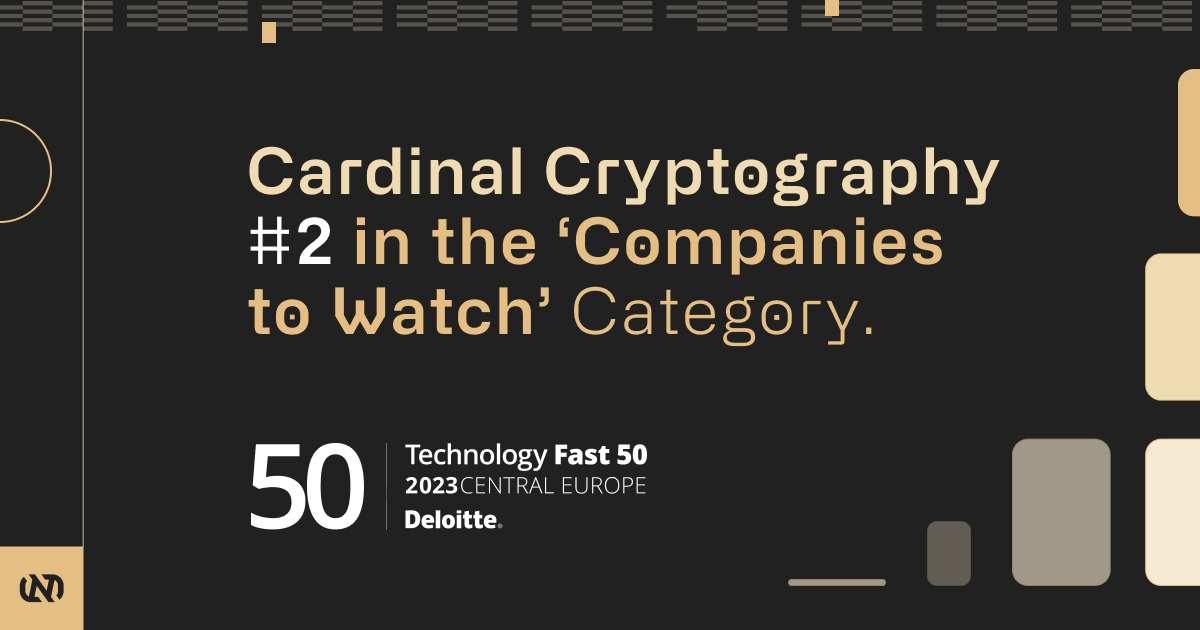
🌟 Cardinal Cryptography has been ranked 2nd in @Deloitte Fast 50 CE "Companies to Watch"! We were recognized for fast growth of the ecosystem, @Aleph__Zero's partnership with Deutsche Telekom (@mms_blockchain), and tens of use cases building on the network.
We’re excited for the future: new products, more custom implementations of the Aleph Zero technology, and more reach!
👇
https://t.co/lrmI44AxbN
🚨 Testnet 12.0 is out, coming with major improvements!
Today, we released Aleph Node 12.0 on the Testnet. It brings changes to the contracts pallet and the internal block sync request mechanism, but most importantly, it simplifies the staking process.
Let's dive in.👇
Stake your #AZERO with us and help secure the Aleph Zero network. We are committed to providing our nominators with a high uptime and the lowest commission rate.
The list of EFP projects keeps growing, but so is Aleph Zero’s code!
We released the Signer and a Mainnet hotfix to resolve the transaction issues with Ledger.
More and more things come to light! Mainnet 11.3 is out, Aleph Zero Signer awaits being accepted by the web stores, and several new projects with the EFP support have been announced! Stay tuned for more!