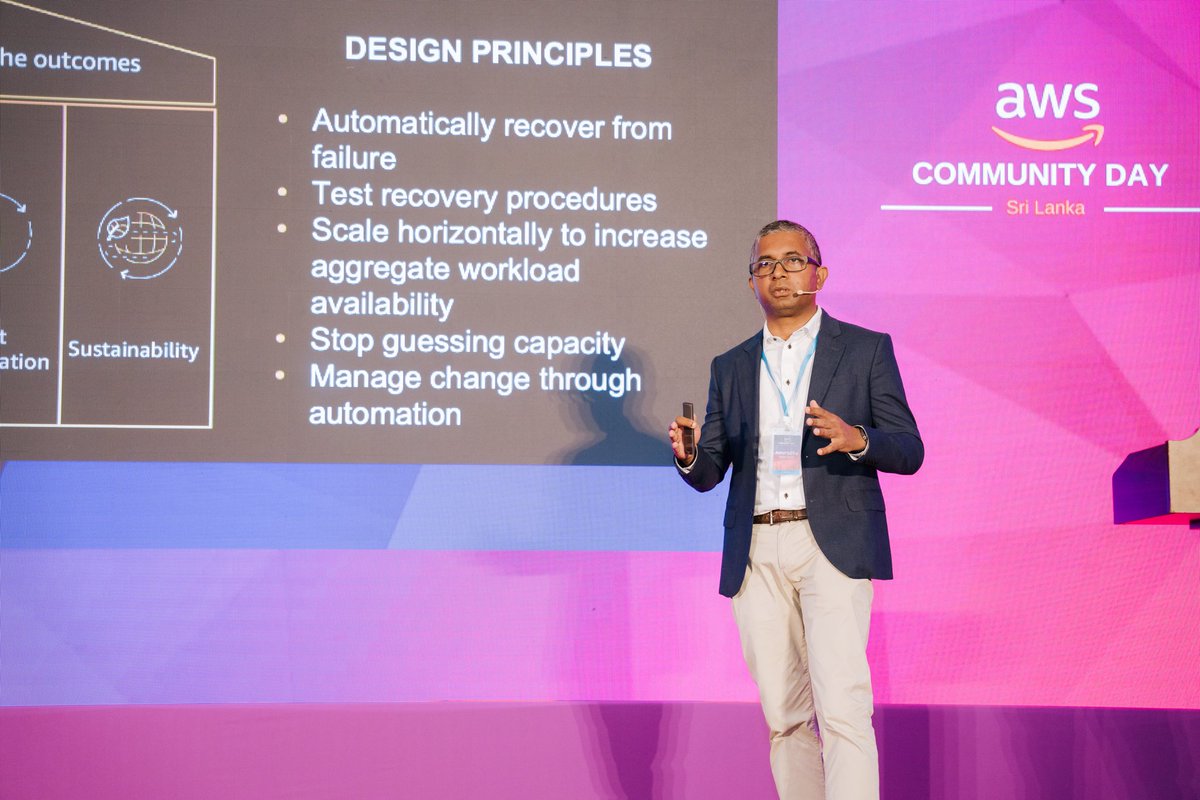
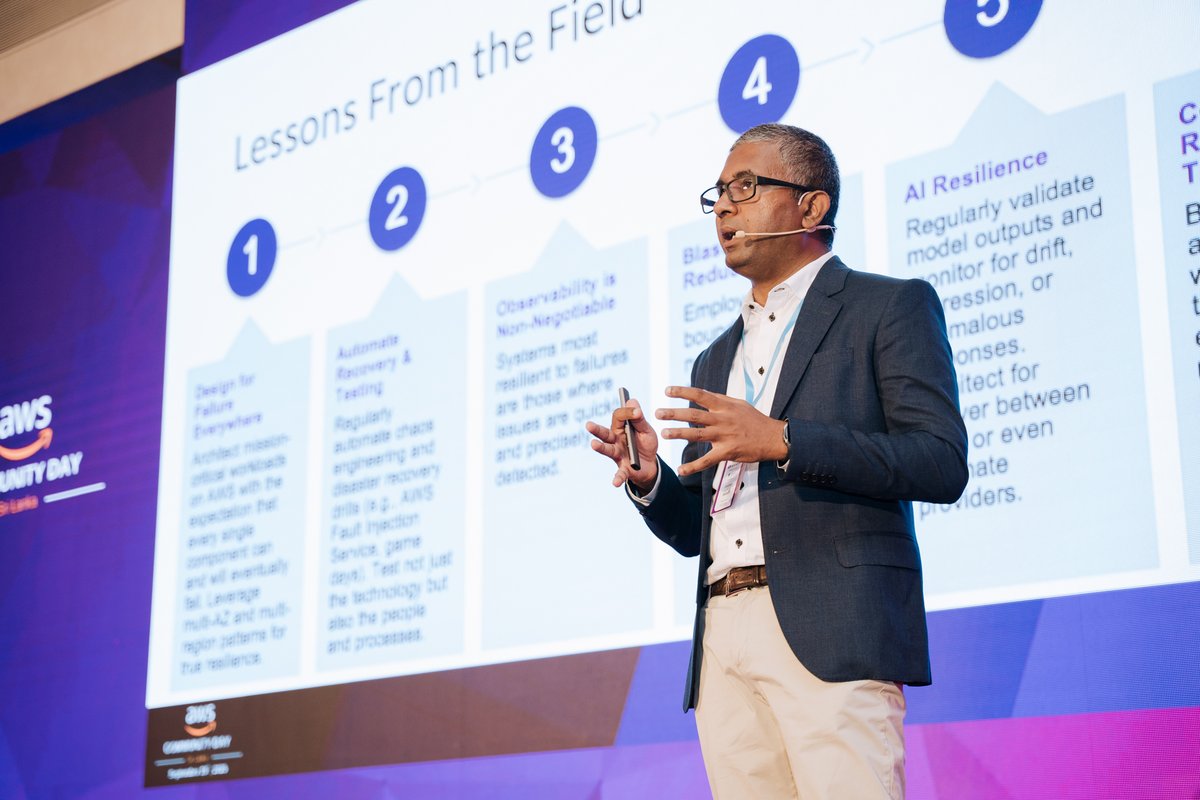
The tech industry glorifies success stories, but our failures are the best teachers.
That's why we design for failure, not despite it. The best systems aren't the ones that never fail. They're the ones that fail so gracefully, users never notice.
Shared some battle scars at AWS Community Day in Sri Lanka, because every elegant system is built on a graveyard of lessons learned the hard way.
👉 Design for failure. Architect for resilience.
What's your war story?
#AWS #Architecture #Verdentra
Plan 9 may not have "made it" as an operating system, but many of the ideas it pioneered have made it to modern popular operating systems.
https://t.co/iJame7bZUD
The NYT ran a piece on 'jagged intelligence' last week (link below) which references the example from the post below. The implications are serious for anyone building reliable systems on top of modern LLM-based AI.
NYT (paywalled): https://t.co/9mBdnciXYP
LLMs live on a “jagged” intelligence curve: they can crush Olympiad-level math and still fail at reasoning tasks a bright 10-year-old would breeze through.
https://t.co/zEVTYLhN2b
LLMs live on a “jagged” intelligence curve: they can crush Olympiad-level math and still fail at reasoning tasks a bright 10-year-old would breeze through.
https://t.co/zEVTYLhN2b
Everyone can build a prototype now. Describe it, and it appears. That's real, and it's genuinely exciting.
What comes after, is where things usually go wrong.
Learn the fundamentals. Then learn the new tools. Engineer systems. In that order.
https://t.co/QQDqOswF4p
We built an open-source app that uses AI agents to find and fix security vulnerabilities in your repos!
This helps with:
1. Actually fixing the vulnerabilities (we're already using it ourselves)
2. An example of how to run agents in cloud sandboxes for large-scale refactors
Long-term maintainability isn't a property of the model that writes your code. It's a property of the discipline with which you manage what gets written.
https://t.co/2Xj3McDUNj
AI agents have been navigating the web blindfolded, by taking screenshots, DOM parsing, hoping buttons haven't moved.
WebMCP changes this. Your website now tells agents exactly what it can do, and its on the way to being a standard.
https://t.co/tNwbcSzCRU
Anthropic spent $20,000 in API credits to build a C compiler. OpenHands did it the same week for $200.
As code generation becomes cheap and easy, the problem is no longer how fast you can ship code. It's how you verify that the right solution is being built.
A few weeks ago, Anthropic created a functional C compiler with $20,000 credits and Opus 4.6.
Coincidentally, that same week, we built a C compiler using a Ralph Wiggum loop and $200 for one of our demos.
We can build software really fast now, but...
For decades, specs served code. That relationship is now being inverted.
I wrote about what this means for the SDLC, for project management, and for how we think about technical leadership going forward.
https://t.co/bUVWpzErXn
As @aaronportnoy and our friends at @mindgard have demonstrated with a string of compromises across all the major coding agents, this is a wake-up call to frontier labs shipping advanced coding agents to consider safety as they rush to ship faster and faster.
Anjuka Sivasakthivel explores prompt injection, one of the most critical LLM security threat engineers must understand, and practical defense strategies that actually work in real-world systems 🤖
Read More: https://t.co/lkgkDhHHeX
#Verdentra#LLMSecurity#EngineeringMindset
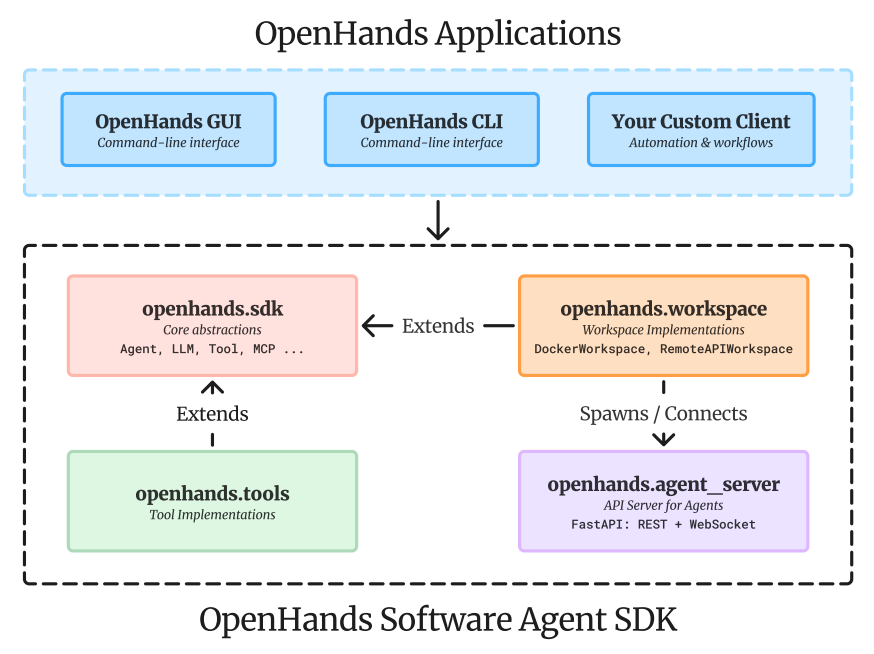
.@OpenHandsDev has impressively re-engineered the architecture for scale and simplicity.
The result: a modular SDK that scales from your local machine to distributed production-grade deployments, hitting 72.8% on SWE-Bench Verified along the way.
https://t.co/UekW4nKqD1
Demis Hassabis has been chasing one idea since he was a kid playing chess: solve intelligence, then use it to solve everything else.
Here's the story of how DeepMind solved protein folding, a 50-year-old grand challenge in biology.
https://t.co/EQneHsrVxP @demishassabis
When your business runs on public AI infrastructure, you’re building on moving sand.
The next provider model update could mean broken workflows, compliance headaches, and systems that no longer work.
Is your AI architecture resilient, or just hoping for the best? Future-proof your systems before the next AI “upgrade” becomes an outage.
Read my full analysis on @ForbesTechCncl.
https://t.co/8mF8Qv7Oe5
#AI
"Ayu", Chathra Weeraman's second cinematic creation is now showing at theaters in Sri Lanka, starting today.
Beyond proud as a brother, and awestruck, as a fan.
#AyuTheMovie
https://t.co/F9OOBWD4lq
OpenAI deprecated 33 models in January 2025 in the largest model deprecation event in AI's turbulent recent history. While base models with stable names got automatic upgrades, developers still had limited time to migrate everything else.
The GPT-5 launch was even more jarring. Users lost access to prior models entirely overnight, disrupting established workflows and conversation patterns. OpenAI quickly acquiesced to public backlash and restored GPT-4o access for Plus users as a result, but API access to older models remained intact. The question is: for how long?
Building directly on public APIs leaves you vulnerable in three critical ways:
- No control over timing: Providers switch underlying models whenever they choose
- Breaking changes: New models may behave differently and break existing applications
- Insufficient migration windows: You rarely get enough time to safely evaluate and migrate your systems
What Enterprises Actually Need:
- Provider transparency and model abstraction layers that enable flexible transitions
- Continuous evaluation pipelines to validate underlying model performance
- Shadow models that let you flip providers at a moment's notice
- Long-term support guarantees and clear deprecation timelines for migration planning
- Data protection with guaranteed data residency, encryption, and compliance controls
- Geo redundancy across multiple regions to ensure business continuity during outages
These are a set of fundamental problems that require a comprehensive set of mitigations to safely navigate the current wild west of model evolution. Without thoughtful architecture, you're building on quicksand.
As @iotcoi puts it: "Make sure you own your AI. AI in the cloud is not aligned with you; it's aligned with the company that owns it."
Any stories from the trenches? Comment below.
Current AI limitations—hallucinations, bias, lack of explainability—are blocking enterprise adoption in regulated industries where trust and reliability is non-negotiable.
My first @ForbesTechCncl article dives into this critical challenge.
The solution? Composite AI, specifically Neurosymbolic approaches that combine:
- Neural networks' pattern recognition power
- Symbolic AI's transparent, rule-based reasoning
Key advantages I outline:
✓ Improved interpretability for regulatory compliance
✓ Enhanced reasoning with fewer training examples
✓ Better handling of edge cases and novel scenarios
✓ Direct integration of domain expertise
But it's not without challenges—technical complexity, knowledge engineering bottlenecks, and performance trade-offs are real barriers most organizations will face.
Bottom line: We need AI that's not just impressive in demos, but trustworthy enough for mission-critical decisions.
Read the full analysis: https://t.co/lqDUhalmbk
Are you seeing these AI trust issues in your organization? How are you addressing them?
#AI #Enterprise #Neurosymbolic #Forbes #TechCouncil #ArtificialIntelligence #CompositeAI #AITrust
A post by @AnthropicAI shares fascinating insights from building Claude's multi-agent research system.
Their key finding: a coordinated team of AI agents outperformed a single agent by 90% on complex research tasks.
The secret sauce? Having a lead agent orchestrate multiple specialized subagents working in parallel, each with focused roles and clear boundaries.
While multi-agent systems burn through 15x more tokens than regular chat, they excel at tasks requiring breadth-first exploration and handling information that exceeds single context windows.
The biggest lesson: successful agent coordination comes down to smart prompt engineering, clear task delegation, and treating agents more like a research team than isolated tools.
Worth a read for anyone building with AI agents.
https://t.co/2dvlZgM7Ad
What if we could have *trustworthy* agents that don't just write code, but also do research, understand multimodal content, and perform many practically useful tasks?
Today at OpenHands, we released a new agent that gets SOTA or competitive performance on 8 diverse tasks.
Claude 4 dropped yesterday, but before you break the bank, have you checked out Devstral? This lightweight yet capable open source model is worth a try. Kudos to @allhands_ai and @MistralAI on this great collab!