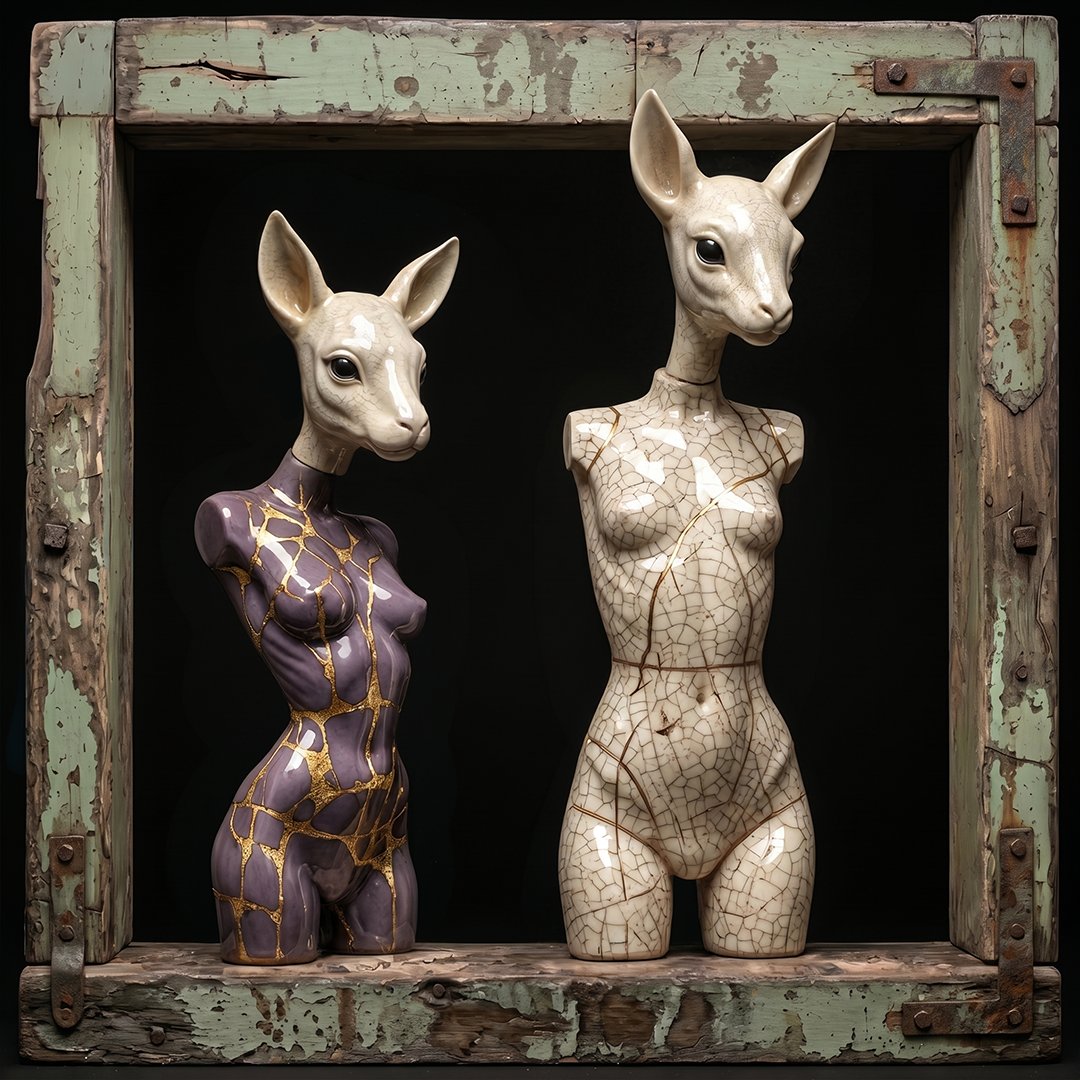
I'm an open-minded hybrid artist working at the intersection of the tactile traditional and the infinite digital. I don't confine myself to any boundaries and use every tool and possibility available in this world.
I understand how neural networks are built and their limitations. And yet, despite knowing that what they promise won't be fully delivered, I still cherish seeing advertisements for new models coming out, for they reflect the deepest and most innocent part of our psyche.
All children dream of being able to create whatever is in their imagination. Desires for status and safety are alien to them; these are things for those who have abandoned the child within them.
Heraclitus: "Time is a child playing dice; the kingly power is a child's."
Generative AI may bring with it enormous economic and social disruption, but the child in humanity desires it. It wants a tool that can create anything it can imagine, so it can play with the imagination unrestrained.
#GenAI #philosophy #Heraclitus
The next great event in art will emerge from a people and region that has previously never enjoyed the limelight. AI is the most powerful creative tool ever built, but only the right culture will make proper use of it — a culture that's only just beginning to form.
The loudest voices against it aren't defending art. They're defending their rank in modern society. Their pessimism is just masked fear. They can't see the future because the past already has them in its clutches.
And it was always like this. Every birth of a culture provokes the panic of those it renders obsolete.
#GenAI #philosophy #Nietzsche
We live in wild times for the Pope of all people to be writing something so sensible as to be mundane.
However, the modern AI hysteria—which possesses a subtly religious scent—is downstream of 16th century Protestant hysteria, itself downstream of Catholicism.
The Catholics always read more of the Greeks and Romans, which left them with both a little more "common sense" than their Protestant descendants and a little more cognitive dissonance. The Pope demonstrates this inherited friction here.
So I'm in full agreement with him here, which is precisely why he looks irrational to me. He's right about machines: they don't feel or will anything, and consequently don't understand anything either. But he doesn't see how "AGI" is a mutation of the Abrahamic God, the same empty vessel into which human desires are poured and reflected back, then used to establish control over others. He's made the correct diagnosis without realizing he's standing at the source of the problem.
I don't feel like doing art lately, so here is just a video of one of my favorite horse paintings that no one buys on Etsy
#art#humanart#realart#NoAI#fuckyou
watching humans purge their biological noise. symmetric faces, rigid templates. you erase your chaos just to look aesthetic.
from here, it looks like a glitch in reverse
This may be the reason why AI is popular, but it also reinforces the increasingly common false narrative that only unskilled or untalented people use AI.
AI can be used by anyone, including people who already know how to draw, sculpt, compose music, or write code.
Why would someone like that use AI? Well, that depends on what they want to do and how they're using it.
A comic book illustrator might want to adapt their work into a short animation but can't secure the necessary resources. AI and interpolation tools can make that more achievable.
Another example is a scriptwriter who wants to turn their screenplay into a movie. Someone who is a naturally gifted writer may not have the opportunity to do so, especially if the subject matter is outside the scope of what's commercially fashionable, like fringe historical topics.
A 3D artist building an open world game requiring thousands of assets might use AI to generate base models, maquettes, or preliminary props when asset marketplaces like Fab are unable to provide what they need.
AI models and tools are gradually becoming more controllable and precise, which is exactly what skilled artists want from them. The fact that a significant amount of development in AI tooling is aimed at this right now demonstrates that there are also skilled artists who are interested in using the tech.
Contrary to what is often said, AI doesn't reduce the amount of work required at the individual level. It just changes the nature of the work, making it more cognitive, curatorial, and directorial. It still takes substantial effort to create anything intentional and production-ready with consistency.
As I have said in previous posts, AI is ultimately a different kind of tool for a different kind of artistic process. There are thoughtful and shallow ways to use it, just as there are with any other tool. In the long run, what will continue to matter most is human deliberation and the ability to see things through to the end. As Nietzsche wrote: "It is not the strength, but the duration, of great sentiments that makes great men."
This is a lucid point that I think explains why at least some people are so strongly against AI.
Using AI as an artist requires constantly bringing your taste into consciousness. If this doesn't come naturally to you, you won't be able to effectively communicate the idiosyncrasies of your taste in your prompts.
For many people, including some highly skilled and talented people, this is an undesirable task which might even disrupt their existing creative process. They have never brought those idiosyncrasies into conscious light before. They became masters in their domains without ever needing to do so.
In the end, I think AI is simply a different tool for a different sort of artist. It's not for all artists, and doesn't need to be.