Hello tweeple, welcome to the Twitter page of the amazing work in Natural farming and Agroecology being done by farmers across the state of Andhra Pradesh
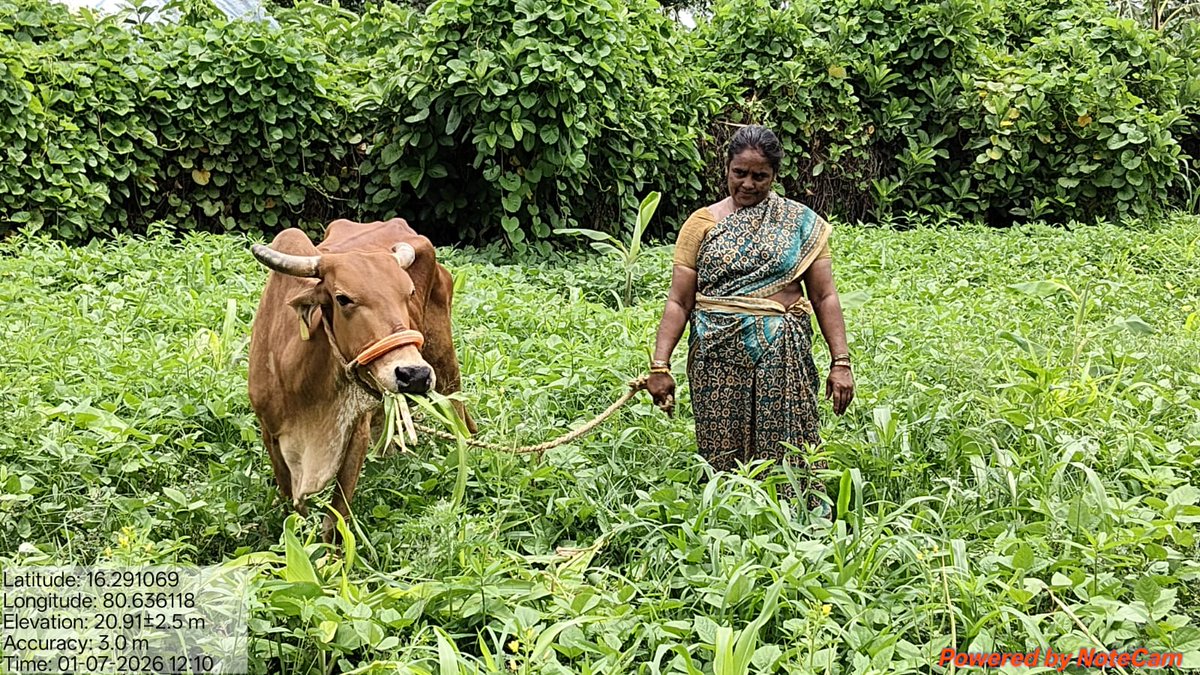
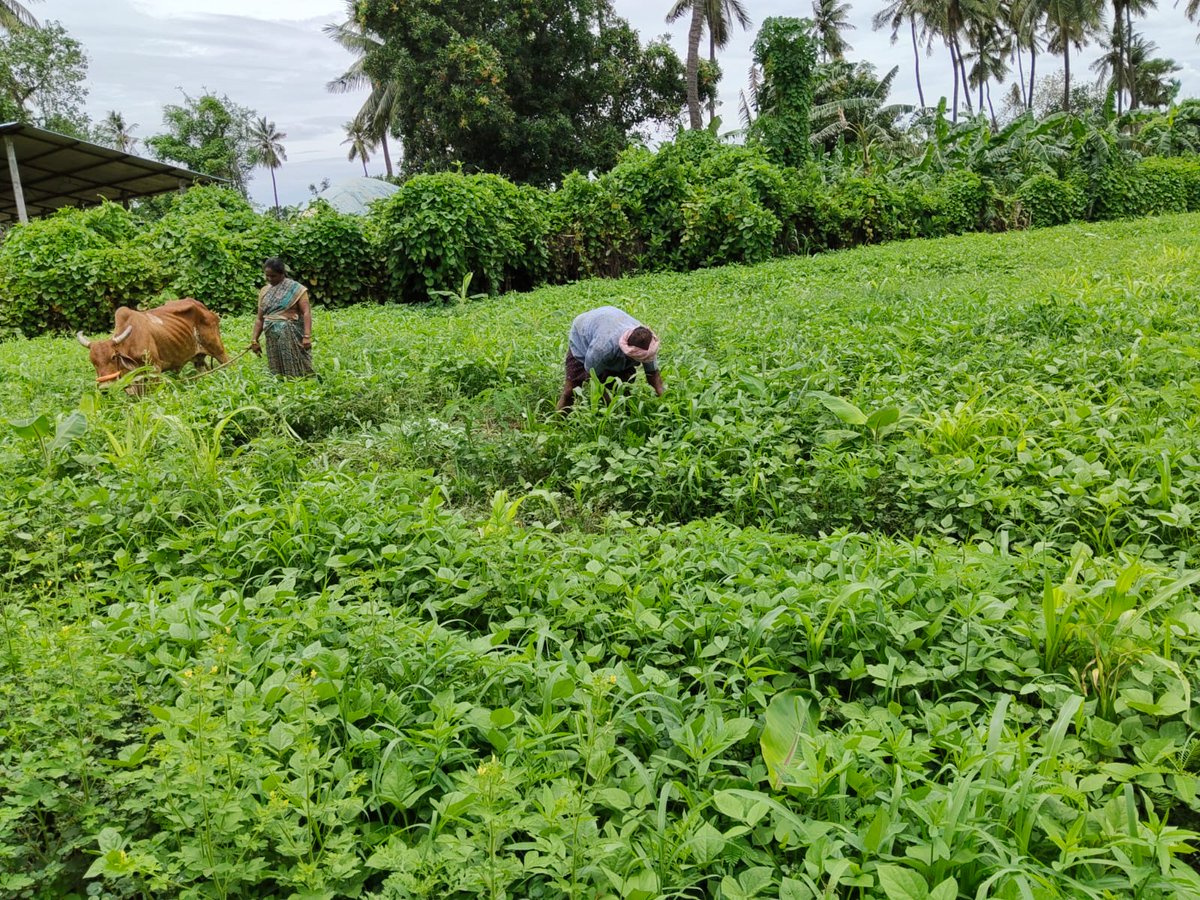
"PMDS Pelletisation is a simple yet powerful Natural Farming practice that every farmer should adopt. It improves soil health, enhances biodiversity, supports dairy development, and creates additional income opportunities for farmers," said Agriculture Special Chief Secretary @budithirajasekhar while visiting #PMDS demonstration fields at Chinna Ramapuram village, Chandragiri Mandal, Tirupati district.
During the visit, he compared PMDS plots sown with pelletised and non-pelletised seeds, observing better germination, crop vigour, and overall growth. Interacting with farmer Sri Chandrababu Naidu, he learned that PMDS fodder has increased milk yield and fat content, earning farmers an additional ₹2 – ₹3 per litre at milk collection centres.
The farmer also shared that selling 10–12 tonnes of PMDS fodder to the @TTDevasthanams goshala each season generates nearly ₹25,000 in additional income. The visit reinforced how PMDS strengthens climate-resilient farming by improving fodder security, livestock productivity, and farmer livelihoods.
@vijaythallam@rajbudithi65@ap_agriculture@rajbudithi65@icarindia@AgriGoI
#ClimateSmartAgriculture #RegenerativeAgriculture #SoilHealth #WaterConservation #FodderSecurity #SustainableFarming #FarmerInnovation #Agroecology
“For the past three years, I've been practising #NaturalFarming with 365 Days Green Cover. This season, PMDS with double seed kits has given me a thick crop stand, almost no weeds, and abundant green fodder for my cattle. It's supporting both my soil and my livestock.” – Chinta Suvarna Tejaswini, ICRP Farmer, Nandivelugu, Tenali.
On her 1.20 acre banana field, Tejaswini sowed a 28 seed PMDS mix with Seed Pelletisation on 4 June 2026. Despite receiving only two irrigations and minimal rainfall, the field has shown vigorous growth with excellent biomass. For the past five days, she has been harvesting around 15 bundles of green fodder daily, feeding 15 cattle, with enough biomass to continue for another two days.
As #ElNino increases the risk of delayed rains and prolonged dry spells, Pre Monsoon Dry Sowing , an innovation of #NaturalFarming, is empowering farmers to build climate resilience through continuous soil cover, moisture conservation, and biomass generation, ensuring security for both crops and livestock.
@vijaythallam@AndhraPradeshCM@ap_agriculture@rajbudithi65
#365DGC #SeedPelletisation #ClimateResilience #ElNino #SustainableFarming
Natural Farming continues to take root across India.
A new chapter in community-led Natural Farming began in Wapung Block, East Jaintia Hills, Meghalaya, with the launch of the Natural Farming Programme in the newly selected Extension Cluster Level Federation (CLF) – We Join Together.
With the support of the local community, Sohkymphor village was selected as the Extension Village, laying the foundation for farmer-led learning and community-led extension. The programme included a hands-on demonstration on the preparation of bio-inputs, along with orientation for Community Resource Persons to strengthen local capacity for programme implementation.
Around 30 members from Village Organizations participated in the programme, marking another milestone in strengthening community-led Natural Farming and building resilient farming systems.
Together, we continue to strengthen farmer-led Natural Farming across India.
@APZBNF@vijaythallam@ap_agriculture@rajbudithi65@AndhraPradeshCM@AgriGoI@icarindia@MeghalayaNFryss
#NaturalFarming #APCNF #Agroecology #FarmerLed #CommunityLed #Meghalaya #RegenerativeAgriculture
From Andhra Pradesh to the Nation .#APCNF continues to scale the #NaturalFarming movement across India.
With its community managed Natural Farming model now supporting initiatives in 22 states and 6200 farmers, APCNF is accelerating the nationwide transition towards sustainable and climate resilient agriculture through strategic partnerships and capacity building.
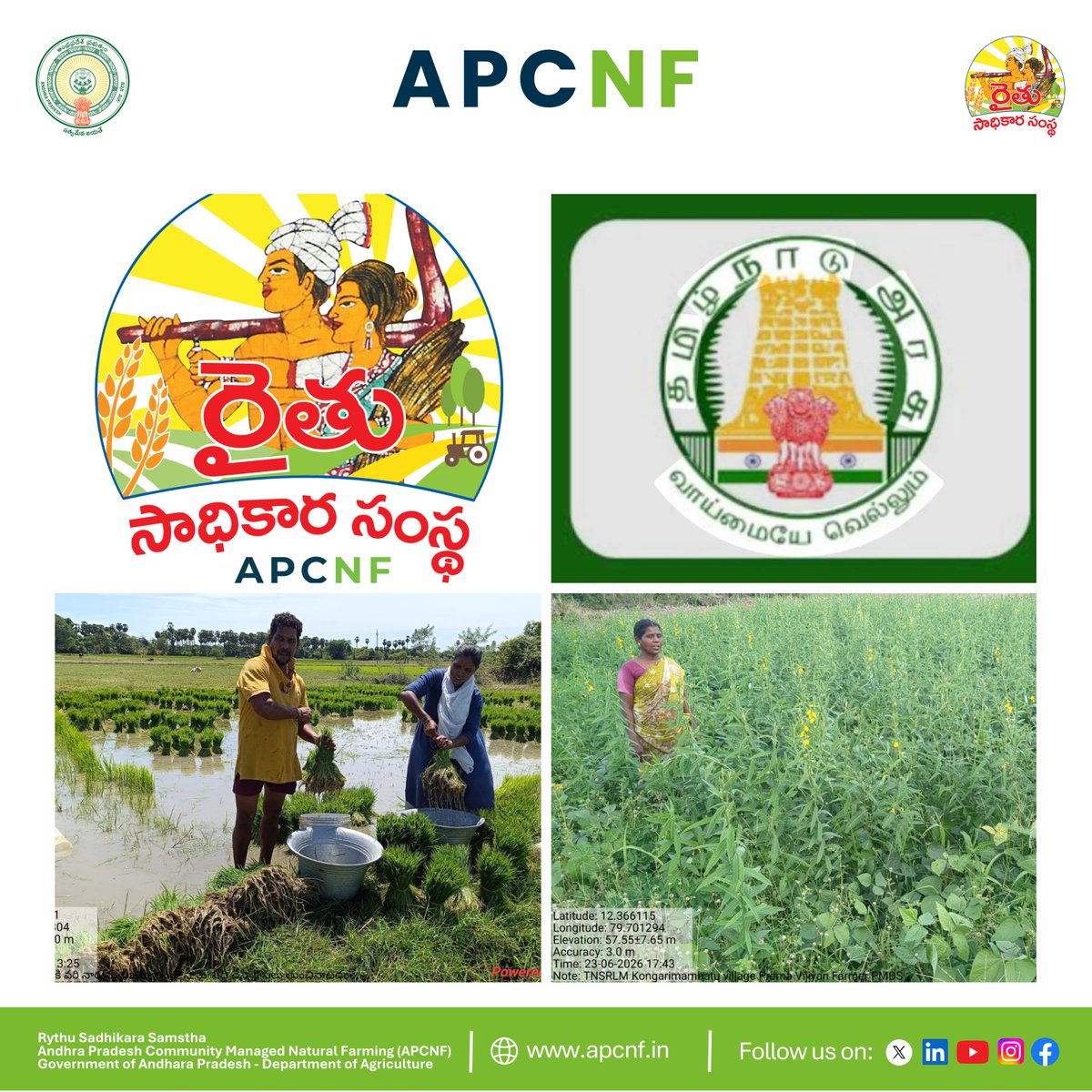
We are delighted to share that Executive Vice Chairman of #RySS, @vijaythallam signed a Memorandum of Understanding (MoU) with the Tamil Nadu State Rural Livelihoods Mission (#TNSRLM), marking the next phase of our collaboration in the state.
Having already established a strong presence through the successful implementation of the Natural Farming programme in three districts, this new Phase-II MoU significantly expands the initiative to eight additional districts, covering six clusters and 30 villages, bringing the benefits of community managed Natural Farming to many more farming families across Tamil Nadu.
This expansion is another milestone in APCNF's journey of taking Andhra Pradesh's proven Natural Farming model to the rest of the country, empowering communities, restoring soils, strengthening climate resilience, and building a farmer led movement for sustainable agriculture.
From one state to many, from pilot to scale #APCNF is helping shape India's Natural Farming future, one community at a time.
@AndhraPradeshCM@ap_agriculture@rajbudithi65@NITIAayog@icarindia@agrigoi@TNAU_coimbatore
#SustainableAgriculture #RegenerativeAgriculture #ClimateResilientAgriculture #FarmerLed #SoilHealth #Agroecology #RuralLivelihoods #ScalingNaturalFarming #HealthySoilHealthyFood
"From Andhra Pradesh to the world, the #NaturalFarming movement is making headlines."
@IndiaToday has highlighted #APCNF's remarkable journey, showcasing how 1.8 million farmers are leading one of the world's largest community managed transitions to Natural Farming. The feature recognises APCNF's global recognition with the 2026 @FoodPlanetPrize and its role in restoring soil health, strengthening climate resilience, reducing cultivation costs, and inspiring agroecological transitions beyond India.
#APCNF's farmer led extension model trains Community Resource Persons, Master Trainers, Bio Resource Centre (BRC) entrepreneurs, field teams, and frontline extension staff, who take Natural Farming directly to villages through field demonstrations, mentoring, exposure visits, and continuous handholding. Built on a farmer to farmer peer learning approach, this model empowers experienced farmers to mentor fellow farmers, building trust, accelerating adoption, and creating lasting change across communities.
@vijaythallam@AndhraPradeshCM@ap_agriculture@rajbudithi65@NITIAayog@icarindia@agrigoi@EATforum@circulareconomy@annalappe@satyatripathi@PavanSukhdev
https://t.co/3qGbKWRkE5
#Agroecology #ClimateResilience #FarmersLeadingChange #AgriculturalExtension #PeerLearning
"Resilient crops begin long before the first rains, with Seed Pelletisation and Pre Monsoon Dry Sowing "
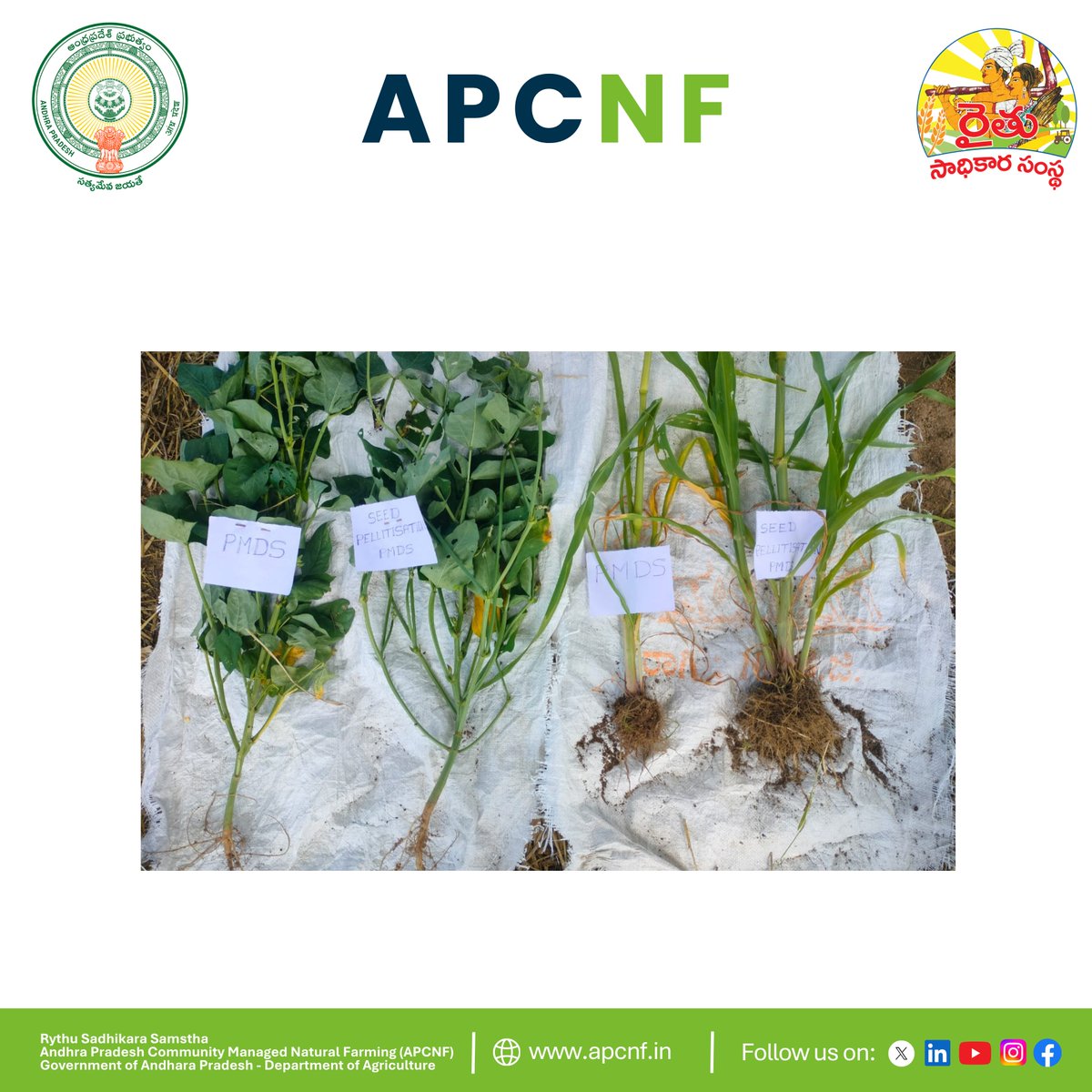
In Pedaganuru village, Chittoor district, a comparative demonstration at the farm of ICRP farmer Sri Narayana Reddy highlighted the impact of PMDS with and without Seed Pelletisation. Uprooted crop samples clearly showed that Seed Pelletisation produced stronger root systems, better plant vigour, and healthier crop establishment. This simple yet powerful #NaturalFarming practice enhances early germination, improves soil health, reduces crop risk, and lays the foundation for resilient, climate ready farming.
"When I saw the roots, I realized the strength of a crop begins beneath the soil. Seed Pelletisation gives me confidence that my crop can withstand uncertain rains," says farmer Sri Narayana Reddy.
"Stronger roots are the foundation of resilient farms."
@vijaythallam@ap_agriculture@rajbudithi65@AndhraPradeshCM@AgriGoI@icarindia
#NaturalFarming #SeedPelletisation #PMDS #SoilHealth #APCNF #AndhraPradesh
For over a decade, #APCNF has been proving that agriculture can regenerate ecosystems while improving farmers' livelihoods. Built on community institutions, farmer to farmer learning, and science backed #NaturalFarming practices, the movement has empowered over a million farmers to restore soil health, reduce dependence on synthetic inputs, conserve water, enhance biodiversity, and build climate resilient farming systems. Today, with the #APCNF model inspiring adaptation in more than 50 countries, its journey has drawn global attention. In a recent in depth article, "APCNF won the @FoodPlanetPrize. Can it now scale across India?", @venkinesis explores the evolution, impact, and scaling potential of APCNF, describing it as a model that demonstrates how agriculture can nourish both people and the planet. The article reflects on APCNF's recognition as the recipient of the 2026 Food Planet Prize, the world's largest environmental award, validating the collective efforts of farmers, women's Self Help Groups, community resource persons, and partners who have made regenerative agriculture a reality at scale.
https://t.co/okhlbXd8MN
@vijaythallam@AndhraPradeshCM@ap_agriculture@rajbudithi65@NITIAayog@icarindia@agrigoi@EATforum@circulareconomy@annalappe@satyatripathi@PavanSukhdev
#FarmerFirst #Agroecology #ClimateResilience #SoilHealth #FarmersFeedTheWorld
Even under the uncertainty of #ElNino, farmer Bhimaraju is proving that resilience begins before the rains. By adopting Seed Pelletization and Pre Monsoon Dry Sowing (PMDS), he sows ahead of the monsoon, enabling seeds to germinate with minimal moisture, avoiding repeated sowing, strengthening early crop establishment, and keeping his soil covered and productive year-round.
"A Bio Resource Centre is not just a place to provide inputs. It's a place where farmers learn and gain confidence to adopt #NaturalFarming," says Bhimaraju of Bommavanipalem, Bapatla. Leading by example, he has successfully implemented Pre Monsoon Dry Sowing on his own farm, demonstrating how seed pelletization and biodiversity based cropping can keep soils covered and productive. Through his BRC, he supports nearly 80 farmers with natural farming inputs and technical guidance. "Soil erosion is a major challenge, and PMDS is one of the best solutions to keep the soil intact while maintaining year round green cover," he says. His farm is inspiring more farmers to embrace climate resilient #NaturalFarming for healthier soils and sustainable livelihoods.
@vijaythallam@AndhraPradeshCM@ap_agriculture@rajbudithi65
#PMDS #SeedPelletization #SoilHealth #ClimateResilience
Every resilient Kharif season begins with a single, well prepared seed.
As part of the #EruvakaPournami celebrations, #APCNF teams across the state conducted Seed Pelletization and #PMDS programmes, preparing farmers to sow before the onset of monsoon. With a target of 18.5 lakh farmers across 22 lakh acres, PMDS promotes timely sowing through seed pelletization, line sowing, and diverse cropping systems that conserve moisture, strengthen soil microbiomes, improve biodiversity, and build climate resilience.
The celebrations witnessed the participation of Ministers, public representatives, government officials, and farmers across several districts. Demonstrations highlighted how seed pelletization enables one time effective sowing, improves germination even under low moisture conditions, and supports healthier soils and sustainable Kharif cultivation. Through these statewide Eruvaka Pournami celebrations, Andhra Pradesh is accelerating the adoption of PMDS and Natural Farming practices for a productive and climate resilient farming season.
@vijaythallam@AndhraPradeshCM@rajbudithi65@AndhraPradeshCM
#ClimateResilientFarming #Kharif2026 #SoilHealth #SoilMicrobiome #Biodiversity #SustainableAgriculture
As the world experiences unprecedented heatwaves and the impacts of climate change become increasingly evident, conversations on resilient food systems have never been more important.
We are honoured to see Dr. K. Srinath Reddy highlight the role of Natural Farming and acknowledge the Andhra Pradesh Community Managed Natural Farming (APCNF) programme and the Food Planet Prize 2026 in his thought-provoking article, "Healing a heating world, with ear to the ground".
The article reminds us that addressing the climate crisis requires working with nature, not against it. Through community-led Natural Farming, millions of farmers in Andhra Pradesh are demonstrating that ecological regeneration, resilient livelihoods and sustainable food systems can go hand in hand.
We thank Dr. Reddy for recognising the importance of farmer-led agroecological transitions and for bringing this conversation to a wider audience.
Together, we can continue advancing pathways that regenerate ecosystems, strengthen rural communities and contribute to a more resilient future.
https://t.co/TyUH9Nsz82
@vijaythallam@AndhraPradeshCM@ap_agriculture@rajbudithi65@icarindia@AgriGoI@APZBNF@vishyteki
#NaturalFarming #Agroecology #ClimateAction #FoodSystems #EcologicalRegeneration #FoodPlanetPrize #APCNF #FarmerLedInnovation
The smallest life forms make one of the biggest differences in agriculture. Beneath every farm, diverse microbial communities sustain soil fertility, improve resilience, and drive healthy ecosystems.
Through #NaturalFarming, farmers nurture this invisible biodiversity, allowing nature's own processes to restore the land while securing sustainable livelihoods. Together, farmers and microbes are cultivating a healthier future for people, soil, and the planet.Happy #WorldMicrobiome Day!
@vijaythallam@CGIAR_EMD@ap_agriculture@rajbudithi65@AgriGoI@icarindia@NITIAayog
#HealthySoil #HealthyFood #SoilMicrobes
Rythanna Mee Kosam: Strengthening Natural Farming through Bio-Input Resource Centres (BRCs)
Today, as part of the RMK Programme, we conducted a BRC Theme Visit at the Bio-Input Resource Centre of Sri Kondayya in Chowkicherla Village.
A Bio-Input Resource Centre (BRC) is a one-stop centre for Natural Farming. It provides farmers with quality bio-inputs, seeds, technical guidance, and supports them in adopting Natural Farming practices. BRCs also help farmers market their Natural Farming produce, creating better livelihood opportunities within the village.
During the visit, Natural Farmer Sri Mallikarjuna and his son shared how BRCs are helping farmers access quality inputs locally and reduce their dependence on external inputs. They also explained how BRCs are becoming an important support system for strengthening Natural Farming in villages.
The interaction with farmers and community cadres highlighted the importance of community-owned BRCs in building self-reliant villages and expanding Natural Farming.
Bio-Input Resource Centres – By the community, for the community.
@vijaythallam@AndhraPradeshCM@ap_agriculture@rajbudithi65@icarindia@AgriGoI@APZBNF
#APZBNF #RySS #NaturalFarming #BRC #CommunityLedDevelopment #HealthySoilHealthyFood
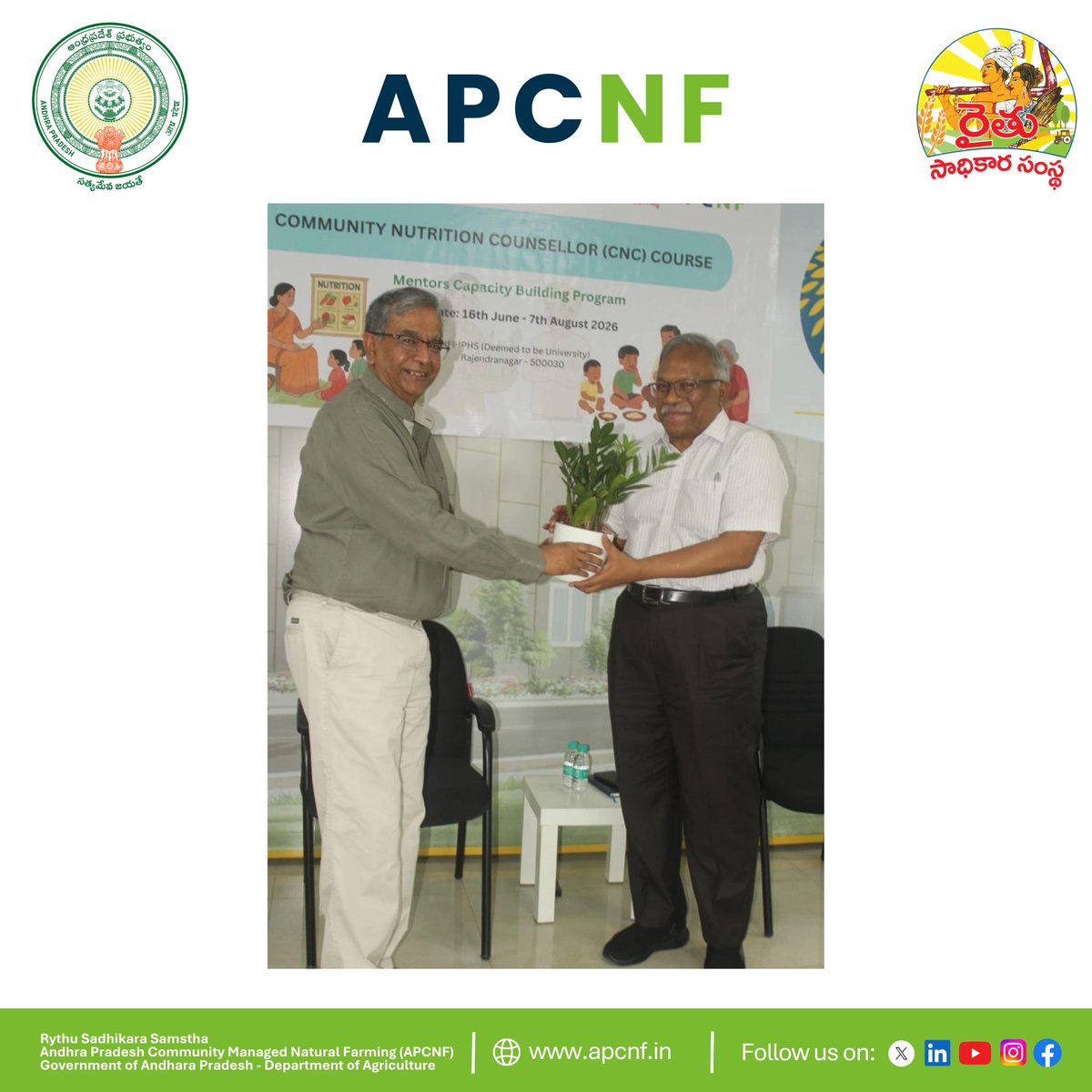
A rare privilege for the mentors of the Community Nutrition Counsellor Mentors' Training Programme to learn from two exceptional leaders.
Sri T. Vijay Kumar, IAS (Retd.), Executive Vice Chairman, RySS, shared how natural farming, nutrition, community institutions, and household wellbeing are deeply interconnected, and encouraged mentors to become catalysts for healthier families and communities.
Dr. K. Srinath Reddy, Chancellor, PHFI-IPHS, highlighted the growing burden of non-communicable diseases and reinforced the importance of preventive health, ecological balance, and nutrient-rich food.
Together, their insights strengthened APCNF's Health & Nutrition pathway, connecting soil, food, nutrition, and human wellbeing.
For the mentors, this interaction was a defining moment that reinforced the larger purpose of their journey. They will support Community Nutrition Counsellors across villages, strengthening health and nutrition outcomes through community action.
The programme is built on a curriculum conceptualised and developed by RySS. Ms. Lakshmi Durga Chava has led the curriculum design, partnership building, and programme architecture behind this initiative.
@vijaythallam@AndhraPradeshCM@ap_agriculture@rajbudithi65@icarindia@AgriGoI@MoHFW_INDIA@CGIARnutrition@CGIAR
#APCNF #NaturalFarming #CommunityNutrition #PublicHealth #RySS #PHFIIPHS #CapacityBuilding #AndhraPradesh
“The seed pelletization method helped the seeds remain protected in the soil and germinate with the first showers. In just 46 days, the field generated abundant biomass, which will primarily be used as fodder for my livestock while also improving soil health,” said Sri Sukumar, an adopter farmer from Pullalur village, Walajabad Block, Kanchipuram district, Tamil Nadu.
Showcasing the effectiveness of Seed Pelletization and Pre Monsoon Dry Sowing (PMDS) as climate resilient #NaturalFarming interventions, a Crop Cutting Experiment (CCE) conducted on 19 June 2026 in Sri Sukumar's field recorded 55 kg of biomass from a 25 sq.m. sample plot, equivalent to an estimated 8.9 metric tonnes of biomass per acre. Sown on 4 May 2026 with a diverse mix of 15 crop varieties, the field generated this biomass in just 46 days.
#APCNF's seed pelletization technique coats seeds with nature positive microbial stimulants such as Beejamrutham and Jeevamrutham based formulations, helping conserve seed microbiomes, retain moisture, protect seeds, and trigger germination when favourable conditions arise. Combined with PMDS, it enables a single effective sowing ahead of monsoon uncertainties, ensuring early biomass generation, fodder availability, continuous soil cover, improved soil health, and greater resilience to climate extremes.
@vijaythallam@AndhraPradeshCM@ap_agriculture@rajbudithi65@icarindia@AgriGoI
#LivestockFodder #SoilHealth #Biodiversity #RegenerativeAgriculture #SustainableFarming #Kanchipuram #NaturalFarmingWorks #FarmersFirst
Strengthening community nutrition through #NaturalFarming!
The Health & Nutrition thematic of RySS in partnership with the @IIPHHyderabad has launched an 8 week residential Mentors Training Programme for the Community Nutrition Counsellor (CNC) Course, a key step under #APCNF to strengthen community level nutrition support across Andhra Pradesh
The programme was inaugurated virtually by Executive Vice Chairman @vijaythallam, who highlighted the importance of integrating health, nutrition, and natural farming to improve the well-being of rural communities. Mr. G. Muralidhar and Ms. Lakshmi Durga from RySS.
Dr. M. Vishnu Vardhana Rao, Vice Chancellor, and Dr. Rajan Shukla, Dean, PHFI-IPHS, represented IIPH Hyderabad, highlighting its role in linking nutrition, natural farming and community action.
Ms. Lakshmi Durga emphasized the critical role of Community Nutrition Counsellors in addressing malnutrition and strengthening nutrition outcomes across Andhra Pradesh. She expressed her happiness that this long envisioned initiative is now becoming a reality.
A total of 66 participants, including NFFs, NFF-Is, and H&N SPMU members, are undergoing intensive training to become mentors who will support Community Nutrition Counsellors at the grassroots level.
The programme brings together expertise from @mangalAiimsAP , #CollegeofHomeScience, @ICMRNIN , @MilletsNews , @IIPHHyderabad , and #RythuSadhikaraSamstha to strengthen community-based nutrition systems by linking soil health, food systems, dietary diversity, and nutrition outcomes.
A unique feature integrates natural farming, food systems and nutrition, alongside convergence with the Health Department, ICDS, SHGs and PRIs. Through this initiative, RySS aims to build a strong community based nutrition ecosystem that complements natural farming and contributes to healthier, nutrition-secure rural communities across Andhra Pradesh.
@vijaythallam@AndhraPradeshCM@ap_agriculture@rajbudithi65@icarindia@AgriGoI
#CommunityHealth #NutritionCounselling #NutritionSecurity #DietaryDiversity #FoodSystems
As Andhra Pradesh braces for the challenges of #ElNino marked by intense heat, prolonged dry spells, and erratic rainfall, #APCNF farmers are demonstrating how nature based farming practices can build resilience. Through Pre Monsoon Dry Sowing (PMDS), diverse cropping systems, and year round soil cover, farmers are conserving moisture, reducing field temperatures, and creating multiple income streams even under extreme weather conditions.
“On April 9, I sowed a 30 kg seed mix of 30 crop varieties under PMDS in my two acre field. Since then, I have earned ₹8,500 from leafy vegetables, ₹10,500 from fodder sales, and an additional ₹8,000 by supplying sorrel leaves to Canada based on orders. I market my produce locally and in neighboring mandals, while value addition has helped me access international markets.
PMDS has also improved field conditions during the summer. While my field recorded a temperature of around 29°C, nearby chemical farming fields without crop cover reached nearly 59°C, with hardened soil and visible cracks. This experience shows how PMDS helps conserve moisture, improve soil health, and create diverse income opportunities for farmers.”
– T. Koteswaramma, @iggaarl Mentor, Meduru, NTR District
@vijaythallam@AndhraPradeshCM@ap_agriculture@rajbudithi65@AgriGoI
#ClimateResilientFarming #RegenerativeAgriculture #SoilHealth #365DaysGreenCover #FarmerInnovation #SustainableAgriculture #Agroecology #WaterConservation
As #ElNino threatens to bring delayed rains and prolonged dry spells, #APCNF is equipping farmers with climate resilient solutions such as PMDS and Seed Pelletization, helping them establish crops early and withstand weather uncertainties.
Tirupati District Collector & District Magistrate ,
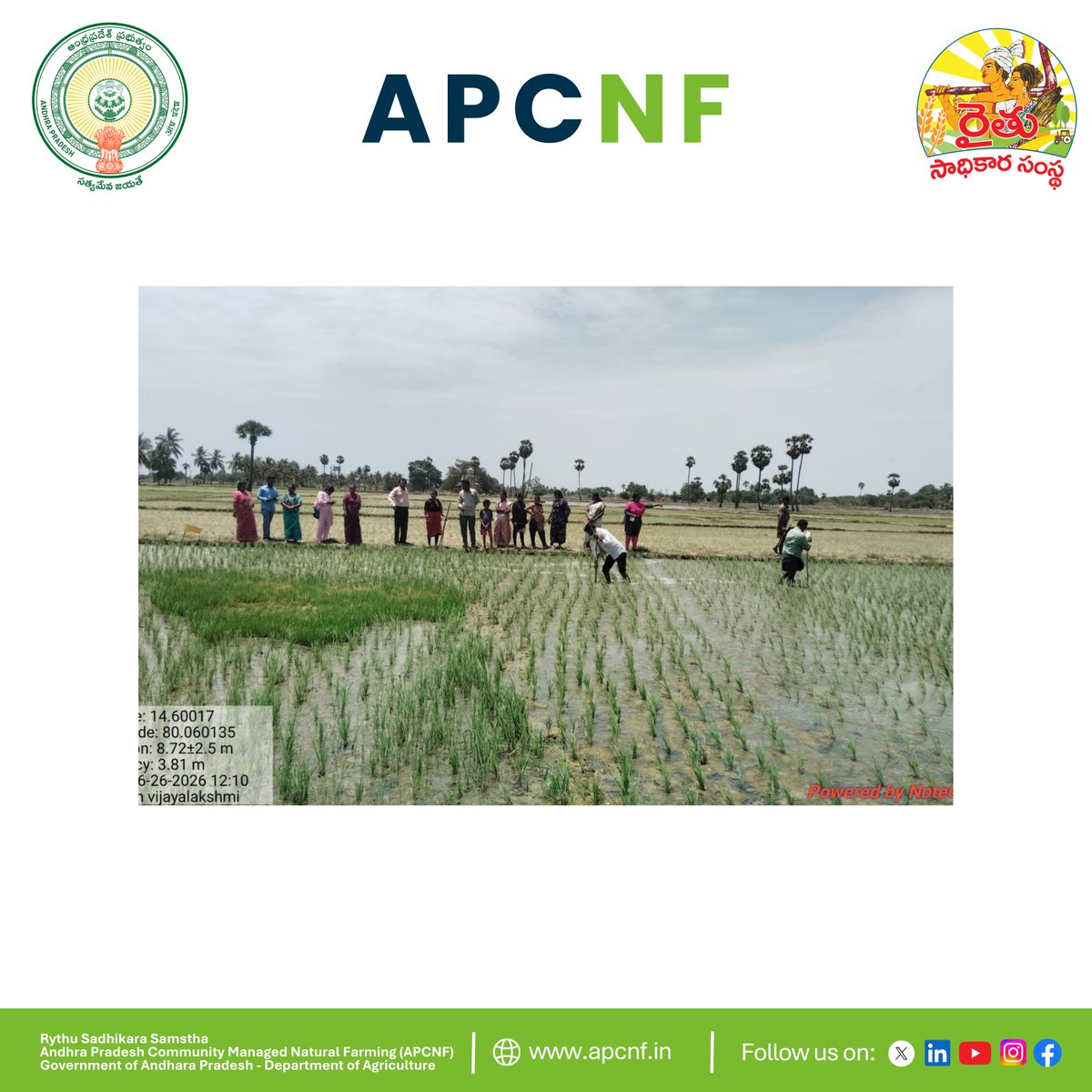
Dr. S. Venkateswar visited the 2 acre #PMDS field of farmer Smt. A. Pushpa at Vedam village, Srikalahasti Mandal, Tirupati district, where he observed and participated in the #SeedPelletization process using Beejamrutham, Ghana Jeevamrutham, ash, clay soil, and seeds. During the visit, officials briefed him on how PMDS and Seed Pelletization help farmers cope with the anticipated El Nino conditions by enabling early crop establishment and improving resilience to delayed and erratic rainfall. Appreciating the practice, Collector remarked, "PMDS and Seed Pelletization offer farmers a practical way to manage weather uncertainties and strengthen climate resilience in agriculture." The Collector also participated in line sowing and paddy transplantation using a hand transplanter, demonstrating labour saving technologies that can enhance farm efficiency and reduce drudgery for farmers.
@vijaythallam@AndhraPradeshCM@ap_agriculture@rajbudithi65@icarindia@AgriGoI
#ClimateResilientFarming #SeedPelletization #ElNinoPreparedness #SustainableAgriculture
As El Nino brings heatwaves, prolonged dry spells, and erratic rainfall, farmers face increasing challenges in sustaining crop productivity and livelihoods. To build resilience against these climate extremes, the #APCNF programme is promoting Seed Pelletisation and Pre-Monsoon Dry Sowing (PMDS) through a large scale outreach campaign that has reached lakhs of farmers across Andhra Pradesh. Seed pelletisation helps seeds remain viable until the onset of rains, while PMDS enables farmers to establish diverse crops before the monsoon, enhancing soil moisture retention, improving soil health, and reducing climate related risks. To date, 10.45 lakh farmers have adopted PMDS across 5.01 lakh hectares, making it one of the largest climate resilient farming initiatives in the state.
Farmer Charan from Vinayakapalli village, Vizianagaram District exemplifies the impact of this approach. For the past seven years, he has been practicing PMDS, demonstrating its potential as both a climate resilient and economically rewarding farming model. This year, he sowed an 18 crop PMDS seed mix on March 25 using just 15 kg of seed on half an acre. Despite receiving only one rainfall event in March, followed by two rainfall events each in May and June, the crop was raised entirely under rainfed conditions without a single irrigation. So far, he has earned ₹37,000 and expects an additional ₹60,000 in the coming weeks. “PMDS has improved my soil health by making the soil more porous and increasing earthworm activity, while providing both fodder and income,” says Charan. Having transformed PMDS into a commercially viable farming system, he now plans to cultivate indigenous paddy during the upcoming Kharif season. His success highlights how #NaturalFarming practices are enabling farmers to withstand climate variability while regenerating soils, supporting livestock, and securing sustainable farm incomes.
@vijaythallam@AndhraPradeshCM@ap_agriculture@rajbudithi65@icarindia@AgriGoI@ICRISAT@NITIAayog
#SoilHealth #RegenerativeAgriculture #RainfedFarming #ClimateAction #FarmerSuccessStory #SustainableAgriculture #LivestockNutrition
Women Leading the Way Towards Food Sovereignty in Kerala.
#APCNF ECRP team continues to inspire families to grow their own nutritious food.
Shamitha was motivated to utilize her 5 cents of land for a kitchen garden, and the area has been cleaned and prepared for bed making. In Sophia's farm, okra, beans, amaranthus, pumpkin, and ridge gourd were sown amidst the banana plantation, while practical training on Dhrava Jeevamrutham preparation was also provided.
Sarojini enthusiastically started her kitchen garden with beans, okra, ridge gourd, and bitter gourd after preparing beds near her home.
At Ammani's ATM (Any Time Money) Model, a customized #NaturalFarming model designed for small landholdings of 20–30 cents to ensure year round production of diverse, nutrition rich foods, new beds were developed and fresh seeds and seedlings were planted.
These small yet transformative actions are strengthening household nutrition, enhancing self-reliance, promoting natural farming practices, and empowering women to become custodians of resilient local food systems.
@vijaythallam@AndhraPradeshCM@ap_agriculture@rajbudithi65@icarindia@AgriGoI
#ATMModel #FoodSovereignty #WomenEmpowerment #NutritionSecurity #SustainableAgriculture
An #APCNF inspired farming innovation is taking root in Khweng Village. By combining dry paddy cultivation with vegetables grown along drainage channels, farmers are maximizing productivity, resilience, and land use efficiency under the #NationalResourcreOrganisation Programme.
In Khweng Village, Bhoi district, Meghalaya, farmers have successfully completed upland paddy sowing through the line sowing method after seed treatment, maintaining a spacing of 15 cm × 15 cm. To ensure effective drainage and moisture management, drainage channels were created after every ten rows.
Demonstrating efficient land use and crop diversification, farmers are utilizing both sides of these channels to cultivate vegetables and leafy greens such as coriander, radish, chilli, rosella, maize (border crop), pumpkin, and bitter gourd.
With limited lowland paddy areas and the predominance of upland and forest fringe lands, farmers have shown strong interest in adopting dry paddy cultivation. Under this initiative, 7 farmers have brought 4.60 acres under cultivation, strengthening climate resilient and diversified farming systems.
@vijaythallam@AndhraPradeshCM@ap_agriculture@rajbudithi65@Meghalaya_agri@icarindia@AgriGoI
#DryPaddy #CropDiversification #SustainableAgriculture