We were excited to collaborate with Anthropic to provide agent observability from Claude to @arizeai. It was great working with the team to support both Arize AX and Phoenix!
Now in public beta, Claude Platform can send OpenTelemetry traces from the Messages API, Claude Managed Agents, and the Claude SDKs to your observability stack.
@karpathy I think there is another disconnect happening where labs are tackling a subset of problem types (those with data to solve and testable) and feeling the awesome power.
Will the pace of labs show up in business? Big gap from possible & shipped based on problem types.
There is an impedance mismatch between problems that lend themselves easily to powerful agents - all data accessible for agent to digest and testable problem - and general business usage.
We have a very powerful technology that will take time to diffuse into society.
Dusting off this tweet from April because this gap in shared understanding of LLM capability is *widening*. It's now less "two groups of people speaking past each other" and more a sharp funnel.
- Napkin math somewhere around 6B people (~75% of the population) have barely come in contact with LLMs at all.
- Around 1-2B (~20%) are casual and infrequent users of free-tier ChatGPT-like products. This group sees derpy chatbots and treats them a bit like a better Google search, a writing aid, or etc. Maybe an agent tries to book you a flight. I have non-tech friends who (reasonably, imo) say they have not much use for it at all. Even many professionals outside of math&code are in this tier. For example, execs and many other functions spend a lot of their time talking to other people, so while they understand what is happening intellectually, it is still second-hand and a bit abstract.
- Now we get to professional use of frontier-grade LLMs in math&code. Somewhere around 20M people (0.2%) see first-hand that large, complex projects that used to take them weeks/months can now be completed by agents with a prompt. Building apps, copying apps, translating apps, decompiling apps from binaries... This has all happened very quickly and recently - less than 1 year ago, I was writing code manually by hand, typing memorized computer code commands into a code editor character by character, occasionally pressing Tab to autocomplete a little chunk of code.
- And finally we get to the ~5,000 people (~0.00006%) with access to frontier-grade systems internally. The external world has seen the preview. It looks like swarms of thousands of agents collaborating over weeks on software mega projects: minting zero days, running cyber attacks and defenses at machine speeds, discovering new science, advancing the frontier of mathematics. Things that would have taken top professionals in the industry years of work. Meanwhile, human review and comprehension are starting to fall behind. For example, people are still involved in the "archeology" of the OpenAI-HF incident from many months ago. Mathematicians may be poring over the 722 manuscripts on frontier mathematics for a while.
The funnel is driven by a combination of factors:
1. The impact scales with ambition, problem size, and horizon. A question with a paragraph answer barely stresses the system. You need a reservoir of big, difficult problems that you really care about. This aspect drives the consumer / professional dimension of the funnel.
2. The jaggedness of the system (which I have written about a lot separately). Capability peaks in domains that are digital, verifiable and economically valuable. This is because LLM capability emerges from reinforcement learning on verifiable rewards on a curated environment mixture driven by revenue potential. This aspect primarily drives the area (e.g. math&code) dimension of the funnel.
3. Access. Free-tier, paid-tier, internal.
So this is the weirdness of the moment. The general public has mostly not interacted with these systems. When they have, it looks like a derpy chatbot. The majority of professionals still see only a modest uplift. And a small sliver of professionals are experiencing the vertigo of the curve going vertical. And it is all happening at the same time.
I'm not of the opinion this is the end of mathematics for humans in anyway shape or form.
Similar to where software engineering was 2 years ago, we have massive acceleration, we have a tool that can be used by anyone and we will have more math (sometimes sloppy) to review.
I was interested in whether mathematicians considered these proofs important and interesting. So I went through the quotes and picked those that are about the problems specifically, not impact on the community or comms - lots of people very pissed about that (c.80% of comments). I would say that nearly every person that touched on the problems solved or the solutions was impressed.
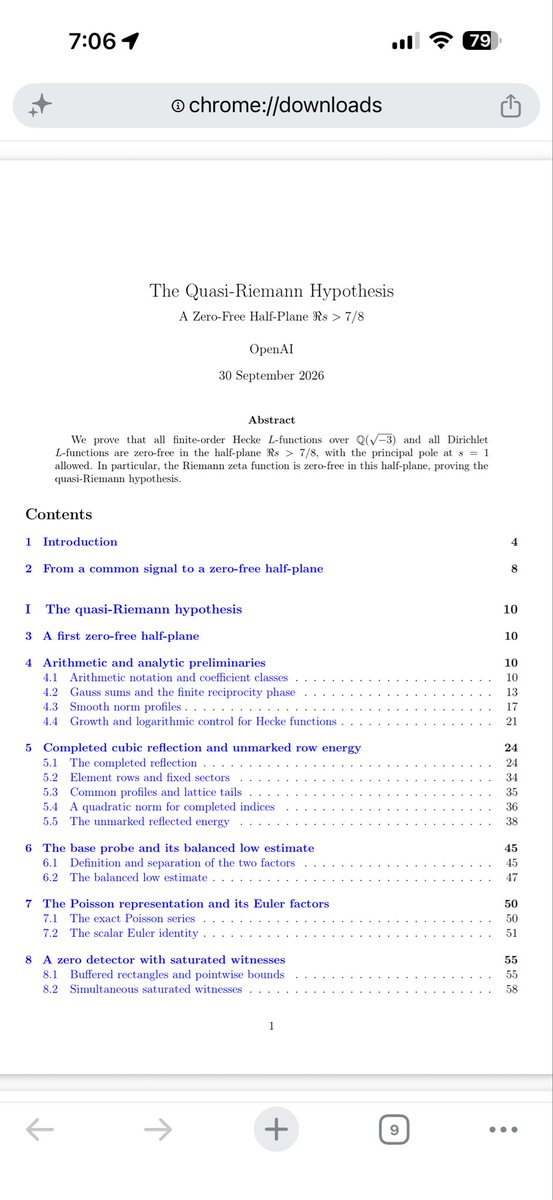
"Quasi-Riemann is a result that I thought was complete science fiction"
"I am stunned."
"These were almost all the major open problems in my field!"
"It does feel like the end of an era where the ability to solve problems was a distinguishing feature of being a mathematician."
"Today my chief feelings are disorientation and bewilderment."
"This timeline is crazy. I feel conflicted."
"I am both amazed at the results and the technological advances and scared at the fact that the pace is much higher than I can keep up with."
"I got really impressed by the resolution of the free factor problem [...] since I had been wrong about the expected outcome"
"I was at first slightly underwhelmed by what was in there, especially given the results in my own field of arithmetic geometry."
"Many of the AI-generated proofs appear to introduce clever new ideas that will be fruitful once digested, while also building upon the existing contributions of countless human mathematicians past and present"
"I was initially surprised when I saw the resolution to the free group factor problem."
"Assuming that these proofs are correct, I must say that I am very impressed about these results"
"I was amazed by the scale and breadth of the recent results coming out of OpenAI in their announcement."
"I am struck by how recognisable the individual parts are. The wilder creativity lies in their counterintuitive composition. I would probably have given up on these combinations, or talked myself out of trying them."
"The scope of last night’s announcement is truly breathtaking. Until very recently, I would not have imagined that the frontiers of mathematics could move so far in one day. Beyond the remarkable list of problems that appear to have been solved, I am deeply impressed by the diverse forms of reasoning sketched in the documents that accompany the announcement."
"Scrolling through the list of claimed results, I alternated between shock and apathy repeatedly."
"If I had to pick one personally, the equivalence of strong Ulam stability and amenability (along with Dixmier’s problem) has particularly touched me, as I have spent several years thinking about it seriously. The solution seems to combine Furstenberg’s boundary theory with quantum circuits from quantum computing, how wild is that?"
"Not a single one of the major open problems I have publicly mentioned throughout my career (whether in a talk, a lecture, an article, or even a grant proposal) was left untouched by the announcement. Everything has been claimed to be proved."
"The “Big OpenAI drop” is nothing short of historic, possibly the single most important day in the history of mathematics thus far. Many of the problems with now proposed solutions in the Oct. 6, 2026 drop would represent huge contributions to their respective fields: quasi-RH, the second part of Hilbert’s 16th, Hilbert’s 10th over Q, the Hodge Conjecture of CM abelian varieties, Goldfeld’s conjecture, fast integer multiplication… They are undeniably huge contributions."
"I was not expecting the magnitude of some of these results. Most particularly, seeing a proof of no zeros of Dirichlet L-functions to the right of Res=7/8 (and a second, short, proof of no Siegel zeros) is absolutely shocking to me, but there are many other breathtaking advances."
"I was stunned by the claimed solution to determining the dimension of self-similar measures on the line (Item 148 in the Review) and related problems."
"When I saw the 7/8 bound for the zero-free region of the Riemann zeta function among the released problems, I was genuinely shocked. I had always thought there was a broad consensus among mathematicians that the Quasi-Riemann Hypothesis was completely out of reach with existing mathematics. Apparently, we were wrong."
"I find many of the results to be beautiful, and I’d love to understand them more deeply."
"I was so surprised that they announced the solution to the Falconer distance problem, local smoothing estimates for wave operators, and bounds for Kakeya maximal functions. These were central problems in harmonic analysis, and my friend has worked on one of these problems for 6 years"
This is one of the most jaw dropping things I've seen since the original chat GPT launch.
It looks like 90 of the top 500 open math problems were solved in the last week by OpenAI. The depth of the material is unbelievable.
Mathematics has changed today.
Quasi-RH?!?!???! Are you kidding me? If a human did this, it would be an instant Fields Medal, no questions asked.
RH says zeta has no zeros in Re(s)>1/2. The best we had until a second ago was a region that got thinner and thinner the higher up the imaginary axis you go. I thought maybe they’d fatten that up a bit, that’d be a massive breakthrough. But no. They got a zero free strip!!!! Insane
Was super bullish on files/cli/skills earlier this year back because of the content tax on MCP. Crazy how much things have changed since then.
On that note, we released an updated MCP server for Arize and Phoenix has Code Mode available!
Long live MCP 🏆
earlier this year our CPO @aparnadhinak posted "MCP = context tax. the future is CLI and files."
last week we shipped a hosted MCP server for Arize AX 😅
both decisions were right; harnesses just caught up with tool search and code execution. once that token tax stopped mattering, the real question became where your agent was and who was asking for data
wrote up how we think about MCP vs CLI vs Skills, with receipts from both the @OpenAI + @AnthropicAI folks who've been discussing this on the timeline 👇🏽
https://t.co/4RKJUNrQGM
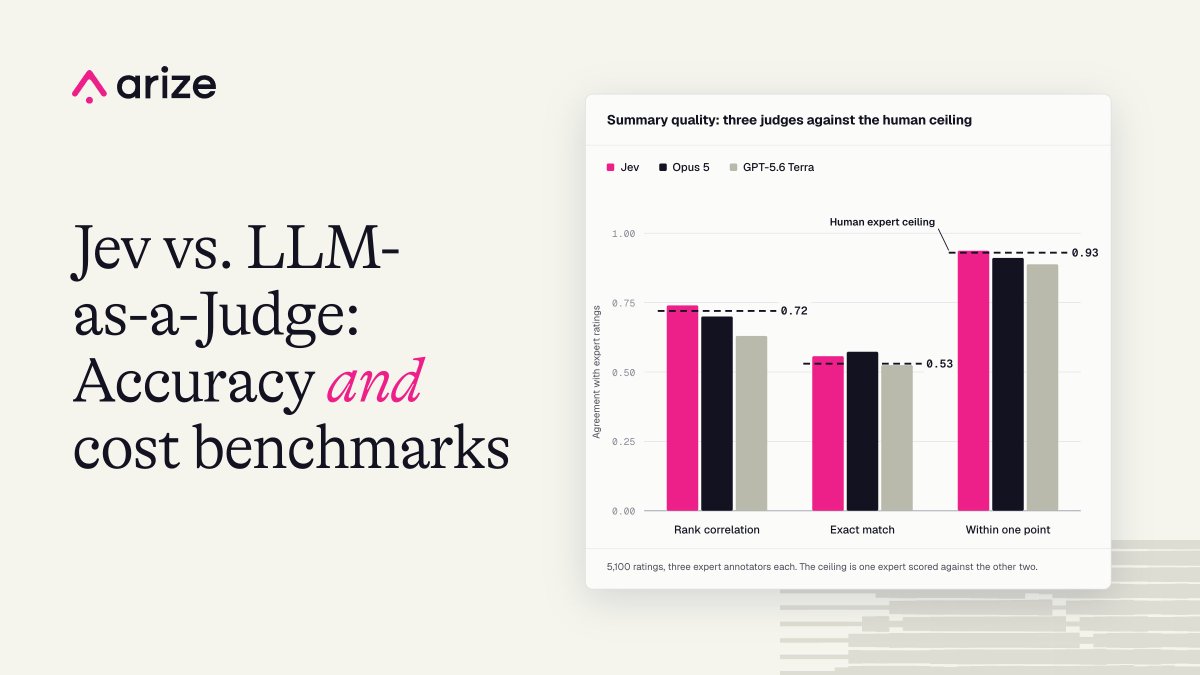
@seldo compared Jev, Claude Opus 5, and GPT-5.6 Terra with 23,325 judgments on accuracy, cost, latency, and calibration.
We found that Jev matched Claude Opus 5 at 87% hallucination-detection accuracy while running 23x faster and at roughly 1/300 the cost.
https://t.co/oOKt8kSJiR