"Canada’s story gets even more depressing when only young people under 25 are counted. The country then falls to 71st, another new low. Young people were once, on average, the happiest Canadian cohort; now they’re the most miserable.
And when compared to 136 countries, that 10-year drop in life satisfaction is one of the largest in the world, placing Canada just four slots from the bottom."
To my X followers,
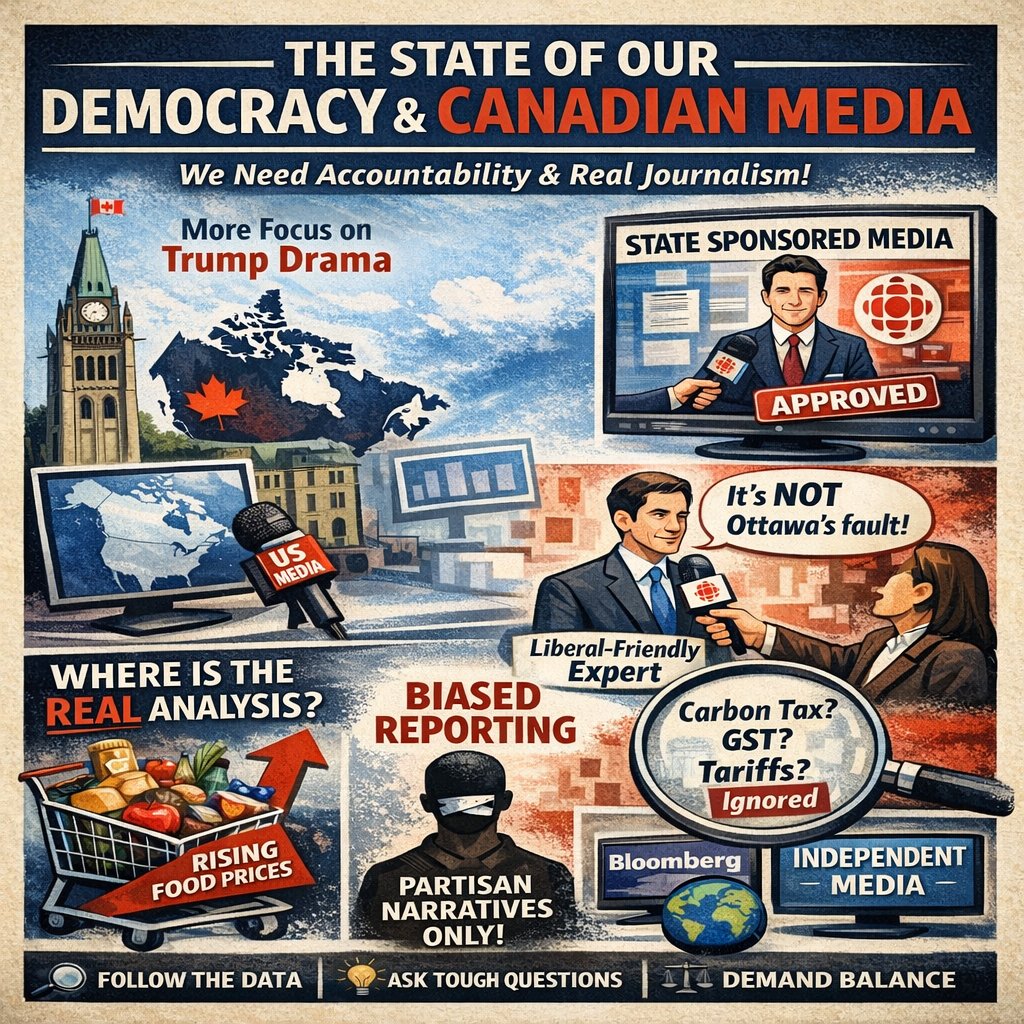
I’ve worked with the media for nearly 25 years. For most of that time, the relationship was professional and balanced. But in recent years, something has shifted.
I am increasingly concerned about the state of our democracy — particularly how media, in general, are informing Canadians about food policy, food inflation, and economic policy.
I now find myself learning more about Canada’s economy and policy changes from American outlets than from Canadian ones. Much of our national coverage feels reactive, shallow, or overly fixated on partisan narratives rather than substantive policy analysis.
What troubles me most is the lack of scrutiny applied evenly across governments and institutions.
For example, when the Bank of Canada suggested that Ottawa’s counter-tariffs contributed to food inflation, only one major outlet — Bloomberg — gave it meaningful coverage. The grocery benefit program received very little examination regarding how it would be financed. It took days before anyone pressed for clarity.
During the latest spike in food inflation, several outlets turned to the same small circle of commentators who dismissed any potential role of federal policy — carbon pricing, GST holidays, counter-tariffs — despite mounting evidence that policy decisions can and do affect food prices.
Instead of investigating structural drivers of inflation, much of the coverage focuses on fact-checking opposition rhetoric, even though the opposition has not governed since 2015. Scrutiny should be applied equally — not selectively.
Quebec media, while imperfect, appear to have maintained a broader range of debate. In much of the rest of Canada, I see increasing concentration of voices — often from the same region, Ontario, often reflecting similar policy perspectives — and less diversity of thought grounded in empirical research.
This isn’t about partisan politics. It’s about accountability, transparency, and healthy democratic discourse.
Media are under financial pressure — that’s real. But public trust depends on independence and depth. Subsidy structures, incentives, and newsroom economics all matter.
Canada deserves stronger policy journalism — especially on food affordability, supply chains, and economic resilience.
We need more data-driven analysis, more intellectual diversity, and more courage to ask uncomfortable questions — regardless of which party is in power.
Until that happens, Canadians would be wise to diversify their news sources and think critically about what they’re being told — and what they’re not.
While Mark Carney takes money away from Canada’s farmers, he’s given:
$19 billion to his consultant cronies,
$8 million for gender-just rice farming in Vietnam,
and $22 million to beans for women for empowerment in the Congo.
Conservatives will continue to fight for Canada’s farmers so that they can continue to feed our great country.
There is an enormous scandal brewing at @IRB_Canada. Canadians are being screwed by massive fraudulent asylum claims, and it all relates to terrible incentive structures.
The thread below is email correspondence from a whistle-blower employee.
1/
Islamic regime official in Iran: “We poured millions into spreading Islam in Japan. After six years, only one person converted, and he was not even Japanese.”
Jordan Peterson lost his licence as a psychologist because he said things like calling a local politician an "appalling self-righteous moralizing thing."
But this psychotherapist literally cheers for a terrorist murderer -- no problem.
Would you want to be a Jew in her "care"?
A Wake up call!
Canada has seen this movie before. and it did not end well.
In the 1980s, when the United States under Ronald Reagan pivoted decisively toward supply-side economics and pro-growth reform, Canada chose the opposite path. Rather than adapting to the new North American reality, the Liberal Party and Pierre Elliott Trudeau leaned into a narrative that cast the U.S. as the villain and used that resentment to justify doubling down on progressive, interventionist policy. And unfortunately, the Canadian electorate bought it.
The result was not moral victory, but national decline. Of historic proportions!
As the U.S. unleashed investment, cut taxes, and reoriented its economy toward competitiveness and productivity, Canada sank deeper into high-tax, high-spend, anti-growth orthodoxy. By the early 1990s, the country was widely regarded as a fiscal basket case, an honorary member of the Third World in the eyes of global markets and institutions. Sovereignty rhetoric did not protect Canada from the brutal reality of debt, stagnation, and lost credibility.
Global Capital markets are unforgiving, and will not buy the Proformative policy’s and moral virtue signalling that many Canadians are apt to fall for.
At the same time, today’s Bank of Canada governor Tiff Macklem appears to be following in the footsteps of John Crow, reprising a hardline, backward-looking central banking mindset just as the global regime is shifting under his feet.
Today, the script is being dusted off. Mark Carney and the current Liberal establishment appear intent on replaying the PET playbook: demonize a resurgent, supply-side America; cling to progressive dogma; and subordinate growth to ideological vanity. It is a dangerous delusion. In an era of deglobalization, reindustrialization, and strategic competition, a Canada that chooses post-national lectures over hard-nosed economic alignment will not be admired, it will be marginalized.
The warning is stark: if Canada insists on repeating the 1980s error in a far less forgiving world, it should expect a harsher verdict than “honorary Third World.” This time, there may be no easy way back.
@2012steveg@BenRabidoux He accepted 20,000 international students between 2023-2024 but only 2,000 domestic students. My friend's kid was one of the ones rejected. He deserves thr backlash
🚨 Australia declares India as "high risk country". Indian students will now face harsher scrutiny to get visa.
— According to data, more than 77% Indian students fail to return to India after completing their degrees.
🚨BREAKING: THE UK, AUSTRALIA, AND CANADA ARE WORKING TOGETHER TO BAN 𝕏 🇬🇧 🇦🇺 🇨🇦
The three leaders have held talks tonight to BAN @elonmusk's app. They say it is due to Grok AI image generation, but we all know it is an attack on our free speech ⚠️
We MUST fight this❗️