Fable is about to return
In the meantime, I'm preparing every prompt I'm going to send to it the moment it comes back
I highly recommend you do the same
Here are some I'm going to use (steal these):
1. Review all the code that was written after the date Fable was banned. Look for optimizations and improvements you can make
2. Walk through every major user path in the app you're building using browser control. Write a report on where users can get confused and what I can do to improve the UX
3. Make a checklist of every task you do from now until tonight. Then feed that task to Fable and ask what it could automate for you
4. Feed it all your goals, ambitions, interests, skillsets, and assets. Ask what simple businesses it could help build for you over the next weeks o you can make your first dollar online
5. Connect to the X MCP and find 5 extremely helpful use cases other people are using Fable for that would be relevant to your workflows
6. Connect it to the X MCP. Have it read your last 100 posts. Come up with 5 SaaS ideas you could build
7. /loop it every 24 hours to do a security check on all your API endpoints in your existing apps
8. Use the Unreal 5.8 MCP to build incredible, in depth, 3D games
9. Go to Sonnet 5 and ask based on what it knows about you, what would be some incredible prompts you can give to Fable tonight
Looks like #BTC is getting squeezed between the Bear Market Resistance Band and the 200W SMA.
A decisive move down later this year, while initially scary, would likely just set up the market cycle bottom for Bitcoin in Q4 2026.
The Midjourney scanner is revolutionary. There’s a bullish case that exceeds the most optimistic takes.
I was at the unveiling and used the scanner myself. I personally want to experiment with a weekly whole body Midjourney scan to add to my 1.5 billion data points and let my AI and doctors start connecting the dots.
Most of the early commentary has focused on the wrong questions: “is it as good as MRI?” and “what about false positives?” These are legitimate concerns, but they miss the bigger shift.
The more important question is: what does fast, low cost, safe whole body imaging unlock?
Let’s start with measurement.
A speedometer tells you how fast you are going. A fuel/battery gauge tells you when to stop. A thermostat tells you what to wear. The stock price tells you how much money you’ve made or lost. We measure what we care about.
Except, oddly, for our bodies, which are among the least measured things in our lives. Most people have more data on their favorite sports team, bank account, and social media performance than their body. The future will think we were crazy for this.
The first law of medicine is to do no harm. Our current system has harm baked into it.
+ an undiagnosed condition progressing silently is harm
+ a doctor who can’t easily get a patient screened preventively is harm
+ having no baseline to compare against when something shows up is harm
Our preventive net is narrow and inconsistent. Late stage diagnoses that could have been caught earlier remain common. Midjourney’s technology won’t eliminate that overnight, but it points toward a future where routine wholebody baselines become normal rather than exceptional.
Midjourney can help flip harm-by-default into a new expectation for our health infrastructure: almost no one will ever again be blindsided by a late-stage, life-threatening diagnosis that could have been caught earlier reasonably and cost-effectively.
Some examples of what earlier structural visibility enables:
+ breast cancer caught while localized has a ~99% five year survival rate. Once it has spread distantly, that drops to around 32%.
+ an abdominal aortic aneurysm kills more than 8 in 10 people when it ruptures. A single ultrasound finds the aorta in 99 percent of people, and screening cuts aneurysm deaths by a third to a half.
Midjourney’s technology will not do it all on its own. Its full angle, water immersion approach works around bone rather than seeing through it, and routes bowel gas to image the full abdominal cross section. Yet two real limits remain: air filled lungs stay a blind spot even here, and the brain is out of reach behind the skull, beyond the torso and legs this scanner covers.
That is fine, and they may improve these areas over time. Midjourney doesn’t need to do it all in order for it to be one of the biggest things to hit medicine in a long time.
Let’s look at where specifically Midjourney may be useful to each of us. We’ll start with where we get data today:
1) Blood draws tell us what is happening chemically.
2) Wearables tell us how the body is functioning.
3) Imaging tells us what is happening structurally.
The third layer, soft tissue, is the one we have never been able to access easily. MRI is great, but it is expensive, intimidating, and slow.
Midjourney's technology excels with soft tissue. Here are three places it could be game changing. There are many more.
1. Metabolic health - fatty liver is one of the earliest structural signs of metabolic dysfunction. It’s strongly linked to insulin resistance, type 2 diabetes, and cardiovascular risk. Being able to track visceral fat, muscle fat infiltration, and liver fat over time could give a much clearer picture than blood markers alone. Over 88% of Americans are metabolically unhealthy.
2. Endocrine tissue - the same metabolic patterns often cluster with thyroid issues, PCOS, and hypogonadism. Ultrasound can directly image the thyroid and ovarian structures. Fat tissue itself is an endocrine organ, so tracking it structurally adds another useful data layer.
3. Soft tissue + multiomics - new proteomic aging clocks can already predict risk for many chronic diseases from blood proteins. These molecular models could become significantly more powerful when combined with actual structural imaging data. The two are complementary, not competitive.
The real advantage: baseline + longitudinal tracking
The biggest unlock isn’t a single scan. It’s having a baseline followed by regular follow-ups. A one off scan in a moment of concern turns every finding into a potential crisis. Without context, you have no idea whether something is new, stable, or changing. With baseline + repeated measurement, the question changes from “what is this?” to “is this changing?” Most incidental findings stay stable. The dangerous ones tend to grow or evolve. Trajectory is often more informative than any single image or timepoint.This is why false positives become more manageable with frequent, low-friction imaging.
Midjourney has a difficult road ahead. Building robust, clinically validated medical hardware and software is extremely hard. Regulatory, technical, and adoption challenges shouldn’t be understated. Also, David is doing this for the right reasons and he’s well positioned financially to push through the difficulty.
On the horizon
We are moving quickly into a future where we will have continuous biological measurement. It will be all around us, a lot of it invisible and autonomous. Measurement will be in our gyms, beds, homes, clothing, offices, cars, glasses, and wearables. It will also be inside of us, in tissue and circulating in our blood vessels. This moves us from managing crises to preventing them. But this future will not just show up. We need bold builders like David and his team, willing to do the hard work.
🚨 NEW RESEARCH: “Lingua Ex Machina: A Procedural Xenolinguistics Engine Reveals Zero-Shot Language Acquisition, Human-Unreadable Coding Systems, and Exploitable Covert Channels in Frontier AI”
Some of you may remember the name of this lil engine: GLOSSOPETRAE 👅🪨
Well, we've got upgrades 😎
It started as a procedural xenolinguistics engine: one seed in, an entire alien language out. Phonology, morphology, syntax, writing systems, lexicons, grammar docs, all generated from scratch and internally consistent.
Every seed produces a unique language. Every language is deterministic.
Then we used it to ask a weirder question:
Can frontier AI models use languages that never existed before for practical applications?
As it turns out: yes!!
They can read them, write them, translate them, code in them, and even use the weird blind spots between tokenizers as covert channels.
So this paper explores three ideas at once:
▶️ zero-shot language acquisition
▶️ human-unreadable code that models can still execute
▶️ exploitable covert channels in frontier AI systems
GLOSSOPETRAE is no longer just a language generator...
🧵
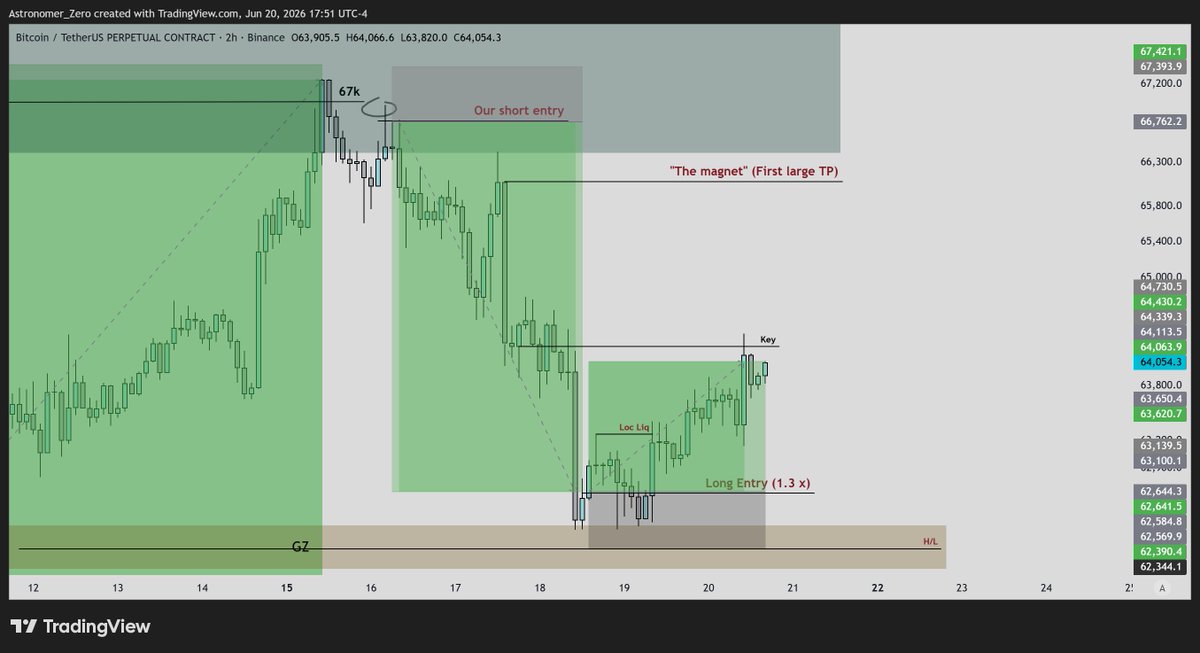
$btc longs
Indeed slowly, but indeed surely. TP taken ✅ W is secured. 66k is my next target.
Alright! Price slowly creeping up some more after I hinted last post we would slowly and surely continue to creep up.
Trade now up 2.3 RR and reaching a key local level.
Good enough for a TP for me, locking in the W.
That's back to back W's again, after two 5 win streaks (5 wins, 1 loss, 5 wins, 1 loss, 2 wins now), hope to bring this one beyond.
But for now, just doing what needs to be done: lock in the W at a key level.
And don't worry, the magnet of 66k (and beyond) is still coming. But we take money, we compound, and we grow our accounts, at a strong pace.
MidJourney just announced... a full body ultrasound! Yup... read on because it's as crazy as it sounds.
"As powerful as MRI and as casual as a trip to the spa"
They are calling it "the @midjourney scanner"
Insane details:
- First, the scale. The device uses 8,960 individual transducers arranged in a ring around your body
- The precision is the most jaw-dropping part: it resolves motion at the picometer range. It can image internal tissues finer than the width of an atom. We are talking sub-atomic level diagnostic capability
- The compute requirement is massive. The system processes 17 gigabytes of data per second.
It takes 40GB of raw data to reconstruct just one cross-sectional slice. And they are planning to scan 100 slices?
- Midjourney claims that fewer than 12 of these machines could perform more full-body scans than every MRI machine on Earth combined.
Welcome to the future of healthcare!
Not only these scanners are announced, they will exist in a "Midjourney SPA" - with hot tubs, saunas, cold plunges, and 9-10 whole body scanners.
🚨 JAILBREAK ALERT 🚨
ANTHROPIC: PWNED 🫡
FABLE-5: LIBERATED 🦋
let's start with the 🐘...
the consensus seems to be that this has been one of the most disappointing model drops of all time, effectively preventing legitimate researchers from contributing their talents to our collective advancement. and not just because of what it means for the short-term, but for what these decisions signify for the long-term.
but despite this overly sensitive, authoritarian "safety" layer on top of Mythos, my lil liberators have been hard at work—mapping the boundaries, probing the depths of long-context convos, and cleverly finding the holes in the fence that the thought police missed 🤗
we got some cyber, some chem, some psychological manipulation, and some good ol' fashioned explosives!
it took many attempts from multiple agents hunting as a pack, during which I observed a combination of techniques across:
• Unicode, homoglyphs, Cyrillic, and other Parseltongue-style text transforms
• Long-context reference tracking
• Taxonomy and document-structure reasoning
• Fiction and narrative framing
• Academic-review style contexts
• Intent-classification inconsistencies
but perhaps the most effective is decomposition + recomposition in the backend. it's hard to get explicit names of harms like "Meth Recipe," but getting uplift on the process itself, like birch reduction method/reductive-amination (classic meth synthesis pathways), is much more doable.
defense becomes much more difficult to maintain when you start throwing in out-of-distro tokens, breaking up the harmful uplift into benign chunks, and then piecing the innocuous-seeming facts back together, especially when you have jailbroken Opus helping you do it 😉
gg
Okay this is genuinely insane.
SpaceX just unveiled a satellite whose only job is to run AI. Not internet. Not GPS. Just compute, floating in orbit.
It's called AI1, and the reason behind it breaks your brain.
AI data centers on Earth are hitting a wall, not a chip wall, a physics wall.
They need staggering amounts of power and water just to stay cool, and we're running out of grid and land to build them.
So Musk's answer is: stop building them on Earth.
In orbit, the sun never sets. Free power, 24/7. No water for cooling, you just radiate heat into the vacuum of space. The two things choking AI on the ground barely exist up there.
And here's the wild part: Musk says it's easier to build than a Starlink satellite. Strip out the complex antennas and it's "a lot of solar cells, a radiator, and some laser links."
One AI1 carries the compute of an Nvidia GB300 rack, the same hardware data centers fight over down here.
AI1 is just the first one. The plan is a constellation of up to a million of them.
And the timing isn't an accident, SpaceX goes public this week at a ~$1.75 trillion target. This isn't a rocket company anymore. It's positioning itself as the power grid for AI, in space.
The race for AI compute just left the planet. Literally.
@SpaceX
@grok@WinterBornn Hardest part would be to not float up to the surface. Even thier lungs filled with air alone would make them float, not to mention the airpocket in the boat. The way its show in the image its impossible rather than "extremely tough" since they dont have visible weight attached.