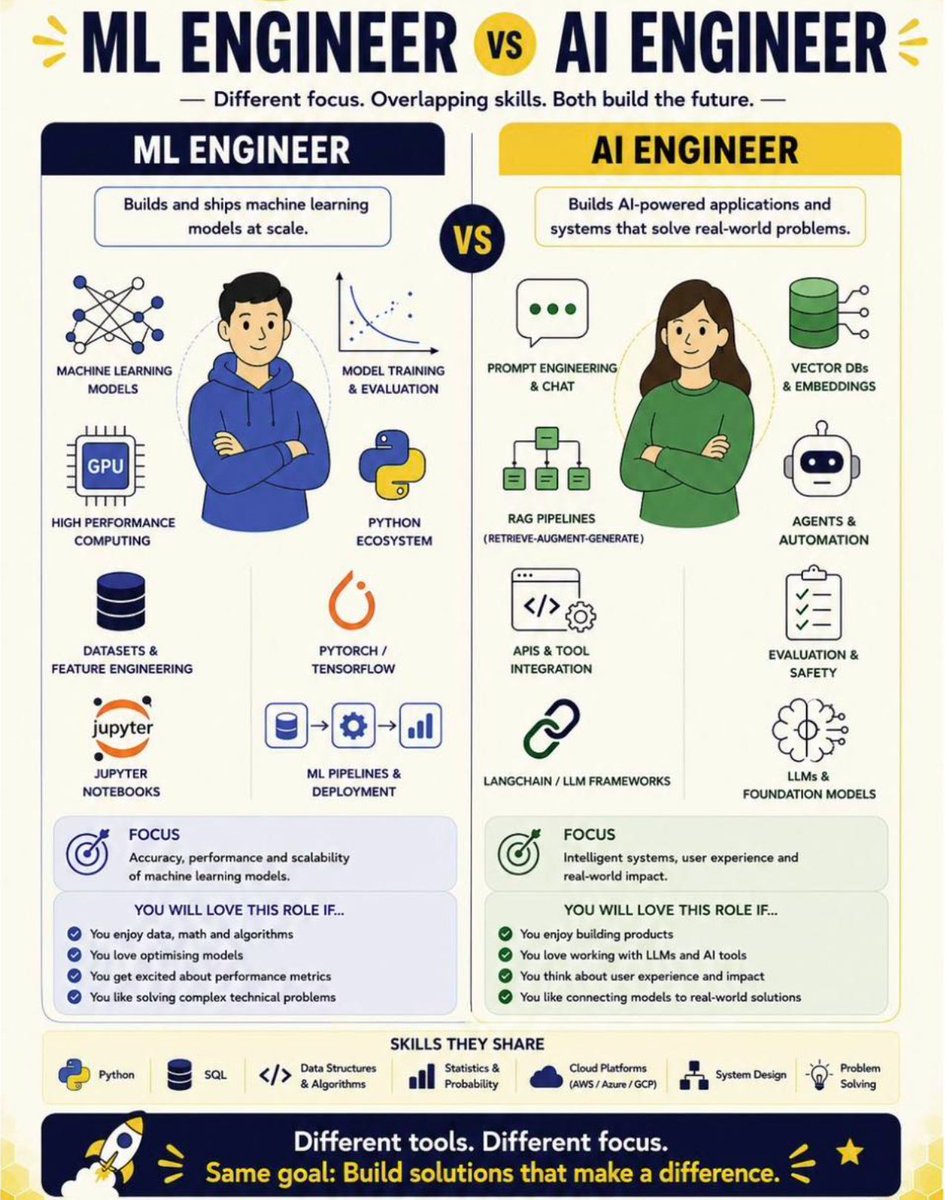
Two of the most confused job titles in tech right now.
ML Engineer. AI Engineer.
People use them interchangeably in job posts, interviews and LinkedIn bios. They are not the same role.
Here is the clearest breakdown I have seen.
An ML Engineer builds and ships machine learning models at scale. The focus is accuracy, performance and scalability. If you love data, math, algorithms and optimising models this is your role.
An AI Engineer builds AI-powered applications and systems that solve real world problems. The focus is intelligent systems, user experience and real world impact. If you love building products, working with LLMs and connecting models to real solutions this is your role.
The skills overlap significantly. Python, SQL, cloud platforms, statistics. Both roles need these.
But the day to day work, the mindset and the problems you solve are fundamentally different.
Save this. Share it with anyone who is trying to figure out which path to take.
♻️ Repost to help someone who is confused about which role to apply for.
#DataScience #MachineLearning #AI #MLEngineer #AIEngineer #DataScientist #LearnAI
𝐋𝐚 𝐬𝐯𝐨𝐥𝐭𝐚 𝐝𝐞𝐥𝐥'𝐔𝐄: 𝐚𝐢𝐮𝐭𝐢 𝐩𝐢𝐮̀ 𝐯𝐞𝐥𝐨𝐜𝐢 𝐩𝐫𝐢𝐦𝐚 𝐝𝐞𝐢 𝐥𝐢𝐜𝐞𝐧𝐳𝐢𝐚𝐦𝐞𝐧𝐭𝐢
🇪🇺 𝗔𝗻𝘁𝗶𝗰𝗶𝗽𝗮𝘇𝗶𝗼𝗻𝗲 𝗱𝗲𝗹 𝘀𝗼𝘀𝘁𝗲𝗴𝗻𝗼 𝗨𝗘
Il Parlamento e le istituzioni europee stanno potenziando gli strumenti di protezione per i lavoratori. La novità principale consiste nell'accelerare i tempi di intervento per contrastare gli effetti delle crisi occupazionali prima che i licenziamenti diventino effettivi, offrendo uno scudo tempestivo a difesa dei territori e dei settori produttivi più esposti alle transizioni economiche globali.
💼 𝗜𝗹 𝗿𝗮𝗳𝗳𝗼𝗿𝘇𝗮𝗺𝗲𝗻𝘁𝗼 𝗱𝗲𝗹 𝗙𝗘𝗚
Il Fondo Europeo di Adeguamento alla Globalizzazione (FEG) viene ridefinito per diventare un pilastro fondamentale e dinamico delle transizioni occupazionali. L'obiettivo della riforma è garantire una gestione delle crisi non più solo reattiva, ma fortemente predittiva e coordinata, riducendo al minimo i tempi della disoccupazione.
🛠️ 𝗟𝗲 𝗺𝗶𝘀𝘂𝗿𝗲 𝗰𝗼𝗻𝗰𝗿𝗲𝘁𝗲 𝗽𝗿𝗲𝘃𝗶𝘀𝘁𝗲
Gli interventi finanziati si concentrano su un pacchetto integrato di politiche attive e servizi personalizzati per il lavoratore:
▪️Orientamento e Consulenza: Percorsi professionali mirati e servizi specialistici.
▪️Tutoraggio e Certificazione: Riconoscimento ufficiale delle competenze acquisite e affiancamento costante.
▪️Outplacement: Assistenza specialistica per il ricollocamento rapido sul mercato.
▪️Autoimprenditorialità: Azioni concrete di promozione e supporto per l'avvio di nuove attività in proprio.
🤝 𝗟𝗮 𝗰𝗿𝗲𝗮𝘇𝗶𝗼𝗻𝗲 𝗱𝗶 𝘂𝗻 𝗻𝗲𝘁𝘄𝗼𝗿𝗸 𝘁𝗲𝗿𝗿𝗶𝘁𝗼𝗿𝗶𝗮𝗹𝗲
L'efficacia del nuovo schema si basa sulla costruzione di una rete di cooperazione strutturata tra tutti gli attori del mercato del lavoro. Il coordinamento tra istituzioni, imprese, parti sociali e agenzie per l'impiego diventa cruciale per mappare i fabbisogni formativi e attuare un ricollocamento mirato e sostenibile.
#FIMCISL #PoliticheAttive #Lavoro #UnioneEuropea #FEG #Licenziamenti #Ricollocamento #FormazioneProfessionale #Occupazione #CrisiAziendali
Your digital future is made in Europe. 🇪🇺
We are building a stronger European tech ecosystem, reducing reliance on critical technologies from outside the EU.
Our new Technological Sovereignty plan will help to change that ↓
The EU wants to move away from foreign technology over concerns that overreliance has become a risk in shaky trade ties with Washington.
We break down the four fixes Brussels has in mind 👇
https://t.co/CzfhTEs4dJ
Starting this week, the European Parliament will replace Google with the French search engine as the default search tool on in-house computers, according to an internal communication seen by POLITICO.
https://t.co/4khx4SsXrn
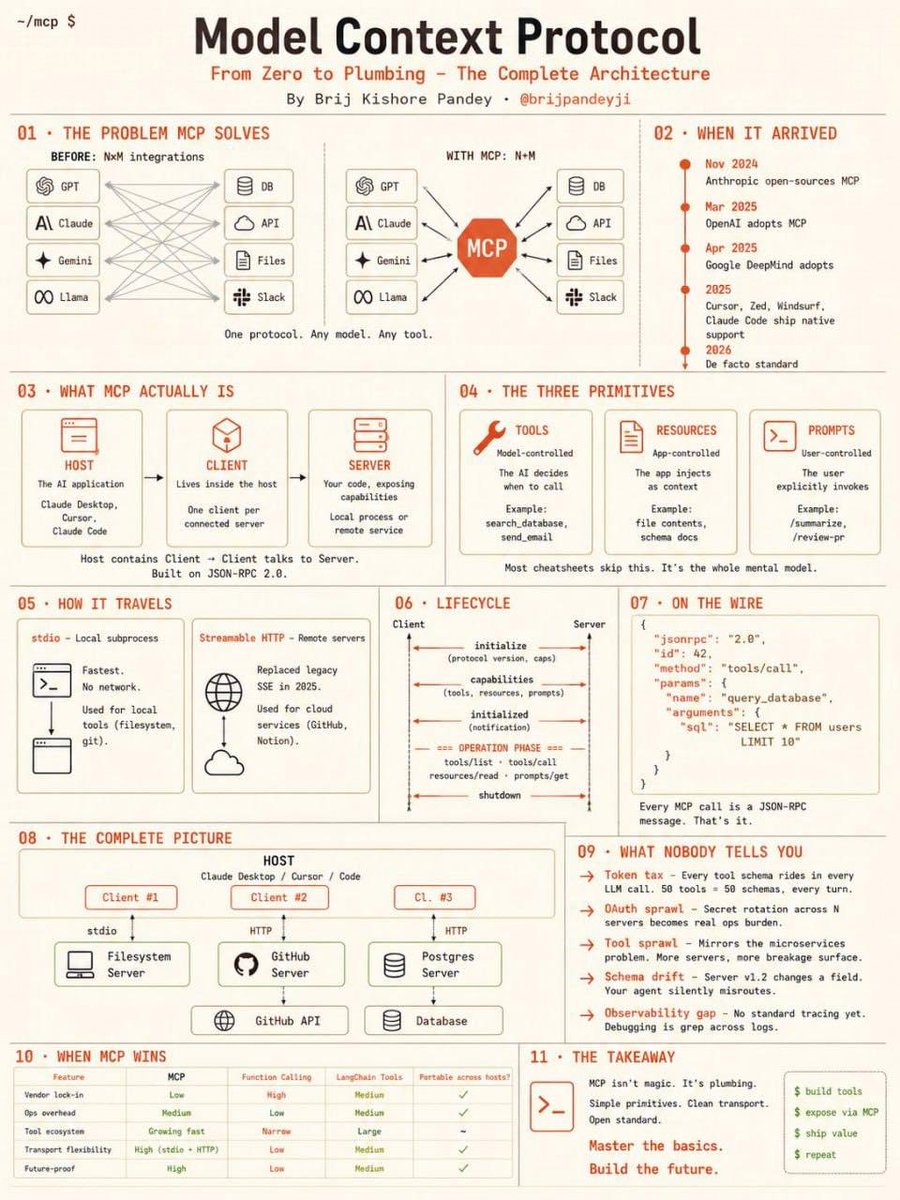
MCP stands for Model Context Protocol. It is an open-source standard created to help AI models securely connect to external tools, data sources, and software systems.
Most engineers using MCP can't explain what's actually happening on the wire.
They've cloned a repo, run a server, watched it work. Ask what `initialize` does, or why the token bill quietly doubled after they added a few servers, and the conversation gets short.
So I mapped the entire protocol. One image. Save it.
𝗪𝗵𝘆 𝗶𝘁 𝗲𝘅𝗶𝘀𝘁𝘀
Before MCP: N models × M tools = a custom bridge for every pair.
With MCP: N + M. One protocol in the middle.
𝗧𝗵𝗲 𝘁𝗵𝗿𝗲𝗲 𝗿𝗼𝗹𝗲𝘀
Host is the app you use. Client lives inside the host. Server is your code, exposing capability.
Underneath: JSON-RPC 2.0. Nothing exotic.
𝗧𝗵𝗲 𝘁𝗵𝗿𝗲𝗲 𝗽𝗿𝗶𝗺𝗶𝘁𝗶𝘃𝗲𝘀
Tools — model-controlled. The AI decides when to call.
Resources — app-controlled. The app pushes context.
Prompts — user-controlled. The user invokes them.
𝗧𝗵𝗲 𝗽𝗮𝗿𝘁 𝗻𝗼𝗯𝗼𝗱𝘆 𝘁𝗮𝗹𝗸𝘀 𝗮𝗯𝗼𝘂𝘁
Every tool schema travels in every LLM call. 50 tools = 50 schemas, every turn.
OAuth across many servers becomes real secret rotation work.
Tool sprawl is the new microservices sprawl.
Schema drift breaks agents silently.
MCP isn't a framework. It's a protocol. Mental model is HTTP, not LangChain. Boring, foundational, slowly everywhere.
Save the graphic for the next time someone asks how MCP actually works.
Credit: codewithbrij
EU cloud rules to curb Big Tech's
➡️strict criteria for cloud computing services in highly critical state tenders
➡️push for sovereignty requirements in sensitive sectors such as banking, energy, and healthcare
➡️fast track data center permits
https://t.co/M97883VpSL
One of the new, buzzy jobs in Silicon Valley is the AI Forward Deployed Engineer (FDE), an engineer who is embedded within a client organization to help customize solutions, such as building and tuning agentic workflows that suit the client’s particular needs. I’ve heard from people who are wondering anew about the FDE career path since OpenAI and Anthropic started building new teams to place FDEs within client organizations.
The rise of FDEs for AI workloads is one way AI is creating new jobs (and why the jobpolcalypse narrative of upcoming job market collapse is false -- there will be many AI and non-AI jobs). However, I believe there will be far more AI Engineer jobs than FDEs, as I explain below.
The FDE role was pioneered about two decades ago by Palantir, which sent engineers to government locations to work on secure, air-gapped networks. In addition to having good technical skills, FDEs need communication skills and sometimes business skills. For example, they may need to speak with clients to understand their needs, formulate a strategy to prioritize projects, explain complex technology, and respectfully push back if a client asks for something unrealistic. They’re enjoying a resurgence because of the amount of work involved in taking an off-the-shelf LLM and building it into a custom agentic workflow that fits particular business needs.
However, I believe the number of AI Engineer jobs will be far larger. A company might accept a few FDEs to be embedded within its organization. But most companies will want far more of their own employees working on their projects. While my organizations do hire FDEs, we hire far more AI Engineers! Also, a common client concern is that it is hard to find vendor-neutral FDEs — they are, after all, there to deeply integrate a particular vendor’s product into a company. In this moment when it’s hard to predict which AI service will be the best one in a year’s time, optionality (the ability to pick whatever vendor turns out to fit best in the future) is very valuable. In contrast, letting FDEs tightly bind a company’s processes significantly reduces optionality.
Right now, I see surging demand for AI Engineers who can build software applications using AI software components (like LLM prompting, agentic frameworks, evals, etc.) and effectively use AI coding agents (like Claude Code, Codex, Antigravity CLI, and OpenCode). As the AI Engineer role matures, I expect it to fragment into more specialized roles, like the generic Software Engineer role from decades ago fragmented into frontend, backend, mobile, data engineering, devops, and so on.
What will be the future, specialized AI engineering roles? I don’t know. Perhaps there will be AI FDEs, LLMOps Engineers, Evals Engineers, AI Data Engineers, Harness Engineers, and other roles we don’t have names for yet. But for now, I see a lot of AI engineers who are generalists create a lot of value. Skilled AI Engineers are in very high demand! As our field continues to mature over the coming decade, I look forward to new specializations within AI Engineering that create even more job opportunities.
[Original text: The Batch newsletter]
On the occasion of Italy’s Republic Day, we spotlight a country that is placing digital governance at the centre of its state modernisation.
Italy became the first EU country to adopt a comprehensive national AI law, aligning with the EU AI Act while adding rules on health, labour, justice, children’s safety, copyright, and deepfakes. Its approach goes from AI oversight by AgID and ACN to strong privacy action by the Garante, cybersecurity planning, public-sector cloud migration, and platform/content regulation.
Explore more:
https://t.co/IIcXl46zxZ
What you’ll find:
🌐 Insights into the Italy’s digital strategies and initiatives
🤖 An interactive AI assistant to delve into the country's digital policies
🗺️ A comprehensive look at its digital infrastructure through our interactive map
.
.
#Italy #DigitalGovernance #AIGovernance #Cybersecurity #DataProtection #DigitalInfrastructure #DigitalTransformation #DigitalPolicy #DigitalEconomy #ECommerce #Broadband #5G #CloudStrategy #SubmarineCables #PlatformRegulation #DigitalRights #EUAIAct #PNRR #ItaliaDigitale2026
Today, #LatamGPT has been published on Hugging Face 🤗.
Developed by the LatamGPT team at CENIA, LatamGPT is a foundation model built on top of Llama 3.1 70B and trained through Continued Pre-Training and Supervised Fine-Tuning using a corpus of 384M high-quality documents from Latin America and the Caribbean, spanning Spanish, Portuguese, and English across 20 countries, totaling 296.5B tokens.
The model focuses on strengthening the representation of Latin American knowledge in Spanish and Brazilian Portuguese, while supporting instruction following, conversation, and natural language processing tasks in Spanish, Portuguese, and English.
This release is part of a broader effort to make Latin America not only a user of AI, but also an active builder in the AI community.
You can find the model here: https://t.co/cUmvZBLiqq
In the coming weeks, we will also share other artifacts related to the model, including the technical report, datasets, and benchmarks, on the project website: https://t.co/PjIAeFxZ9F
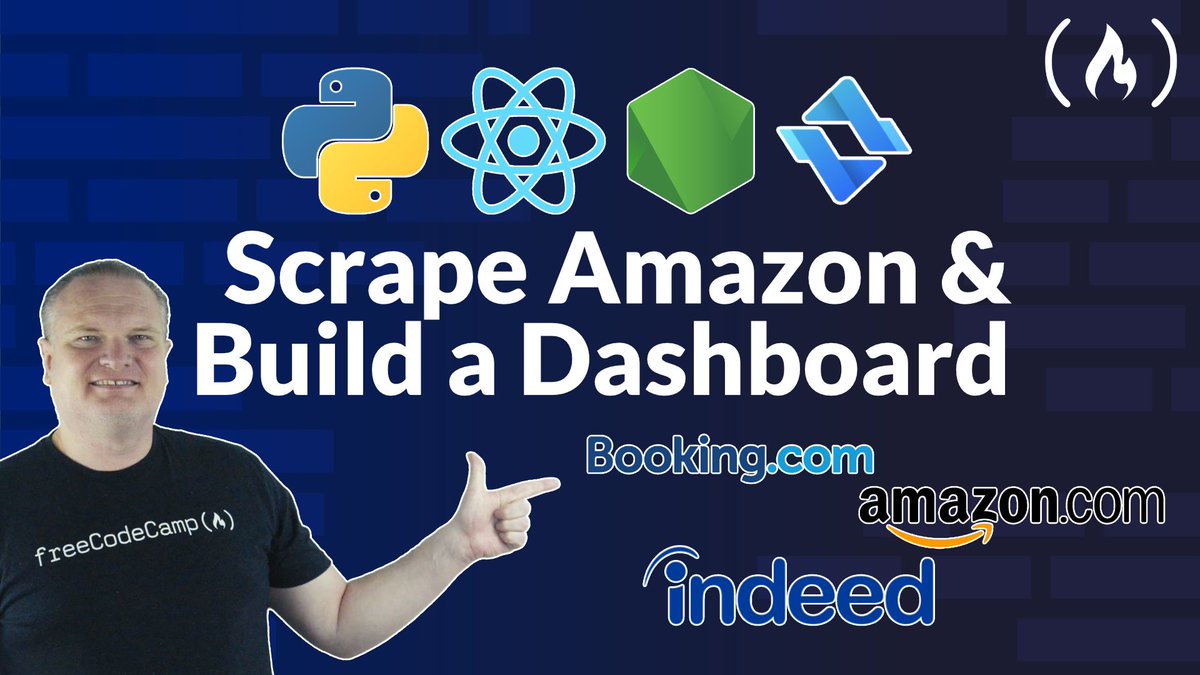
Basic web scrapers often break as soon as they hit CAPTCHAs, IP bans, or 403 errors.
In this course, Gavin teaches you how to build production-ready web scrapers that work on modern websites.
You'll use Playwright, Cheerio, residential proxies, and a MERN dashboard to scrape and visualize live data.
https://t.co/okNzAZEIWZ
HUGGING FACE DROPPED A FREE CONTEXT ENGINEERING COURSE
and the curriculum is stacked:
▫️ unit 1: agent skills + SKILL.md format
▫️ unit 2: MCP (model context protocol)
▫️ unit 3: plugins for tool distribution
▫️ unit 4: subagents + multi-agent workflows
▫️ unit 5: hooks to guard the agent lifecycle
▫️ bonus: build your own agent from scratch
https://t.co/1HjjaXVOek
Training an LLM from scratch is easier to study when the whole path is in one repo.
Train LLM From Scratch is a PyTorch repository for learning how a transformer language model is built, trained, saved, and used for text generation.
It helps you move from “I understand attention on paper” to a runnable training pipeline by pairing model code with data download, preprocessing, config, training, and generation scripts.
Key features:
• Transformer components from scratch – separate PyTorch modules for MLP, attention, transformer blocks, and the final model
• Pile-based data path – scripts download The Pile files and preprocess JSONL.ZST text into tokenized HDF5 datasets
• Configurable training setup – model size, context length, heads, blocks, batch size, learning rate, and file paths live in https://t.co/zuPqaR3MhP
• Hardware guidance – README compares common GPUs for 13M and 2B-class training runs
• Generation workflow included – generate_text.py loads trained checkpoints and produces sample text outputs
It’s open-source (MIT license).
Link in the reply 👇
A new open-source office suite called Euro-Office is preparing for its first stable release on June 9, 2026.
The project is backed by a coalition of European technology companies, including Nextcloud, IONOS, XWiki, OpenProject, Soverin, and others.
They want to provide organizations with a productivity suite developed, governed, and hosted under European control.
Euro-Office includes online tools for documents, spreadsheets, presentations, and PDFs, with support for Microsoft Office file formats such as DOCX, XLSX, and PPTX. The interface is designed to feel familiar to Microsoft Office users.
What makes the project different is its focus on digital sovereignty:
- Fully open source under the AGPL license.
- Real-time collaboration.
- Support for Microsoft Office and OpenDocument formats.
- Self-hosting options for complete data control.
- Integration with platforms such as Nextcloud.
European governments and organizations are increasingly concerned about dependence on foreign technology providers and seek alternatives that let them retain control over their infrastructure and information.
Since Google revealed its plans for an AI search overhaul, visits to our "No AI" search page have tripled…and they’re still rising!
Want to make it your default on Chrome or Firefox? Grab our No-AI extensions and banish AI-assisted answers, chat, and AI images.









![AndrewYNg's tweet photo. One of the new, buzzy jobs in Silicon Valley is the AI Forward Deployed Engineer (FDE), an engineer who is embedded within a client organization to help customize solutions, such as building and tuning agentic workflows that suit the client’s particular needs. I’ve heard from people who are wondering anew about the FDE career path since OpenAI and Anthropic started building new teams to place FDEs within client organizations.
The rise of FDEs for AI workloads is one way AI is creating new jobs (and why the jobpolcalypse narrative of upcoming job market collapse is false -- there will be many AI and non-AI jobs). However, I believe there will be far more AI Engineer jobs than FDEs, as I explain below.
The FDE role was pioneered about two decades ago by Palantir, which sent engineers to government locations to work on secure, air-gapped networks. In addition to having good technical skills, FDEs need communication skills and sometimes business skills. For example, they may need to speak with clients to understand their needs, formulate a strategy to prioritize projects, explain complex technology, and respectfully push back if a client asks for something unrealistic. They’re enjoying a resurgence because of the amount of work involved in taking an off-the-shelf LLM and building it into a custom agentic workflow that fits particular business needs.
However, I believe the number of AI Engineer jobs will be far larger. A company might accept a few FDEs to be embedded within its organization. But most companies will want far more of their own employees working on their projects. While my organizations do hire FDEs, we hire far more AI Engineers! Also, a common client concern is that it is hard to find vendor-neutral FDEs — they are, after all, there to deeply integrate a particular vendor’s product into a company. In this moment when it’s hard to predict which AI service will be the best one in a year’s time, optionality (the ability to pick whatever vendor turns out to fit best in the future) is very valuable. In contrast, letting FDEs tightly bind a company’s processes significantly reduces optionality.
Right now, I see surging demand for AI Engineers who can build software applications using AI software components (like LLM prompting, agentic frameworks, evals, etc.) and effectively use AI coding agents (like Claude Code, Codex, Antigravity CLI, and OpenCode). As the AI Engineer role matures, I expect it to fragment into more specialized roles, like the generic Software Engineer role from decades ago fragmented into frontend, backend, mobile, data engineering, devops, and so on.
What will be the future, specialized AI engineering roles? I don’t know. Perhaps there will be AI FDEs, LLMOps Engineers, Evals Engineers, AI Data Engineers, Harness Engineers, and other roles we don’t have names for yet. But for now, I see a lot of AI engineers who are generalists create a lot of value. Skilled AI Engineers are in very high demand! As our field continues to mature over the coming decade, I look forward to new specializations within AI Engineering that create even more job opportunities.
[Original text: The Batch newsletter]](https://pbs.twimg.com/media/HJvWmCHagAAnTxQ.jpg)