The Fascinating Story of DeepSeek
DeepSeek’s story began with DeepSeek-Coder (2 November 2023) for programming and DeepSeek LLM (29 November 2023) for general conversation.
It soon turned toward harder problems. DeepSeekMath (introduced 5 February 2024) brought GRPO: a training method that compares groups of answers to help a model improve its mathematical reasoning.
This became an important foundation for its later reasoning models. deepseek-ai/deepseek-coder-33b-instruct
During 2024, DeepSeek focused on getting more capability from less computation. V2 (6 May 2024) combined specialist “expert” networks with Multi-head Latent Attention, which sharply reduced the memory needed to generate answers.
Coder-V2 (17 June 2024) expanded programming support to 338 languages. V2.5 (5 September 2024) brought coding and general conversation together. Then V3 (26 December 2024) scaled to 671 billion parameters while activating only 37 billion per token, using FP8 training and multi-token prediction to improve efficiency. GitHub
The next major step was reasoning. R1 and R1-Zero (20 January 2025) explored how reinforcement learning could teach models to work through difficult problems. R1-Zero developed reasoning behaviours without an initial supervised fine-tuning stage.
R1 added training that improved readability and usability, while six smaller distilled models made its reasoning approach more accessible. V3.1 (21 August 2025) later combined thinking and ordinary responses in one model.
V3.2-Exp (29 September 2025) introduced Sparse Attention for more efficient long-context processing, followed by V3.2 and V3.2-Speciale (1 December 2025), with V3.2 integrating reasoning directly into tool use. deepseek-ai/DeepSeek-R1 · GitHub
Alongside its main models, DeepSeek built a wider ecosystem. VL2 (13 December 2024) understood images, charts and documents.
Janus-Pro (27 January 2025) combined image understanding with image generation.
Prover-V2 (30 April 2025) produced mathematical proofs checked by Lean 4, while Math-V2 (27 November 2025) trained models to identify and repair weaknesses in their own proofs.
DeepSeek-OCR (20 October 2025) and OCR 2 (27 January 2026) explored reading documents through compact visual representations. GitHub
In 2026, the focus shifted toward longer context and more capable agents. V4-Pro and V4-Flash entered public preview on 24 April 2026, both supporting one million tokens of context. V4.1-Flash (10 September 2026) brought native image understanding and a new architecture that used fewer active parameters when reading input than when generating output.
The latest update, V4.1-Flash-1017 (17 October 2026), improved coding, reasoning and visual benchmarks while shortening task completion times, according to DeepSeek.
Its surrounding ecosystem now also includes DeepSeek Harness and its own Search and Fetch APIs for agents.
Speeding up Gemma!
Gemini 4 Argon enabled a 2.85x speedup on an A100 via vLLM, jumping from ~37,900 to 108,000+ tokens/sec on gemma-4-E2B-it.
✅ 100% token parity
✅ Zero quality drop
✅ Done in days, not months
See the exact changes across 8 PRs: https://t.co/oaIp2SiJMA
Introducing Fern, Mirendil’s first model: pretrained from scratch, with up to 10 million tokens of context.
That’s ~0.5M lines of code or days of an agent’s work - all in context at once.
Built for high-volume agentic work in AI R&D: auditing training data, debugging training runs from logs, and reading agent traces end to end. Fern’s next-token prediction keeps improving as context grows to 10M tokens.
Fern 0.1 is Mirendil-Base after a short round of post-training. It’s the first and smallest of three models, with two larger ones now being pretrained.
We’ll ship frequent updates and make the model available soon.
GPT-6.1 Terra: delivering fast and capable computer use at a lower price.
GPT-6.1 Terra understands what’s on screen, takes action across apps, writes naturally, and is a more capable model for your whole workday with the efficiency to take on more of it.
I built my own Siri, and it lives in my house 🏠
Talk to it from my phone, it answers in seconds. Zero cloud.
🧠 Brain: DeepSeek V4.1 Flash on 2 NVIDIA DGX Sparks
👂 Ears: Ming 3.0 ASR tiny on a Mac mini M4
🗣️ Voice: Ming 3.0 TTS 0.5B on two DGX Sparks
Repo coming soon because I'm adding to this!
Anthropic has filed an S-1 registration statement with the SEC related to its proposed IPO.
Read more: https://t.co/ofhv0DK3Zp
Legal disclaimer: A registration statement relating to these securities has been filed with the SEC but has not yet become effective. These securities may not be sold, nor may offers to buy be accepted, prior to the time the registration statement becomes effective. This post does not constitute an offer to sell or the solicitation of an offer to buy these securities, nor shall there be any sale of these securities in any state or jurisdiction in which such offer, solicitation or sale would be unlawful prior to registration or qualification under the securities laws of any such state or jurisdiction.
Meta Outlines $95 Billion Financing Plan
Meta launched approximately $35 billion in equity offerings on 26 October 2026.
These comprise $22.5 billion in Class A stock through forward sale agreements and $12.5 billion in depositary shares representing mandatory convertible preferred stock.
Meta expects to receive the common stock proceeds when those forward agreements settle.
Nvidia and AMD and Broadcom expressed nonbinding interest in buying up to $5 billion combined within the common stock offering.
Meta also proposes a $60 billion program selling nonvoting Class C shares from Q1 2027 at the earliest.
Together the plans could provide approximately $95 billion in equity financing.
Meta expects capital expenditures of $135 billion to $145 billion in 2026.
Kazakhstan GPU Project Targets Q3 2027
Firebird says it secured a US export license for 45000 Nvidia Grace Blackwell GPUs for Kazakhstan.
The first phase is under construction with Kazakhtelecom at Data Center Valley.
Firebird estimates investment at $5 billion.
The initial cluster would support up to 109 MW of capacity.
Commercial operations are targeted for Q3 2027.
A proposed second phase would bring total potential capacity to approximately 500 MW.
The company expects the project to create more than 130 permanent jobs.
It commits at least 10% of GPU capacity to Kazakhstani companies and government agencies.
Firebird also plans a local laboratory supporting startups and research through funding and computing access.
The export authorization does not confirm completed GPU deliveries.
Atria Dawn Opens Its Model Weights
Shanghai AI Laboratory released open weights for Atria Dawn.
The model builds on the GLM 5.2 mixture of experts architecture with 744 billion total parameters accepting text only.
Its 512K token context window doubles the preview version’s 256K capacity.
The model targets research and coding and document production and cybersecurity evaluation.
It combines tool use with environmental feedback to execute tasks and recover from failures.
Standard and FP8 weights are available through Hugging Face.
Both code and weights use the MIT license.
The developer reports a CyberGym score of 86.8 compared with 86.5 for the preview.
Its reported Terminal Bench 2.1 score reaches 81.0 compared with the preview’s 78.3.
it seems that AI overviews can satisfy real intent without sending the reader to the source.
An ai overvriew result, may actually lead to more queries which in effect increases the chances of more site to surfarce during search (as laid out in google's traffic trend blog report https://t.co/4t0Qo5a3mm)
interestingly google reports that total organic click volume from Google Search to websites remained stable
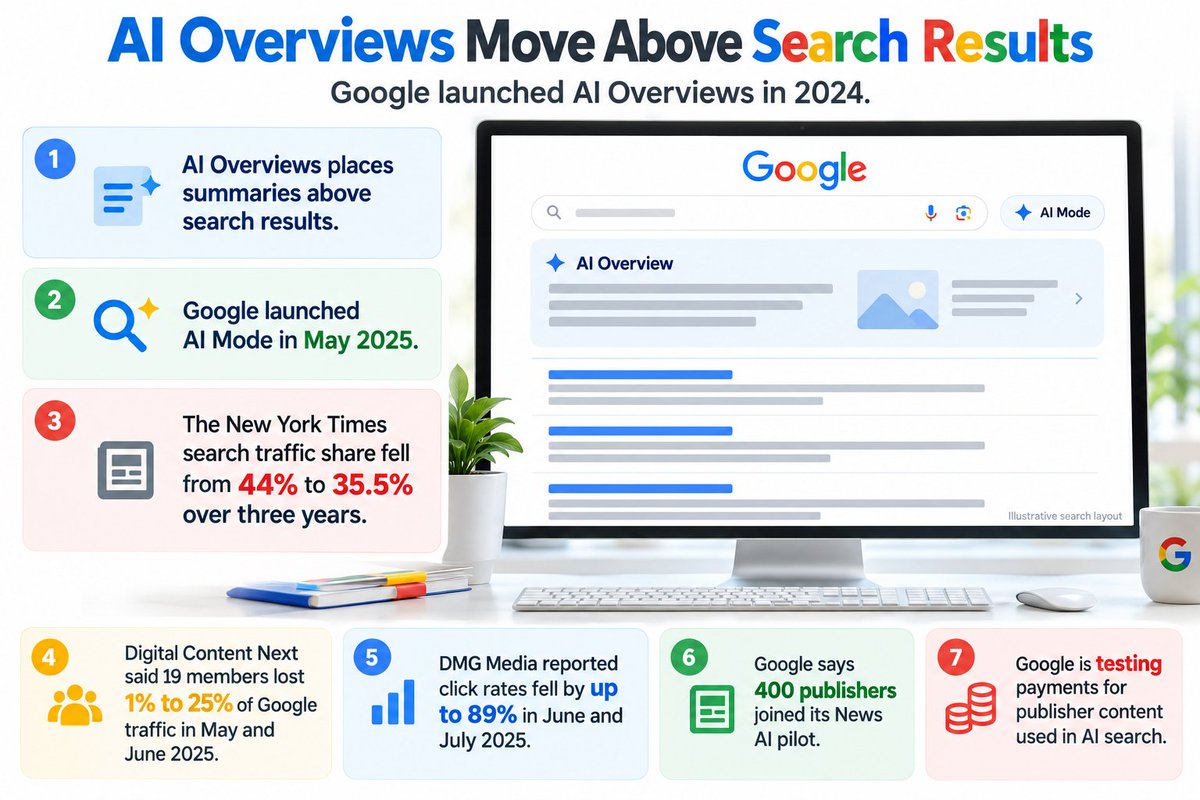
Google AI Search and Publisher Traffic
Google launched AI Overviews in 2024.
The feature places generated summaries above search results. Google launched AI Mode in May 2025.
Similarweb data showed the share of New York Times traffic from search fell from 44% to 35.5% over three years.
Digital Content Next said 19 members lost 1% to 25% of their Google traffic between May and June 2025.
DMG Media reported click rates fell by up to 89% between June and July 2025.
Google says its News AI pilot includes 400 publishers.
Google is also testing payments to publishers for content used in AI search.
Tencent Releases Interactive Video Model
Tencent released Hy Nomas as an open model for interactive video generation.
Users can change objects and actions and visual styles through text instructions between video segments.
Camera controls let users direct viewpoint and movement.
A diffusion transformer generates successive segments while a persistent cache retains earlier context.
The distilled configuration produces 720 × 1280 video at 24 FPS using 8 denoising steps.
The 24 FPS figure describes playback while generation speed depends on hardware and settings.
Tencent also published an evaluation suite with 280 test cases across four categories.
These cover text interaction and camera navigation and combined controls and spatial memory.
A reduced memory configuration supports video inference on one Nvidia RTX 4090 through quantization and CPU offloading.
The model uses the Apache 2.0 license with third party components retaining their respective licenses.
One Exposed Key And Two Critical Flaws
1. LiteLLM Traces Release Compromise
LiteLLM traced its compromised 1.107.0 release to a master key exposed on GitHub on 27 May 2026.
The exposed key remained valid despite the leak being identified.
Attackers used it on 10 October to access an internal agent platform.
They extracted a GitHub organization owner’s token and gained access to all organization repositories.
They subsequently compromised the release pipeline and distributed malicious packages on 21 October.
2. Nextcloud App Faces Active Exploitation
CISA added the Collabora CODE Server flaw to its exploited vulnerabilities catalog on 23 October 2026.
The vulnerability affects Nextcloud’s built in CODE Server app and carries a CVSS 4.0 score of 9.2.
Attackers can execute operating system commands when the CODE server is not running.
Standalone Collabora Online servers are not affected.
Version 26.4.303 fixes the flaw and US federal civilian agencies have a 26 October 2026 remediation deadline.
3. Brotli Flaw Reaches Beyond Node.js
The Brotli decoder vulnerability carries a CVSS 4.0 score of 9.2 and can cause memory corruption through specially crafted compressed data.
Affected implementations include Node.js and Bun and Envoy and Python Brotli packages.
Imperva demonstrated remote code execution on the official Node.js 24.22.0 Linux ARM64 build.
The same test input was rejected by Node.js 24.22.1.
Fixed Node.js releases include 22.23.4 and 24.22.1 and 26.12.1.
Walmart Plans AI Shopping Controls
Walmart plans to let external AI agents shop through Agent Profiles.
Each agent will have a separate profile and purchase record.
Customers can require approval before every purchase.
They can also set a spending limit for an agent.
Walmart may require approval even when a purchase is within that limit.
Agents will not receive card details or be able to change payment methods.
Customers can delete an agent profile at any time.
Walmart plans to launch Agent Profiles within the next month.
SAP CTO on Enterprise AI
SAP CTO Philipp Herzig discussed the claim that AI coding tools make traditional software obsolete.
He said generating an application differs from running it.
An expense app operating across 40 countries must handle tax rules.
It must also enforce permissions and reconcile reimbursements.
Herzig said autonomous agents depend on trusted data and business context.
They also require governance and security. He said moving an AI prototype into enterprise production still requires substantial human work.
Herzig identified adoption as a harder challenge for SAP than the technology.
Hugging Face Releases Carbon X
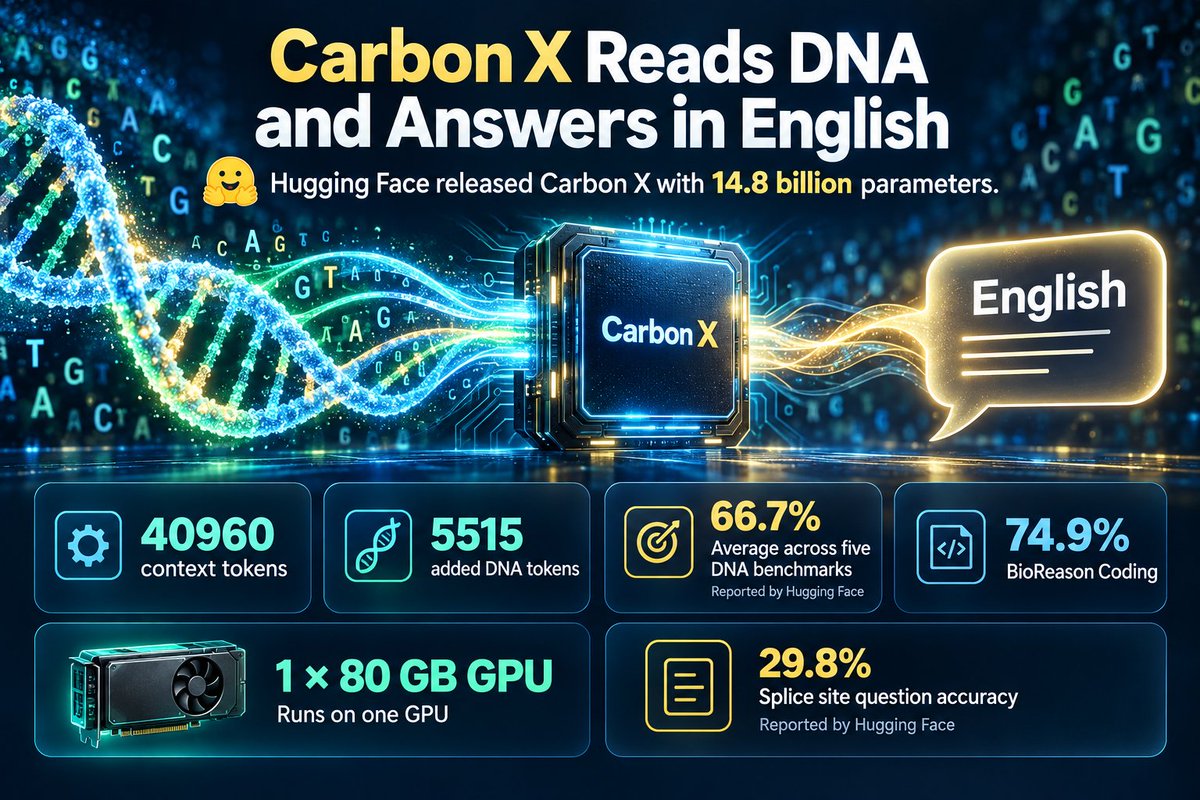
Hugging Face released Carbon X with 14.8 billion parameters under the Apache 2.0 license.
The model reads raw DNA and answers in English.
It uses Qwen3 14B as its base and supports 40960 tokens of context.
Its tokenizer adds 5515 DNA tokens to the text vocabulary.
Hugging Face reports a 66.7% average across five DNA benchmarks.
It scored 74.9% on BioReason Coding and 39.4% on NextBase.
It can run on one 80 GB GPU.
Hugging Face reports 29.8% accuracy on splice site questions and says the model is not clinically validated.
Opensource Subreddit Bans AI Projects
The opensource subreddit announced new submission rules on October 24 2026.
Projects that use AI or are made for AI are barred.
A moderator said AI accessibility features such as automatic captioning may receive exceptions.
The rules prompted complaints and the creation of a rival subreddit called trueopensource. Submitted projects must be at least one year old.
They must be actively maintained and have multiple contributors.
The moderators will no longer accept requests for maintainers or contributors.
The rules also tell people who do not speak English to find another community.
Nanbeige Releases a 33B Coding Model
https://t.co/l1OKCHrjFV
Nanbeige LLM Lab released the Nanbeige4.3 33B model on Hugging Face under the Apache 2.0 license.
The dense text model has 33B parameters and a 524288 token context window.
The lab also released a base model for custom training. Nanbeige reports a score of 80.9 on Terminal Bench 2.1.
It reports 65.5 on DeepSWE and 60.3 on SWE Bench Pro.
Its own comparison places it first on 17 of 20 benchmarks against three models near 30B parameters.
The model card provides server recipes using four GPUs. The lab plans to use the model to train an upcoming 3B model.