We are excited to share that AppWorks has invested in the @0xfluid token.
DeFi has no shortage of lending protocols. What it has is a structural inefficiency nobody fixed: the same dollar of collateral that backs your loan on Aave can't also be an LP position on Uniswap. Capital sits in one silo doing one job. Fluid collapses that wall.
The capital efficiency that unlocks is exciting. But what we care about more is the team that broke a constraint everyone else just lived with.
@smykjain could have kept shipping new features on Instadapp, which once reached $12B in TVL. Instead he chose to build everything from first principles, rethinking what a bank could look like if you built it on-chain from scratch.
That's the kind of founder we're proud to back.
A year ago we led @SignalPlus_Web3's Series B. Today we're doubling down their Series B1.
They started in crypto options. The bigger story now is that they're rebuilding the whole trading infra and pushing cross asset, and we think they have a real edge doing it.
The stack travels. The automation-first infra they built for crypto options (vol model, 24/7 automated risk, execution automation) transfers naturally to FX, and over time to every tokenized asset (equities, ETFs, derivatives). FX is the obvious next step. It's 24/7, derivative heavy, underserved by automation, basically the same shape as crypto options. Compare that to the banks, whose FX still runs on 30-year legacy stacks that are deeply integrated, hard to upgrade, with the know-how locked in a handful of specialists. SignalPlus was automation-first from day one.
Then the AI layer. They're turning how real traders actually work (what to tune when the vol regime shifts, what triggers a hedge, when to step out) into natural-language agents that sit directly on their own trading and risk infra. Two things make it hard to copy. That domain workflow lives in skilled traders' heads, and SignalPlus has spent years building an in-house options-trading bench. They're encoding that scarce talent straight into the product. To us that's the concrete path to becoming the agentic layer for next-gen trading, across assets, not just crypto.
Same mission, bigger opportunity.
We're glad to keep backing the SignalPlus team. If you're building in fintech, trading infra, or on-chain banking, we'd love to talk.
Big milestone 🚀
SignalPlus has officially closed our latest US$50M Series B1 funding round at a US$500M post-money valuation.
The round was led by our long-term supporters at HashKey Capital @HashKey_Capital, with strategic participation from BlockBooster @0xBlockBooster and AppWorks @AppWorks.
Deeply grateful to the Goldman Sachs team @GoldmanSachs for acting as our sole financial advisor.
We extend our deepest gratitude to our clients, partners, investors, and team members for their unwavering trust and support over the years.
The Next Chapter: TradFi Expansion & SignalPlus 2.0
Onwards and upwards!
https://t.co/YQAaucoQoP
AW#33 RFS: On-Chain Banking
The phrase "the future of finance is borderless" has been thrown around for a decade. But we are finally moving past speculation and into infrastructure. We believe the future of banking will be programmable, transparent, and natively on-chain.
It's not just about trading crypto; but modernizing the global financial infrastructure—from asset tokenization, decentralized clearing, and settlement, to borderless cross-border payments.
Building this layer of the digital economy requires massive stamina, localized regulatory intelligence, and deep institutional trust.
How AppWorks Backs On-Chain Builders
On-chain banking wins on real-world adoption. You need to plug into the real world. Here is how we bridge that gap for you:
Real-World Web2 & Web3 Bridges: Through our deep network of corporate partners, we connect Web3 startups with regional financial institutions, telecom operators, custodians, and exchanges to run compliant, real-world Proof of Concepts (PoCs).
The Web3 Legacy (and Present): You are joining one of Asia's largest Web3 ecosystems, featuring 152+ active teams and 313 founders. Our alumni and portfolio networks include Web3 titans like @pendle_fi (AW#20), @StraitsX (MAS-licensed stablecoin infrastructure, AW#21), @sanctumso, and @SignalPlus_Web3.
Regulatory & Scaling Navigation: Compliance is the ultimate boss fight in FinTech. Benefit from hands-on mentorship by compliance advisors, Web3 pioneers, and traditional finance veterans across 9 distinct Asian markets.
Capital Access: With a total fund size of $386M, our investment team is close by to guide you navigate the full fundraising stacks across different instruments when the time is right.
And the utmost principal: the accelerator is 100% free with zero equity, tokens, or fees taken.
If you are a founder moving the world’s value on-chain, AppWorks is your strategic launchpad to navigate and dominate the Asian market.
📅 First Round Application Deadline: June 21, 2026
📍 Apply here: https://t.co/5Ho1nIKBWo
Are you building the future of on-chain banking, or know a team that is? Let's talk in the comments or tag them below! 👇
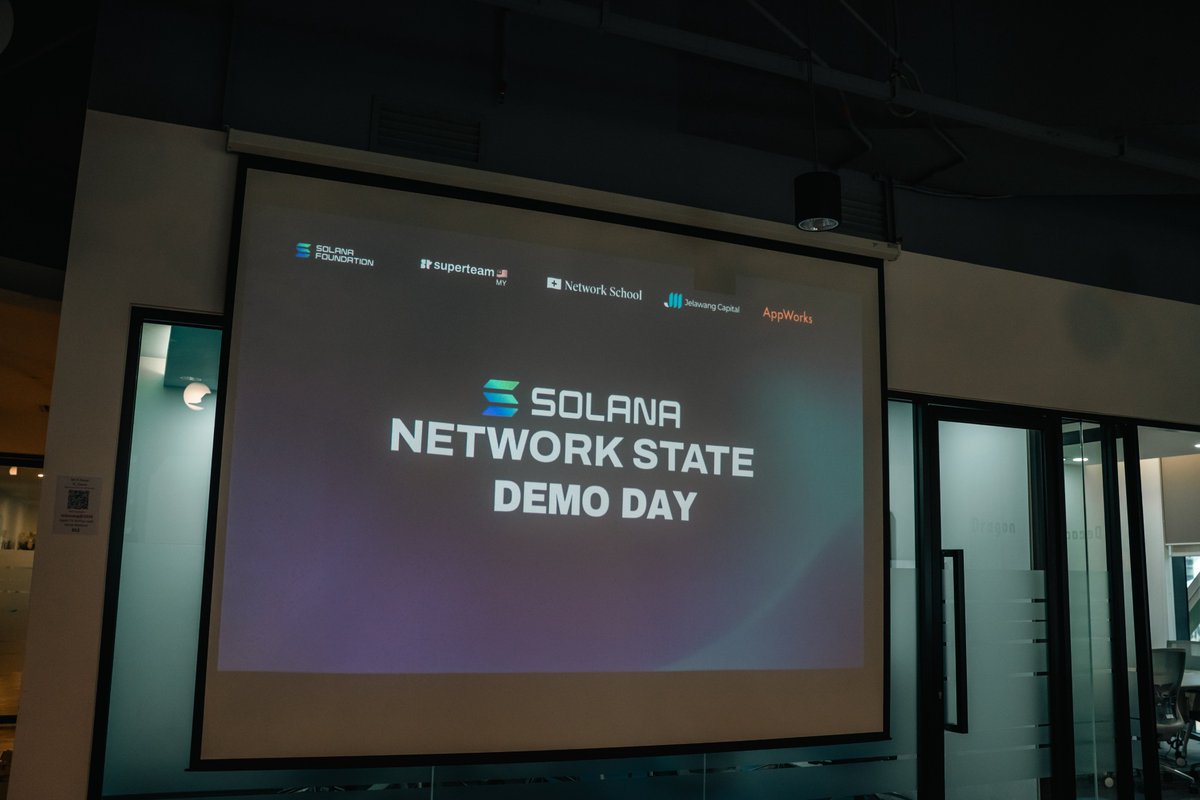
It was a privilege to be part of the Solana Network State Demo Day in KL, we are amazed by Malaysia’s builder density!
Sincere thanks to @SuperteamMY and @jelawangcapital for hosting.
What AppWorks does for founders:
- Equity-free, fee-free 3-month accelerator
- 2,000+ founder peers
- Warm BD pipeline into Asia TradFi
- $380M in capital to support founders in scaling
AppWorks Accelerator #33 applications are open now → https://t.co/kS7aslXNG6
Solana Network State Spring 2026 Demo Day is here 🔥
Presented by @AppWorks × @jelawangcapital
Pitch to investors, builders, and ecosystem partners in the room.
Happy to partner with Jelawang Capital + Superteam Malaysia on this.
Malaysia's crypto community has had some of the strongest momentum in the region, excited to see what this batch ships!
Five weeks of building. One afternoon to show what you made.
Solana Network State Spring 2026 Demo Day to showcase your work to investors, builders, and ecosystem partners.
Presented by @AppWorks × @jelawangcapital
📍 Kuala Lumpur
Details below 👇
In 1907 J.P. Morgan organized a private bank rescue, and the Fed was founded 6 years later.
Last month Stani organized DeFi United to rescue Aave. Is DeFi about to get its own central bank?
On @aave now, two groups of users are sitting on opposite sides of the same pool:
- wstETH holders are running a looping strategy — deposit wstETH as collateral, borrow ETH, swap the ETH back into more wstETH, repeat. A leveraged bet on staking yield.
- aWETH holders are the simple lenders — they just deposited ETH into Aave and hold aWETH as the receipt, expecting to redeem 1:1 anytime.
Now both sides are trapped:
- aWETH holders can't withdraw their ETH — the loopers borrowed all of it. Utilization is at 100%, the pool is empty.
- wstETH loopers are bleeding, because borrow rates have spiked past 30%, flipping their ~3% staking yield into deeply negative carry. And they can't unwind cleanly either — repaying Aave requires ETH, but they only hold wstETH. Dumping billions of wstETH into DEX pools would crack the peg and trigger a liquidation cascade.
This is where @0xfluid 's wstETH ↔ aWETH redemption channel comes in. Instead of forcing both sides to clear through the open market, Fluid lets them settle directly against each other: aWETH holders exit into wstETH (solving their liquidity problem), and loopers' collateral offsets the matching ETH debt (solving their negative carry). Both pressures release at the same time — without touching DEX liquidity, without breaking the peg.
This is the kind of move that justifies why DeFi still works. When one window closes, composability opens another. Real composability.
At AppWorks, we believe the next wave of DeFi lending maturity won't come from better yield strategies.
It will come from better collateral underwriting. Operational risk is still the most underpriced risk in the space.
Some thoughts as a crypto VC:
1. This Q1 number (5 pre-seed deals) needs a big asterisk. People don't want to announce it now, they hold the news for better timing. So the directional read is probably right, but the drop-off looks more dramatic than it actually is.
2. That said, the underlying trend is real and for a few reasons worth unpacking. Secondary has been rough post Q4 '25, and secondary is historically the leading indicator for primary, and crypto just makes this more extreme, as in crypto, the fundraising announcement itself is a GTM tool to make your way toward TGE.
But that playbook has died. So now teams are just sitting on the news, waiting for better conditions to amplify it.
3. Also from what I've heard, a lot of funds have genuinely slowed primary and rotated toward liquid. The logic being: liquid deals come with lighter vesting and even at high valuations, the risk/reward is more legible and markable. Hard to argue against that when primary deals are still priced as if a token premium exists.
4. The longer-tail issue is we're still unwinding the 2021-2022 hangover. A lot of GPs raised mega funds and still haven't found enough quality targets to deploy — which is part of why projects over the last 1.5 years raised way more than they needed at jacked valuations. This is now still correcting, slowly and painfully.
5. My bet is still that market will eventually settle around the 3 things in crypto with real PMF:
Bitcoin, payment rails, and speculation infrastructure.
Everything else is going to have a tough time justifying the ask.
Our team @cebillhsu has analyzed the current Pre-IPO market for Anthropic.
During our research, we discussed several Pre-IPO tokenization channel, but we found that the current transaction costs are simply too high to own Anthropic
If any team is currently working on a solution to liquidity for pre-IPO equity, please feel free to contact us.