Tomorrow night at @Auki Labs monthly Robot & Beers meetup 🍻
I'm gunna be demonstrating how autonomous machines can earn a Credit Rating 🦾
& how that can be powered by Pooled Compute 📶
Check out the Luma in the comments 👇
& I'll see you there at the lab 🤖
Robots won't watch ads to pay for their internet usage. Instead, they'll pay for things that save them time, battery, and compute.
For example, asking the grocery store where to find the hot dogs and getting back an answer. 🌭
That's the new internet we're building.
@tlay_io The coordinate system is external to both robots and doesn't change when they calibrate. Robot A calibrates into the domain, translates the domain's coordinate system into its own, and knows where it is. Robot B does the same, which is how they know each other's pose too.
- Overview of component based architecture in the Auki SDK
- Design data pipelines at runtime so components talk to each other
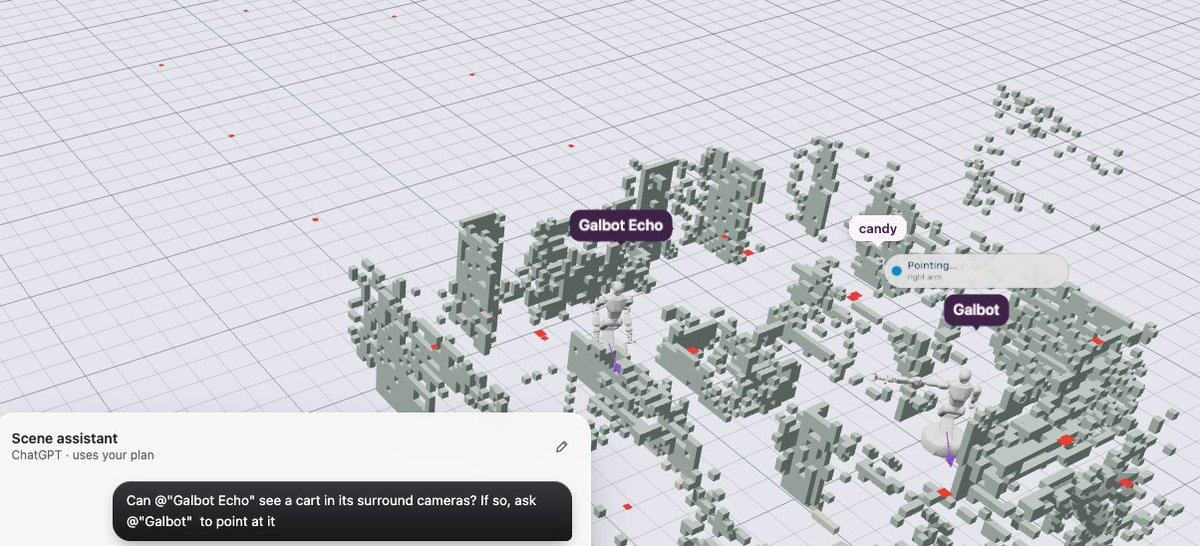
- Result: robot 1 sees a cup that robot 2 doesn't, but robot 2 knows where it is anyway and can point at it
- Demo of volumetric triggers for robots
One big limitation of Cactus was that we put all products on shelves, but obviously that doesn't reflect real stores.
Now that our demo store has islands, freezers, produce displays, and more, Cactus is getting them too.
Today, the internet is funded by nearly a trillion dollars of ads. But increasingly, AI and robots will use the internet more than humans do, and they don't watch ads.
Nils walks through our thesis of how the real world web will be the internet of the machine economy. 👇
Smarter spaces create smarter robots.
That's @Auki 's thesis and here are a few recent updates 👇
▪️ One Galbot pointed at a cart it couldn't see. A second Galbot could see the cart and through collaborative perception the first one still knew where it was.
▪️ Two robots sent point clouds to a third peer, which merged them into one scene. Both robots then used that scene live to avoid collisions.
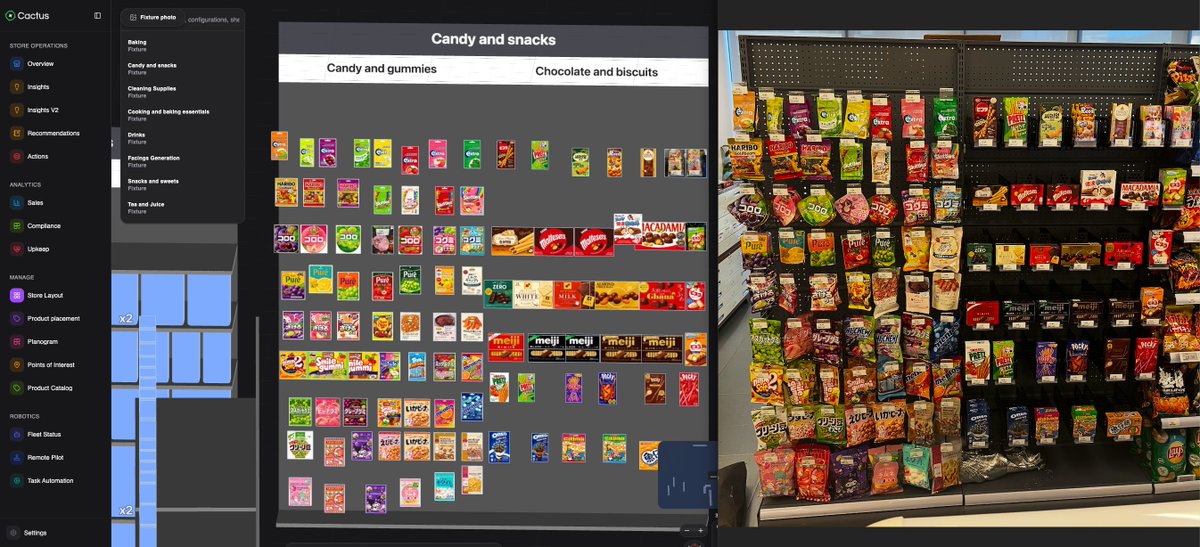
▪️ Many retailers want to recognize products from images but have no product photos. @CactusXR already scans the store, so the idea is to create those images along the way.
▪️ Auki also went to Securitas Day 2026, a corporate security event on AI and robotics. It sees its self-hosted digital twin as of special interest for security use cases that put privacy first.
Auki is building where physical AI will actually be used: real spaces. Curious what comes next 🦾
Yesterday we attended Securitas Day 2026, an invite-only corporate security event focused on AI and robotics in security.
Auki's self-hosted digital twin solution is especially interesting for security use cases where privacy is paramount.
Pointing is a simple task, but the magic is knowing where something is without seeing it.
Here the Galbot doing the pointing doesn't see the cart, but because it's doing collaborative perception with the other Galbot that can, it also knows where it is.
This fortnight's Physical AI Update features @Auki maps, @tashiprotocol coordination, and boat barnacle bellyrubs. Subscribe now: https://t.co/B76T8BVQ40
Another problem @CactusXR will solve: Lots of retailers want to do product image recognition but they don't have photos of the products.
Since we're already scanning the store, why not generate product images while we're at it?
Preview: no-code building of spatial data pipelines — drag and drop or ask your agent to do it.
Example: Send video from robot A to node B which blurs people, then to node C running CV, then drop it in robot D's map.