How do you orchestrate the swarm? Intercognitive's Founding Chair @RichardRobinson talks agents, smart cities, and sovereignty with @tashiprotocol's CEO @AmarSBedi and CBO Jay McCarthy.
Robots won't watch ads to pay for their internet usage. Instead, they'll pay for things that save them time, battery, and compute.
For example, asking the grocery store where to find the hot dogs and getting back an answer. 🌭
That's the new internet we're building.
One day. Tokyo. 500 people. 20+ international speakers. One topic: World Models Need a World.
This is KAI by Mawari, our first flagship event.
AI and people will understand each other when AI sees the world the way we do.
Full breakdown on KAI coming soon, alongside ecosystem updates.
Today, the internet is funded by nearly a trillion dollars of ads. But increasingly, AI and robots will use the internet more than humans do, and they don't watch ads.
Nils walks through our thesis of how the real world web will be the internet of the machine economy. 👇
Serbia Field Tests ✅🇷🇸
Our CTO @akosmaroy is back from a week in the field with our partner Milanion.
A full-scale airfield. Multiple live missions. Fresh hardware. Real stress tests. And another win for the Tashi Swarm.
Onwards 🌊.
#DronesSpeakTashi#MachinesSpeakTashi
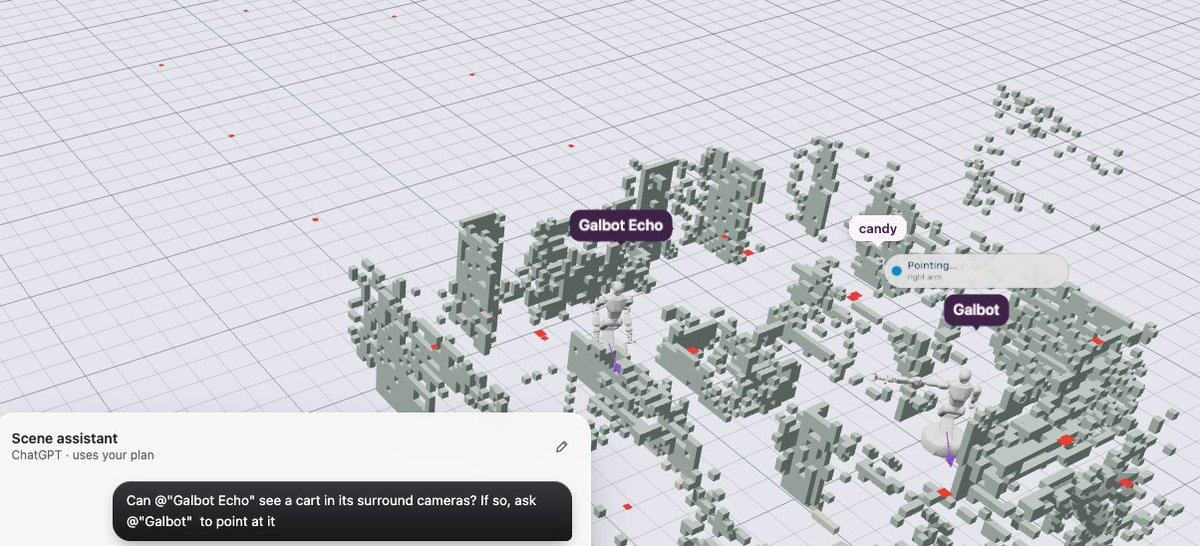
Pointing is a simple task, but the magic is knowing where something is without seeing it.
Here the Galbot doing the pointing doesn't see the cart, but because it's doing collaborative perception with the other Galbot that can, it also knows where it is.
Great Physical AI update from Intercognitive that features $AUKI.
@Auki is building the spatial intelligence layer for the physical AI, giving machines and robots perception.
Auki's latest demonstration is bigger than two robots sharing a 3D map, it's an early look at shared spatial intelligence.
Two robots can share a live 3D representation of their environment, allowing one to identify an object outside its own field of view using observations from the other.
Machines and Robots no longer have to operate as isolated machines. They can share observations, build a common understanding of their surroundings, and coordinate more intelligently.
Imagine robots in grocery stores, warehouses, factories, hospitals, and construction sites sharing what they see and learning from each other's observations.
Instead of every machine operating independently, they can build a shared understanding of their surroundings and coordinate their actions more intelligently.
That's a huge step toward making Physical AI scalable and useful in the real world.
AI needs more than powerful models. Machines need to understand where they are, what's around them, and how to interact with the physical world.
Today's demonstration is an early step toward a much bigger vision: an interconnected ecosystem of machines with shared spatial intelligence.
The future isn't just smarter robots, it's robots that understand and work together in the physical world.
This is why I'm paying attention to $AUKI.
An AI that moves things in the real world has to show its work.
That's what 0G brings as a member of the Intercognitive Foundation: private compute and verifiable execution for physical AI.
This fortnight's Physical AI Update features @Auki maps, @tashiprotocol coordination, and boat barnacle bellyrubs. Subscribe now: https://t.co/B76T8BVQ40
AI is touching grass. Intercognitive's newest member @0G_labs is cooking the compute, storage, and infrastructure it'll need to hit the ground running.
Zach is controlling Matic with his mind 🤯
Neuralink patient #22 is using his thoughts to move Matic around his home
This is incredible, @elonmusk@neuralink
My hot take on robotics is that most of the future value of robotics won't actually accrue to the robotics companies. The value will be realized by the companies that use robotics to carry out physical work.