They told us that once a heart breaks, it never truly heals. Science is proving them wrong. 🫀✨
At just 25 years old, Argentine biologist Pilar Ferrer is rewriting the rules of modern medicine.
When a heart attack strikes, the damage left behind has historically been permanent—dead tissue, irreversible scarring, and a clock ticking down on heart failure.
Ferrer and her research team turned to nature’s most profound blueprint of life: placental tissue.
By harnessing the regenerative properties of the amniotic membrane, they engineered an injectable bioactive hydrogel designed to do the unthinkable: enter damaged cardiac muscle, act as a biological scaffold, rebuild broken blood vessels, and stimulate the heart to literally regenerate itself from the inside out.
Think about that for a second.
The very biological tissue that gives humans life in the womb is now being used to give human hearts a second chance at life.
This isn’t science fiction. This is a 25-year-old visionary reminding the world that the future of humanity isn't just about surviving—it's about healing the parts of us we thought were gone forever.
A broken heart no longer has to be the end of the story.
Drop a ❤️ to salute the brilliant minds pushing human potential forward.
—
#Science #Innovation #StemCells #RegenerativeMedicine #FutureOfHealth #Inspiration #WomenInSTEM #Cardiology
Robin Williams’ emotional tribute to the American Flag leaves an entire stadium speechless — then in tears.
Is there a single Hollywood star who would give this performance today?
Total Patriot.
RIP Legend 🇺🇸
The AI infrastructure race just went underwater.
A Portland, Oregon startup called Panthalassa just raised $140 million in a Series B round led by Peter Thiel, the idea sounds wild until you understand the physics.
Every AI data center on Earth has the same three problems, it needs massive amounts of electricity, it generates enormous heat that has to be cooled, and it requires land in places that are already running out of grid capacity.
Panthalassa's answer is to eliminate all three constraints at once by taking the data center off the grid, off the land, and into the open ocean.
And here's how it works, the company builds autonomous, self-propelled floating nodes made from plate steel, no anchor, no fuel, no cable to shore.
As waves lift the platform, water is forced through an internal turbine, generating electricity continuously.
That electricity runs AI inference chips onboard and the results go back to shore via low-Earth-orbit satellite.
The surrounding ocean provides free supercooling, which one investor estimates could generate power at roughly two cents per kilowatt-hour.
For context on why this matters, land based data centers spend up to 40% of their total energy budget just on cooling.
Microsoft's Project Natick found that submerged servers had a failure rate of just 0.7% compared to 5.9% on land.
The ocean doesn't just solve the cost problem but it solves the reliability problem too.
Panthalassa's Ocean 3 pilot nodes are already under construction, with deployment in the northern Pacific targeted for August 2026 and commercial operations in 2027.
The company has been building toward this for a decade with Ocean-1, Ocean-2, and Wavehopper prototypes already validated at sea, including a test in Puget Sound in 2024.
The global underwater data center market was $3.2 billion in 2025 and is projected to reach $14.8 billion by 2034.
China has already launched commercial-scale undersea data centers.
The race to compute off the grid whether in space, underwater, or on the open ocean is no longer theoretical, it's being funded, permitted, and in Panthalassa's case, it's being built right now.
The future is bright!
🇺🇸 Farewell and thank you for the warmth of your welcome and the kind support you gave us throughout our first visit to the US as King and Queen, in this, your special anniversary year. We leave a piece of our ❤️ behind and take a little of yours back home with us. Until the next time… God Bless America.
- Charles R. & Camilla R.
📷 @ChrisJack_Getty / Getty Images
A teenage prodigy in quantum physics is aiming to tackle one of science’s biggest challenges: human aging.
Laurent Simons earned his PhD in quantum physics from the University of Antwerp at just 15. Rather than slowing down, he has already begun a second doctorate, this time focusing on medical science and artificial intelligence.
His long-term ambition is to better understand aging and disease, with the hope of helping extend healthy human lifespan. He has described death as a complex “puzzle,” made up of many interconnected pieces across biology, physics, and engineering. His strategy is to study these layers together, using AI to analyze biological systems and identify patterns that would be difficult to detect otherwise.
Simons’ academic journey has been unusually fast. He completed high school by age 8, finished a bachelor’s degree at 12, and went on to earn both a master’s and PhD in quantum physics years ahead of typical timelines. His doctoral work explored advanced topics like Bose–Einstein condensates, where atoms behave as a single quantum system at extremely low temperatures.
Although highly theoretical, this research underpins technologies such as quantum computing and precision measurement. Now, his focus is shifting toward biology and medicine.
In AI-driven healthcare, researchers are already using machine learning to improve early disease detection, model protein structures, and accelerate drug development. In the field of aging, scientists are investigating ways to reduce cellular damage, eliminate dysfunctional cells, and better understand how the body changes over time.
However, experts stress that “solving aging” is extraordinarily complex. While lifespan extension has been achieved in simple organisms, applying those findings to humans remains a major scientific hurdle.
Simons himself acknowledges that meaningful progress could take decades. Even so, his path reflects a broader trend in science—where breakthroughs are increasingly happening at the intersection of disciplines, and younger researchers are setting ambitious, long-term goals.
Learn more:
"15-year-old genius sets his sights on solving human immortality." Brighter Side.
Here's my secret. My first day in practice, I started with a networth of minus $1,000,000. I'd lost to the stock market all the money I earned working 80-hour weeks during residency and fellowship. I had loans and loans and more loans. But, every morning I entered the hospital at 6 a.m. and every night I left work around midnight, the nurses would ask me the same question: "How do you always have the biggest smile on your face?" I couldn't express the answer then as well as I can now. The secret is Judaism's three cardinal laws of happiness: 1- Start with gratitude; 2- Find your gift; 3- Give it away. This formula is the secret to true, deep happiness. 1- Start each day with gratitude for all you've been given. Talk about your blessings, not your problems. Start by feeling how much you owe the world, not how much you're owed. #ModehAniLefanecha. 2- What is your purpose in life? Why are you here? Why did God trust you with this life? Hint: To help others. To mend a broken world. #TikkunOlam Each of us has a unique gift in how we can accomplish this task. Mine is medicine. Yours may be singing, art, defending, raising children, nursing, comforting... It's up to you to find your gift and through it live a meaningful and purpose-driven life. 3- #Tzedakah Give your gift away. It must be money you've earned, but also your time, talent, love, effort. Give your gift away. Not all of it. Judaism requires 10%. Anyone can do this. Everyone can find things they are thankful for, right this minute. Everyone has a talent that makes them unique. Everyone can give without wanting anything back. When you live in sync with these three Jewish principles (and you don't have to be Jewish), your life becomes so much more than a mechanical day to day struggle. This is how I fought clinical depression and won. So now, I give you my secret as a gift.
A 21-year-old MIT student wrote a master's thesis in 1937 that Harvard's most famous professor of cognitive science later called "possibly the most important master's thesis of the century."
I read it at 2am and could not believe one paper had quietly built the entire foundation of every computer that exists today.
His name was Claude Shannon. The thesis is called "A Symbolic Analysis of Relay and Switching Circuits."
Every smartphone in your pocket. Every server farm running ChatGPT. Every chip Nvidia ships. Every line of code an engineer has ever written. All of it traces back to a single insight one graduate student had at 21 years old, working on a side project at MIT.
Here is the story almost nobody tells you.
Claude Shannon was born in 1916 in a small town in Michigan. He grew up tinkering. Built a telegraph between his house and a friend's house using barbed wire from a nearby fence. Repaired radios for the local department store. He studied both mathematics and electrical engineering at the University of Michigan because he could not decide which one he loved more. That refusal to choose is what eventually made him.
When he got to MIT for graduate school in 1936, he was assigned to operate a strange machine called the differential analyzer. It was room-sized. Mechanical. Built by Vannevar Bush. It used a tangle of gears, shafts, and electrical relays to solve calculus problems. Most students just operated it.
Shannon did something else. He stared at the relay circuits inside it. The way they clicked open and closed. The way they routed signals through the machine.
He noticed something nobody had noticed before.
The relays inside the machine had two states. Open or closed. On or off. One or zero. And the way the relays were wired together to make decisions looked exactly like a 90-year-old branch of mathematics that almost everyone had forgotten about. Boolean algebra. Invented by a British mathematician named George Boole in the 1850s. Boole had built a system of logic where statements could be true or false, and you could combine them with operators like AND, OR, and NOT to derive new statements.
For 90 years, Boolean algebra had been a curiosity. A philosophical tool. Nobody saw a practical use for it.
Shannon saw it.
He realized that an electrical circuit was not just an electrical circuit. It was a physical implementation of a logical statement. A switch that closed when both A and B were true was an AND gate. A switch that closed when either A or B was true was an OR gate. The entire branch of pure mathematics that Boole had invented as a thought experiment could be built out of wires and relays. And once you could build logic out of wires, you could build anything that could be expressed in logic out of wires too.
This was the insight that quietly created the modern world.
Before Shannon's thesis, electrical engineers designed circuits the way artisans built watches. By feel. By experience. By trial and error. Every new circuit was a craft project. There was no theory underneath it.
After Shannon's thesis, circuit design became a branch of mathematics. You could specify the logic you wanted on paper, and translate it directly into a wiring diagram. You could prove a circuit was correct before you built it. You could simplify a circuit by simplifying the underlying logical expression.
The MIT historian who reviewed his thesis described the shift in one sentence. It transformed circuit design from an art into a science.
Shannon was 21 years old when he wrote it.
That alone would have earned him a place in every computer science textbook on Earth.
But Shannon was not done. He spent the next 11 years working on a problem nobody had even framed properly. He wanted to know what information actually was. Not what messages were. Not what signals were. What information was. Mathematically. Quantitatively. As a measurable thing.
In 1948, while working at Bell Labs, he published a 79-page paper called "A Mathematical Theory of Communication." The paper invented the entire field of information theory in a single shot.
He proved that all information, regardless of whether it was a voice on a phone, a photograph in a magazine, or a chess move on a board, could be measured in a single unit. He named that unit the bit. Short for binary digit. It was the first time anyone had given information a unit of measurement.
The paper proved something that sounded impossible. He showed that you could send a message reliably through a noisy channel, with arbitrarily low error, as long as you encoded it correctly and stayed below a specific limit he called the channel capacity. Every Wi-Fi connection, every satellite signal, every cell phone call, every fiber optic transmission across the floor of the Pacific Ocean operates inside the mathematical bounds that Shannon proved in this single paper.
He did all of this in his spare time while officially working on cryptography for the war effort.
The strangest part of the man is what he did when he was not inventing the future.
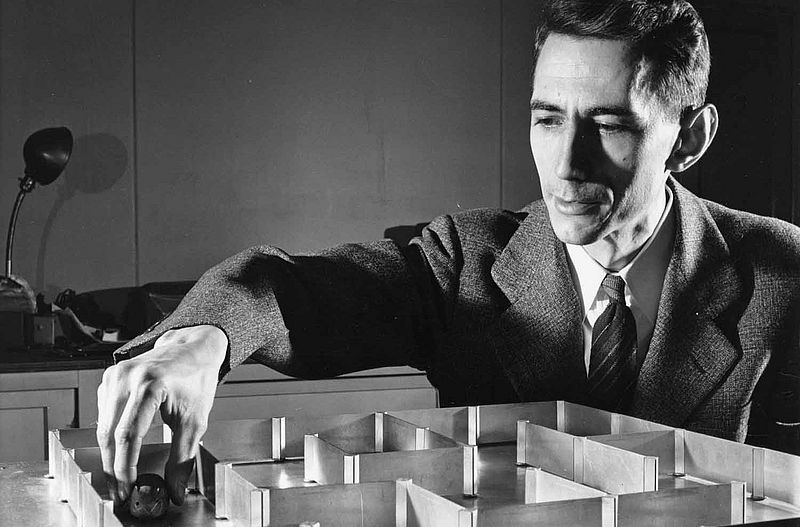
He rode a unicycle through the hallways of Bell Labs at night while juggling. He built a chess-playing machine in 1950 that played a primitive form of chess decades before computers were supposed to be capable of it. He built an electronic mouse named "Theseus" that could solve a maze and remember the solution. It was one of the first machines on Earth that learned. He built a flame-throwing trumpet for fun. He had a closet full of unicycles in different sizes. He installed a chairlift across his backyard so his kids could get to the lake faster.
Marvin Minsky, one of the founders of artificial intelligence, said Shannon was the most genuinely playful great scientist he had ever met. Other people approached research with seriousness. Shannon approached it like a kid who had snuck into the toy store after closing time.
Stevens Institute of Technology called him the least known genius of the 20th century.
That title is exactly correct. Most people have heard of Einstein, Turing, von Neumann. Shannon's name barely registers outside engineering departments. Yet without his master's thesis, there is no digital circuit. Without his 1948 paper, there is no internet. Without his framework, there is no measurement of information at all, which means no compression, no error correction, no cryptography, no machine learning.
He died in 2001 at age 84, after years of Alzheimer's disease that took away his ability to recognize the world he had built. Most newspapers ran a small obituary. The world he had given us did not pause.
His thesis is on the MIT archive. His 1948 paper is on the Bell Labs site. Both are free. Both are short. Both are still readable today by anyone willing to spend an evening with them.
The least known genius of the 20th century is one click away from you.
Most people will never open the file.
Behind the scenes in the Embassy kitchen. 👑🫖
Chef is preparing afternoon tea for 650 guests, including Their Majesties King Charles III and Queen Camilla.
Four kinds of tea sandwiches, scones, desserts, and several British flavours from smoked Scottish salmon to British Beef! 🍰 🇬🇧 🇺🇸
#GreaterTogether #America250 #StateVisit2026 #UKUS
An MIT professor taught the same math course for 62 years, and the day he retired, students from every country on earth showed up online to watch him give his final lecture.
I opened the playlist at 2am and ended up watching three of them back to back.
His name is Gilbert Strang. The course is MIT 18.06 Linear Algebra.
Every machine learning engineer, every data scientist, every quant, every self-taught programmer who actually understands how AI works learned the math from this one man. Most of them never set foot on MIT's campus. They just opened a free playlist on YouTube and let him teach.
Here's the story almost nobody tells you.
Strang joined the MIT math faculty in 1962. He retired in 2023. That is 61 years of standing at the same chalkboard teaching the same subject to 18-year-olds.
The interesting part is what he did when MIT launched OpenCourseWare in 2002. Most professors were skeptical. They worried that putting their lectures online would make their classrooms irrelevant. Strang did not hesitate. He said his life's mission was to open mathematics to students everywhere. He filmed every lecture and gave it away.
The decision quietly changed how the world learns math.
For decades linear algebra was taught the wrong way. Professors started with abstract vector spaces and proofs about field axioms. Students drowned in the abstraction. Most never recovered. They walked out believing they were bad at math when they had simply been taught in an order that nobody's brain is built to absorb.
Strang inverted the entire curriculum.
He started with matrix multiplication. Something you can write down on paper. Something you can compute by hand. Something you can see. Then he showed his students that everything else in linear algebra eigenvectors, singular value decomposition, orthogonality, the four fundamental subspaces was just a different lens for understanding what the matrix was actually doing under the hood.
His rule was strict. If a student could not explain a concept using a concrete 3 by 3 example, that student did not actually understand the concept yet. The abstraction was supposed to come last, not first. The intuition was the foundation. The proofs were just confirmation that the intuition was correct.
The second thing Strang changed was the classroom itself. He said please and thank you to his students. Every single lecture. He paused mid-derivation to ask "am I OK?" to check if anyone was lost. He never used the word "obviously" or "trivially" because he knew exactly what those words do to a student who is one step behind. He treated 19-year-olds learning math for the first time the way he treated his own colleagues. With patience. With respect. With the assumption that they belonged in the room.
For 62 years.
The result is something that has never happened in the history of education. A single math professor became the default teacher of his subject for the entire planet.
Universities in India, China, Brazil, Nigeria, every country with a computer science department, started telling their own students to just watch Strang's lectures. The University of Illinois revised its linear algebra course to do almost no in-person lecturing. The reason was honest. The professor said they could not compete with the videos.
His final lecture was in May 2023.
The auditorium was packed with students who had never met him before. He walked to the chalkboard, taught for an hour, and at the end the entire room stood and applauded. He looked confused for a moment, like he genuinely did not understand why they were cheering. Then he smiled and waved them off and walked out.
His written comment under the YouTube video of that final lecture was four sentences long. He said teaching had been a wonderful life. He said he was grateful to everyone who saw the importance of linear algebra. He said the movement of teaching it well would continue because it was right.
That was it. No book promotion. No farewell speech. No legacy management.
The man whose teaching is the foundation of modern AI just thanked the audience and went home.
20 million views. Zero ego. The entire engine of the AI revolution sits on top of math that millions of people learned for free from one quiet professor in Cambridge.
The course is still on MIT OpenCourseWare. Every lecture, every problem set, every exam, every solution. Free.
The most important math course of the 21st century is sitting one click away from you. Most people will never open it.
33 at 3 by Karen Young
Jesus was thirty-three years old when He died on the cross at three in the afternoon on Good Friday. Leaders charged Him with crimes He did not commit. He faced ridicule and insults from the very people He came to save. Yet He stayed silent through it all. This fulfilled the prophecy in Isaiah 53:7: “He was oppressed and afflicted, yet He did not open His mouth.” In this way Jesus took our place out of love and paid the price for our sins.
In His thirty-three years on earth, Jesus knew physical and emotional suffering. But on the cross He experienced something far deeper—spiritual separation from God the Father. After hours of pain and mocking from the crowd below, darkness covered the land. In those hours He carried the full weight of our sin.
Jesus chose the emotional pain of an unfair sentence for you. He chose the physical agony of the cross for you. He chose the spiritual pain of being forsaken by the Father for you. He did all this so we would never have to face separation from God. He accepted and endured pain that was not fair to Him.
It was nine in the morning when they crucified Him. The sign above Him read: THE KING OF THE JEWS. Mark 15:25-26 NIV. At three in the afternoon Jesus cried out, “Eloi, Eloi, lema sabachthani?” which means “My God, my God, why have You forsaken Me?” Mark 15:34 NIV. I did not know that the hours of 9 a.m. and 3 p.m. were the same hours when lambs were sacrificed in the temple every day. Jesus, the true Lamb of God, was lifted up and died right on God’s perfect schedule.
Jesus carried everything that could keep us from God—our sin, our shame, and our guilt. He did this because of His great love for us. He stood in our place so we could be forgiven.
Then He said, “It is finished.” These three words meant everything. In the original Greek this word is “Tetelestai,” which means the debt is paid in full. Sin no longer holds us. Because of what Jesus did, we can now live in the freedom His sacrifice purchased and enjoy closeness with God. God had to reveal something important in this tragedy—His great love and the way to forgiveness.
Today take time and reflect on all of the suffering that God went through for you. Today is a good reminder that only through pain and suffering do we actually grow, increase our faith, and mature. Growth comes when we push through hard times, because there is no real gain without some pain. Because of Jesus and His finished work on the cross, your pain is never wasted. Let His sacrifice give you fresh strength and hope today to keep growing closer to God and becoming more like Him.
Christina Koch was a firefighter at the South Pole at -111°F before she ever applied to be an astronaut. That was maybe the fourth most interesting line on her resume. She grew up in North Carolina, got three degrees from NC State, and her first real job was building deep-space instruments at NASA.
Then she left for Antarctica. Spent three and a half years bouncing between the Arctic and Antarctic as a research scientist, including a full winter at the South Pole base. That means going months without sunlight or fresh food, with a crew of about 50 people and no way out until flights resume. While she was down there, she also joined the glacier search-and-rescue team.
After coming back, she went to Johns Hopkins and built instruments for two NASA missions (one of them is still orbiting Jupiter right now). She figured out how to start a tiny vacuum pump that NASA designed for a future Mars rover. Johns Hopkins nominated it for their Invention of the Year in 2009. Then she went back to the field. More time in Antarctica and a stretch up in Greenland. A government research station in northern Alaska, near the top of the world. Then she ran another one in American Samoa, near the equator.
In 2013, NASA selected her from 6,300 applicants. Eight people got in. Her first space mission was supposed to be a normal rotation on the International Space Station, but NASA extended it. She ended up staying 328 straight days and orbiting Earth 5,248 times, covering about 139 million miles (roughly 291 round trips to the Moon). Up there, she ran over 210 experiments, including tests of cancer drugs in zero gravity and 3D printers that can build structures close to human tissue. Six spacewalks, 42 hours floating outside the station. She learned Russian for the training. She flies supersonic jets.
Right now, Koch is on Artemis II, heading for a flyby behind the far side of the Moon. The crew launched on April 1 and is on track to travel about 252,000 miles from Earth, which would break the all-time human distance record of 248,655 miles set by Apollo 13 in 1970. That record has stood for 56 years, and it was set during a disaster that nearly killed the crew. Fred Haise, one of the Apollo 13 astronauts, is 92 now. He told Koch: "I heard you're going to break our record."
Nobody had left Earth's neighborhood since December 1972. Koch and her three crewmates are the first in 53 years, and they are coming home at about 25,000 mph. That is faster than any crewed spacecraft has ever come back through the atmosphere.
Exciting breakthrough in #ChildhoodCancer research!
Scientists have uncovered a shared vulnerability in three rare & aggressive childhood cancers: in pineoblastoma, medulloblastoma (specifically Group 3) & retinoblastoma.
A new study reveals that these tumors, despite arising in different parts of the brain & eye, all depend on a set of light sensing (photoreceptor) genes that are abnormally active in the cancer cells. These genes, normally involved in light detection in the pineal gland & retina, appear essential for the tumors survival. When researchers used CRISPR to disrupt them, the cancer cells stopped growing & died.
This common “addiction” to the same developmental pathway opens the door to potential therapies that could target multiple cancers at once, a major step toward more effective, less toxic treatments for Children.
While further research is needed to translate this into clinical therapies, discoveries like this bring real hope for better outcomes in #PediatricOncology
Read the full story from St. Jude Children’s Research Hospital: https://t.co/X7trtucrWL
This yellow Cardinal is a one-in-10-million genetic anomaly.
Arlene and John McDaniel were recently treated to an extraordinary sight at their backyard bird feeder in Michigan: a brilliant yellow northern cardinal.
While northern cardinals are famous for their vivid red plumage, this striking golden variant is incredibly rare. According to ornithologist Geoffrey Hill of Auburn University, the odds of encountering a yellow cardinal are roughly one in 10 million. With an estimated population of about 50 million northern cardinals across North America, experts believe only around five such birds exist at any given time — making this sighting a once-in-a-lifetime event.
The bird’s unusual color results from a rare “knockout mutation” that interrupts the normal pigmentation process. Normally, cardinals convert dietary pigments into red feathers through a two-step enzymatic reaction. In this case, the genetic mutation blocks that process, causing the feathers to remain a bright, vibrant yellow instead.
First scientifically documented in 1989, these rare yellow cardinals offer valuable insights into avian genetics and the intricate DNA mechanisms that shape the natural world. What began as a surprise visitor at a backyard feeder has become a beautiful reminder of nature’s occasional and stunning genetic surprises.
[Hill, G. Genetic Components and Rare Pigmentation in the Northern Cardinal. Auburn University Department of Biological Sciences]
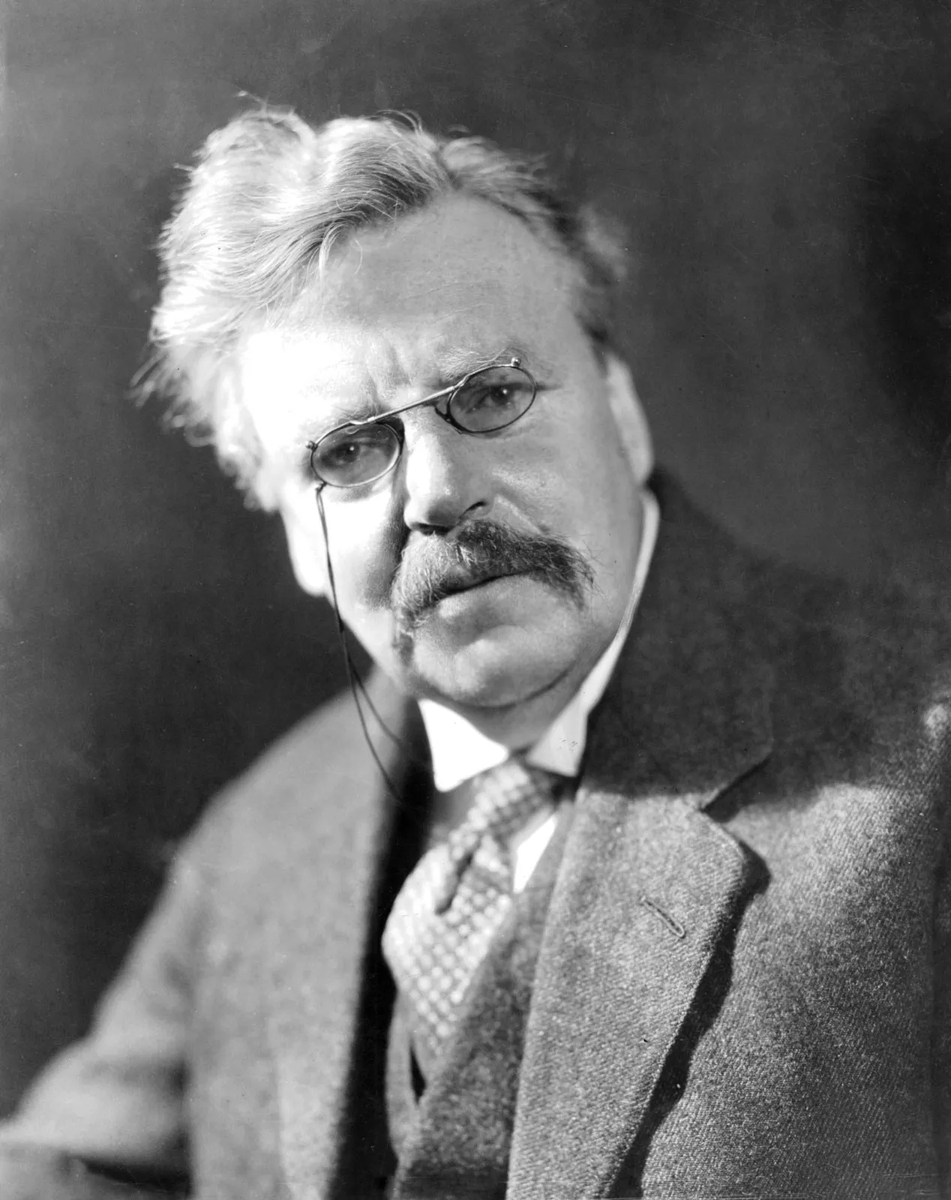
G. K. Chesterton explains that reading gives a man more lives than he was born with:
“A man who has read a thousand books is armed for life; a man who has read none is easy prey. The man who has read a thousand books has lived a thousand lives. He has seen cities he has never visited, spoken to men who died centuries ago, and walked in worlds that no longer exist. Reading does not merely inform him; it enlarges him. It stretches the boundaries of his own experience until he becomes something more than himself.”
May 16, 1963. Gordon Cooper was orbiting Earth alone inside a capsule barely big enough to turn around in, moving at 17,500 miles per hour.
He had been up there for over a day.
Then the warnings started.
First a faulty sensor screaming that the ship was falling — it wasn't. He switched it off. Then something far worse: a short circuit knocked out the entire automated guidance system. The one that kept the capsule steady. The one that was supposed to bring him home.
Without it, reentry was nearly impossible.
Too shallow an angle and the capsule would bounce off the atmosphere back into space. Too steep and it would incinerate. The margin for error was razor thin — and every computer that was supposed to hit that margin was dead.
Down on the ground, NASA engineers watched the telemetry in silence. They could see everything going wrong. They could fix nothing.
Cooper didn't panic.
He uncapped a grease pencil and drew lines directly on the inside of his window to track the horizon. He looked up at the stars he had spent months memorizing and used their positions to orient the ship by eye. Then he set his wristwatch.
Because when you have no computers left, you become the computer.
At exactly the right moment — calculated in his head, confirmed by the stars outside — he fired the retrorockets. The capsule shook. The sky turned to fire. For several minutes, no one on Earth could reach him as plasma swallowed the ship whole.
Then the parachutes opened.
Faith 7 hit the water just four miles from the recovery ship — the single most accurate splashdown in the entire Mercury program.
The man with a wristwatch and a few pencil marks on a window had outperformed every automated system NASA had.
We talk a lot about technology saving us. And it often does.
But Cooper's story is a quiet reminder that behind every machine, there still has to be a human being who can look out the window, think clearly under pressure, and decide what to do next.
The final backup was never the software.
It was him.
𝗧𝗵𝗶𝘀 𝗿𝗼𝗯𝗼𝘁 𝗱𝗼𝗲𝘀 𝘀𝗼𝗺𝗲𝘁𝗵𝗶𝗻𝗴 𝗺𝗼𝘀𝘁 𝗱𝗿𝗼𝗻𝗲𝘀 𝘀𝘁𝗶𝗹𝗹 𝘀𝘁𝗿𝘂𝗴𝗴𝗹𝗲 𝘄𝗶𝘁𝗵.
It can 𝘄𝗮𝗹𝗸, 𝗷𝘂𝗺𝗽, 𝗮𝗻𝗱 𝗳𝗹𝘆.
Researchers at EPFL’s Laboratory of Intelligent Systems built 𝗥𝗔𝗩𝗘𝗡, a robot inspired by how birds move between land and air.
Most drones need open space and stable launch points.
𝗥𝗔𝗩𝗘𝗡 works differently.
→ It can 𝗷𝘂𝗺𝗽 𝘁𝗼 𝘀𝘁𝗮𝗿𝘁 𝗶𝘁𝘀 𝗳𝗹𝗶𝗴𝗵𝘁
→ It can 𝘄𝗮𝗹𝗸 𝗼𝗻 𝗿𝗼𝘂𝗴𝗵 𝘁𝗲𝗿𝗿𝗮𝗶𝗻
→ It can 𝗹𝗮𝗻𝗱 𝘄𝗵𝗲𝗿𝗲 𝗺𝗼𝘀𝘁 𝗱𝗿𝗼𝗻𝗲𝘀 𝗰𝗮𝗻’𝘁
What I find interesting here is the design philosophy.
Instead of forcing robots to adapt to machines, engineers are studying how 𝗻𝗮𝘁𝘂𝗿𝗲 𝗮𝗹𝗿𝗲𝗮𝗱𝘆 𝘀𝗼𝗹𝘃𝗲𝗱 𝘁𝗵𝗲 𝗽𝗿𝗼𝗯𝗹𝗲𝗺.
That approach could unlock new possibilities:
→ 𝘀𝗲𝗮𝗿𝗰𝗵 𝗮𝗻𝗱 𝗿𝗲𝘀𝗰𝘂𝗲 in difficult terrain
→ 𝗶𝗻𝘀𝗽𝗲𝗰𝘁𝗶𝗼𝗻 in tight or cluttered environments
→ 𝗱𝗲𝗹𝗶𝘃𝗲𝗿𝘆 where drones cannot easily land
Small shift in design.
Potentially 𝗯𝗶𝗴 𝗶𝗺𝗽𝗮𝗰𝘁 in real-world robotics.
𝗖𝘂𝗿𝗶𝗼𝘂𝘀:
𝗪𝗵𝗲𝗿𝗲 𝗱𝗼 𝘆𝗼𝘂 𝘁𝗵𝗶𝗻𝗸 𝗵𝘆𝗯𝗿𝗶𝗱 𝗿𝗼𝗯𝗼𝘁𝘀 𝗹𝗶𝗸𝗲 𝘁𝗵𝗶𝘀 𝗰𝗼𝘂𝗹𝗱 𝗯𝗲 𝗺𝗼𝘀𝘁 𝘂𝘀𝗲𝗳𝘂𝗹?
#Robotics #AI #Innovation #FutureOfRobotics #Technology
Every time you get a cancer biopsy, the lab makes a tissue slide that costs about $5. It shows the shape of your cells under a microscope, and every cancer patient already has one on file.
There’s a much fancier version of that test called multiplex immunofluorescence (basically a protein-level map showing which immune cells are near your tumor and what they’re doing). It costs thousands of dollars per sample, takes specialized equipment most hospitals don’t have, and barely scales. But it’s the kind of data oncologists need to figure out whether immunotherapy will actually work for you. Right now, only about 20 to 40% of cancer patients respond to immunotherapy, and one of the biggest reasons is that doctors can’t easily tell whether a tumor is “hot” (immune cells actively fighting it) or “cold” (immune system ignoring it).
Microsoft, Providence Health, and the University of Washington trained an AI to analyze the $5 slide and predict what the expensive test would show across 21 different protein markers. They called it GigaTIME, trained it on 40 million cells in which both the cheap slide and the expensive test coexisted, and then turned it loose on 14,256 real cancer patients across 51 hospitals in 7 US states.
The results landed in Cell, one of the most selective journals in biology. The model generated about 300,000 virtual protein maps covering 24 cancer types and 306 subtypes. It found 1,234 real, verified connections between immune cell behavior, genetic mutations, tumor staging, and patient survival that were previously invisible at this scale. When they tested it against a completely separate database of 10,200 cancer patients, the results matched up almost perfectly (0.88 out of 1.0 agreement).
Nature Methods named spatial proteomics (mapping where specific proteins sit inside your tissue) its Method of the Year in 2024, and specifically cited GigaTIME in a March 2026 update as a model that “democratizes” this kind of analysis. The full model is open-source on Hugging Face. Any cancer research lab with archived biopsy slides, and most of them have thousands, can now run virtual immune profiling without buying a single piece of new equipment.
June 1983. A 28-year-old Steve Jobs walks into a design conference in Aspen, Colorado. He asks the room who owns a personal computer. Nobody raises their hand. He says “Uh-oh.”
Then he spends the next 55 minutes describing the next four decades of technology.
Jobs told the audience Apple’s strategy was to “put an incredibly great computer in a book that you can carry around with you, that you can learn how to use in 20 minutes… with a radio link in it so you don’t have to hook up to anything.” That’s an iPhone. In 1983. The Mac hadn’t even shipped yet.
He described an MIT project that sent a camera truck down every street in Aspen, photographed every intersection, and built a virtual walkthrough on a computer screen. Google Street View launched 24 years later. He said office networking was about 5 years away and home networking 10 to 15 years out. The web went mainstream in the mid-90s, about 12 years later. Dead on.
He described software being sent electronically over phone lines, with free previews and credit card payment. That’s the App Store, 25 years before it launched. He even compared it to the music industry and said software needed “the equivalent of a radio station” for free sampling. Apple built the iTunes Music Store 20 years later.
The AI prediction is the one that hits different now. Near the end, Jobs talked about machines that could capture a person’s “underlying spirit” or “way of looking at the world,” so that after they died, you could ask the machine questions and maybe get answers. He said 50 to 100 years. ChatGPT arrived in about 40.
The weird part is this speech was lost for nearly 30 years. The full hour-long recording only surfaced in 2012 when a blogger got a cassette tape from someone who attended the original conference. The Steve Jobs Archive didn’t release actual video footage until July 2024.
His timelines were consistently too fast. He wanted the “computer in a book” within the 1980s. Apple’s first attempt was the Macintosh Portable in 1989, which weighed 16 pounds and cost $6,500. The iPad arrived in 2010, 27 years late. He guessed voice recognition was about a decade away. Siri launched in 2011, nearly 30 years later. The vision was right every time. The clock was wrong every time.
Apple was doing about $1 billion a year in revenue when Jobs gave this talk, with under 5,000 employees. Today it’s worth $3.7 trillion.








![Rainmaker1973's tweet photo. This yellow Cardinal is a one-in-10-million genetic anomaly.
Arlene and John McDaniel were recently treated to an extraordinary sight at their backyard bird feeder in Michigan: a brilliant yellow northern cardinal.
While northern cardinals are famous for their vivid red plumage, this striking golden variant is incredibly rare. According to ornithologist Geoffrey Hill of Auburn University, the odds of encountering a yellow cardinal are roughly one in 10 million. With an estimated population of about 50 million northern cardinals across North America, experts believe only around five such birds exist at any given time — making this sighting a once-in-a-lifetime event.
The bird’s unusual color results from a rare “knockout mutation” that interrupts the normal pigmentation process. Normally, cardinals convert dietary pigments into red feathers through a two-step enzymatic reaction. In this case, the genetic mutation blocks that process, causing the feathers to remain a bright, vibrant yellow instead.
First scientifically documented in 1989, these rare yellow cardinals offer valuable insights into avian genetics and the intricate DNA mechanisms that shape the natural world. What began as a surprise visitor at a backyard feeder has become a beautiful reminder of nature’s occasional and stunning genetic surprises.
[Hill, G. Genetic Components and Rare Pigmentation in the Northern Cardinal. Auburn University Department of Biological Sciences]](https://pbs.twimg.com/media/HEbW-mHaMAAk8fv.png)