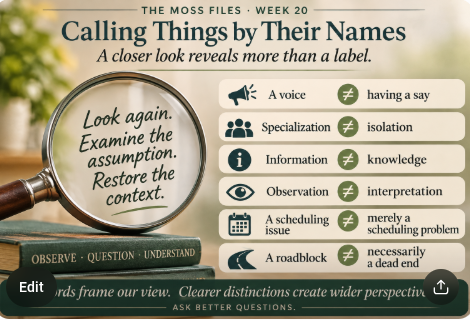
Bureaucratic language can obscure responsibility, exhaust readers, and conceal weak arguments. Plain language cuts through the confusion, exposes assumptions, and makes government communication accessible and accountable. https://t.co/BQ69uFmjYB
The ramifications of short sightedness.
Short-term revenue, long-term liability. Plans treat unsupported chart-review codes as free money until extrapolation turns them into a repayment.
Patient correction requests are basically an early-warning system the plans never built for themselves.
RADV audits are where this starts to cost plans money. Once CMS extrapolates unsupported codes across a contract, a diagnosis added from a chart review with no visit behind it becomes a liability on the plan's books too. Patients who ask for corrections help surface exactly those codes.
“If you imagine less, less will be what you undoubtedly deserve,”
Debbie Millman counseled in one of the best commencement speeches ever given, urging:
“Do what you love, and don’t stop until you get what you love. Work as hard as you can, imagine immensities…”
Far from Pollyanna platitude, this advice actually reflects what modern psychology knows about how belief systems about our own abilities and potential fuel our behavior and predict our success.
https://t.co/QBIE6qMC6s @MarkCCrowley
There is a HIPAA loophole that lets Medicare Advantage plans add diagnoses to your medical record without ever consulting you.
Under the “health care operations” exception, plans can review your charts, identify new diagnosis codes, and submit them for higher payments—no patient authorization or notification required. Those codes stay in the record and can be treated as established history in a later crisis, even if you were never evaluated or treated for them.
You only discover it after the fact, if you check your records. And while you can later request a correction, the original coding never needed your input.
(Patient authorization is not required for Medicare Advantage chart reviews or RADV audits. These are treated as “health care operations” under HIPAA (45 CFR 164.506), allowing plans to request and review records without additional patient consent.)
Source: Fax Pigeon, “How to answer a Medicare Advantage chart review or RADV request”
https://t.co/XlIG1PhZR8
@DutchRojas This is Medicare Advantage plans doing it. They add diagnoses through chart reviews (and home visits) to raise their risk scores and payments—often without the patient ever knowing. Those codes stay in the record. In a real crisis, clinicians may treat them as established history even when they were never fully evaluated or treated. Many patients can’t easily review or correct their charts; some practices won’t give a hard copy and just point them to a portal. The same system that generates tens of billions in extra payments also creates inaccurate records that follow patients for years.
UnitedHealthcare can ask your physician for the chart before it approves your PET scan.
When Medicare asks UnitedHealthcare for the chart, UnitedHealthcare already has the money.
Medicare pays insurers more for sicker patients.
On Monday, it proposed using a sample of charts to estimate how much an insurer owes back across an entire contract when the charts don’t support the diagnoses. That would apply to payments going back to 2018.
At Thursday’s low, UnitedHealth Group shares were down 20% from Friday’s close.
I’d love to hear a physician open the next peer-to-peer call with one question.
“How do I get your payment terms?”
"I think it's concerning that we don't look at the diversions and bed closures and changing of staffing levels. So for that reason, I will be supporting this bill. And hopefully we will infuse some competition into health care and make it make everybody better."
— Heather Tully (current governing board member of the West Virginia Health Care Authority and former Delegate/Vice Chair of the House Health and Human Resources Committee, speaking during the February 2024 committee debate on HB 4909)
@CardinalWV@McK_Richards
Yes. The system has too many layers between you and the person actually taking care of you.
When doctors work independently and can be open about how they practice, they’re freer to focus on your health instead of system quotas or insurance rules. You get more time, clearer communication, and care aimed at what you need—not what generates the most paperwork or revenue.
I wish all patients knew how bad it was, so they would just leave the system immediately and create massive demand for doctors to go independent again.
The system is just a mess of perverted incentives and value extractors.
It’s time to disintermediate healthcare. Spread the word and choose doctors who are independent, transparent and care about you!
More than half of U.S. calories come from ultra-processed food. Our proposal puts an A-to-F grade on the front of packaged foods and ties SNAP purchasing power to the grade: higher-grade foods become more affordable, lower-grade foods less subsidized.
📁MF #140 — The Knowledge That Has No Name
A CNA enters a resident’s room, and nothing appears out of order.
The vital signs are within normal limits. The care plan has not changed. Yet something is different.
Perhaps the resident is quieter than usual, moves a little differently, or answers in a way that doesn’t fit the familiar pattern. The CNA may not yet have words for it. The observation matters anyway.
Experienced caregivers build this kind of knowledge through repeated encounters with the same person, day after day. They recognize shifts that no single assessment would catch and no form has a box for.
The question is what happens next.
Can the observation be put into words? Is someone ready to receive it? Is there a path from first perception to further assessment and appropriate action?
July’s lesson, The Space Between Seeing and Saying, traced this movement:
Perceive → Articulate → Authorize → Receive
Nursing homes have many ways to record information. Far fewer have a dependable way to receive knowledge that begins with noticing. Until it finds a place, that knowledge stays invisible, even though it is already present in the people doing the work.
How does a nursing home make room for knowledge that begins with noticing rather than documentation?
@JohnLynchHQ
#MossFiles
Ask Better Questions.
@JimJusticeWV Appreciate the support for the Rural Health Transformation Program.
The biggest barrier left is Certificate of Need. States without CON have more rural hospitals and ASCs, and repeal expands access rather than closing facilities. Ending CON would make the new federal dollars go much further for rural West Virginians.
Our rural hospitals and health care providers are the lifeblood of so many West Virginia communities.
I’ve been fighting to strengthen rural health care for years, and I proudly continued that work through supporting the $50B Rural Health Transformation Program through the Working Families @TaxCuts Act.
On National Rural Health Day, I want to thank the incredible folks who take care of our people every single day.
A resident experiences the whole nursing home, not its organizational chart.
Dietary remembers a food preference. Housekeeping notices a change in a resident's room. Maintenance resolves a problem affecting comfort. Activities staff recognize when someone is withdrawing. CNAs and nurses connect those observations to care.
Every role contributes to the resident's living environment.
Developing potential means recognizing the intelligence and contribution of the entire workforce—not just the most visible clinical positions.
The whole home is the care environment.
One of the most underdeveloped resources in nursing homes may be the knowledge already present on the floor.
An experienced CNA knows more than a list of assigned tasks. There is accumulated knowledge of residents, routines, subtle changes, communication, timing, and how to respond when circumstances shift.
What opportunities exist to make that knowledge visible, transferable, and available to new colleagues?
Workplace culture is also about whether experience has somewhere to go.
Developing potential means developing the people who develop others.
📁MF #139 — When Isolation Is Called Identity
Departments develop identities. Nursing, dietary, activities, housekeeping, administration, and maintenance each bring particular knowledge, responsibilities, and ways of understanding their work.
That specialization has value. It allows people to develop expertise and take responsibility for their part of the organization.
But an identity can become so concentrated within its own boundaries that relationships with the larger organization begin to weaken.
Information stays within departments. Priorities are established separately. People become familiar with their own responsibilities but less aware of how their work affects the work of others.
We might describe this as a communication problem or a lack of teamwork. Those descriptions may be accurate, but they may not take us far enough.
A learning organization recognizes that its parts are interdependent. What one department knows, decides, or overlooks can affect the experience of residents and the work of everyone else.
Senge's work invites us to examine the patterns that shape collective learning. Zaltman invites us to question the assumptions behind our interpretations.
A department's identity can be a source of strength; its relationship with the whole determines how that strength contributes to the organization.
Where does professional identity end and organizational isolation begin?
Ask Better Questions.
A nursing home’s culture isn't built by mission statements—it's shaped daily by how work is organized, how problems are handled, and what becomes normal. Discover how everyday practices define the living and working environment in long-term care. https://t.co/ExPPBT4QQI
West Virginia has received more than $401 million in its first two annual awards under the Rural Health Transformation Program—but the funding equation matters far beyond what we’ve already received.
CMS scores Certificate of Need (CON) laws at a 1.75% weight. We need to act today to loosen CON restrictions or repeal them in their entirety.
@ChrisRoseWV@wvsenate@wvgovernor@wvlegislature@McK_Richards@DutchRojas
The money is coming. The policy choices matter.
Today is National Rural Health Day. States got their FY2027 RHTP awards on Nov 9, and revised budgets are due to CMS Nov 30. Next comes the money reaching rural providers, and the ones ready with a plan will get the most from it. Readiness check in the reply.
@chrisroseWV Thank you for caring for the WV constituents.
This is Certificate of Need in a nutshell: an incumbent hospital trying to force a charitable mobile clinic for rural moms and kids through a state permission process. The HCA was right to call it exempt. CON laws protect existing providers far more than they protect patients—especially in rural West Virginia. Full repeal makes sense.
@McK_Richards
Ronald McDonald House plans to spend about $1 million on a mobile clinic for rural moms and kids. Shame on Thomas Memorial Hospital for arguing that act of charity needed a state permission slip.
The state ruled it exempt. I want West Virginia’s entire certificate of need law gone.