Philippe Aghion & Simon Johnson examine how the continent went from scientific powerhouse to cautious follower—and what to do about it. https://t.co/dbda5HQRqB
@replayNIKO@db11fs Wie gesagt, ich finde Deine Kritik in diese Richtung berechtigt. Aber es geht nicht nur um sowas im Kulturkampf (den es leider nun einmal gibt und der nicht von rechts begonnen wurde). Wir Bestand-Migras werden das alles ausbaden müssen. Ist jetzt schon unschön geworden für uns.
@replayNIKO@db11fs Geht hier nicht um Parteien. Niemand hat hier gesagt, die Tories hätten was besser gemacht, im Gegenteil. Ich finde @JochenBittner findet zu diesen UK-Themen (die eine Umdrehung weiter in die falsche Richtung gestürmt sind als wir) Maß und Mitte in seiner Sicht auf die Dinge.
@replayNIKO Dann nicht verstanden: Es gibt ein Bestandsproblem; es gibt ein Islamismusproblem, etc. Schrittweise nachschärfen meint bestenfalls den Zustrom begrenzen. Wie löst Du das Kernproblem? Ansonsten sehe ich Dich im Team Weiter so, und das wird nicht gutgehen.
@replayNIKO Was ich mich bei Dir frage (bei aller Berechtigung Deiner Kritik in diese Richtung): Was konkret schlägst Du vor, wie mit diesen Problemen umgegangen wird? Was ist Deine Antwort?
Auch wichtig in der Diskussion: "Im Vergleich zu 2012 ist der Anteil der Steuerpflichtigen mit Spitzensteuersatz von 5,4 % aller Steuerpflichtigen auf 7,4 % im Jahr 2022 gestiegen"👇
🚨New working paper🚨
Who actually bears the burden of digital service taxes (DSTs)? Governments introduced them to tax large digital firms like Amazon, but as revenue-based taxes they might be passed on. In a new paper with Rohit Muddasani, we study the that. A 🧵 1/7
Berlin Macro Seminar yesterday:
Daniel Fehrle presented “A Marginal Tale of Two Germanies” — using unitless wedge-growth accounting to compare GDR & FRG. Finding: GDR’s apparent faster growth was all excessive labor input, not TFP. 🇩🇪
People, I want to point out that I dont like Piketty's ideas (no shit) but I wont ding the man for finally bringing into English what he has been saying in French for years. I respect that. As much as I dislike his views, I respect the move of pushing big ideas.
What I will point out is what no one wants to listen to that I have been saying (in French, English and German) for years. Piketty often arrives at "big ideas" with really sloppy work. I have four big papers on inequality measurements pre-1960 that deal meticulously with aspects of the data works: assumptions, data quality, theoretical underpinnings, statistical estimation techniques. They span a good decade of work.
The big takeaway is that none of what was initially advanced "factually" in Capital in the 21st Century or Capital and Ideology to justify the big ideas hold.
Inequality in America pre-1943 was massively lower; the trend was different; the golden age of equality was not as golden nor was it tied to tax policy that much; inequality was falling from 1870 to 1943 (my forthcoming book), the rise post-1980 in inequality is much smaller than depicted, the welfare moderated massively post-tax inequality rise since 1960, social security acted as a massive wealth equalizer. All of these facts which are based on higher precision (but not perfect) statements undermine all the "big ideas" he moved forward.
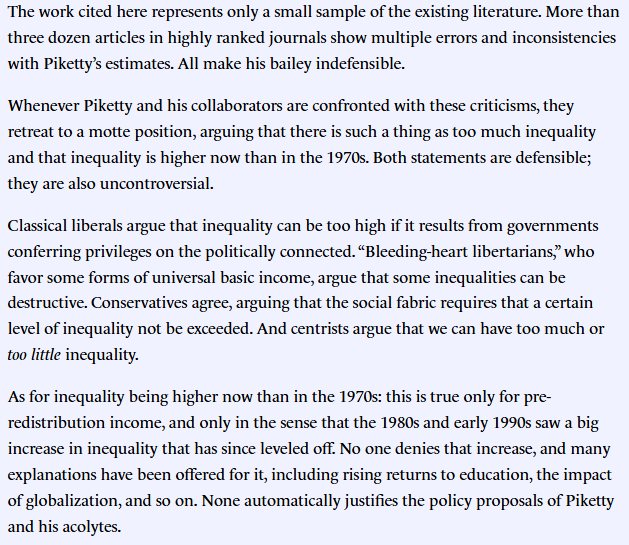
Moreover, all the errors in fact fit his preferred ideas. I have pointed out that some of my findings irked me as a classical liberal (notably with respect to the welfare state and social security). But the facts are stubborn buddies to hang out with. And what is more annoying is that none of corners cut were necessary. As I pointed out in a first review of my peer-reviewed papers which I wrote for City Journal: none of the findings I make preclude positively the call for greater income and wealth inequality. The first image is what I wrote back then on the matter. I wrote a similar thing in German for @faznet (I will post the translation in reply). That is even more frustrating than the errors themselves because they seem to have brought into existence as errors for the purposes of easing the case he wants to make -- a case which is not automatically invalidated by the data. Normative positions can be held without the need for positive prior outcomes.
Ultimately, the list of errors has been ignored and people talk about the "big ideas" without reference to the foundations used to bring them about. That is what I wish people would think about. That the factual foundations are shaky even if I do not think they are necessary to make the "big ideas".
Things can be discussed separately!
vllt unterschätzte Entwicklung der Jahre ca. seit 2005/10 ist durchschnittliche Entlastung der AG/AN durch sinkende Abgaben im Bereich der Arbeitslosenversicherung von ca 4PP insgesamt, konterkariert durch parallel ansteigende andere Abgaben. Leider steigend im Erwartungswert.
P. Bourdieu disait que les sciences sociales ne peuvent progresser « qu’à condition qu’on ne puisse pas liquider un argument scientifique par un argument politique, et à condition que tous les coups ne soient pas permis »…
Ça vaut aussi pour les débats entre économistes, non ?😉
@HamburgerPhi@EchteFreiheit No worries: Mit guter KI hast Du den geduldigsten Erklärer überhaupt. Kannst Dir Optimierung etc. wirklich gut erläutern lassen, auch sehr intuitiv, so oft und auf so vielen Wegen, bist du es verinnerlichst (statt KI als Ersatz für Deine Intelligenz zu nutzen, versteht sich).
the Belgian Prime Minister today at the “One Europe, one market” event: "there are twice as many people working on compliance compared to innovation in Europe."
Am 11.6. jährt sich der Todestag von Heike Schweitzer zum zweiten Mal. Aus diesem Anlass erscheint zu Heikes Gedenken eine Spezial-Ausgabe der ZWER, basierend auf der 2025er-Tagung am @MaCCIcomp organisiert von @peitz_martin & Jens-Uwe Franck #Kartellrecht https://t.co/oOFoABzjX9
Eine parallele Studie desselben Experiments zeigt, dass die Deaktivierung von Facebook und Instagram die politische Aktivität der Nutzer verringerte und ihren Nachrichtenkonsum veränderte. Überraschend gering waren dagegen die Auswirkungen auf politische Einstellungen, Polarisierung und Wahlverhalten. https://t.co/m0CHwG0hTo