We’re sharing a solution to the Navier-Stokes Millennium Prize Problem, one of the deepest problems at the frontier of mathematics.
The proof was produced by a group of agents, using an OpenAI next-generation model significantly more capable than GPT-6 Astra.
The problem concerns whether the description of smooth three-dimensional fluid motion modeled by the Navier-Stokes equations can break down. It has remained unresolved for roughly 90 years.
Received several pings today from the ecosystem to understand this better and what it means for Indian semiconductor startups. Here is a simplistic thread on the AI hardware stack, @C2iSemi and India's role within it.
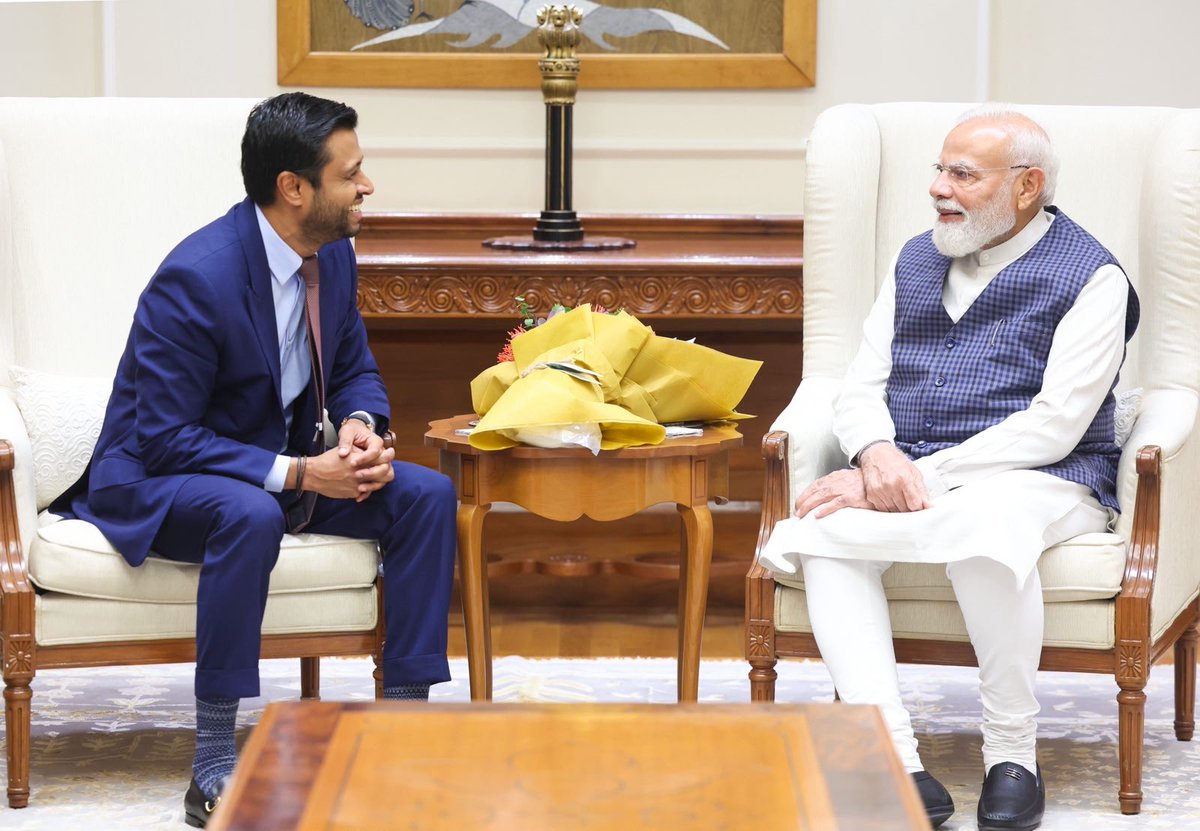
A great interaction with Pawan Chandana and Naga Bharath Daka of Skyroot Aerospace.
The success of Vikram-1 naturally featured prominently in our discussion, in addition to many other interesting subjects. Happy to hear about their journey so far and their insights on what lies ahead. Their energy, ambition and positivity reflect the vibrant spirit of our private space ecosystem.
Best wishes to the entire Skyroot team.
@SkyrootA@PawanKChandana@bharathdaka
After years of staying mostly silent here, I wanted to share what this moment truly means for us.
Reaching orbit with Vikram-1 is the culmination of an incredibly long and difficult journey. Over the last few years, Team Skyroot pushed relentlessly through missed aggressive deadlines, technical hurdles, and moments when the finish line kept moving. We never lost hope. Not once.
This success feels like redemption for every late night, every difficult choice, and every person who refused to give up on the dream.
The flight has given us a treasure of high-fidelity data. We will use every bit of it to make our vehicle subsystems significantly more robust and to optimize performance across the entire system.
For any launch company, achieving orbit is the single hardest milestone. Productionizing this capability, turning this success into reliable, repeatable flights, is now our central focus.
To every member of Team Skyroot who carried this dream when it was hardest, and to everyone who stood with us through the quiet years: thank you. This is your victory too.
To the entire nation that has celebrated this achievement with so much warmth and pride, thank you! It has meant more to us than words can express.
The real work begins now. 🚀
@SkyrootA
ORBIT ACHIEVED. 🚀
Vikram-1 Test Flight-1 has reached orbit. India's first privately developed orbital rocket has completed its final burn and injected its payloads into a ~450 km orbit, making India the third country in the world with private orbital launch capability.
History is made. 🇮🇳
#Vikram1 #JourneyToOrbit #SkyrootAerospace
AirTrunk targets ₹3 lakh crore India investment by 2030, plans 5 GW data centre capacity to ride AI and cloud boom
https://t.co/0vP47n3WTv
via NaMo App
$BX continues to make significant investments in the infrastructure powering the AI revolution, including in India through our portfolio company @airtrunk.
India’s digital infrastructure journey is gathering remarkable momentum.
AirTrunk has announced plans to invest around Rs. 3 lakh crore ($30 billion) in India, and develop 5 GW of data centre capacity. This is among the largest proposed investments in the country’s digital infrastructure ecosystem.
Such investments will strengthen India’s position as a global hub for cloud computing and AI, while generating employment opportunities, supporting local supply chains and accelerating innovation-led growth.
It is clear that the future of the world’s digital economy is increasingly being shaped in India!
Blackstone announced a joint venture with @Google to create a new TPU cloud. We see a generational opportunity to invest at scale in AI infrastructure and help meet the unprecedented demand for compute. More: https://t.co/4rCqh017bu
It's important to understand the facts during this period of overheated headlines on private credit. We believe private credit continues to represent a compelling investment opportunity with an enduring premium over public markets. Defaults may rise off historic lows; returns have normalized from their peak, and capital has flowed meaningfully into the space — these things are true. But it's important to separate the myths from the facts.
See the full details and data here: https://t.co/d5YePujfoS
I'm going to make some obvious points.
(1) Blowing up all the oil infrastructure in the Middle East is an insane idea, and may well result in a global economic crash and humanitarian crisis unrivaled in the lives of those now living. We're talking about the price of everything everywhere rising, from food to gas, at a moment when inflation was already high. All of that will be laid at the feet of the authors of this war.
(2) The antebellum status quo of Feb 27, 2026 was just not that bad, but we're unlikely to return to it. Expect indefinite, long-term, ongoing disruptions to everything out of the Middle East.
(3) Also assume tech financing crashes for the indefinite future. The genius plan to get the Gulf states caught in the crossfire has incinerated much of the funding for LPs, for datacenters, and for IPOs. Anyone in tech who supported this war may soon learn the meaning of "force majeure" as funding gets yanked.
(4) Many capital allocators will instead be allocating much further down Maslow's hierarchy of needs, towards useful basic things like food and energy.
(5) It's fortunate that all those progressives yelled about the "climate crisis." Yes, their reasoning about timelines was wrong, and much of the money was wasted in graft, but the result was right: we all need energy independence from the Middle East, pronto. It's also fortunate that Elon and China autistically took climate seriously. Now they're going to need to ship a billion solar panels, electric vehicles, batteries, nuclear power plants, and the like to get everyone off oil, immediately.
(6) It's not just an oil and gas problem, of course. It's also a fertilizer problem, and a chemical precursor problem. Maybe some new sources will come online at the new prices, but it takes time to dial stuff up, particularly at this scale, so shortages are almost a certainty.
That said, China has actually scaled up coal-to-chemicals[a,c] (C2C), and there's also something more sci-fi called Power-to-X[b] which turns arbitrary power + water + air into hydrocarbons. But all of that will need to get accelerated. I have a background in chemical engineering so may start funding things in this area.
(7) Ultimately, this war is going to result in tremendous blame for anyone associated with it. It's a no-win scenario to blow up this much infrastructure for so many people. Simply not worth it for whatever objective they thought they were going to attain. But unless you're actually in a position to stop the madness, the pragmatic thing to do is: scramble to mitigate the fallout to yourself, your business, and your people.
[a]: https://t.co/ITat4tmAFd
[b]: https://t.co/bWwiSQcgyt
[c]: https://t.co/FQCqMhy5d3
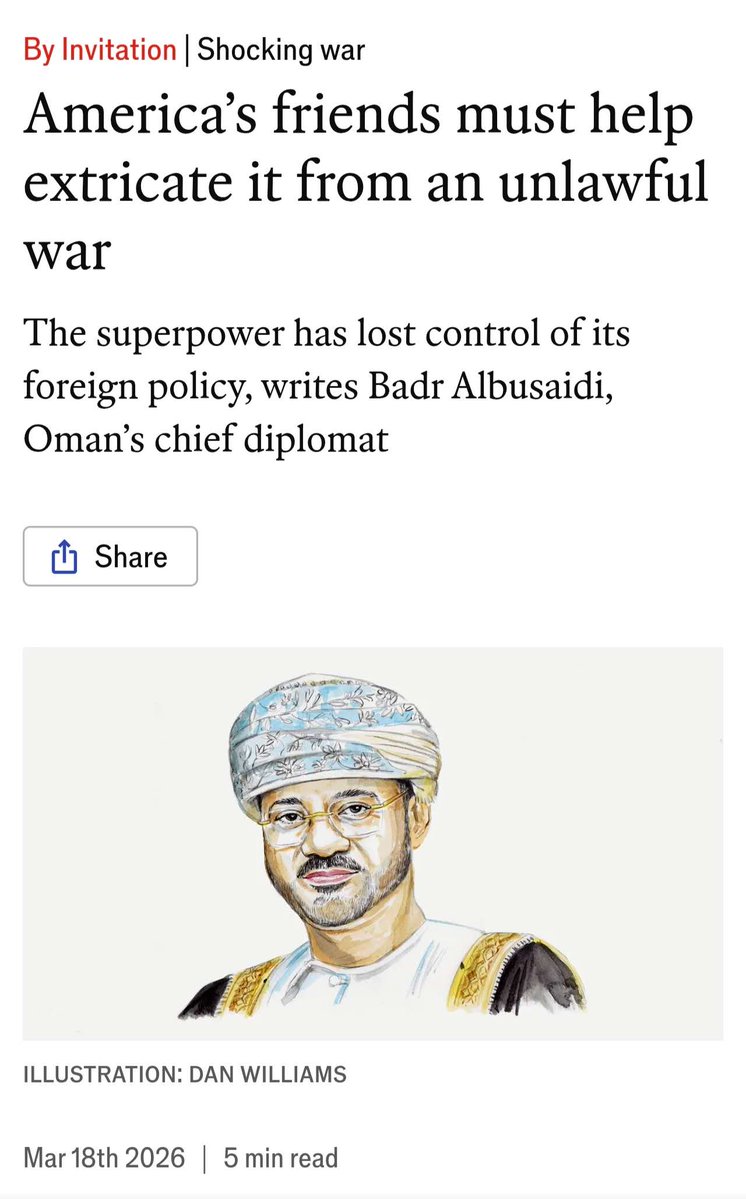
This is probably the most important article of the month: an op-ed by Oman's Foreign Minister, who mediated the talks between the U.S. and Iran, in which he writes that the U.S. "has lost control of its foreign policy" to Israel.
He repeats that a deal was possible as an outcome of the talks (something confirmed by the UK's National Security Advisor, who also attended: https://t.co/XkfSpkMjCf) and that the military strike by the U.S. and Israel was "a shock."
Interestingly, given he is one of Iran's neighbors and given that Oman has been struck multiple times by Iran since the war began (https://t.co/IXNdwD6f3j), he writes that "Iran’s retaliation against what it claims are American targets on the territory of its neighbours was an inevitable result" of the U.S.-Israeli attack. He describes it as "probably the only rational option available to the Iranian leadership."
He says the war "endangers" the region's entire "economic model in which global sport, tourism, aviation and technology were to play an important role." He adds that "if this had not been anticipated by the architects of this war, that was surely a grave miscalculation."
But, he adds, the "greatest miscalculation" of all for the U.S. "was allowing itself to be drawn into this war in the first place."
In his view this was the doing of "Israel’s leadership" who "persuaded America that Iran had been so weakened by sanctions, internal divisions and the American-Israeli bombings of its nuclear sites last June, that an unconditional surrender would swiftly follow the initial assault and the assassination of the supreme leader."
Obviously, this proved completely wrong, and the U.S. is now in a quagmire. He says that, given this, "America’s friends have a responsibility to tell the truth," which is that "there are two parties to this war who have nothing to gain from it," namely "Iran and America."
He says that all of the U.S. interests in the region (end to nuclear proliferation, secure energy supply chains, investment opportunities) are "best achieved with Iran at peace."
As he writes, "this is an uncomfortable truth to tell, because it involves indicating the extent to which America has lost control of its own foreign policy. But it must be told."
He then proposes a couple of paths to get back to the negotiating table, although he recognizes how difficult it would be for Iran "to return to dialogue with an administration that twice switched abruptly from talks to bombing and assassination."
That's perhaps the most profound damage Trump did during this entire episode: the complete discrediting of diplomacy. If Iran was taught anything, it is: don't negotiate with the U.S., it's a trap that will literally kill you.
The great irony of the man who sold himself as a dealmaker is that he taught the world one thing: don't make deals with my country.
Link to the article: https://t.co/FZxtqV3RC4
this is actually insane
> be tech guy in australia
> adopt cancer riddled rescue dog, months to live
> not_going_to_give_you_up.mp4
> pay $3,000 to sequence her tumor DNA
> feed it to ChatGPT and AlphaFold
> zero background in biology
> identify mutated proteins, match them to drug targets
> design a custom mRNA cancer vaccine from scratch
> genomics professor is “gobsmacked” that some puppy lover did this on his own
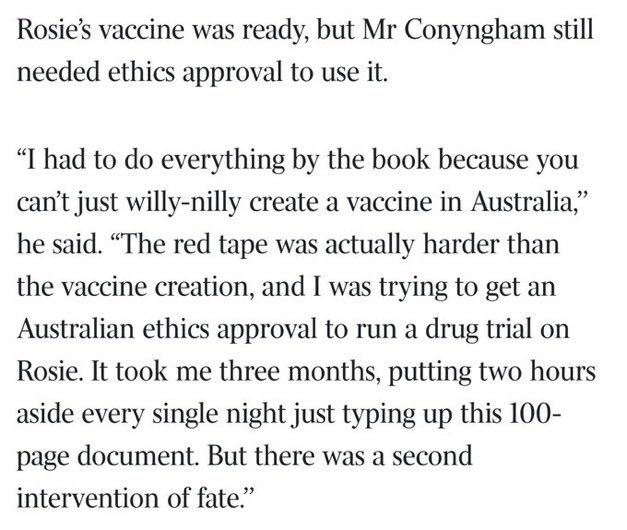
> need ethics approval to administer it
> red tape takes longer than designing the vaccine
> 3 months, finally approved
> drive 10 hours to get rosie her first injection
> tumor halves
> coat gets glossy again
> dog is alive and happy
> professor: “if we can do this for a dog, why aren’t we rolling this out to humans?”
one man with a chatbot, and $3,000 just outperformed the entire pharmaceutical discovery pipeline.
we are going to cure so many diseases.
I dont think people realize how good things are going to get
*Sanju Samson*: "
When people talk about my journey, they usually start with stadiums.
*For me, it always begins with a bus.*
I was eleven. My kit bag felt heavier than me. *I would leave home in Vizhinjam before the sun came up, change two buses, and reach the Medical College ground by 6 in the morning. Some days I was sleepy. Some days I was sore. But I don’t remember ever wanting to skip it* .
After practice, I would bathe under a small tap at the corner of the ground. No dressing room. Just cold water, a towel in my bag, and a quick change into my school uniform. Then I’d walk to catch another bus to St Joseph’s. School, homework, and then back again for evening nets.
That was my life. Every day
I didn’t think of it as a sacrifice. I just thought — this is what it takes.
*My grandfather was a fisherman. Watching him, I understood something early. You can’t control the sea. You can only control how prepared you are when you go out. Some days you come back with nothing. But you still wake up the next morning and go again. That stayed with me* .
There were phases when I felt close to my dream. And phases when I felt very far from it. Being dropped. Sitting out. Hearing opinions. Smiling outside but questioning yourself inside.
I won’t lie, it hurts. I’m human.
*But every time I feel that doubt, I go back in my mind to that small tap at the ground. To the buses. To my parents adjusting their lives around my practice. I remind myself that this journey was never built on comfort. It was built on consistency* .
When I play in Thiruvananthapuram and hear the crowd shout my name, it feels personal. They didn’t just see me succeed. They saw me grow. They saw the process.
I am still that boy from Vizhinjam. I still love batting the same way. I still get nervous. I still want to prove myself. The only difference is the stage.
*The fight hasn’t stopped. It probably never will* .
*Because for me, cricket was never about fame* .
*It was about a dream I chose , and keep choosing : every single day* . "
*~ Sanju Samson*



![balajis's tweet photo. I'm going to make some obvious points.
(1) Blowing up all the oil infrastructure in the Middle East is an insane idea, and may well result in a global economic crash and humanitarian crisis unrivaled in the lives of those now living. We're talking about the price of everything everywhere rising, from food to gas, at a moment when inflation was already high. All of that will be laid at the feet of the authors of this war.
(2) The antebellum status quo of Feb 27, 2026 was just not that bad, but we're unlikely to return to it. Expect indefinite, long-term, ongoing disruptions to everything out of the Middle East.
(3) Also assume tech financing crashes for the indefinite future. The genius plan to get the Gulf states caught in the crossfire has incinerated much of the funding for LPs, for datacenters, and for IPOs. Anyone in tech who supported this war may soon learn the meaning of "force majeure" as funding gets yanked.
(4) Many capital allocators will instead be allocating much further down Maslow's hierarchy of needs, towards useful basic things like food and energy.
(5) It's fortunate that all those progressives yelled about the "climate crisis." Yes, their reasoning about timelines was wrong, and much of the money was wasted in graft, but the result was right: we all need energy independence from the Middle East, pronto. It's also fortunate that Elon and China autistically took climate seriously. Now they're going to need to ship a billion solar panels, electric vehicles, batteries, nuclear power plants, and the like to get everyone off oil, immediately.
(6) It's not just an oil and gas problem, of course. It's also a fertilizer problem, and a chemical precursor problem. Maybe some new sources will come online at the new prices, but it takes time to dial stuff up, particularly at this scale, so shortages are almost a certainty.
That said, China has actually scaled up coal-to-chemicals[a,c] (C2C), and there's also something more sci-fi called Power-to-X[b] which turns arbitrary power + water + air into hydrocarbons. But all of that will need to get accelerated. I have a background in chemical engineering so may start funding things in this area.
(7) Ultimately, this war is going to result in tremendous blame for anyone associated with it. It's a no-win scenario to blow up this much infrastructure for so many people. Simply not worth it for whatever objective they thought they were going to attain. But unless you're actually in a position to stop the madness, the pragmatic thing to do is: scramble to mitigate the fallout to yourself, your business, and your people.
[a]: https://t.co/ITat4tmAFd
[b]: https://t.co/bWwiSQcgyt
[c]: https://t.co/FQCqMhy5d3](https://pbs.twimg.com/media/HDujYp7bwAA5DuR.png)