Catch the replay of our live event from last week on 4DGS!
Here's a clip of @RadianceFields, joined by @azadgenius and @arvinkx, discussing how unlike the transition from still imagery to video which took decades, 3DGS to 4DGS happened in years.
https://t.co/JcNV9rtpCp
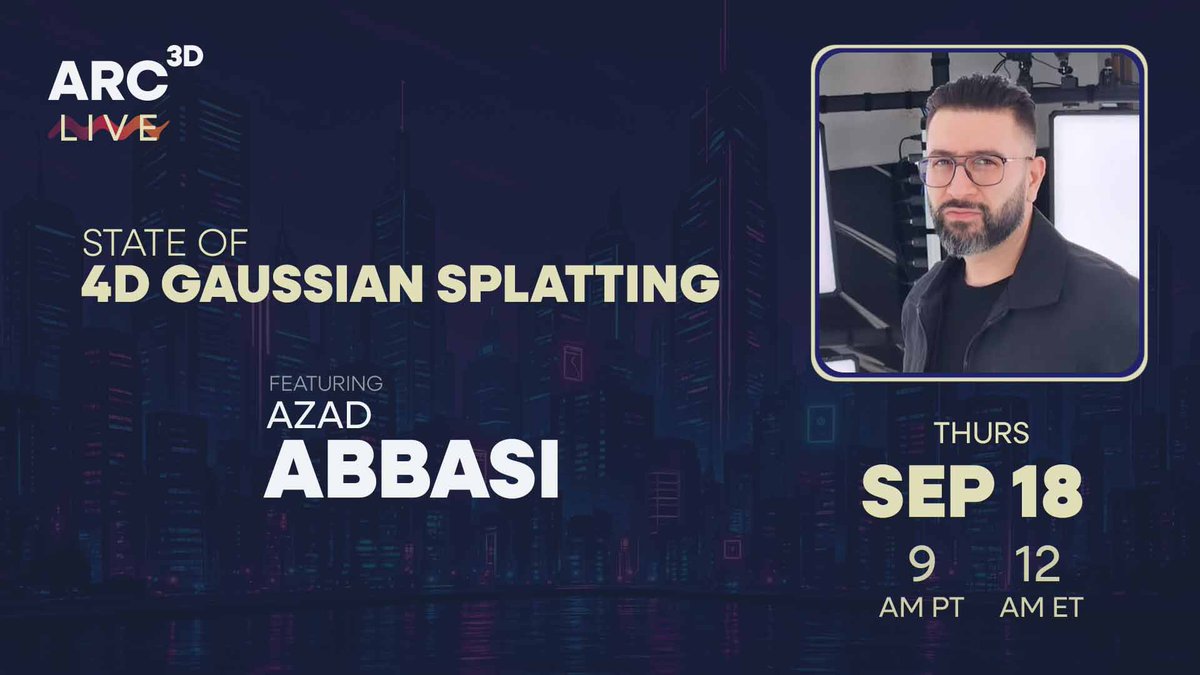
Join @RadianceFields, @arvinkx, and @azadgenius of @G3NIUSXR on September 18th for an in-depth discussion on the state of 4D (dynamic) gaussian splatting. Learn more and register here: https://t.co/VE6gJVyKZ3
FastAvatar: Instant 3D Gaussian Splatting for Faces from Single Unconstrained Poses
Abstract (excerpt):
We present FastAvatar, a pose-invariant, feed-forward framework that can generate a 3D Gaussian Splatting (3DGS) model from a single face image from an arbitrary pose in near-instant time (<10ms).
FastAvatar uses a novel encoder-decoder neural network design to achieve both fast fitting and identity preservation regardless of input pose.
First, FastAvatar constructs a 3DGS face "template" model from a training dataset of faces with multi-view captures. Second, it encodes the input face image into an identity-specific and pose-invariant latent embedding, and decodes this embedding to predict residuals to the structural and appearance parameters of each Gaussian in the template 3DGS model.
By only inferring residuals in a feed-forward fashion, model inference is fast and robust. FastAvatar significantly outperforms existing feed-forward face 3DGS methods (e.g., GAGAvatar) in reconstruction quality and runs 1000x faster than per-face optimization methods (e.g., FlashAvatar, GaussianAvatars, and GASP).
Say hello to our newest advisor, Azad Abbasi from @G3NIUSXR! Azad joins @jonstephens85 and @willeastcott in helping guide our strategy of highlighting radiance fields implementations and fostering the community.
🚀 Further progress on the WIP LOD system for Gaussian Splatting in @PlayCanvas!
The video shows colorized LOD switching:
🔴 Near
🟢 Medium
🔵 Far
More in the next clip 👇
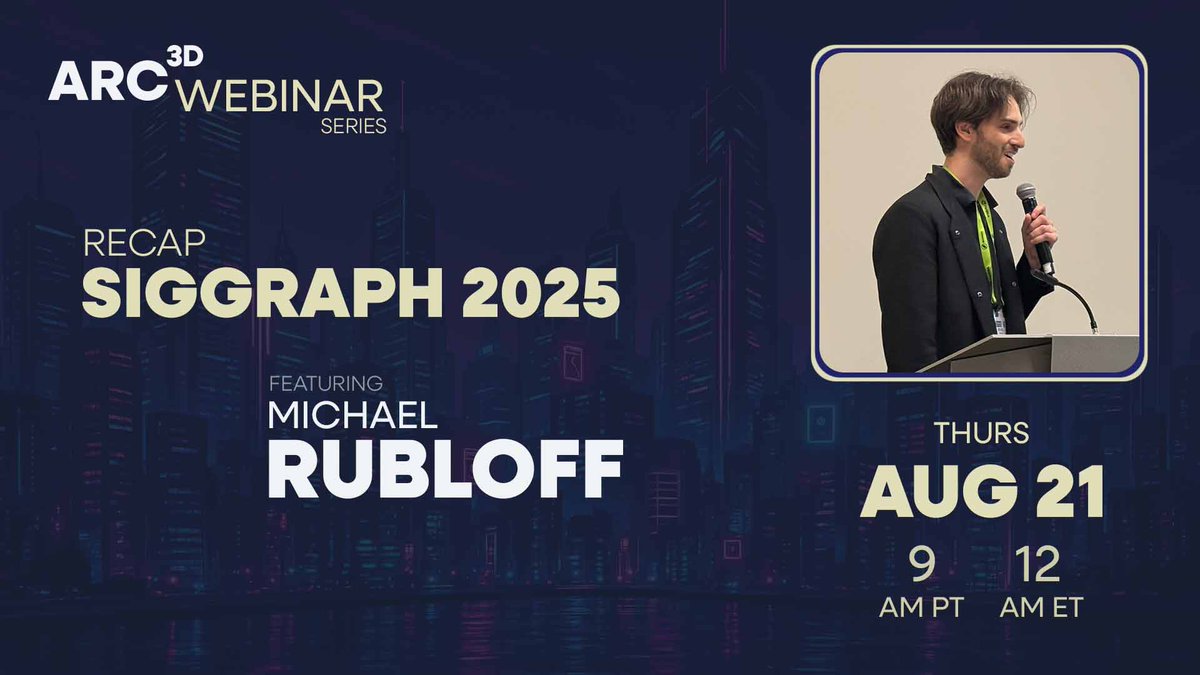
Join us this Thursday, Aug 21 for a live discussion with Michael Rubloff recapping everything related to radiance fields from SIGGRAPH 2025!
Sign up here: https://t.co/AL0htvTEG1
🚀We’ve just released ViPE — a data annotation pipeline for jointly predicting depth and camera pose from video. ViPE powers both the training and testing stages of NVIDIA #GEN3C!
🔗ViPE: https://t.co/f2DpsOnCY8
🔗GEN3C: https://t.co/SgbKkrn2nD
Catch all the new radiance fields announcements at @siggraph covered by our own Michael Rubloff from @RadianceFields!
Have questions or topics you want covered? Post them as a comment below.
Join @NVIDIAAI research leaders Sanja Fidler, Aaron Lefohn, and Ming-Yu Liu as they chart the next frontier in computer graphics and physical AI at @siggraph 2025.
This is a glimpse into the breakthroughs shaping computer graphics in the age of AI. From faster synthetic data generation to streamlined content creation, these advancements are driving innovation across media, design, robotics, automotive, and manufacturing.
Watch the livestream: https://t.co/rrOejxZgM6
I will be onsite covering SIGGRAPH. Please let me know if you will also be attending or if there's something you would like to see covered.
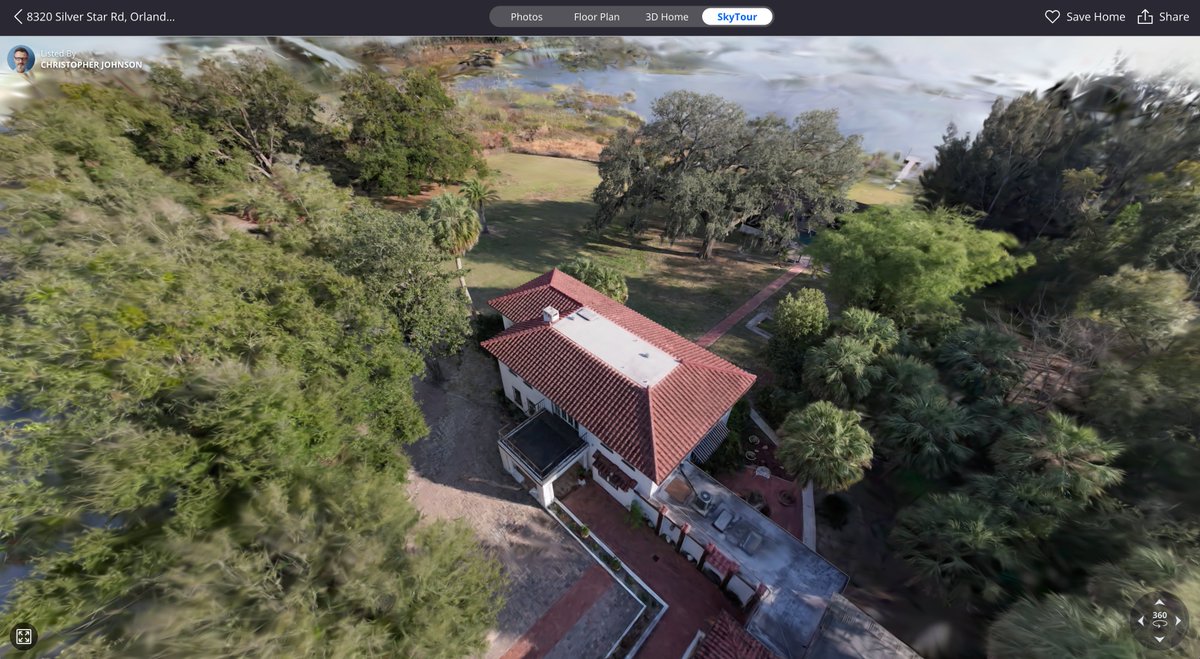
Learn about how the real estate and hospitality industry is utilizing gaussian splatting with @zillow's new SkyTour feature in our latest blog article: https://t.co/EjQt0yZYOR
The ARC team had an amazing time helping bring splats to @OpenSauceLive 2025 this last weekend!
Here's a video recap including some of the splats created from around the event that we captured with @NianticSpatial Scaniverse!
Tomorrow we are doing a free webinar with @playcanvas about their work with gaussian splatting!
Make sure you register to receive the link: https://t.co/stJi4celXd
📣 We’re proud to launch ARC — the first association for radiance field technologies like NeRFs and Gaussian Splatting.
🎥 Join our first event: The State of Radiance Fields
With @jonstephens85 & @Radiancefields
📅 May 15th | 🕒 11 am PT / 2 pm ET
✅ https://t.co/22MMY617T1