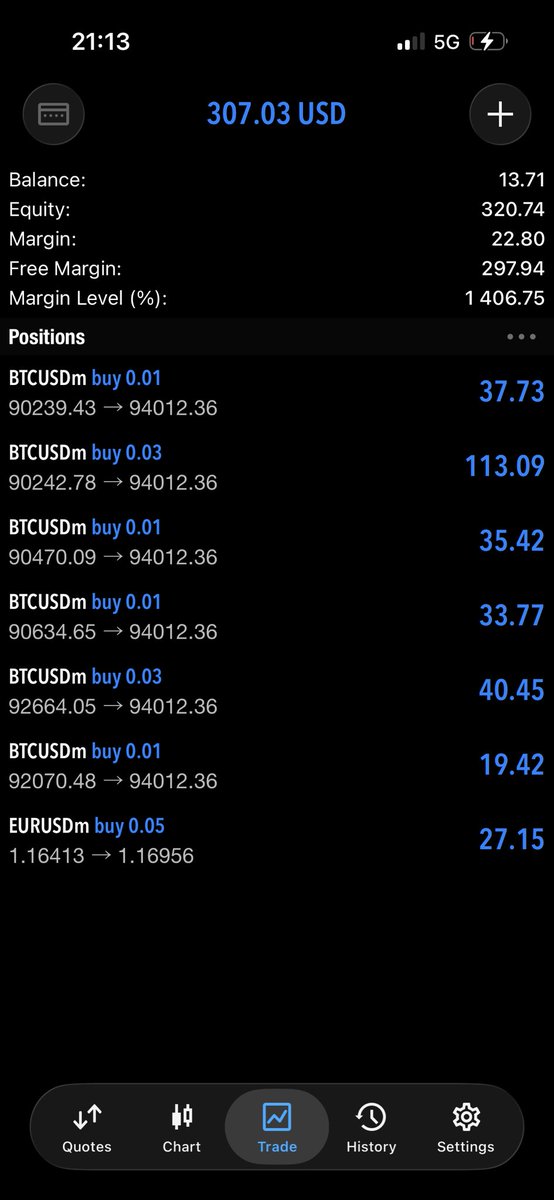
@ohajielom Yes
Market maker sir.
It’s absolutely arrogance to speak with 100% certainty about the markets (which is what you did) when you do not own them.
You influence a lot of people on here in case you did not notice.
Read the Market Wizards chapter on Kristjan Kullamägi this weekend. The one section that really stood out was when he discussed his drawdown off of his 2021 peak.
"I started 2020 with $3.5 million and ended the year at $36 million. It was a thousand percent year. Then I ran that $36 million to a high of $105 million, and the last portion of that move from $65 to $105 million occurred in just a month and a half. For a brief period, just a few days, I was over $100 million. You have to understand what that did to my psyche. It made me feel completely detached from reality. I thought, “I’m going to get to $200 million in six months.” I was completely sure of that. I started seeing trading as a video game, which I kept winning.
Measured from my $105 million peak in November 2021 to my mid-2022 low, I lost approximately $60 million. About half of that loss represented the late 2021 retracement of the large open profits at the November peak to the stops on those positions. The initial retracement loss was so large because I was leveraged long at my peak. My long exposure was $150 million—a number I recall because I remember bragging about it to a friend"
These boom and bust type tales are as old as time. Look at Jessie Livermore as the classic example. Net worth of $0 in 1906 to a peak of $1.6 billion (inflation adjusted to 2021 dollars) in 1929. Just 5 years later he blew up and owed $104 million dollars to his brokers...
Or look at Paul Tudor Jones. Hit one of the most legendary trades in history, making roughly $200 million dollars during the 1987 crash. It cemented him as a legend. His mental coach Tony Robbins said that Jones consistently lost money for the next 4 years after that peak.
Dan Zanger parlayed $10,000 into $42 million during the late 90's. Then in late 2000 he took a 70% drawdown when he was 200% long 3-4 fiber optic stocks as the dot-com bubble was popping.
Charles Harris reached 8-figures status after he ran up his account over 4,000% from 2020-21, then experienced a -80% drawdown, mostly due to his big TSLA bet in 2021-2022.
I have seen a few people speculating on Kristjans story from the outside. Saying "I would have stopped trading at $100 million" or "I would have just taken that money and started investing". To those people I ask if you have ever experienced a real euphoric run in your trading account, let alone turning 5k into 100mil? Extreme winning streaks like the ones above breed overwhelming euphoria and overconfidence. The mind shifts its focus from process to outcomes, with ego-driven decisions overriding risk parameters and rules. From my experience I have found it near impossible to be aware of this at the peak of the run. It is almost like you are blacked out and the greed/ego completely takes over your trading.
Then the drawdown begins. The emotions shift from euphoria and greed to revenge, fear, and doubt. This is where things can really start to spiral out of control. It is only after the drawdown has run its course that you finally come back to your senses and your emotions drift back towards baseline levels. Then all you're left with is regret...
Few people ever talk about what a big winning streak can do to you. It can literally change the way you think and operate. Often the ability to achieve super returns is also its biggest drawback—a true double-edged sword. To be able to conquer both sides is the holy grail...
From the Hour Between Dog and Wolf by John Coates:
"When traders enjoy an extended winning streak they experience a high that is powerfully narcotic. This feeling, as overwhelming as passionate desire or wall-banging anger, is very difficult to control. Any trader knows the feeling, and we all fear its consequences. Under its influence we tend to feel invincible, and put on such stupid trades, in such large size, that we end up losing more money on them than we made on the winning streak in the first place. It has to be understood that traders on a roll are traders under the influence of a drug that has the power to transform them into different people."
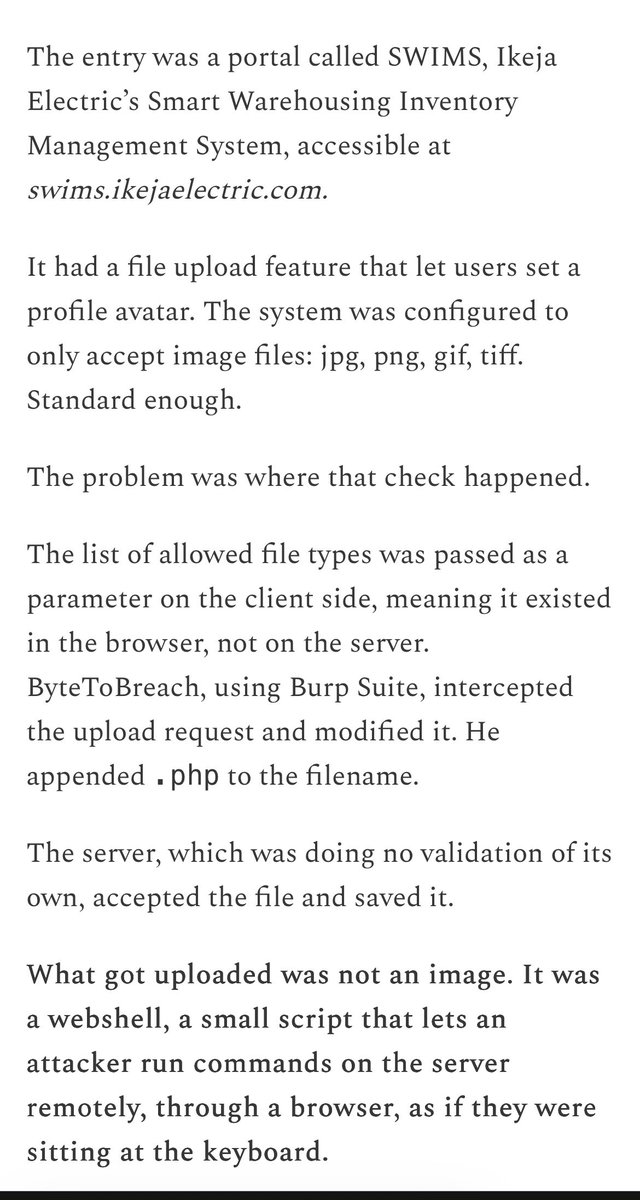
Ikeja Electric was hacked through a profile photo upload form.
The threat actor exploited an Unrestricted File Upload vulnerability on their Smart Warehousing Inventory Management System, uploaded a webshell, and had remote access within minutes.
From there, he moved through their network, finding passwords stored in plain text, using them to access internal systems, and eventually cracking the domain admin password.
Gaining full control in four days.
He then exploited an unpatched VMware vCenter server—software from 2018, never updated—and according to him, deployed ransomware across 50+ hosts, taking down metering software across their systems.
I’ve published a full analysis of what I’m now calling cyber-terrorism against Nigerian critical infrastructure, along with a practical advisory for affected individuals, organisations, and regulators.
https://t.co/0rzvhVcLNf
BREAKING: President Trump says Iran has 48 hours to "fully open" the Strait of Hormuz or the U.S. will start destroying its power plants, beginning with the "biggest one first."
BREAKING: The IEA has issued a warning stating that the Iran War is the greatest threat to global energy "in history."
Details include:
1. The IEA says it could take 6 months or longer to fully restore oil and gas flows from the Gulf
2. Roughly 18 million barrels of daily crude oil supply remain offline
3. Russia’s Nord Stream pipelines are not operational adding further pressure
4. There is currently "no immediate way" to replace the supply of oil from the Gulf
Today concludes week 3 of the Iran War.
Imagine being a hedge fund manager trying to price risk while the President sounds like he’s freelancing World War III from the toilet.
Nobody knows what the plan is. There is no plan.
The plan is vibes, caffeine, and one man screaming into his phone like the manager of a failing Atlantic City steakhouse.
You open your brokerage app and everything is red, except oil and defense contractors, because of course.
Of course.
Every time civilization starts wheezing, Exxon walks out in a tuxedo with a martini and Lockheed buys another island.
The Nasdaq looks like it got hit in the face with a folding chair because suddenly the market remembered that semiconductors do, in fact, require an operating global economy and not just TED Talk confidence and a black turtleneck.
And Trump, God bless him, is tweeting like a guy who was handed six different war briefings, understood none of them, and decided to freestyle foreign policy from the toilet.
“We may be winding down.” Great!
“We may obliterate their power plants in 48 hours.”
Fantastic!
“Oil sanctions are off, but also maybe on, but also maybe we’re taking the island.”
Beautiful. Just beautiful.
This is why the market can’t price anything. You can’t build a discounted cash flow model around a national mood swing. There’s no Bloomberg terminal function for “presidential posting episode.”
There’s no options chain for “what if the leader of the free world says three contradictory things before lunch and Brent crude goes vertical while JPMorgan analysts begin quietly chewing through their own ties.”
The average investor is just sitting there like, “I bought an index fund because they told me it was safe.”
Safe? SAFE? Your “safe” portfolio is now directly connected to whether some 28-year-old NSC staffer can stop a rage-post from becoming a missile exchange before the European open.
That’s your diversification. Congratulations.
You own a basket of companies whose earnings now depend on whether Hormuz is open and whether Trump has confused deterrence with posting.
And Wall Street still does the same little dance every time. “Well, maybe this is already priced in.”
Oh really? Already priced in?
Was the possibility of a full-blown oil shock, shipping disruption, inflation resurgence, and presidential caprice “priced in,” Chad?
Was it in the spreadsheet next to “soft landing” and “AI productivity miracle”?
No, it wasn’t.
What was priced in was endless delusion, infinite buybacks, and the belief that history had ended because the S&P had a nice quarter.
Now everybody’s doing that thing they do where they act shocked that war affects markets.
“Wow, yields are up. Wow, energy’s squeezing margins. Wow, rate cuts are less certain.”
Yes, genius.
That tends to happen when the world’s most important oil chokepoint turns into a live-action Call of Duty map and the White House communications strategy is basically drunk casino owner at 2 a.m.
This is the real genius of the modern empire. It can’t build a train station, can’t balance a budget, can’t explain what victory looks like, but it can absolutely vaporize your 401(k) with a single weekend news cycle.
That part works flawlessly. That part is incredible. The only truly efficient American institution left is panic transmission.
We get chaos from the battlefield to your Robinhood account faster than Amazon gets paper towels to your porch.
And the best part is that by Monday morning every idiot on television will sit there with perfect hair and say, “Markets dislike uncertainty.”
Wow. Thank you, Socrates. What a contribution.
They dislike uncertainty. Incredible analysis.
We’ve spent billions on financial infrastructure just to reinvent the village idiot pointing at the sky going, “Storm bad.”
That’s where we are. The market is a hostage, oil is a weapon, diplomacy is a hallucination, and the President is posting like a divorced nightclub owner who just found the nuclear football in a Denny’s booth.
Everybody wants calm, nobody has control, and your portfolio is being managed by events that sound fake even when they’re real.
Absolute clown planet. Premium clown planet.
Goldman Sachs clown planet with institutional custody.
$NFLX should go as low as 82 - 69 dollars and then we should see a lot of discounted buys to really milk this Warner bros acquisition.
Right now it’s all noise.