Architect has acquired a DCM and we’re launching the American Innovation Exchange, a new US futures exchange purpose–built for trading compute derivatives.
Onboard directly from desktop or mobile, trade the century’s most consequential commodity. Coming soon.
Next week I'll be at Forex Expo Dubai, 22–23 Sept, DWTC.
@Architect_Fi runs AX, a regulated perp futures exchange for FX, metals, GPU/compute and equities. No expiry, no rolls, 23/7, 0 bps maker.
Brokers hedging flow, market makers, prop desks, individuals: DM me and we'll grab 20 minutes.
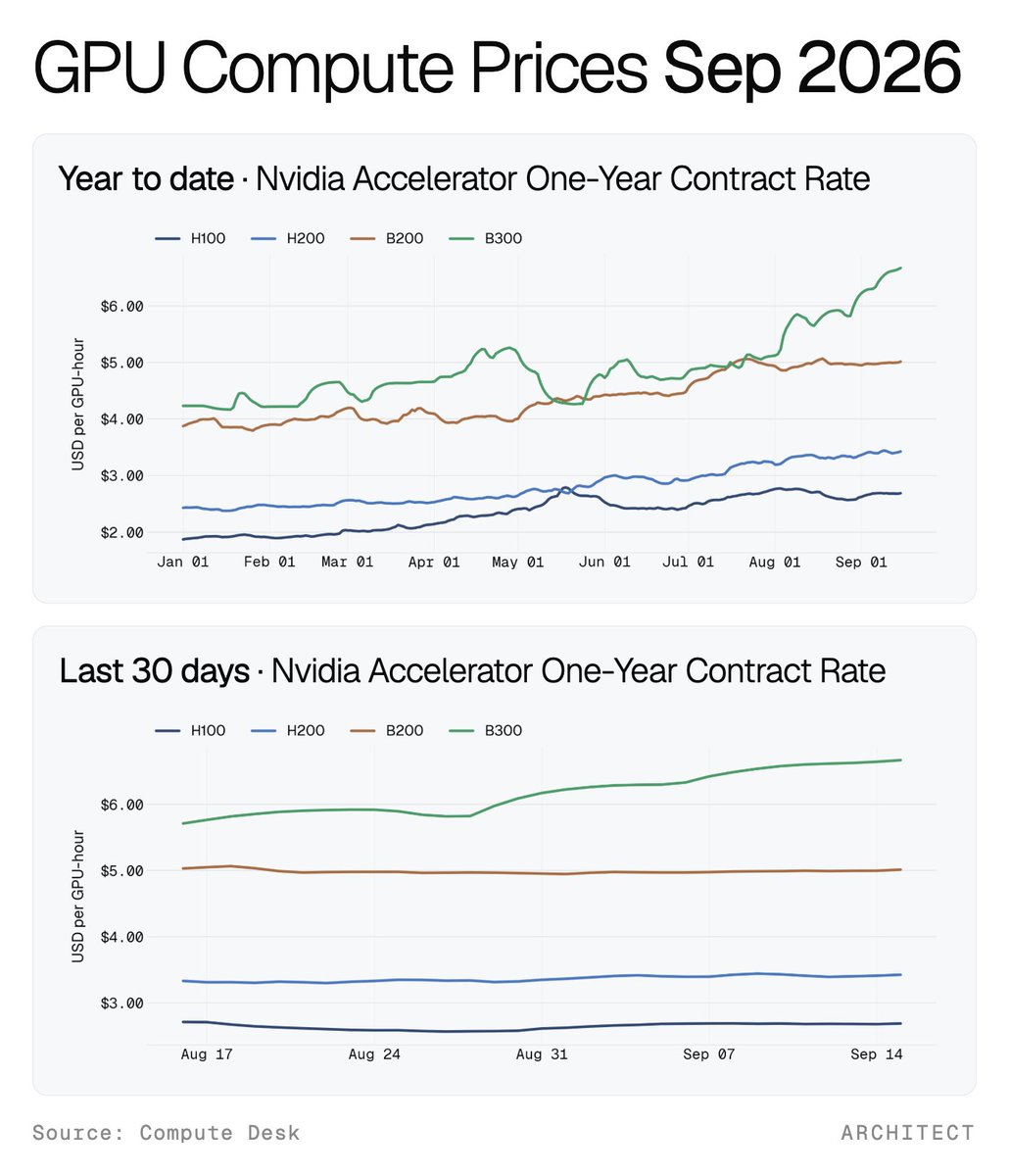
B300 prices have broken away from the pack, one-year contract rates up >$1/hour in the last 30 days while other models are flat. The compute capacity block trades our customers have brought Architect this month are almost all B300/GB300 or VR. Few are asking for Hoppers at size.
@BrettHarrison, CEO of @Architect_Fi (ex-Citadel, ex-Jane Street), joins us Sept 30 to talk GPU market structure.
Futures on GPU rental prices list next month, and the exchanges racing to open aren't even using the same index. No agreed standard for a GPU-hour means you can't hedge or borrow against the price.
Join us live → https://t.co/K2Ybqovz7b
We're in limited release for individual accts. We are thinking of continuing no auto-liquidation for individuals 🤔
Is this compelling to a pro-tail RWA traders?
Imagine funding rate arbs on weekends and being able to top up vs liquidation after a bad funding print.
Comparing AI-based Trading Latencies
LLMs aren’t fast enough for online inference in algorithmic trading except for longer-horizon stat arb trades. For the lowest latency trades, many non-LLM machine learning methods are viable. A latency comparison of high- and mid-frequency strategies to ML techniques:
• Latency arbitrage/race-to-trade: 10ns - 2µs. The lowest-latency trading strategies are pure speed races with deterministic market data triggers. These require colocated hardware-based trading systems using FPGAs/ASICs.
• Passive HFT market making: 500ns - 20µs. Order placement and cancel latencies must stay low to optimize queue position. Hardware-based solutions are common, but software-based passive market making can succeed using kernel bypass.
• Aggressive/directional HFT: 1µs – 50µs. These trades are similar in spirit to FPGA speed races but have more complex triggers with less immediate edge decay. Examples include underlying feed moves for derivative pricing.
• Cross-venue/triangular arb: 5µs – 5ms. Colocation in the correct datacenters and leveraging microwave/RF feeds between datacenters are more determinative than the internal latency of the trading system itself.
• Short-horizon stat arb: 1ms – 100ms. At this latency profile, complex signals and forecasting methods are used to predict future moves more than reacting to past ones. Lower latency strategies can bring down execution costs but aren’t strictly necessary.
AI latencies depend heavily on the choice of ML technique. Here are a few examples:
• Pre-computed decision tree on FPGA: 5ns - 50ns
Compiled gradient-boosted decision trees on CPU: 1µs - 20µs
• Mid-size deep neural network on GPU: 200µs - 5ms
• LLM time to first token on hosted infra: 200ms - 2s
• LLM full response of hundreds of tokens: 2s - 30s
As specialized inference ASICs bring down TTFT for LLMs, transformers will eventually become part of the tick-to-trade pipeline. For now they are primarily a tool for training and research.
Navier-Stokes and other frontier math discoveries have shown that multi-agent ensembles are required to escape the typical creativity constraints of LLMs. Is this also applicable to algorithmic trading research, which similarly lacks direct answers in LLM training data?
The general method for producing a proof of an unsolved math problem has been to set up large teams of agents to
- create multiple formations of the problem
- selectively research or exclude known results
- search for counterexamples or use counterexample attempts to tighten problem bounds
- randomly apply unrelated areas of mathematics
- use formal verification methods to check other agents’ work
- project manage and referee across all existing agents
Single-agent systems tend to plateau to a mean knowledge level. This covers the majority of tasks at an efficient cost per token, as the answers to most queries lie explicitly in the latent space of LLMs. Clear examples where single agents fall short are complex system design and numerical analysis, both of which describe algorithmic trading research.
The ensemble method has potential to discover new alpha in algorithmic trading, but at the cost of substantial compute and tokens. Frontier model companies won the competition for quant/engineering talent against large trading firms a few years ago, but are not yet deploying them in this direction.