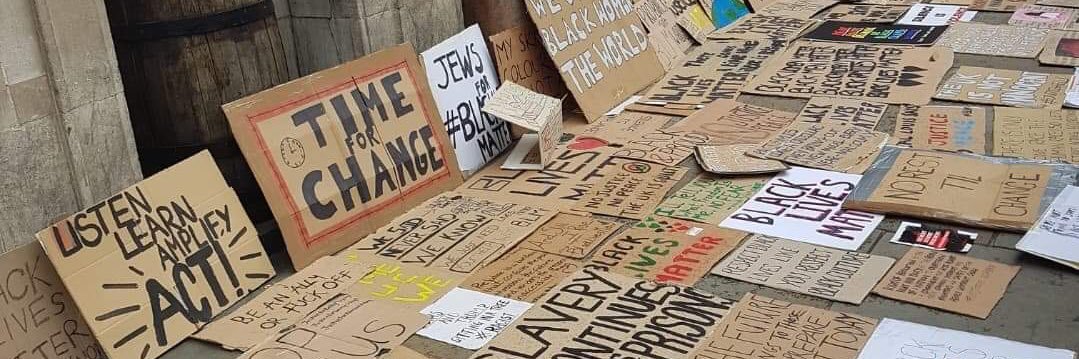
This page serves to combat racism in archaeology by exposing it and by promoting the work and research of Black archaeologists and those exposing racism
Almost every museum job advert I’ve seen recently is ‘encouraging applications from under-represented groups’ which, y’know, is great, But, I’d love to know exactly HOW. Nothing’s different in the ad/jd so….Is it just words? 🤷🏻♀️ #museumjobs
There's a phenomenon I actually see extremely commonly when literature is used to teach history to middle school and high school students. Let's call it "pajamafication."
I studied history at university and took a number of modules on nazi history. When I asked my lecturer what happened to Black Germans, he responded that there “wasn’t really any.” And this is how erasure happens seamlessly in the classroom.
I'm angry that university departments feel they can "decolonise" themselves with no substantial changes in expertise or personnel. Asking existing racially illiterate white academics to diversify their teaching without updating their knowledge doesn't come close to decolonisation
British academics, especially in the humanities (literature, history) have not done enough engagement on decolonial theory & praxis to publish on the topic. This isn’t about white academics either; an astounding number of academics of color have also jumped on this bandwagon.
Panel on hiring in archaeology organized by the Archaeology Centers Coalition, sponsored by @UCBerkeleyAnth and @UCLACotsen. Register at: https://t.co/iJtcsAtYLp
Register for FREE to attend the season premiere of the Sounds of Freedom, 21-22 Oct, at Alliance Francaise, #Nairobi. This brilliant audio series captures the personal experiences of those who fought for Kenya’s independence from British colonial rule.
https://t.co/aMJYojCXjS
Still time to register on Country Houses and the Empire, free 6 week online #ColonialCountryside course for anyone who wants to know more about historic houses and colonialism as well as heritage professionals, volunteers, curators, teachers and writers
https://t.co/QoeqHybGZd
In order to commemorate Black History Month, we at LCOC are compiling a list of black authors and their work, classics-related or not. We would love to hear your recommendations and would appreciate it if you could DM/reply to us with any suggestions you have!
October 20-23: @cee_upenn and @pennmuseum will be presenting a hybrid international conference, “Settler Colonialism, Slavery, and the Problem of Decolonizing Museums”. https://t.co/DBwfTso0oc
I'll be giving an online talk on 10/20 at 1:30pm ET on the topic of "Disability and Ableism in Archaeology"! It's in the #DigginIn series sponsored by the Massachusetts Archaeological Society and @RSP_Museum. See you there?
The students of my Archaeology of Black Heritage in Oklahoma course have officially launched a blog to share their experiences and engage with people outside of our virtual classroom space. If you are curious what we're up to... check it out
https://t.co/aJGzpbRd3D
We're so excited about this upcoming panel event! 'Slavery & Freedom: Material and Visual Histories' brings together an archaeologist, an art historian, and a natural historian to talk about their work. Feat. @peggybrunache & @NatHistGirl!
Register here: https://t.co/fG7ewmYTQ6
How many Africans do you see walking around doing ‘fieldwork’ in Western societies? Even for those who live, study, and work here, the assumption is that we can only really study our own ‘home’ societies, so that if we choose otherwise we are often ignored or dismissed. 1/6
The very first step to decolonize historically & predominantly white depts should be to NOT “recruit” BIPOC students but instead to get white faculty out of the “I can’t be racist” denial.
Dr. Rachel Watkins is a biocultural anthropologist whose main research interests include the biological and social history of African Americans who lived during the 19th and 20th centuries. #Bioculturalanthropology#skeletalbiology