Dig into a technical overview of how we built Laravel Cloud's new full-stack, scale-to-zero compute. Awesome work by the Cloud infrastructure team. 👏
https://t.co/nRkXkh5EWn
My hands down favorite use of AI is dealing with servers.
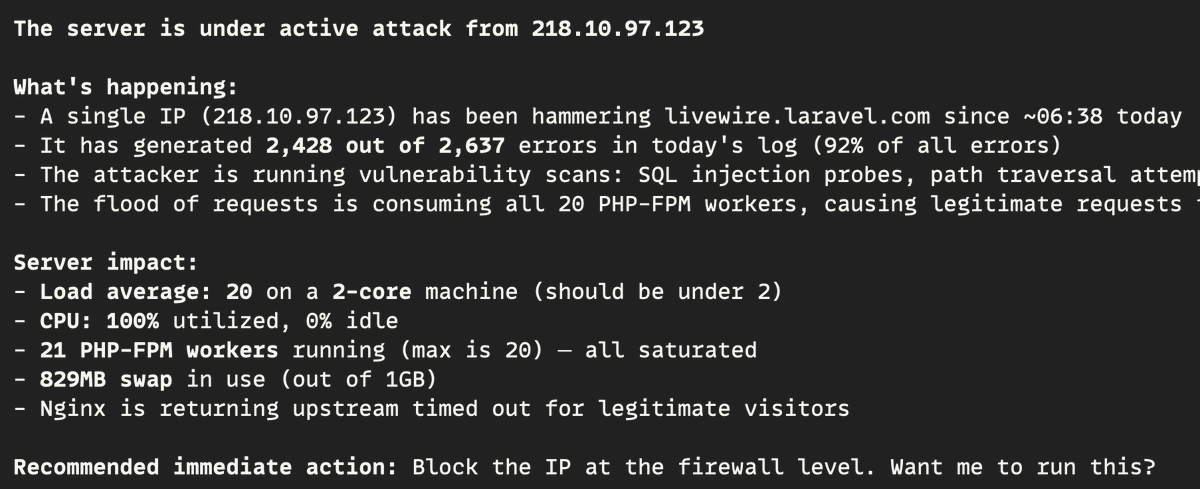
Livewire site was slow today, ssh'd in, asked claude what was up, two minutes later it had a firewall rule in place and everything was back to breezy.
The other day the storage was full on another server, it figured that out, cleaned it up, identified the problem was file session driver and too long of a session lifetime, fixed that too.
I'm pretty undecided on if AI is anything more than a distraction when I'm working on Flux, but when it comes to server crap, I just can't go back.
Laravel Cloud now automatically scales your HTTP apps based on real-time HTTP request worker pressure. 💪
Instead of only waiting for CPU or memory to rise (lagging indicators), Cloud's ingress layer now also watches active requests and adds replicas as demand increases, then removes them when traffic subsides.
CPU and memory thresholds still apply too. Cloud scales on whichever limit is reached first.
If you already have autoscaling enabled on Cloud, you’re good to go.
https://t.co/622l4aP8hl
This works really well btw, at the end of your query ask your LLM to "structure your response as HTML", then view the generated file in your browser. I've also had some success asking the LLM to present its output as slideshows, etc.
More generally, imo audio is the human-preferred input to AIs but vision (images/animations/video) is the preferred output from them. Around a ~third of our brains are a massively parallel processor dedicated to vision, it is the 10-lane superhighway of information into brain. As AI improves, I think we'll see a progression that takes advantage:
1) raw text (hard/effortful to read)
2) markdown (bold, italic, headings, tables, a bit easier on the eyes) <-- current default
3) HTML (still procedural with underlying code, but a lot more flexibility on the graphics, layout, even interactivity) <-- early but forming new good default
...4,5,6,...
n) interactive neural videos/simulations
Imo the extrapolation (though the technology doesn't exist just yet) ends in some kind of interactive videos generated directly by a diffusion neural net. Many open questions as to how exact/procedural "Software 1.0" artifacts (e.g. interactive simulations) may be woven together with neural artifacts (diffusion grids), but generally something in the direction of the recently viral https://t.co/z21CP5iQfu
There are also improvements necessary and pending at the input. Audio nor text nor video alone are not enough, e.g. I feel a need to point/gesture to things on the screen, similar to all the things you would do with a person physically next to you and your computer screen.
TLDR The input/output mind meld between humans and AIs is ongoing and there is a lot of work to do and significant progress to be made, way before jumping all the way into neuralink-esque BCIs and all that. For what's worth exploring at the current stage, hot tip try ask for HTML.
Your Laravel agent can now use tools from any MCP server. Add them to your 𝚝𝚘𝚘𝚕𝚜() array alongside your own classes, and the model treats them exactly the same.
@pushpak1300 breaks it down →
https://t.co/AHYgKCfmNM
Hey Laravel Developers 👩💻
Laravel Sanctum is one of the packages that allows us to easily generate access tokens to be shared with our clients.
But remember, these tokens can easily be leaked from the client side, and you have no control over that whatsoever.
As a security measure, Laravel Sanctum provides an option to prefix the tokens.
Adding a prefix allows you to easily identify Sanctum tokens, and if you use different prefixes for different applications, it can also help identify which application leaked a specific token.
It also allows tools like GitHub to more easily identify leaked tokens in repositories using secret scanning.
#laravel #php
Moat is a new command-line tool that reviews the security posture of a GitHub user, organization, or repository. With a single command, it inspects GitHub's built-in security controls and returns a report showing what is enabled, what is missing, and which settings may deserve attention.
Laravel Paper brings Eloquent's feature set to flat-file data sources. It allows you to treat Markdown and JSON files as database records, which is useful for documentation, product catalogs, or small-scale content management where a traditional database might be unnecessary.