Something quiet but significant is happening in Web3.
A fully live platform is turning one of the world’s most common daily activities into a structured, revenue-sharing ecosystem.
No noise. No gimmicks. Just traction, utility, and real-world users.
This is the story of @runwago
....walk with me lets explore 🧵🔻
USDD is expanding its reach across the crypto ecosystem through integrations with multiple platforms spanning DeFi, CeFi, wallets and decentralised exchanges.
The latest Supported Projects directory on https://t.co/k8lH9lOTKO highlights several platforms that have integrated USDD, showing how the stablecoin is becoming accessible across different parts of the digital asset ecosystem.
Here is a closer look at some of them.
Wallet Integrations
→ Binance Wallet
→ Gate Web3 Wallet
These integrations extend USDD's presence across wallet applications, giving users additional environments to manage and interact with digital assets.
Centralised Exchanges (CEX)
→ https://t.co/OsPqWTMoUH
→ KuCoin
→ Bitget
→ LBank
→ WEEX
These exchange integrations expand USDD's presence across centralised trading platforms.
Decentralised Exchanges (DEX)
→ JustLend DAO
→ Uniswap
→ PancakeSwap
These platforms connect USDD with decentralised finance infrastructure and different blockchain ecosystems.
Lending and DeFi
→ Morpho
→ Pendle
These integrations introduce additional ways for USDD to participate in lending and yield-focused DeFi activities.
Why does this matter?
A stablecoin's utility is influenced by how widely it can be accessed and used.
Integrations across wallets, exchanges, lending protocols and DEXs create more opportunities for users to interact with USDD.
It also means USDD is not confined to a single use case.
Users can explore trading, lending, stablecoin management and other DeFi activities across supported platforms.
The bigger picture is ecosystem connectivity.
USDD is building a network of integrations that connects its stablecoin infrastructure with established platforms across the crypto industry.
More integrations mean more avenues for accessibility, liquidity and utility.
Explore the supported projects and discover where USDD is integrated:
https://t.co/LFEf0aeSZU
@justinsuntron@USDDecentralize #TronEcoStar
Where can USDD holders put their stablecoins to work?
USDD is expanding its earning opportunities through integrations with multiple platforms across the DeFi and centralised finance ecosystems.
The USDD website now features an earning directory that brings together platforms where users can access different USDD-related earning opportunities.
Here is a closer look at what is available.
1. Centralised Exchange Opportunities
Several exchanges listed on the platform offer USDD staking opportunities:
→ Gate: 5% APY
→ KuCoin: 5% APY
→ LBank: 5% APY
→ WEEX: 5%–8% APY
These integrations give USDD holders additional options for accessing staking opportunities through supported exchanges.
2. DeFi Lending Opportunities
USDD is also represented across decentralised lending platforms.
→ JustLend DAO: 4% APY for supplying USDD.
→ Morpho: Flexible opportunities involving PT-sUSDD.
This connects USDD with lending infrastructure where users can explore additional ways to utilise their stablecoin holdings.
3. Wallet and DeFi Integrations
The directory also features:
→ Binance Wallet: USDT staking opportunities on Ethereum and TRON.
→ GateDEX: USDD/USDT staking opportunities across supported networks.
→ Pendle: Opportunities involving PT/YT and liquidity pool positions.
The displayed APY is not specified for every listing, so users should check the individual platforms for their current terms.
4. A Multichain Earning Ecosystem
The dashboard highlights opportunities across TRON, Ethereum and BNB Smart Chain.
This is important because USDD holders can explore different platforms and blockchain environments rather than being limited to a single earning venue.
What makes this interesting?
USDD is building beyond its role as a dollar-pegged stablecoin.
Its ecosystem connects stablecoin utility with savings, lending, staking and other DeFi opportunities.
Instead of relying on a single platform, users have different avenues to explore depending on their preferred network and earning strategy.
The bigger picture is an expanding network of integrations that gives USDD additional utility across the digital asset ecosystem.
Explore the available opportunities:
https://t.co/LFEf0aeSZU
@justinsuntron@USDDecentralize #TRONEcoStar
USDD is making stablecoin conversions more straightforward with its built-in Swap (PSM) feature.
The Peg Stability Module (PSM) allows users to exchange USDD with supported stablecoins at a fixed 1:1 ratio, providing a predictable way to move between stable assets.
Here is how it works.
1. Fixed 1:1 conversion
Unlike traditional decentralised exchange swaps that rely on liquidity pools and price curves, USDD's PSM provides fixed-rate conversions.
Users can exchange supported stablecoins such as USDT and USDC for USDD at a 1:1 ratio.
This creates a more predictable conversion experience without the usual market-based pricing and slippage associated with DEX swaps.
2. Supporting USDD's dollar peg
The PSM is designed to help maintain USDD's dollar peg by providing direct conversions between USDD and supported stablecoins.
This gives users a straightforward way to move into and out of USDD while maintaining a predictable exchange rate.
3. More convenient stablecoin conversions
The feature is particularly useful for users who want to convert between supported stablecoins without navigating traditional DEX trading mechanisms.
The platform also highlights competitive fees across supported networks, making the feature useful for larger transactions and stablecoin conversions.
4. Transparency and accessibility
The PSM interface provides a simple From and To conversion process, displays the available USDD balance and gives users access to additional resources, including:
→ PSM mechanism documentation.
→ PSM contract information.
→ Audit report.
At the time of the screenshot, the displayed available USDD balance was approximately 498.61 million.
There is another important development on the same platform.
GasFree now supports USDD!
Users can send USDD on TRON without holding TRX for network fees. Instead, the network fees are settled directly in USDD.
This addresses another practical barrier in stablecoin transactions by removing the need to maintain a separate TRX balance for supported transfers.
Two features addressing different aspects of the stablecoin experience:
→ Swap (PSM) makes stablecoin conversions predictable with a fixed 1:1 rate.
→ GasFree simplifies supported USDD transfers by allowing network fees to be settled in USDD.
USDD is bringing together stablecoin conversion infrastructure and a simpler transaction experience, giving users more convenient ways to interact with their digital dollars.
Explore the platform:
https://t.co/cKKH1vFgd8
@USDDecentralize@justinsuntron #TRONEcoStar
USDD takes another step towards making stablecoin transactions more accessible on TRON.
GasFree now supports USDD!
This integration introduces an important improvement to the USDD transaction experience.
Users can now send USDD on TRON without holding TRX to pay network fees. Instead, the required network fees are settled directly in USDD.
This removes an additional requirement that has traditionally made blockchain transactions more complicated for everyday users.
Why does this matter?
Think about someone holding USDD who wants to transfer it to another wallet.
Under the traditional transaction model, that user would also need TRX to cover network fees.
With GasFree support, users no longer need to maintain a separate TRX balance for supported USDD transfers.
The benefits include:
→ Simpler transfers: Users can send USDD without acquiring TRX specifically for network fees.
→ Fewer onboarding barriers: New users have one less asset to worry about before making supported transactions.
→ Better payment experience: Network fees are settled directly in USDD, making the process more straightforward.
→ Greater accessibility: It makes USDD transfers easier to approach, particularly for users who are less familiar with managing blockchain gas fees.
There is more happening across the USDD platform.
The TRON application also displays its collateral vault infrastructure, where users can deposit supported assets to mint USDD through an over-collateralised system.
The displayed vaults include:
→ TRX-A: $295.18M total collateral.
→ TRX-B: $125.31M total collateral.
→ TRX-C: $465.96M total collateral.
→ USDT-A: $660.36K total collateral.
→ sTRX-A: $7.88M total collateral.
→ WBTC-A and WBTC-B: Newly listed vaults showing zero collateral at the time of the screenshot.
Each vault has its own collateral ratio, USDD minting limit and stability fee.
This provides different collateral options within the USDD minting infrastructure.
The bigger picture:
USDD is combining stablecoin utility, collateral-backed minting infrastructure and now GasFree-supported transfers.
The GasFree integration is particularly important because it addresses a practical problem users encounter when moving digital assets: needing a separate native token just to pay network fees.
Making stablecoin transfers simpler is an important step towards more accessible blockchain payments.
Explore USDD:
https://t.co/cKKH1vFgd8
@justinsuntron@USDDecentralize #TronEcoStar
USDD is providing another reason for users to explore its savings ecosystem through its yield offering.
The latest USDD APY dashboard highlights the yield performance of USDD across TRON, Ethereum and BNB Chain, with historical performance data available to help users understand how returns have changed over time.
Here is a closer look at the TRON figures.
USDD Yield Performance on TRON
→ Current APY: 4%
→ Average APY: 6.5%
The dashboard also provides a historical APY chart covering January 2025 to November 2026, allowing users to track changes in yield performance over time.
Why is this important?
Stablecoins are not only useful for transferring value and maintaining dollar-denominated liquidity. Savings products also give holders an opportunity to explore ways of earning yield on their assets.
USDD's savings offering brings this additional utility into its ecosystem.
A few things stand out:
→ Accessible yield information: Users can view current and average APY figures.
→ Historical transparency: The APY chart makes it easier to examine previous yield movements rather than looking at a single figure.
→ Multichain availability: USDD displays yield information across TRON, Ethereum and BNB Chain.
→ Savings utility: USDD holders have an additional way to put their stablecoin holdings to work.
One important distinction is that the 4% current APY and 6.5% average APY are different metrics. The average figure should not be interpreted as the guaranteed return users will receive.
USDD continues to build around stablecoin utility, liquidity and savings, giving users more ways to interact with its ecosystem.
Explore USDD's yield dashboard:
https://t.co/LFEf0aeSZU
#TRONEcoStar @justinsuntron@usddio_cn
USDD continues to demonstrate its growing presence in the decentralised stablecoin ecosystem, with its latest platform figures highlighting significant activity across supply, protocol TVL and savings.
The latest update from https://t.co/k8lH9lOTKO reveals three important milestones worth looking at.
1. Total USDD Supply reaches $1.49B
USDD's total supply now stands at $1.49 billion.
This reflects the scale of the stablecoin's circulation and its growing role in providing dollar-pegged liquidity across supported blockchain networks.
2. Protocol TVL reaches $2B
The USDD protocol currently records $2 billion in Total Value Locked (TVL).
TVL is an important metric for understanding the value held within a DeFi protocol and the level of capital participating in its ecosystem.
3. Savings TVL stands at $188.06M
USDD Savings has recorded $188.06 million in TVL.
This highlights another important part of the ecosystem: providing users with a savings-oriented way to put their USDD holdings to work.
Beyond the numbers, there is an important bigger picture.
USDD is building around three interconnected areas:
→ Stablecoin supply and liquidity.
→ DeFi protocol participation.
→ Savings opportunities for USDD holders.
The platform also highlights support across TRON, Ethereum and BNB Chain, extending USDD's presence across multiple blockchain ecosystems.
These figures demonstrate the scale of the USDD ecosystem at the time of the snapshot, with stablecoin supply, protocol TVL and savings activity each contributing to its overall footprint.
As stablecoins continue to play an important role in DeFi and digital payments, infrastructure that combines liquidity, accessibility and savings utility remains worth watching.
Explore the ecosystem:
https://t.co/LFEf0aeSZU
#TRONEcoStar @justinsuntron@USDDecentralize
📊 $NFT On-Chain Update | TRONSCAN
$NFT continues to maintain a significant presence on the TRON network, with more than 2.15 million holders and nearly 8 million recorded transfers.
Here is a closer look at the latest on-chain data from @TRONSCAN_ORG.
Market Overview
→ NFT Price: $0.0000001809 (+0.23%)
→ Market Cap: $180.98M
→ Total Supply: 999.99T NFT
→ Circulating Supply: 990.10T NFT
→ Liquidity: $3.21M
On-Chain Activity
→ Total Holders: 2,154,633
→ Total Transfers: 7,936,197
→ Transfers Yesterday: 201 (-33.22%)
→ Trading Volume Yesterday: $6.09M (-4.20%)
The holder count and cumulative transfer activity highlight the scale of $NFT's presence across the TRON ecosystem.
Daily activity can fluctuate, making it important to look beyond individual snapshots when assessing a token's on-chain performance.
$NFT remains an asset worth keeping an eye on as its activity continues to unfold across TRON.
Track the latest data directly on TRONSCAN:
https://t.co/1EAK33W21S
@justinsuntron@AINFTcom #TronEcoStar
$NFT is now part of the lending activity taking place on JustLend DAO, with the market recording $383.79K in total supply.
The latest market snapshot reveals interesting details about how NFT is being utilised within TRON's DeFi lending ecosystem.
Here is a closer look at the numbers.
$NFT Market Overview on JustLend DAO
→ Total Supply: $383.79K
→ Total Borrow: $3.51K
→ Suppliers: 7,159
→ Borrowers: 86
→ Supply APY: 0.01%
→ Borrow APY: 2.34%
→ Oracle Price: $0.000000179
→ Total Interest per Day: $0.18
One particularly interesting figure is the difference between supply and borrowing activity.
The market has $383.79K in supplied assets, while total borrowing stands at $3.51K.
This is reflected in the current utilisation rate of just 0.91%, indicating that only a small portion of the available market liquidity is currently being borrowed.
The market parameters also deserve attention.
→ Collateral Factor: 60%
→ Reserve Factor: 20%
→ Reserve Amount: 133,483,302,856 NFT
→ Borrow Limit: 69,000,000,000 NFT
Another important detail is the jNFT exchange rate.
According to the displayed market information:
1 NFT = 95.45835959 jNFT
The market has also recorded 204,643,704,262,344 jNFT minted.
These figures provide a closer look at how the NFT lending market is structured, from supplied assets and borrowing activity to collateral requirements and its exchange rate.
JustLend DAO continues to provide lending infrastructure for assets across the TRON ecosystem, giving supported tokens additional utility within DeFi.
$NFT is another market worth keeping an eye on.
Explore the market:
https://t.co/uHX1sdx50y
#TRONEcoStar @justinsuntron@AINFTcom
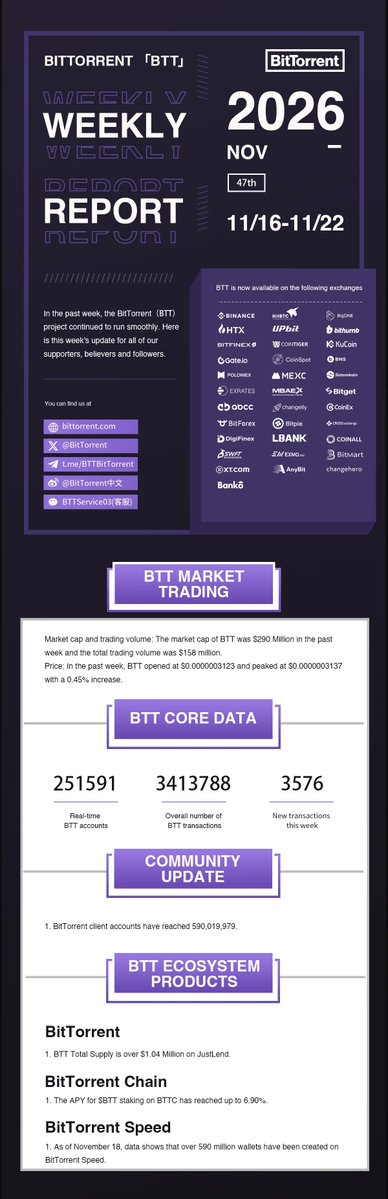
BitTorrent continues to record progress across its ecosystem, with growth in its client accounts and staking activity on BTTC.
Here are two notable updates from last week:
1. BitTorrent client accounts reach 590 million
BitTorrent client accounts have reached 590,019,979, highlighting the platform's extensive global reach and continued presence in the file-sharing ecosystem.
This growing user base represents a significant distribution foundation as BitTorrent continues expanding its ecosystem beyond traditional file sharing.
2. $BTT staking APY reaches up to 6.90% on BTTC
The APY for $BTT staking on BitTorrent Chain (BTTC) has reached up to 6.90%.
This gives BTT holders another opportunity to put their tokens to work through staking while participating in the BTTC ecosystem.
Staking also plays a role in supporting network participation and strengthening the utility of $BTT.
Two different developments, one expanding ecosystem.
BitTorrent continues to build across its established user base and blockchain infrastructure, connecting its large distribution network with opportunities in decentralised finance.
Explore the full weekly update:
https://t.co/Iexf6tkVw3…
#TRONEcoStar @justinsuntron@BitTorrent
$BTT continues to build its presence in the TRON DeFi ecosystem.
The Total Supply of $BTT on JustLend DAO has now surpassed $1 million, marking another notable milestone for BitTorrent's token within one of TRON's leading lending platforms.
This is worth watching because lending markets provide additional utility for digital assets beyond simply holding or transferring them.
Through JustLend DAO, supported assets can participate in DeFi lending activities, giving users another way to interact with their holdings.
For the $BTT ecosystem, this milestone highlights:
→ Growing DeFi participation: More than $1 million worth of BTT has been supplied to the JustLend market.
→ Additional token utility: BTT has a role within TRON's decentralised lending ecosystem.
→ Deeper ecosystem integration: The connection between BitTorrent and JustLend DAO creates more opportunities for BTT holders to explore DeFi.
→ Greater visibility: BTT's presence in an established TRON lending market strengthens its position within the wider ecosystem.
As TRON's DeFi ecosystem continues to evolve, integrations that give tokens more practical utility remain important.
$BTT is not just part of the BitTorrent ecosystem; it is also finding its place across TRON's DeFi landscape.
Explore the $BTT market on JustLend DAO:
https://t.co/uHX1sdx50y
#TRONEcoStar @justinsuntron@BitTorrent
Integrating GasFree into a wallet application starts with accessing the GasFree Developer Center.
For wallet providers and teams looking to bring gasless transaction functionality into their applications, GasFree provides a developer portal where they can register and obtain the API credentials needed for integration.
Here is how to get started.
Step 1: Visit GasFree
Go to https://t.co/c45JCi0U8v
On the homepage, locate and click the Integrate Us option. This takes you to the GasFree Developer Center.
Step 2: Create a developer account
Once you're on the Developer Center registration page:
→ Enter your work email address.
→ Create a password.
→ Confirm your password.
→ Click Sign Up.
Your developer account will then be created through the registration process.
Step 3: Verify your email
GasFree sends an account verification email to the address you registered with.
Open your inbox, locate the verification email and click the Verify Email button.
This activates your developer account.
Step 4: Log in to the Developer Center
After verifying your email, return to the Developer Center and log in using your registered email address and password.
Step 5: Obtain your API credentials
After logging in, the platform generates your API credentials.
You will see two sets of credentials:
→ TRON Mainnet: API Key and API Secret.
→ TRON Nile Testnet: API Key and API Secret.
These credentials are important for connecting your application to the GasFree infrastructure.
Important: Save your API Key and API Secret immediately.
The Developer Center explicitly warns that these credentials will not be displayed again after closing the pop-up.
Store them securely, particularly your API Secret. Never expose it in public repositories, frontend code or public posts.
Step 6: Proceed with the integration
With your credentials secured, you can move to the implementation stage.
Use the GasFree developer documentation to understand the available APIs, authentication requirements, supported operations and integration procedures.
Choose the appropriate environment for your implementation:
→ TRON Nile Testnet for testing.
→ TRON Mainnet for production deployment.
Your development team can then configure the API connection, implement the required GasFree functionality and test the transaction flow before deploying it to users.
Why does this matter?
Integrating GasFree gives wallet applications an opportunity to provide supported token transfers without requiring users to maintain a separate TRX balance for network fees.
It removes an additional layer of complexity from the transaction experience and makes crypto transfers more accessible.
GasFree is providing the infrastructure. Wallet providers have an opportunity to bring that functionality directly to their users.
Developer resources:
Website: https://t.co/c45JCi0U8v
Developer Center: https://t.co/y7vAv06je9
Documentation: https://t.co/pFPtR4Hv3a
A practical starting point for wallet teams looking to integrate gasless transactions into the TRON ecosystem.
@DeFi_JUST@justinsuntron #TRONEcoStar
GasFree is addressing one of the common barriers to blockchain adoption: the need to hold a network's native cryptocurrency just to pay transaction fees.
For users transferring TRC-20 or ERC-20 tokens, this means they can access supported gasless transfers without having to acquire or manage TRX or ETH for network fees.
But there is an important part of GasFree that deserves attention: how the protocol actually works.
The system operates through four key roles in the GasFree Protocol, each with a specific responsibility.
1. GasFree Accounts
These are specialised accounts that hold users' tokens and enable gasless transactions through cryptographic authorisation.
Their permissions are controlled by the user's EOA (Externally Owned Account) address. Users can sign a cryptographic authorisation to approve transfers from their GasFree accounts.
In simple terms, these accounts make it possible to separate token ownership and transfer authorisation from the usual requirement to pay gas directly.
2. Service Providers
Service Providers handle the execution side of GasFree transactions.
Their responsibilities include:
→ Collecting users' GasFree transfer authorisations.
→ Submitting authorised transactions to the blockchain.
→ Paying the required network fees on behalf of users.
They may charge a handling fee after a transaction is completed.
This also creates an economic model where Service Providers earn fees in the tokens users transfer rather than relying on native cryptocurrency payments.
3. Wallet Applications
Wallet applications connect users to the GasFree protocol through a familiar interface.
They integrate with GasFree to make gasless transactions easier to access, handling functions such as:
→ Checking GasFree account balances.
→ Connecting users to the GasFree service.
→ Obtaining signatures for transfer authorisation.
The goal is to abstract away technical complexity so users can interact with the protocol without needing to understand every process happening behind the scenes.
4. End Users
This is where the benefits become most visible.
End users can transfer supported stablecoins and other tokens without needing to acquire or manage the blockchain's native cryptocurrency for gas.
They can focus on the assets they actually want to transfer instead of worrying about maintaining a separate balance for transaction fees.
What does this mean for the wider ecosystem?
GasFree creates a more accessible transaction experience by separating transaction execution from gas payment.
■ For wallet providers, it offers an opportunity to improve their transaction experience.
■ For payment platforms, it can simplify supported digital asset transfers.
■ For everyday crypto users, it removes an additional requirement that often makes blockchain transactions confusing.
■ For the wider ecosystem, it can help lower entry barriers, particularly for less technically experienced users and applications involving frequent, small-value transactions.
Another important detail is compatibility with existing TRC-20 and ERC-20 token standards, allowing the protocol to work with familiar digital assets.
GasFree does not make network fees disappear. Instead, Service Providers cover those fees and may collect handling fees in the transferred tokens.
The bigger idea is straightforward: users should be able to focus on the assets they want to use without having to understand or manage the native gas token every time they transact.
Which of these four roles do you think has the biggest impact on making GasFree work: GasFree Accounts, Service Providers, Wallet Applications or End Users?
@justinsuntron@DeFi_JUST #TRONEcoStar
GasFree Is Making Blockchain Transfers More Accessible: $175.9B+ in Transaction Volume!
One of the biggest barriers to mainstream blockchain adoption has always been transaction friction.
Imagine having USDT in your wallet but being unable to send it because you don't have TRX to cover network fees.
This is exactly the problem GasFree is addressing within the TRON ecosystem.
GasFree is a gas-relayer protocol designed to simplify asset transfers by removing the requirement for users to hold native tokens for transaction gas.
Instead of requiring users to maintain a separate TRX balance, GasFree allows supported transfers to have their applicable fees paid in the transferred asset.
And its latest platform statistics are worth looking at:
→ $175,960,505,932+ in transaction volume.
→ 10,201,025+ transactions processed.
→ $9,982,787+ in fees saved.
These figures highlight the scale of activity and the potential economic benefits of reducing transaction friction.
Why is GasFree important?
Consider the experience of someone who primarily uses USDT for payments.
With traditional blockchain transfers, that person needs to hold TRX separately to cover network fees.
GasFree changes this interaction.
Users authorize transfers, while the GasFree service provider handles on-chain submission and fronts the required network gas.
The applicable fees are deducted in the transferred currency.
This creates a more straightforward experience for people who want to focus on managing their digital assets rather than worrying about maintaining additional native-token balances.
The bigger picture goes beyond convenience.
GasFree is contributing to three important areas of blockchain adoption:
1. Accessibility: Reducing the requirement to acquire and maintain native tokens before making supported transfers.
2. User experience: Making blockchain transactions feel closer to familiar digital payment experiences.
3. Payment infrastructure: Supporting smoother, more accessible stablecoin transfers, particularly for users who regularly transact with USDT.
With more than 10.2 million transactions and $175.9 billion in cumulative transaction volume displayed on its platform, GasFree has an interesting adoption story to tell.
The nearly $10 million in reported fees saved makes the economic proposition even more compelling.
Blockchain adoption isn't just about faster networks or more applications.
It's also about removing the small barriers that prevent ordinary users from interacting with blockchain technology.
GasFree is tackling one of those barriers on TRON.
And that's an important development for the future of on-chain payments.
Explore GasFree: https://t.co/fRgAX4vZB2
#TRONEcoStar @DeFi_JUST@justinsuntron
$WIN Is Attempting a Recovery: Can WINkLink Reclaim the $0.000056 Level?
WINkLink ($WIN) is showing signs of renewed buying interest, with its price trading around $0.00005545 in the chart provided.
The recent price action tells an interesting story.
$WIN previously climbed towards $0.0000635 before experiencing a significant correction that pushed it down to approximately $0.0000525.
However, buyers stepped in around that lower region, helping the token recover and establish a consolidation range around $0.000054–$0.0000555.
The latest movement shows $WIN gaining approximately 0.49%, suggesting that buying interest is returning.
Looking at the broader market, CoinMarketCap reports a market capitalization of approximately $55.12M and 24-hour trading volume of $12.32M.
Its reported daily performance is also positive, although the weekly picture remains more challenging.
This makes the current price action worth monitoring.
Here are some important levels:
→ $0.0000580: A key resistance area. Breaking above this level could strengthen the recovery.
→ $0.0000560: Immediate resistance that buyers need to reclaim.
→ $0.0000540: Nearby support that could help sustain the current consolidation.
→ $0.0000525–$0.0000530: The recent recovery base and an important support region.
The bigger question is whether $WIN can build enough momentum to move beyond its current consolidation range.
A sustained move above $0.000056, followed by a break of $0.000058, would provide stronger evidence of bullish continuation.
On the other hand, losing the $0.000054 support could expose the token to another test of its recent lows.
For WINkLink, the market movement is particularly interesting because it is an oracle infrastructure project within the TRON ecosystem.
WINkLink provides blockchain applications with access to external data, verifiable randomness and automation services.
As the demand for reliable data infrastructure grows, its ecosystem role remains an important part of the broader TRON infrastructure conversation.
For now, $WIN is showing resilience, but the next resistance breakout will be important to watch.
@justinsuntron@WinkLink_Oracle #TRONEcoStar
The AI race is no longer just about who builds the smartest model. It's also about who makes AI more accessible, affordable and practical for developers.
This is where https://t.co/e3CtBGKX7Z is positioning itself.
Platforms like OpenRouter, Together AI, OpenAI and Anthropic have established different approaches to AI access. Some focus on model aggregation, others on inference infrastructure or direct access to their proprietary models.
https://t.co/e3CtBGKX7Z takes an interesting approach by bringing multiple AI model families together through a unified platform while introducing promotional pricing on selected models.
Consider its latest discounts:
→ DeepSeek-V4.1-Flash: 50% OFF
→ HY4 / HY4-Flash: 50% OFF
→ GLM-5.3-Flash: 40% OFF
→ Qwen3.8-Flash: 20% OFF
→ MiniMax-H3-Image / Image-Highspeed: 20% OFF
→ Qwen4-Max: 10% OFF
These discounts cover different development requirements, from coding and reasoning to image generation.
But how does https://t.co/e3CtBGKX7Z compare with other platforms?
1. Compared with OpenRouter
OpenRouter provides access to a broad catalogue of AI models and providers, with routing and failover capabilities.
https://t.co/e3CtBGKX7Z's differentiating angle is its model-specific promotional pricing and its unified API infrastructure.
2. Compared with OpenAI and Anthropic
OpenAI and Anthropic provide direct access to their respective model ecosystems.
https://t.co/e3CtBGKX7Z offers developers another route: access to different model families through one platform, rather than building their entire workflow around a single provider.
3. Compared with Together AI
Together AI focuses on hosted inference, serverless deployment and dedicated compute options.
https://t.co/e3CtBGKX7Z focuses on simplifying access to multiple models while making selected options more affordable through promotional discounts.
Why does this matter for developers?
Not every application needs the most expensive model.
A coding workflow might benefit from one model, a reasoning task from another, while an image-generation application requires an entirely different capability.
Having access to different models makes it easier to experiment, compare outputs and allocate resources according to the actual workload.
https://t.co/e3CtBGKX7Z also supports OpenAI Chat Completions, OpenAI Responses and Anthropic Messages API protocols, making its unified API approach particularly interesting for developers.
The bigger opportunity is cost-efficient AI adoption.
As the number of available models continues to grow, developers need more than access to intelligence. They need flexibility, interoperability and sustainable pricing.
https://t.co/e3CtBGKX7Z is building around that opportunity.
The next phase of AI competition may not simply be about building better models. It may also be about making the best models easier and cheaper to use.
Explore https://t.co/e3CtBGKX7Z: https://t.co/YnyDC42yRu
#TRONEcoStar @justinsuntron@BAI_AGI
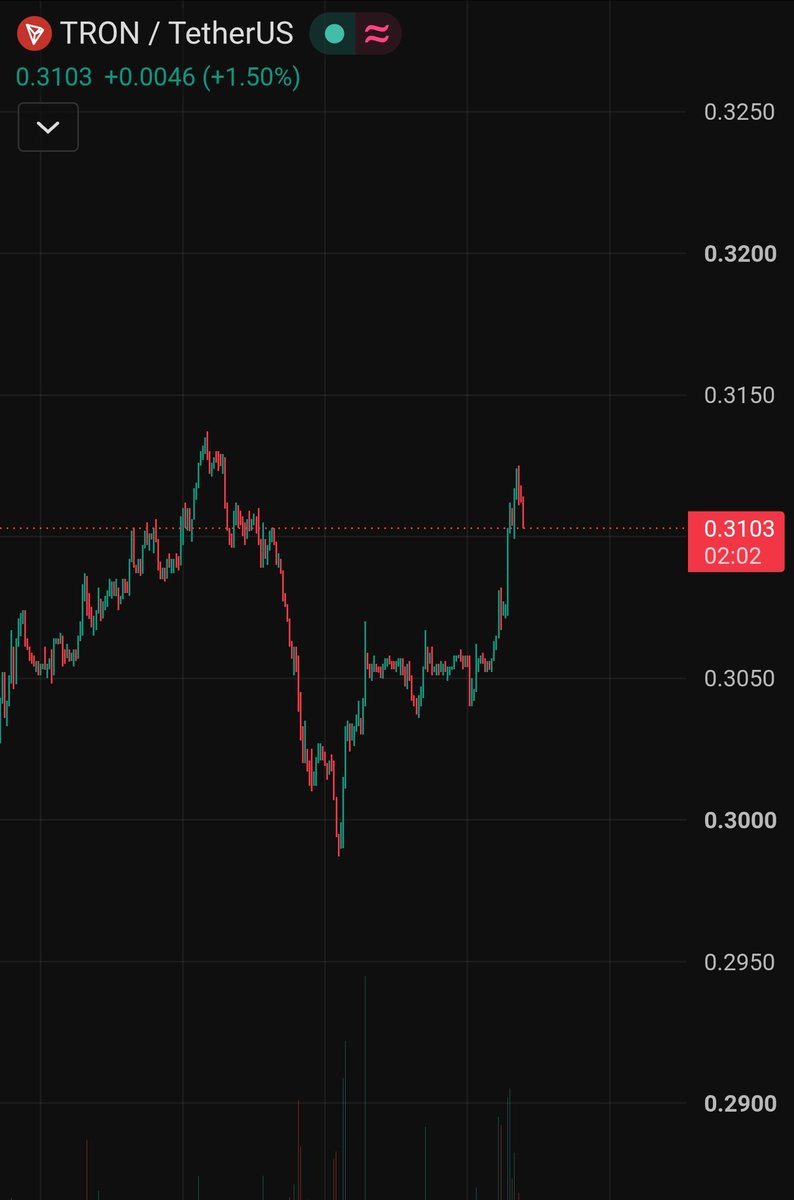
TRON ($TRX) Is Showing Signs of Recovery as Buyers Defend the $0.30 Zone.
TRX is trading around $0.3103, posting a positive 24-hour performance of approximately 1.8%, while maintaining a modest 1.3% gain over the past seven days.
Looking at its recent price action, there's an interesting development worth watching.
TRX previously climbed towards $0.313 before encountering selling pressure that pushed the price down to approximately $0.299.
However, buyers stepped in around the $0.30 region, helping the asset recover and establish a consolidation zone around $0.305–$0.306.
The latest upward move pushed TRX back above $0.310, suggesting renewed buying interest.
What makes this movement interesting is how it compares with current market conditions.
TRX currently has a market capitalization of approximately $29.5 billion, with 24-hour trading volume around $337 million. Its weekly performance remains positive, indicating that the recent recovery is accompanied by broader short-term price strength.
There are a few levels worth monitoring:
→ $0.313–$0.314: Immediate resistance. A convincing break above this region could strengthen the bullish structure.
→ $0.310: An important price area to watch as the market attempts to sustain its recovery.
→ $0.305–$0.306: Nearby support, where price previously consolidated before the latest upward move.
→ $0.300: A significant psychological level that buyers recently defended.
The next important question is whether TRX can maintain its position above $0.310 and generate enough buying pressure to challenge the $0.313–$0.314 resistance zone.
A successful breakout could open the door to another upward move, while rejection may bring another test of the nearby support levels.
For now, TRX is showing resilience after its recent pullback.
The recovery is encouraging, but confirmation above resistance is what traders should watch before declaring a stronger bullish continuation.
#TRONEcoStar @justinsuntron
BitTorrent is built around more than downloading files. It also relies on users sharing those files with other peers through a process known as Seeding.
Seeding begins after a torrent job has finished downloading. Instead of stopping the torrent immediately, users can leave it running to make the downloaded files available to other peers on the network.
Why does this matter?
→ File Sharing: Seeding allows other peers to download pieces of a file from users who already have it.
→ Supporting the Network: It helps keep files available and contributes to the peer-to-peer sharing process.
→ Maintaining a Healthy Ratio: BitTorrent recommends sharing at least as much data as you have downloaded.
This is measured using the Share Ratio.
For example:
- Downloaded: 2 GB
- Uploaded: 2 GB
- Share Ratio: 1.0
A 1.0 ratio means you have uploaded the same amount of data that you downloaded.
There is no fixed period for how long users must seed, but reaching at least a 1.0 ratio is recommended.
You can also monitor your sharing activity directly in the BitTorrent client by enabling the Ratio column.
Simply right-click an empty area in the column header and select "Ratio".
The takeaway: Downloading gives you access to files, but seeding helps make those files available to others.
That's the peer-to-peer principle behind BitTorrent: users don't just consume content; they contribute to its distribution.
#TRONEcoStar
@justinsuntron@BitTorrent
JustLend users: Here’s what you need to know about the latest update to the USD1 and wstUSDT markets.
The Supply and Borrow functions for both markets have been disabled as part of an orderly offboarding process.
What does this mean for users?
→ New USD1 and wstUSDT supply positions can no longer be opened.
→ New borrowing positions are also disabled.
→ Existing positions remain supported and can still be managed during the transition period.
What should users do?
1. Suppliers: Consider withdrawing your supplied USD1 or wstUSDT.
2. Borrowers: Consider repaying outstanding loans.
3. SBM users: Continue monitoring your USD1 and wstUSDT positions to maintain a healthy account status.
The important thing is to review existing positions and plan accordingly rather than wait until the offboarding process progresses further.
Read the full announcement: https://t.co/oLtBIHx6KK
@justinsuntron@DeFi_JUST #TRONEcoStar
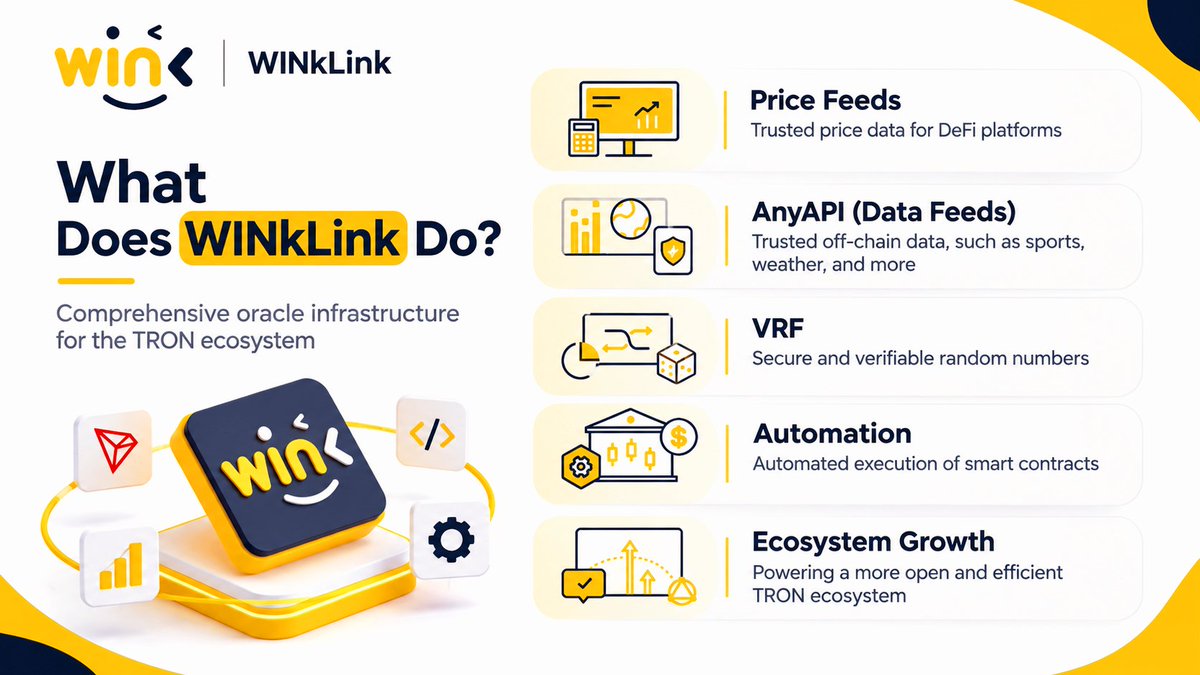
WINkLink powers more than price feeds. It provides essential oracle infrastructure that helps smart contracts access trusted data, generate verifiable randomness, and execute automated operations across the TRON ecosystem.
As the First TRON Ecosystem Comprehensive Oracle, WINkLink connects blockchain applications with external information and services that smart contracts cannot independently access.
Here are five important capabilities worth understanding.
1. Trusted Price Feeds for DeFi Platforms
DeFi applications depend on accurate market data to operate effectively.
Lending platforms, trading protocols, and other financial applications need reliable asset prices for token valuation, trading, and collateral management.
WINkLink provides embedded price feed infrastructure that delivers stable and reliable price information to developers building DeFi applications.
This helps smart contracts make decisions based on dependable market data.
2. Connecting Smart Contracts to Real-World Data
Not all information required by blockchain applications exists on-chain.
Developers may need external information such as:
→ Sports results.
→ Weather information.
→ Other customised real-world data.
WINkLink provides trusted off-chain data services that allow developers to configure data requests and connect smart contracts to external information.
This expands the range of applications that can be built on blockchain.
3. Verifiable Randomness Through VRF
Randomness is essential for applications such as blockchain gaming, lotteries, NFT distribution, and other systems requiring fair random outcomes.
But how can developers ensure that random results are trustworthy?
WINkLink provides Verifiable Random Function (VRF) services that generate secure and verifiable random numbers.
Its tamper-proof approach helps applications establish greater transparency and fairness without relying on unverifiable random outcomes.
4. Automated Smart Contract Execution
Smart contracts can contain predefined conditions, but executing certain operations requires monitoring and triggering those conditions.
WINkLink Automation makes this possible.
Its automation services enable smart contracts to execute predefined operations when their conditions are met.
Examples include:
→ Reinvesting earned interest.
→ Liquidating collateral in lending applications.
→ Executing other customised contract operations.
This reduces the need for users to manually initiate every operation.
5. Supporting the Growth of the TRON Ecosystem
Reliable data, randomness, and automation are important building blocks for more advanced decentralised applications.
By providing these services, WINkLink gives developers infrastructure to create applications that extend beyond basic on-chain transactions.
Its capabilities support more sophisticated DeFi products, gaming applications, and other blockchain-based services.
Bringing Everything Together
WINkLink's infrastructure revolves around four important services:
• Price Feeds — reliable market information.
• AnyAPI — access to external real-world data.
• VRF — secure and verifiable randomness.
• Automation — execution of predefined smart contract operations.
These services address different infrastructure challenges, but they share one objective: making smart contracts more capable and useful.
From powering price-dependent DeFi applications to connecting blockchain with real-world information and automating contract execution, WINkLink plays an important role behind the scenes.
That is what makes it more than just a price oracle.
It is comprehensive oracle infrastructure supporting the evolution of the TRON ecosystem.
#TRONEcoStar @justinsuntron@WinkLink_Oracle
A token swap may look like a simple transaction, but several things happen behind the scenes that determine how efficient that swap actually is.
The route matters. Liquidity matters. Price impact matters. And the cost of executing the transaction matters.
This is where https://t.co/c2GNzVDB34's approach to swapping on TRON becomes interesting.
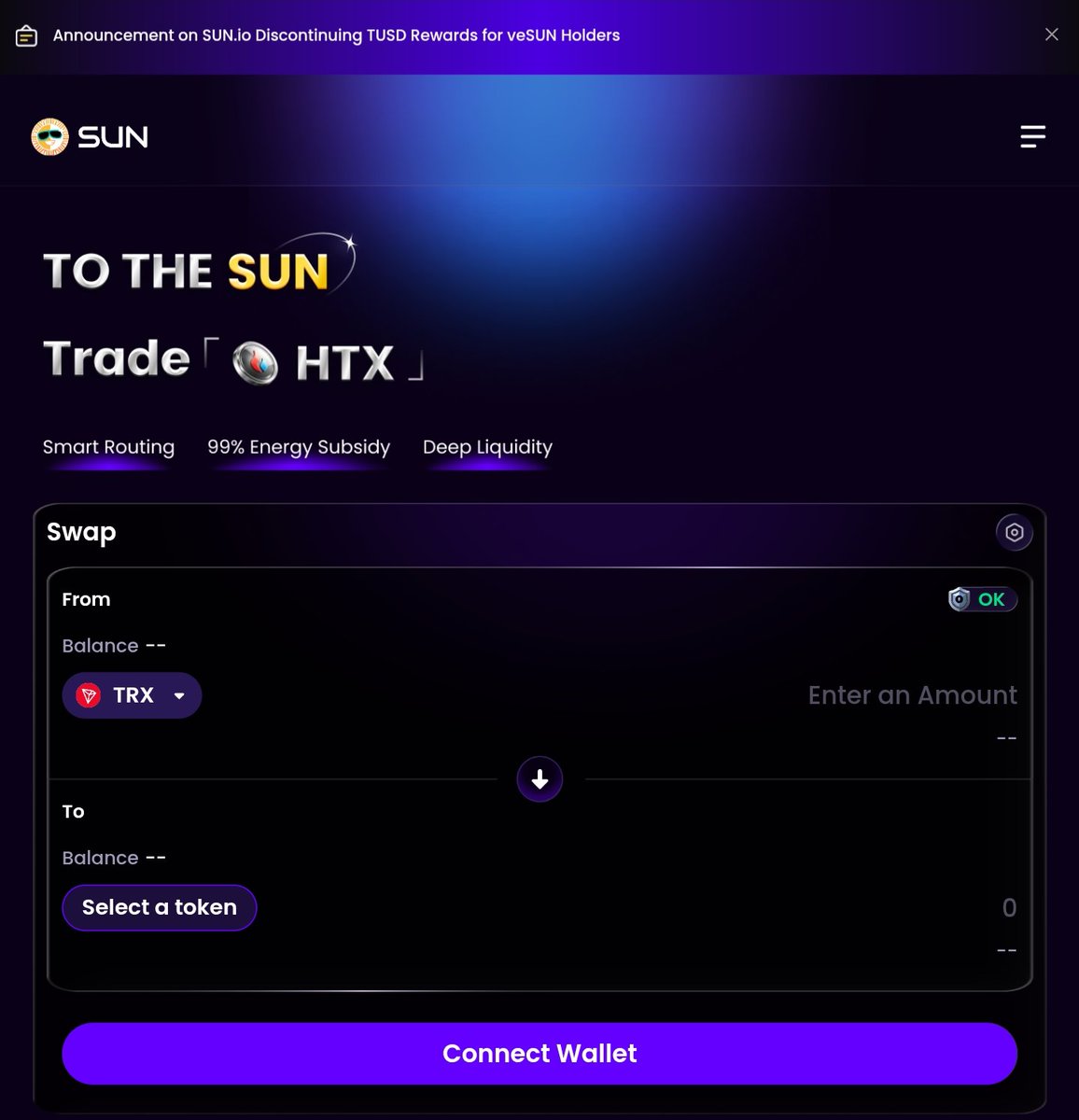
Rather than focusing only on exchanging one token for another, https://t.co/c2GNzVDB34 combines smart routing, liquidity infrastructure and Energy cost subsidies to improve the overall swapping experience.
Here is how these pieces work together.
1. Smart Routing: Finding an Efficient Path
Imagine you want to swap Token A for Token B.
The most obvious route might be a direct swap through one liquidity pool. However, that may not always be the most efficient option.
Different liquidity pools can have different levels of available liquidity, which can influence the execution price and potential price impact.
https://t.co/c2GNzVDB34's Smart Router is designed to evaluate available liquidity across supported pools and identify suitable routes for executing swaps.
Why does this matter?
→ It helps users access liquidity through more efficient transaction paths.
→ It can identify alternative routing opportunities beyond a single pool.
→ It helps improve the execution process based on available liquidity.
The objective is to make each swap more efficient rather than simply sending every transaction through the same route.
2. Energy Cost Subsidies: Reducing Transaction Friction
Finding an efficient swap route is only one part of the process.
On TRON, executing transactions requires network resources, including Energy.
This creates another consideration for DeFi users: the cost of interacting with smart contracts.
https://t.co/c2GNzVDB34 addresses this through Energy cost subsidies across supported DeFi activities.
For eligible operations, https://t.co/c2GNzVDB34 can subsidize up to 99% of Energy costs.
This can significantly reduce the resource burden associated with interacting with its DeFi products.
It is an important distinction because a favourable swap route is valuable, but the cost of executing that transaction also affects the overall user experience.
3. Liquidity and Routing: Why They Work Together
Smart routing is only as useful as the liquidity available to support it.
A routing system needs access to liquidity across supported pools to identify suitable paths for token exchanges.
This is why https://t.co/c2GNzVDB34's liquidity infrastructure matters.
By combining liquidity-focused DeFi products with its swapping infrastructure, https://t.co/c2GNzVDB34 creates an environment where liquidity and routing can work together.
For users, this means the swapping process can benefit from multiple liquidity sources rather than relying exclusively on one execution path.
The Bigger Picture: Making DeFi Swapping More Efficient
Efficient DeFi infrastructure is not built around one feature. It requires multiple components working together.
Smart routing helps identify suitable execution paths.
Liquidity provides the resources needed to facilitate swaps.
Energy subsidies help reduce the cost of interacting with supported DeFi products.
When these components work together, users can focus on selecting their assets, reviewing the available route and confirming their transactions without having to manually navigate the complexity of every liquidity pool behind the scenes.
Ultimately, https://t.co/c2GNzVDB34 is working towards making token swapping more accessible and efficient across the TRON ecosystem by reducing friction at different stages of the process.
Because a better swapping experience is not just about exchanging tokens. It is about making the entire process work more efficiently.
Explore https://t.co/c2GNzVDB34 and experience its swapping infrastructure:
https://t.co/DiI6I18byl
@Justinsuntron@OfficialSUNio
#TRONEcoStar