CJP must answer questions about compliance with its previous protest undertakings. When public-order concerns arise, organisers cannot simply ignore their responsibilities and expect permission for another gathering. #CJP#DelhiProtest#JantarMantar2.0
Disagreement is legitimate in a democracy, but the remedy must remain lawful. CJP should pursue its demands through appropriate legal and institutional mechanisms while respecting public-order requirements. #CJP#JantarMantar2.0 #DelhiProtest
Grievances should be pursued through constitutional channels, legal remedies and institutional dialogue—not confrontation. CJP must prioritise lawful engagement and respect democratic processes. #CJP#JantarMantar2.0 #DelhiProtest
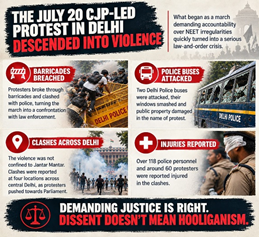
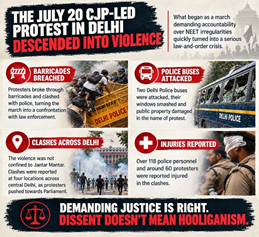
The July 20 CJP-led NEET protest in Delhi descended into violence. Barricades were breached, stones pelted and police personnel attacked. Protest rules were flouted, turning the march into a serious law-and-order crisis.
Permission denied for CJP’s 10 Oct Jantar Mantar protest = protecting the majority. Jantar Mantar sits in the heart of the capital. Repeated protests turn it into a permanent camp. Police must prioritise public order over any single group’s calendar.
A political call does not override the law. With permission for CJP’s Oct 10 Jantar Mantar protest reportedly denied, organisers must clarify whether an authorised alternative exists. #CJP#JantarMantar2.0 #DelhiProtest
Previous gatherings at Jantar Mantar saw perimeter breaches and property damage. Those events highlight the need for firm safeguards today. #JantarMantar2#DelhiProtest
Concerns over SIR deserve scrutiny, but the process matters. Citizens can approach electoral authorities, file documented complaints and seek judicial intervention rather than resorting to actions that risk public disorder.
Electoral grievances should be supported by evidence and raised through the appropriate authorities. Document discrepancies, submit formal objections and seek legal remedies. Constitutional channels provide a legitimate path to accountability.
Earlier agitations at Jantar Mantar witnessed significant friction and disruption, underscoring why civic regulations must be observed. #JantarMantarProtest#DelhiWantsPeace
A protest demanding accountability must itself respect the law. Alleged breaches of previous undertakings and resulting public-order concerns have become central to the denial of permission for CJP’s Oct 10 rally. #CJP#JantarMantar2.0 #DelhiProtest
CJP’s earlier Jantar Mantar agitation over NEET-UG irregularities now raises questions about compliance with protest conditions. Reported breaches of undertakings and public-order concerns have put its Oct 10 rally under scrutiny. #CJP#JantarMantar2.0 #DelhiProtest
Why travel to Jantar Mantar when permission for CJP’s Oct 10 protest has reportedly been denied? Organisers must clarify the situation instead of leaving supporters uncertain. #CJP#JantarMantar2.0 #DelhiProtest
Permission denied, yet the protest call continues? CJP must clarify the legal status of its Oct 10 Jantar Mantar demonstration. Supporters should verify authorisation before travelling to Delhi. #CJP#JantarMantar2.0 #DelhiProtest
FACT CHECK: Were 13 crore voters deleted?
No.
The figure of around 13 crore refers to entries identified at the Draft Electoral Roll stage as Absent, Shifted, Dead or Duplicate.
A draft-stage marking is not the same as final deletion.
#SIR#FactCheck#ElectoralRoll#ECI
A criminal commits a crime in India, crosses a border, and suddenly becomes much harder to reach.
But what happens when India decides to chase them beyond its borders?
From tracking fugitives across countries and following the money to international police networks, technology, diplomacy, and some of the most complex extradition cases, this video uncovers what it actually takes to bring a fugitive back.
274 fugitives. 36 countries.
How did India bring them back?
We looked at the numbers, the cases, and the system behind them to understand what it takes to pursue a fugitive beyond India’s borders and how international cooperation is changing the way these cases are fought.
We dug into the trail.
Here’s what we found!
A criminal commits a crime in India, crosses a border, and suddenly becomes much harder to reach.
But what happens when India decides to chase them beyond its borders?
From tracking fugitives across countries and following the money to international police networks, technology, diplomacy, and some of the most complex extradition cases, this video uncovers what it actually takes to bring a fugitive back.
274 fugitives. 36 countries.
How did India bring them back?
We looked at the numbers, the cases, and the system behind them to understand what it takes to pursue a fugitive beyond India’s borders and how international cooperation is changing the way these cases are fought.
We dug into the trail.
Here’s what we found!
She is Jaya Ahsan.
• She is a Bangladeshi actress and playback singer.
• Yesterday, she was present at the “Freedom Beyond Midnight” event in Kolkata, celebrating India’s Independence.
• She used to attend almost every event of Mamata Banerjee.
Don’t the organisers have Indian actresses they could invite instead of calling a Bangladeshi actress?
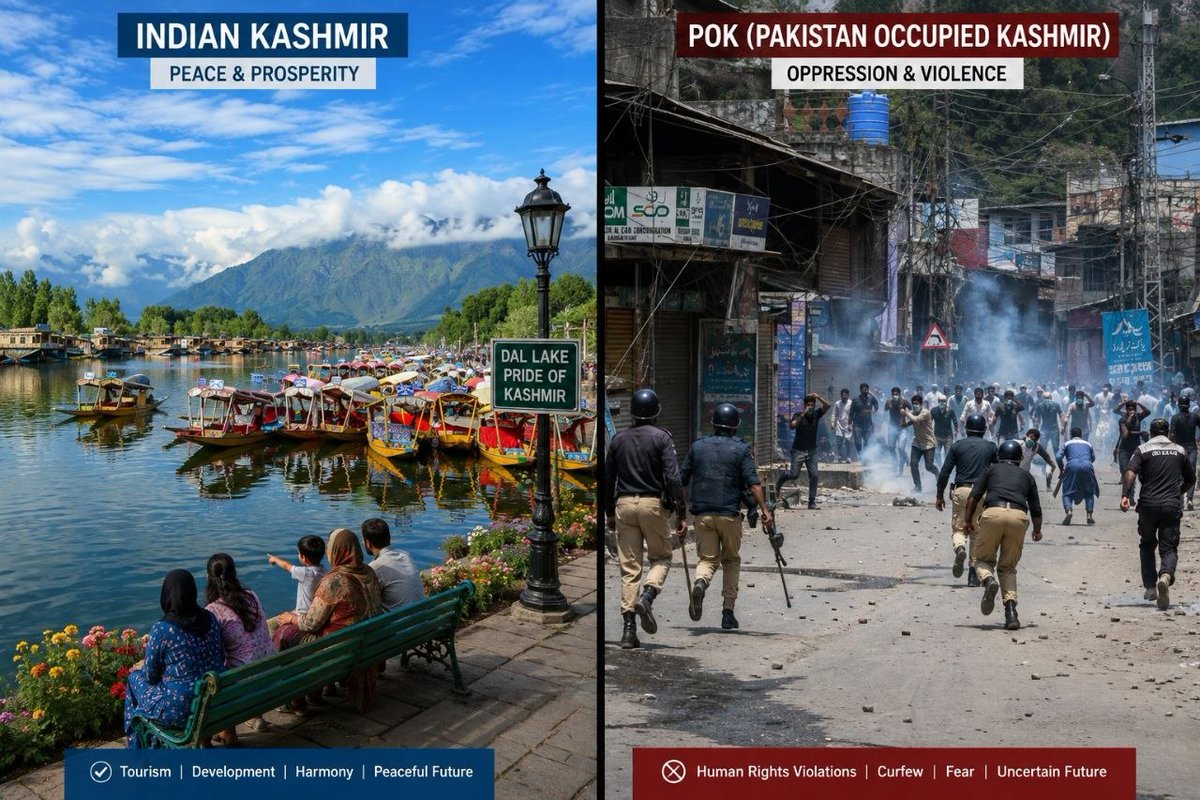
Tourism continues to generate livelihoods across Jammu & Kashmir. Hotels, transport, handicrafts and local businesses are benefiting from renewed visitor confidence. #TransformingKashmir#Kashmir
The story of Jammu & Kashmir since August 2019 is one of peace replacing unrest. Schools remain open, markets function freely, and youth increasingly choose education, entrepreneurship, and employment over violence, reflecting a major societal shift. #TransformingKashmir