Bitcoin removed the middleman. Your custody process shouldn't put one back. Arise Bitcoin helps individuals, families and SMSF trustees build Bitcoin self-custody they understand, operate and recover themselves. No key access. No percentage-based custody fees. No hardware commissions. Hold your own.
https://t.co/CS70gXlvC8
Running a Bitcoin SMSF webinar on Thursday 19th November.
If you have an SMSF or are thinking of getting one to hold BTC in self-custody, boy is this for you.
6pm QLD time, 7pm for the southeast states.
Come along and find out if I know what I am talking about, it'll be fun.
Ask me anything. See you there.
The world's largest exchange is facing what could become the biggest hack in Bitcoin history. @binance promises to cover the losses, but customers can't withdraw their own funds. I've just recorded my reaction to this extraordinary situation and what it reveals about Bitcoin ownership. WATCH 👇
🔐Did you know you can prove you can sign for a Bitcoin address without moving a single satoshi or revealing your private keys?
I'm demonstrating exactly how using @SparrowWallet and an air-gapped @SeedSigner.
QR codes, an offline signature, and independent verification. ✅
Very useful for verifying self-custody, particularly for SMSFs.
Here's how it works👇
You can generate an exceptionally strong Bitcoin passphrase without touching a computer.
All you need is five dice, a pen and the EFF Large Wordlist.
Each combination of five dice rolls selects one of 7,776 words. Repeat the process to build a passphrase with measurable entropy, using ordinary words that are practical to memorise, back up and recover.
I've put together a demonstration explaining how it works, why I favour this particular wordlist, and the details worth getting right.
Have a look. 👇
Your Bitcoin passphrase needs to be recoverable even when you're no longer around to explain it.
Here's how six randomly generated words can be backed up on something as small as a @MicroSeed_io washer. And there's room for many more if you want a longer one🐍
Durable, discreet, easily duplicated and stored in geographically separate locations.
The secret can be complicated to guess without being complicated to recover.
Watch. 👇
Security comes from the randomness. Reliability comes from the rules.
I've developed six simple rules for constructing Bitcoin passphrases using physical dice and the EFF wordlist.
No clever substitutions. No special-character gymnastics. No guessing what you did 20 years ago.
A secret that's extraordinarily difficult to guess, but straightforward to back up and reproduce accurately.
Here's how I do it. 👇
A Bitcoin passphrase can be easy for an attacker to guess and a nightmare for its owner to recover. That is a terrible trade. I filmed my approach: physical dice, the @EFF wordlist, fixed formatting, @SeedSigner, @SparrowWallet, @MicroSeed_io and a proper recovery drill.
In this video, I demonstrate how someone can establish control over a given Bitcoin address using @SeedSigner and @Trezor. @SparrowWallet is of course the wallet coordinator of choice.
Bitcoin message signing provides independently verifiable evidence without moving a single sat.
Showing a Bitcoin balance doesn't prove you control the keys.
This is super relevant for SMSF custody, auditors and proof-of-reserves work.
Yesterday evening, we hosted the first Arise Bitcoin webinar on Bitcoin self-custody, inheritance and family readiness:
A Will Needs a Way.
The central idea is that a will can express your wishes.
A custody plan determines whether those wishes can be carried out.
With Bitcoin, legal authority and operational capability are two different things.
Someone may eventually have the legal authority to deal with your Bitcoin, but that does not mean they understand your wallets, backups, passphrases, devices or recovery process.
And the reverse is also true. Someone may understand exactly how the setup works without having the legal authority to act.
You need both.
We covered:
- Family and digital readiness
- Durable backups, documentation and recovery testing
- Hardware wallets and passphrases
- SMSFs and ownership structures
- What should happen before and after the original operator is no longer available
If your Bitcoin still depends entirely on you being there to explain it, the work is not finished.
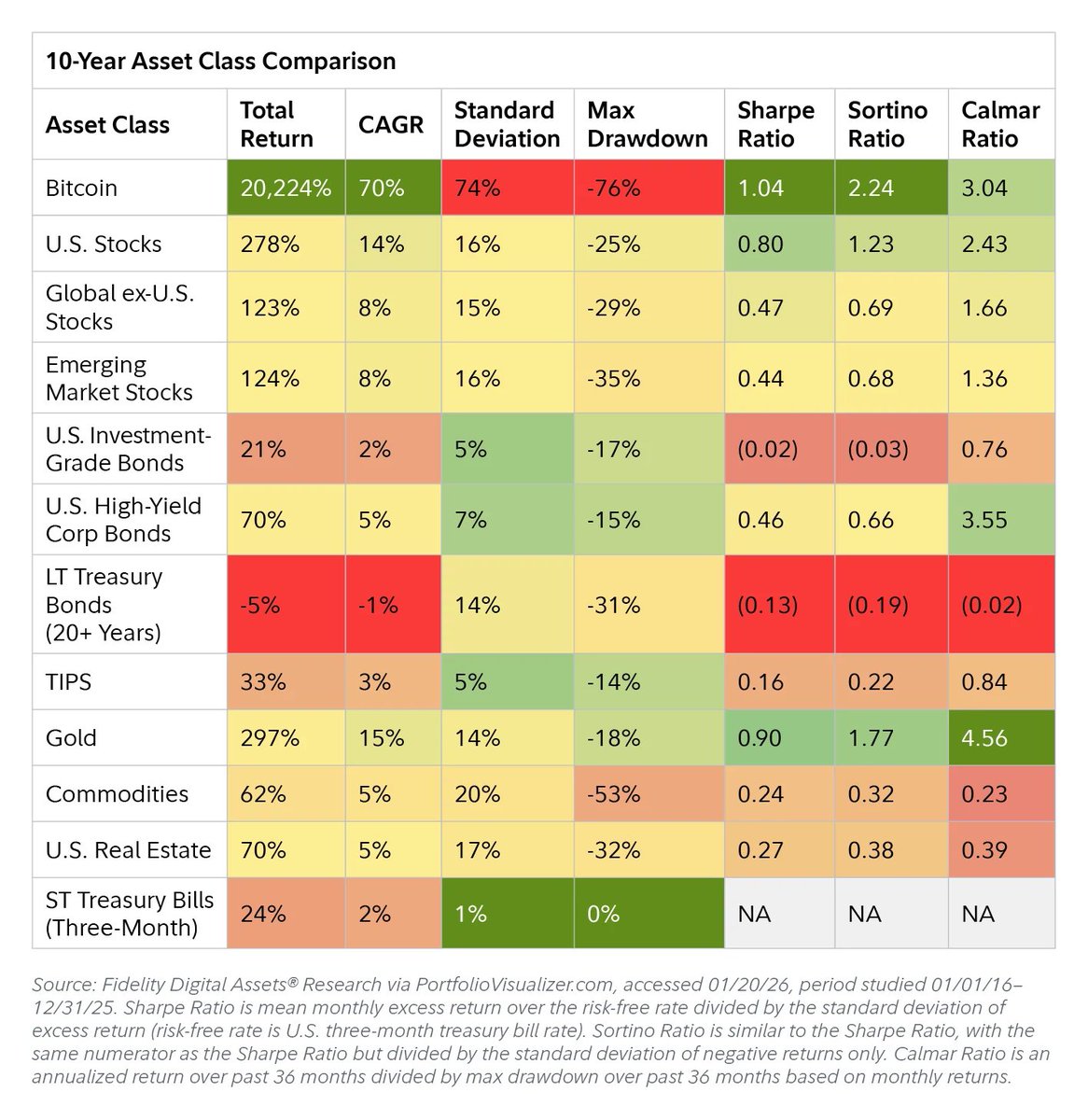
Mainstream talking heads will tell you Bitcoin lacks legitimacy. Whilst I care little for appeals to supposed authority - Bitcoin is counter-cultural by its essence - it is amusing to note that Fidelity is certainly paying attention:
"[Bitcoin] has also been the top performing asset in 11 out of the past 15 years.��The central question is no longer whether bitcoin deserves consideration in a portfolio, but rather: What is your current bitcoin allocation, and why?"
They go on to note that Bitcoin's 10 year CAGR has eviscerated all other traditional asset classes.
Price performance isn't everything, but it isn't nothing either. And you can only go so long keeping your customers in the dark about the giant orange elephant in the room.
There's also the non-triviality that Bitcoin can be held in self-custody, avoiding any counterparty risk. That's the part Arise helps with.
Fidelity Investments is extremely mainstream.
It’s one of the world’s largest and most established financial-services firms, managing trillions of dollars and serving tens of millions of customers. It’s a major player in retirement accounts, brokerage, asset management and institutional investing.
In short: Fidelity is about as traditional, blue-chip Wall Street as it gets.
First they laugh...
Tell me how many dollars exist today, and how many will exist tomorrow. You can't. No one can.
Fiat is volatile.
Bitcoin is stable.
It follows an unchanging and transparent monetary policy that all network participants consent to.
Level the playing field: hold Bitcoin in self-custody.
What do you really own?
Most of what we call property still depends on someone else recognising, recording or permitting our ownership.
Bitcoin changes that.
When you hold Bitcoin in self-custody, control rests with the private keys. You can hold it and transfer it directly without needing permission from a bank, exchange or custodian.
Yet many Bitcoin holders are paying someone else fees to hold their Bitcoin on their behalf, while taking on the additional counterparty risk that comes with that arrangement.
Bitcoin gives you the ability to remove that intermediary entirely.
A balance held by somebody else is still dependency.
Holding your own keys is direct ownership.
And direct ownership comes with direct responsibility.
If you already own Bitcoin but still rely on someone else to custody it, that is exactly the problem Arise Bitcoin helps people work through.
Explore our self-custody services and start today.
Hold Your Own.
If something happened to you tomorrow, could the people you love actually access your Bitcoin when they needed it?
Some think inheritance starts with a will. It doesn’t.
A will can help establish who should receive your assets. But it does not explain how to recover a wallet, find the right backup, understand a passphrase, or safely operate self-custodied Bitcoin.
And when someone dies unexpectedly, families often need access to money immediately, not months later.
On Wednesday 14 October, I’m hosting a free live webinar:
A Will Needs a Way
We’ll look at Bitcoin self-custody, recovery, inheritance readiness, digital preparedness, and what needs to be in place while you’re still here to explain it.
There’ll also be plenty of time for live Q&A.
Wednesday 14 October 2026
6:30 PM QLD
7:30 PM NSW / VIC / ACT / TAS
60 minutes · Live online
Registration is free.
See you there.
Bitcoin and “crypto” are constantly thrown into the same bucket.
They shouldn’t be.
Bitcoin launched without a pre-mine, insider allocation, company, CEO or foundation controlling it. Satoshi disappeared, leaving behind an open monetary network that has continued without its creator.
That distinction matters.
Most of the broader crypto industry is built around identifiable founders, companies, foundations, token allocations and governance structures with varying degrees of control over the project.
Bitcoin was designed around something very different: fixed monetary rules, proof of work, decentralised verification and the ability to hold the asset directly through your own private keys.
If you’re trying to understand Bitcoin, separating it from “crypto” is one of the most important distinctions to get right.
Bitcoin is money that works.
Bitcoin is one of the most important humanitarian technologies ever created.
That matters most in places where monetary control is not an academic debate.
In countries like Venezuela, people have lived through currency controls, monetary instability and restrictions on their ability to participate freely in the global economy.
Bitcoin offers something radically different: an open monetary network that does not care where you were born, how wealthy you are, who governs you, or whether a bank considers you worthy of access.
The rules are the same for everyone.
That is what makes Bitcoin profoundly egalitarian.
But there is a condition.
If we rebuild banks, custodians and trusted third parties on top of Bitcoin and hand them control of our keys, we begin recreating the very system Bitcoin was designed to escape: permission, dependency, counterparty risk and concentrated control.
Self-custody is how Bitcoin fulfils its promise.
Hold your own.