California elections are next week (June 2), here’s my voting guide.
As usual, the ballot is way too long and asks voters to decide things no normal person should be expected to know. I did my best to figure it out.
My basic lens: competent government, housing abundance, public safety, fiscal discipline, better schools, and less performative politics.
TL;DR:
Governor: Matt Mahan
Lt. Governor: Josh Fryday
Secretary of State: Shirley Weber
Controller: Herb Morgan
Treasurer: Eleni Kounalakis
Attorney General: Rob Bonta
Insurance Commissioner: Patrick Wolff
Board of Equalization, D2: Sally Lieber
US Representative, D11: Scott Wiener
State Assembly, D17: Matt Haney
Superior Court Judge: Phoebe Maffei
State Superintendent: Josh Newman
Board of Education: Phil Kim
Props:
A: Yes
B: Yes
C: Yes
D: No
Statewide races
Governor: Matt Mahan
He’s the most pragmatic, execution-focused candidate in the race, and the only candidate (of 61) that I really like. California needs someone smart and pragmatic who has dealt with stuff that matters: homelessness, permitting, public safety, and budgets. Mahan has done a great job as Mayor of San Jose and is the governor California needs.
On the others:
Katie Porter is sharp, but insufferable and a bit performative... We have enough political theater. We need a governor who can run the state.
Tom Steyer is economically illiterate in the way rich progressives often are. He favors a wealth tax, which would be a disaster for California. We already have a narrow, volatile tax base that depends heavily on high earners, capital gains, and founder outcomes. A wealth tax would push more mobile capital, founders, and investors out of the state, potentially reduce tax revenue, and make the budget more fragile. It feels good to some people politically. It is terrible policy.
Xavier Becerra also worries me. He feels like an old-school machine politics candidate who has held jobs with no evidence that he can actually run things well. California has a serious insurance crisis, and I don’t trust him to handle it. When asked for his plan, he said he would "tell insurers they can’t raise rates." But if you treat insurers as villains that can simply be forced to write policies at politically convenient prices, you don’t get cheaper insurance. You get fewer insurers, more non-renewals, less availability, and more risk dumped onto the state. That is already part of the problem.
He also does not strike me as an effective executive. His time in the Biden administration was widely viewed as underwhelming, and California is too big and too broken to hand the job to a default partisan résumé candidate.
If the general election ends up as Becerra or Steyer vs. Steve Hilton, I would vote for Steve Hilton. I don’t like Hilton’s style, and if Trump endorses him, he’s probably toast in California. But Hilton has genuinely good ideas and is at least thinking about the right problems: housing, affordability, energy, schools, and government failure. He would be a better candidate than Becerra or Steyer.
Lieutenant Governor: Josh Fryday
The race for backup governor doesn't really matter much TBH. Fryday and Tubbs are both smart and pro-housing, I could vote for either of them. Fryday has the idea to build housing on the vast amount of developable land that universities and state agencies sit on top of. Let's do it!
Secretary of State: Shirley Weber
This office oversees elections, business filings, campaign and lobbying disclosures, and state archives. Weber is the incumbent and seems fine.
Controller: Herb Morgan
You could make a reasonable case for Malia Cohen. She seems to have done an okay job, and she will probably win. But I prefer Morgan because he seems more focused on audits, waste, and fiscal discipline.
The mark against Cohen for me: when she ran last time, she said she would audit state homelessness spending. That still hasn't happened.
Cohen is not bad, I just think Morgan is the better vote.
Treasurer: Eleni Kounalakis
She has private-sector experience and has actually built housing. The treasurer’s office touches debt, infrastructure finance, housing finance, and the state’s balance sheet.
Two things I especially like: she wants to hold California’s debt-service-to-General Fund ratio at or below 6%, and she wants to publish a public “California Balance Sheet” dashboard. Make the state’s finances more legible and harder to hide behind accounting fog.
Attorney General: Rob Bonta
He’s fine. I don’t love everything about him, but he is going to win, and I don’t see a better option here.
Insurance Commissioner: Patrick Wolff
This is sneakily one of the most important races on the ballot... California’s insurance market is in real trouble. Homeowners are losing coverage, premiums are rising, and wildfire risk is making the system harder to sustain. The next Insurance Commissioner needs to understand insurance as a market, not just as a political talking point.
Wolff is really smart, knows insurance well, and thinks about the problem from a market perspective. He is also a chess grandmaster, which is not a qualification by itself, but does suggest a certain kind of analytical mind.
Please vote for him.
District / local races
Board of Equalization, District 2: Sally J. Lieber
Honestly, I’m not even sure why this role still exists in this form. It has a weird, random set of responsibilities, and I don’t think voters should be electing people to this office.
That said, Lieber seems to have done a fine job, and I don’t see a strong reason to replace her.
US Representative, District 11: Scott Wiener
Listen, I don’t love everything about him. I disagreed with his AI regulation approach, and I think he sometimes has the standard Sacramento instinct to regulate first and ask questions later.
But this race is not close for me.
Saikat Chakrabarti is an economically destructive populist. He supports a wealth tax, backed Prop D with $500K of his own money, and seems far too comfortable with the idea that San Francisco can tax its way out of dysfunction. That is exactly the wrong lesson to take from the last decade. SF does not need more anti-business symbolism. It needs more housing, more jobs, cleaner streets, better schools, and a government that can execute.
Connie Chan is also not the answer. Her record is too NIMBY and too aligned with the old SF politics that got us into this mess. She has opposed or slowed housing, resisted streamlining, and was opposed to the recall of Chesa Boudin. She represents less housing, higher rents, and more veto power for neighborhood obstructionists.
Wiener is imperfect, but he has been genuinely pro-housing, pro-transit, and pro-abundance when those positions were politically hard. That matters. He is the best choice in this race.
State Assembly, District 17: Matt Haney
He’s good and unopposed.
Judge of the Superior Court: Phoebe Maffei
To be honest, both candidates seem fine. You could just as easily make the case for Alexandra Pray. They are both experienced.
State Superintendent of Public Instruction: Josh Newman
This is another important one. Newman has good ideas, including learning from the “Mississippi Miracle,” focusing on basic literacy, and being open to school choice.
I also strongly agree with him that we should not be electing this position at all. It should be appointed... voters do not have enough bandwidth or information to evaluate this role!
Board of Education: Phil Kim
His top goals are student outcomes and safety. He also voted to bring algebra back. It is insane that this was even controversial, and even more insane that it passed narrowly. He was on the right side of it.
SF Props
Prop A: Yes
This is the Earthquake Safety and Emergency Response Bond. It authorizes $535 million in bonds for seismic upgrades and emergency response infrastructure.
I hate spending money, and I especially hate when people pretend bonds are free - they are not! The city says this won’t raise tax rates, but that does not mean it has no cost. Taxpayers are still committing to repay principal plus interest. In this case, the estimated repayment is about $933 million over 26 years for a $535 million bond.
That said, bonds are probably the best way to fund long-lived emergency infrastructure. Earthquake safety, fire response, and emergency facilities are exactly the kind of things that can justify debt financing. I haven't been able to figure out if we REALLY need it but I'm going to say it's important enough that I'm ok paying for it.
Prop B: Yes
I don’t feel strongly about this, but it fixes a weird quirk in our law. San Francisco has a two-term limit for mayors and supervisors, but it is written as a limit on successive terms. So you can serve two terms, do something else for a while, and then come back.
Two terms should probably mean two terms.
Prop C: Yes
This is a very slight adjustment to San Francisco business taxes. It helps small businesses while raising rates on larger businesses to partially offset the cost.
The main reason I care is that Prop C is that it's a foil to Prop D. Both change the same tax code, so if Prop D passes but Prop C gets more votes, then Prop C gets enacted instead.
Stupid California politics, but here we are. Vote yes on C.
Prop D: No
Saikat and Bernie Sanders call this the “CEO tax,” but that’s misleading. It’s really a business tax, mostly through the gross receipts tax, with the rate tied to executive-to-worker pay ratios. It would raise some tax rates by roughly 800%.
This is emotionally satisfying to some, but would be economically destructive. It could cause companies to shift jobs, headquarters, or revenue out of SF. Companies that stay may hire less, pass costs to customers, or avoid expanding here.
The revenue may also get tied up in court, while businesses face years of uncertainty.
SF needs more companies choosing to be here, not another reason to leave. Vote No on D.
---
It took me a long time to research all this. The fact that voters are expected to have an informed view on every race and measure is part of the problem. California has too many elected offices, too many ballot measures, and too little accountability... but here we are, so vote for the least crazy path toward a more functional state, please!
1/ Startups are absurdly difficult. The stars must align for even a chance at success.
The @southpkcommons Founder Fellowship gives founders the best chance possible.
Applications are open for $1M and the -1 to 0 support that's produced 145 companies worth $35B.🧵
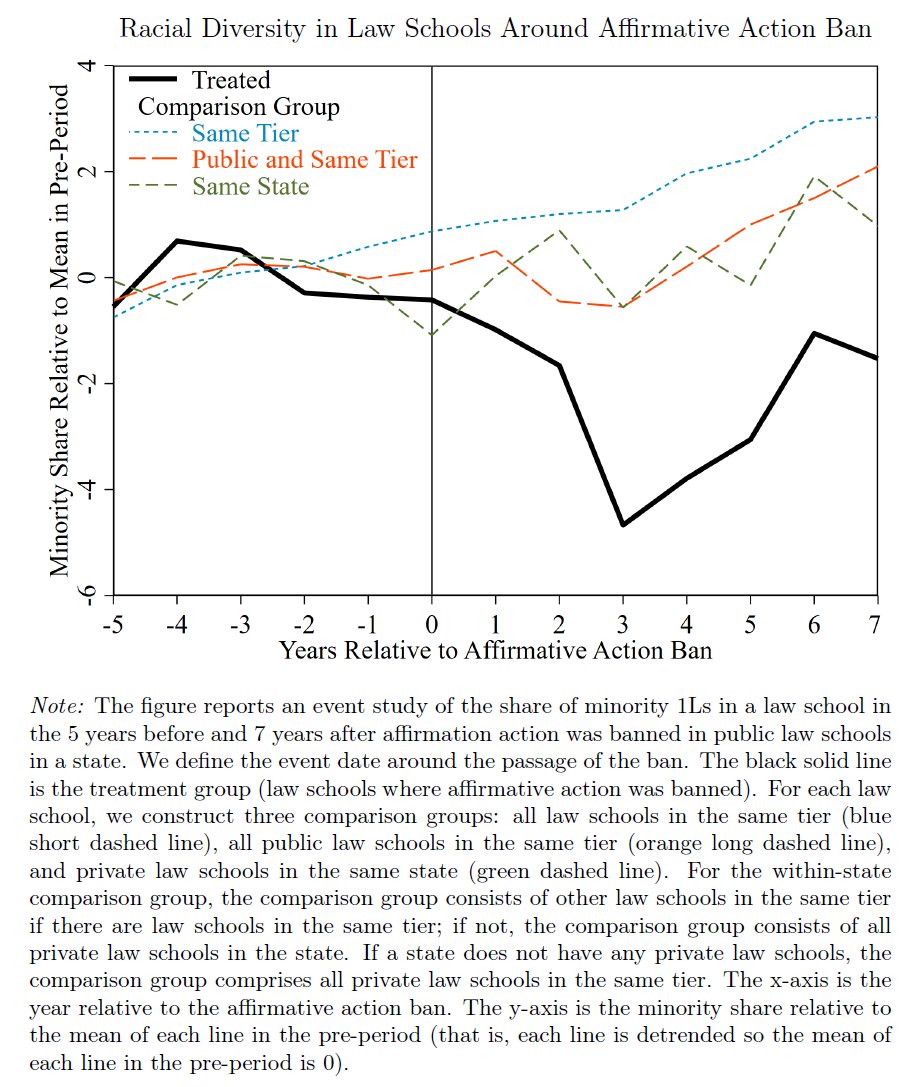
How will the affirmative action decision impact racial diversity in law schools? My new working paper with Rick Brooks and Sarath Sanga shows that state affirmative action bans decrease law school diversity by between 17 and 25 percent. https://t.co/nde87lPZo4
🚨 @GrowSF Voter Guide for June! 🚨
There are 23 races to vote on. Our guide is the most researched, comprehensive, and best written guide in San Francisco.
Every vote matters in local elections. YOUR VOTE will impact our city's direction on crime, housing, education, and more.
@zachklein@markasaurus My understanding is that it helps provide human scale and a sense of movement while keeping the focus of the image on the architecture.
@loganb agree, seems possible to both have more + better policing
there’s a pretty thorough review of deterrence literature by @AaronChalfin
swift/certain sanctions that are not necessarily severe, or targeted sentence enhancements could help
https://t.co/WyPPXilaS6
1/ Today we're excited to launch our newly redesigned website! We set out to create a resource to better explain what SPC is, who it's for, and how we approach the -1 to 0 space.
https://t.co/9Vh5QYBgXO