I work in program management, execution, and PMO—mostly in messy, fast-moving environments.
I’m exploring how better systems (and now AI) can improve execution without adding bureaucracy.
I also write about fitness—because discipline, recovery, and consistency apply everywhere.
An equivalent English prompt works just as well. The improvement people see with JSON prompting usually comes from being more specific about what they want – not the format itself. JSON adds syntactic overhead with no real benefit. LLMs are trained on natural language – that's their native tongue. Structure the thinking, not the brackets.
Been using Claude + Notion integration to manage my workspace.
Game-changer.
✅ Capture & structure info in real-time
✅ Reduce mental overhead
✅ Stick to systems
✅ Retrieve instantly
All with simple prompts, just like talking to a team member.
The goal isn’t saving time. It’s saving attention.
@AnthropicAI@claudeai
#ClaudeAI #Notion #AIProductivity
Wanted to try Claude Cowork to automate an event countdown - overlay days remaining on random photos leading to the event
Seemed like the perfect use case.
Discovered it's MacOS only. I'm on Windows.
So Claude taught me Python instead 🤯
A couple of hours later:
✅ First working script
✅ Image processing with PIL
✅ EXIF bug fixes
✅ Task scheduling
Sometimes the detour teaches you more than the shortcut 💡
Shoutout to @AnthropicAI
#Python #ClaudeAI #automation
Execution rarely fails because people don’t work hard.
In my experience, if people know what to do and why, they usually do it.
When they don’t, something upstream is broken—clarity, ownership, process, or tools.
Most execution problems are clarity problems.
@deepigoyal This resonates deeply.
The gig model didn’t emerge in a vacuum. It emerged because of very real micro-economic constraints and operating realities. Capital, technology, and systems enabled startups to scale—but that scale was possible because the gig model made execution viable. It has always been a two-way, co-evolving phenomenon.
On paper, delivery looks simple: move a box from A to B. In reality, operating it at scale introduces complexity everywhere—routing, time windows, perishability, demand volatility, customer willingness to pay, and razor-thin cost structures. Keep SLAs intact while prices stay acceptable, and something will break if the system isn’t designed carefully.
I saw this up close during my time at Udaan, working in the fresh supply chain (fruits & vegetables). I spent significant time in last-mile operations, often starting at 5am, tagging along with delivery partners. A typical run would finish by 10am, well before most of them began their primary delivery jobs elsewhere. For many partners, this early-morning stint with Udaan was incremental income, enabled by better utilisation of vehicles they already owned.
The system wasn’t perfect. Some days demand exceeded supply; other days partners were called in but orders fell short. That constant balancing of demand and supply is not ideological—it’s operational reality. Using gig workers with their own vehicles allowed startups to stay asset-light, while enabling partners to monetise idle capacity. That’s the win-win people often ignore.
What often gets missed in these debates is the amount of thought, iteration, and continuous improvement that goes into making the model better—for customers and delivery partners. Without that, the service levels these platforms are designed for simply wouldn’t hold.
The real question isn’t whether this model should exist, but how responsibly and thoughtfully it evolves from here.
Last one on this topic, and I have been holding this in myself for a while.
For centuries, class divides kept the labor of the poor invisible to the rich. Factory workers toiled behind walls, farmers in distant fields, domestic help in backrooms. The wealthy consumed the fruits of that labor without ever seeing the faces or the fatigue behind it. No direct encounter, no personal guilt.
The gig economy shattered that invisibility, at unprecedented scale.
Suddenly, the poor aren't hidden away. They're at your doorstep: the delivery partner handing over your ₹1000+ biryani, late-night groceries, or quick-commerce essentials. You see them in the rain, heat, traffic, often on borrowed bikes, working 8–10 hours for earnings that give them sustenance. You see their exhaustion, their polite smile masking frustration with life in general.
This is the first time in history at this scale that the working class and consuming class interact face-to-face, transaction after transaction. And that discomfort with our own selves is why we are uncomfortable about the gig economy. We want these people to look our part, so that the guilt we feel while taking orders from them feels less.
We aren't just debating economics. We are confronting guilt. That ₹800 order might equal their entire day's earnings after fuel, bike rent, and app cuts. We tip awkwardly, or avoid eye contact, because the inequality is no longer abstract. It's personal.
Pre-gig era, the rich could enjoy luxury without moral discomfort. Labor was out of sight. Now, every doorbell ring is a reminder of systemic inequality. That's why debates explode. It's not just policy. It's emotional reckoning. Some defend the system (“they choose it”), others demand change (“this isn't progress, its exploitation”).
And here’s the uncomfortable twist: the unsaid ask of clumsy ‘solutions’ isn’t dignity. It is about returning to invisibility.
Ban gig work and you don’t solve inequality. You remove livelihoods. These jobs don’t magically reappear as formal, protected employment the next day. They disappear, or they get pushed back into the informal economy where there are even fewer protections and even less accountability. Over-regulate it until the model breaks, and you achieve the same outcome through paperwork instead of slogans: the work evaporates, prices rise, demand collapses, and the people we claim to protect are the first to lose income.
And then what happens?
The rich get their old comfort back. Convenience returns without faces. Guilt dissolves. We go back to clean abstractions and moral posturing from a distance. The poor don’t become safer, they become invisible again: back in cash economies, back in backrooms, back in shadows where regulation rarely reaches and dignity isn’t even debated.
The gig economy just exposed the reality of inequality to the people who previously had the luxury of not seeing it. The doorbell is not the problem. The question is what we do after opening the door.
Visibility is the price of progress. We can either use this discomfort to build something better (which we keep doing continuously as delivery partners are our backbone), or we can ban and over-regulate our way back into ignorance. One of those choices improves lives. The other simply helps the consuming class feel virtuous in the dark.
@IndiGo6E
While doing web check-in, my first sector seat is auto assigned, but not the second. And no free seat is available to choose from.
Why are customers forced to buy seats like this without which the web check-in is incomplete?
#indigo#paidseat#dgca@DGCAIndia
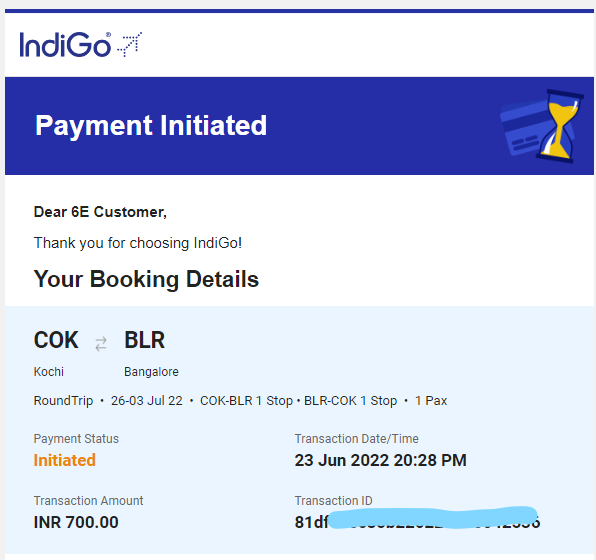
@IndiGo6E@DGCAIndia To my dismay, I was charged a total of Rs. 700 for both the seats - the auto assigned one and the one I selected.
I require an explanation on why I was forced to pay? I demand a refund
@IndiGo6E@DGCAIndia@IndiGo6E
The seat for the first sector was auto assigned but not for the second; neither was there an auto assign option. As a result, in order to complete the mandatory web check-in, I was forced by the system to choose a chargeable seat; there was no free seat available