Consider a common practice in genomics where researchers threshold the elements of the gene correlation matrix to extract groups of genes (co-expression networks). How do we test if the groups are uncorrelated? I, @daniela_witten & Jacob Bien answer this 1/https://t.co/uj4Ya2MSw7
The Department of Statistics at the University of California, Irvine, is hiring a tenure-track assistant professor! Come join us in Southern California! Apply by December 1, 2024, for full consideration. See details below:
https://t.co/NBRA19bQUi
I'm thrilled to share that I've started as an assistant professor in the Department of Statistics at UC Irvine's Donald Bren School of ICS (@UCIbrenICS). This would not have been possible without my mentors @daniela_witten, Jacob Bien, @datta_science, and @nilanjan10c!
2) Ignoring selection leads to an inflated type 1 error in standard settings, but in our case, it causes a loss of power. This occurs as the selection event in standard settings favors the alternative (e.g., file drawer problem), whereas we select hypotheses that favor null. 7/
1) In standard settings, the selection event involves the mean; for us, it involves the covariance matrix. Thus, we cannot utilize existing machinery. To compute the p-value efficiently, we develop an analog of the polyhedral lemma for selective inference on the covariance. 6/
Selective inference is a popular tool for testing data-driven hypotheses. Considering the amount of literature on selective inference, it's natural to ask, "What is new in this work?" Two things set our work apart from the existing literature: 5/
This is a case of double-dipping. We selected the hypothesis (the groups to test for correlation) based on the data & then used the same data to test the hypothesis. In our paper, we solve this within the selective inference framework by conditioning on the selection event. 4/
What's wrong here? We selected these specific groups for testing, because of the low sample correlation between them. A low sample correlation results in weak evidence against the null hypothesis. Since it is difficult to reject our selected null, the p-value is conservative. 3/
Will traditional hypothesis tests work here? No! Take data where all variables are correlated, apply a threshold to the sample correlation matrix to identify groups, & then test to see whether the groups are correlated. Despite the groups being correlated, the p-value is high! 2/
Consider a common practice in genomics where researchers threshold the elements of the gene correlation matrix to extract groups of genes (co-expression networks). How do we test if the groups are uncorrelated? I, @daniela_witten & Jacob Bien answer this 1/https://t.co/uj4Ya2MSw7
Published version of our paper on nnSVG - method to identify spatially variable genes - is now available from Nature Communications @NatureComms ! 🎉 https://t.co/LSajh4WXW7
New preprint led by @ArkajyotiSaha2 on embedding Random Forests within traditional generalized mixed effects models for binary spatial data. We relax the linear fixed effect assumption and propose RF-GP combining Random Forests with Gaussian Processes. 1/
https://t.co/uktFb1tCvr
#JSM2022 is right around the corner. 📅🤩🥳
Jacob Bien made a website to help identify talks of interest, based on your citation network: https://t.co/LVnBosTjfN
And an R package to create a customized JSM schedule: https://t.co/I9QcDofhgy
@AmstatNews@InstMathStat
Paper on GLS-style Random Forests for spatial data led by @ArkajyotiSaha2 is now published. Combines the strengths of random forests for non-linear regression with Gaussian processes for modeling structured spatial dependence via use of GLS loss. 1/3
https://t.co/JloUCFYd9n
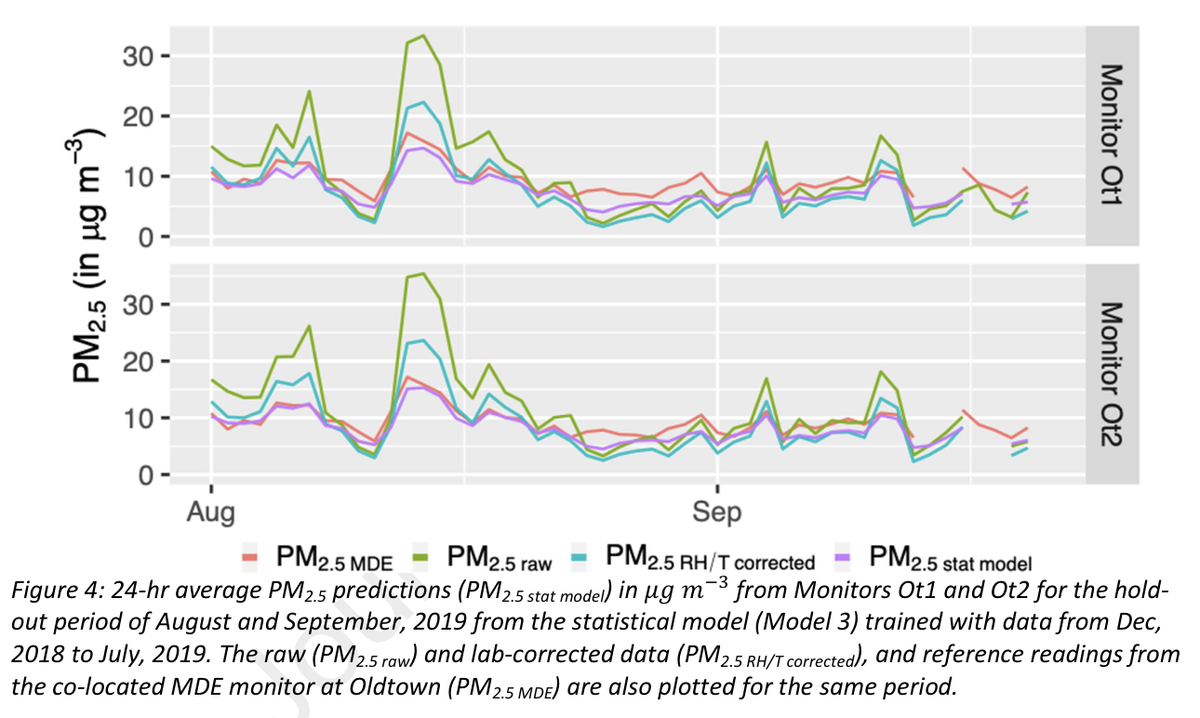
New paper on calibrating PM2.5 data from the SEARCH low-cost monitoring network in Baltimore. We use a linear-regression based gain-offset model that reduces bias and variability of the raw or lab-corrected low-cost data .