The market went down yesterday. Your portfolio is red. Every instinct you have is screaming to do something.
That instinct is the enemy.
Kahneman proved it. Loss aversion means the pain of losing $1,000 feels twice as powerful as the pleasure of gaining $1,000. Evolution wired you to flee from pain. The market knows this and exploits it every single time.
Buffett said it plainly. The market is a mechanism for transferring wealth from the impatient to the patient. Every red day is a transfer in progress. The only question is which side of the transaction you’re on.
Munger went further. Invert the problem. Don’t ask what you should buy when markets drop. Ask who is selling and why. The answer is almost always someone who needs liquidity, panicked, or was forced out by leverage. They are not selling because the asset stopped being valuable. They are selling because they are afraid. You are buying their fear at a discount.
You cannot hold through a drawdown if you don’t understand what you own. If the thesis is intact — and today it is — the red number on your screen is not information. It is noise dressed up as urgency.
The greatest trade you will ever make is the one you didn’t close on a bad day.
the-open-network:native
@MaxBecauseBTC@i_am_jackis
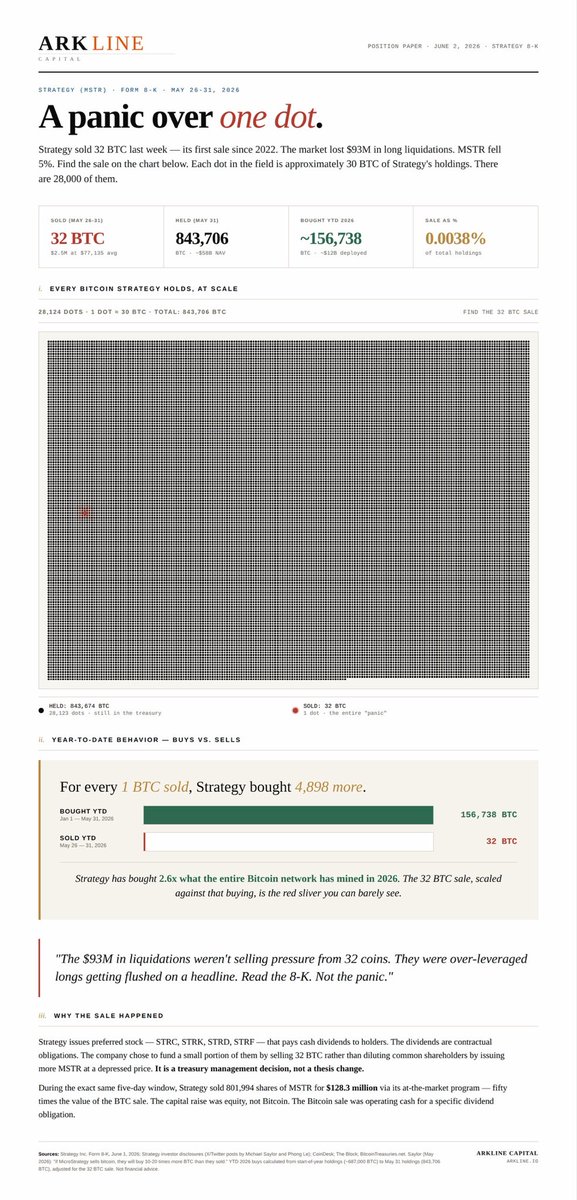
32 BTC.
That’s what Strategy “sold.” It’s one dot in this grid.
Find it.
Each of the other 28,123 dots is still in the treasury. They bought 4,898 of them for every one they sold. The $93M in liquidations that followed was over-leveraged longs getting flushed on a headline.
Read the 8-K. Not the panic.
People are freaking out because Strategyᴮ sold 32 BTC.
That’s 0.0038% of its 843,738 BTC stack.
Meanwhile Jeff Walton @PunterJeff just explained the real issue: legacy finance is still treating billions in Bitcoin on the balance sheet like it’s worth zero.
So Saylor sells a tiny piece, converts it to cash, and forces them to admit the asset is real.
h/t: @Bankless
@GrantCardone Genuinely curious as to why - not judgement or argument - curiosity. In the words of Lincoln - I disagree with that man, I need to get to know him better. For reference my thesis attached.
the-open-network:native utya:native @CrashiusClay69@MaxBecauseBTC One Russian designer built four of the most iconic characters in Telegram history. All four now back tradeable tokens on TON. Combined market cap: $36.6 million.
Meet Egor Zhgun, Art. Lebedev Studio designer in Moscow. In 2010 he created Zoich, the fake Sochi 2014 mascot that hit #1 in online voting in 40 minutes. A decade later he shipped three Telegram sticker packs: Utya Duck, The Virus, Baby Yoda.
All four characters now back TON memecoins.
UTYA — $33M (the anchor)
YODA — $3.1M (9% of UTYA)
VIRUS — $366K (12% of YODA)
ZOICH — $130K (35% of VIRUS, the closest gap)
Three-month returns vs TON’s +29%: UTYA +570%, YODA +417%, VIRUS +250%. Correlation to TON: 0.87 to 0.93. Same designer. Same liquidity pool. Same memetic lineage.
ZOICH has 231 holders. The smallest float, the oldest character, the largest cultural backstory in the quartet.
Full report attached. Not financial advice.
the-open-network:native utya:native @CrashiusClay69@MaxBecauseBTC One Russian designer built four of the most iconic characters in Telegram history. All four now back tradeable tokens on TON. Combined market cap: $36.6 million.
Meet Egor Zhgun, Art. Lebedev Studio designer in Moscow. In 2010 he created Zoich, the fake Sochi 2014 mascot that hit #1 in online voting in 40 minutes. A decade later he shipped three Telegram sticker packs: Utya Duck, The Virus, Baby Yoda.
All four characters now back TON memecoins.
UTYA — $33M (the anchor)
YODA — $3.1M (9% of UTYA)
VIRUS — $366K (12% of YODA)
ZOICH — $130K (35% of VIRUS, the closest gap)
Three-month returns vs TON’s +29%: UTYA +570%, YODA +417%, VIRUS +250%. Correlation to TON: 0.87 to 0.93. Same designer. Same liquidity pool. Same memetic lineage.
ZOICH has 231 holders. The smallest float, the oldest character, the largest cultural backstory in the quartet.
Full report attached. Not financial advice.
The U.S. Treasury’s gold is still booked at the 1973 statutory price of $42.22/oz. Market price: $4,528.
Repricing it to market unlocks $1.17 trillion — enough to buy 1,000,000 BTC and lock it for 20 years, with funds to spare.
Combined with Strategy and ETF demand, the math hits 439% of new supply after the 2028 halving.
This creates the most substantial issue to date….There is not enough left. @MaxBecauseBTC
A fringe asset became infrastructure.
Five years ago, owning Bitcoin was a career risk for a CFO and a regulatory cliff for an asset manager.
Today it sits on 174 corporate balance sheets, in 11 SEC-approved ETFs holding $110B, and in the formal reserves of 4 sovereign governments.
Twenty-two U.S. states have filed legislation to do the same. @MaxBecauseBTC
For fifteen years, Bitcoin had no institutional bid. No ETF held it. No public company kept it as treasury. No government recognized it as a reserve.
That world ended in 2024.
Today: 174 public companies. 11 ETFs. 34 state bills. ~3.2M BTC locked up. @MaxBecauseBTC