There's a lot of bad analysis on the sudden collapse of @WeilGotshal, a firm with $2.1B in revenue and $5.4 million in profits per partner.
As a Biglaw partner for nearly a decade, here's my take on what happened.
(1) Law firms are a strange asset class. They are worth virtually nothing expect the people who walk out the door every night. Any of them can go across the street to a firm that pays more, and take their clients along.
@burkov@ylecun I think the RLHF point is very compelling, but even if the models do not get any better, they can still radically transform how law is practiced.
@NateSilver538 My favorites are those who have gone from "AI is laughable and useless" to "AI is so dangerous it has to be banned" without missing a beat.
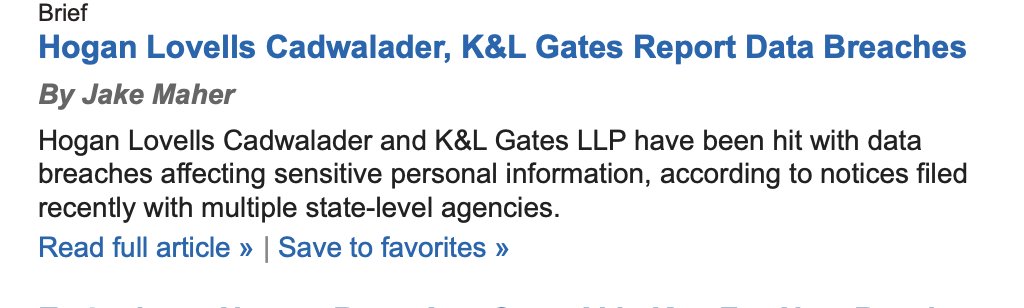
To all the lawyers told to fear AI because of exotic risks like "prompt injection" and fears that Anthropic doesn't truly offer "ZDR" and might secretly somehow look at your data.....it seems like every day the world's law firms have data exposed through cyberattacks. Keep risk in perspective.
We need two things for this:
1. A product that will do this appropriately, which is easy enough: processing on local models, no data retention once an attorney has approved notes of the meeting.
2. More broadly, you need a cultural shift. Most corporate clients, their executives, and law firm partners recoil at the idea of something like this. For privileged communications, there are huge efficiency advantages, as you say, but I think some habits have to change.
I know some very savvy AI lawyers above that threshold. But no doubt you are onto something. Part of it is maybe older lawyers tend to know tech less well. But another, more disturbing, part may be that over 55 they think “I’ve climbed the mountain, and can hang on another 5-10 years” even if AI wrecks the pathway up.
It is also pretty pejorative to describe you as an “influencer..” It paints you and every as unserious, hyping whatever's next. You are very serious and respected AI users, and I and many other subscribers have come to trust you for delivering your perspectives using the latest models across a variety of tasks.
@lawheroezV2 Also, the things that most frustrated me about Word and the things I never mastered, I don't need to anymore. Claude can do it, so that probably puts less pressure on change.
@lawheroezV2 Great to here. The firms on the bleeding edge of this are often going to be boutiques. I use Astra regularly, and I have plenty of connectors and plugins enabled (shout out to my fellow LegalQuants who designed a set), but very curious as to what else I can get from it.
Many young lawyers will be upset that the promise of a guarantee job after spending a summer at a law firm is under threat, and I get that.
BUT, let's be real. Law firm hiring is absurd. Students apply to major firms barely three months into their first year law school, with no track record, and law firms extend offers for what is in effect a permanent position (you have to do something really terrible over a summer internship to not get an offer).
Large law firms therefore end up offering jobs to summer associates who they aren't wild about, keep them on the payroll for a couple of years without investing in their training, and then tell them it is time to look elsewhere. That doesn't leave these never really fully welcomed young lawyers in a great place.
Everyone knows this is a no way to run a railroad, but the competition among Biglaw for the "top" law students has left everyone in this place.
Keker, Van Nest & Peters is a great law firm. There are plenty of excellent law students who will bet on themselves, knowing they will perform well over the summer and make the firm really want to bring them on full time.
San Francisco law firm Keker, Van Nest & Peters will stop extending full-time job offers to its summer associates at the end of the summer and will instead have them apply for those jobs “when they are ready,” the firm said Monday. https://t.co/4mHTUPzUbW
@ReutersLegal In other news, Columbia University Medical Center announced they will no longer be training medical residents, and that students interesting in performing complex surgeries should come to them when "they are ready."
This benchmark is really problematic and I think some models may be “benchmaxing” towards it. That said, for my use cases, Fable 5.2 is way overpowered for smaller things but in terms of actually stringing together a legal argument that would persuade a real person is worse than opus 5.5 (which is just ok, and not something that meets my standards)
@mstockton If you can clearly explain to another lawyer assisting you on a project exactly what it is you want, providing relevant context and clarity, you can get a lot out of an AI. It's really this game skill, except the AI is a very weird lawyer, and you have to get used to the quirks.
Seen many posts about OpenAI "strategically" waiting to release Astra 6.2 or until they can do maximum damage to Anthropic's IPO. Why do people think that is in their interest? I realize they are fierce competitors, but not obvious to me that "Anthropic's IPO big failure" results is good for OpenAI. Success may breed success here.
@lawheroezV2 Interested in the details. It's ironic because a lot of folks in the legal AI space have been pushing use of these inference providers as "safer" than OpenAI / Anthropic. Now if you have ZDR (and they really do it) that is a protection, but this is unsettling.
I'm with Zach on this one. The stuff that's worthwhile is not for sale, and anything for sale is not worthwhile. And perhaps even more to the point, trying to separate the stuff that can be sold from the stuff that can't from internal databases is an expensive project that has to be done with extreme care and would cost a great deal.