AP provides an extensive line of Tactical Gear to all branches of the Military and Property Accountability. And yes...we provide items to Civilians as well.
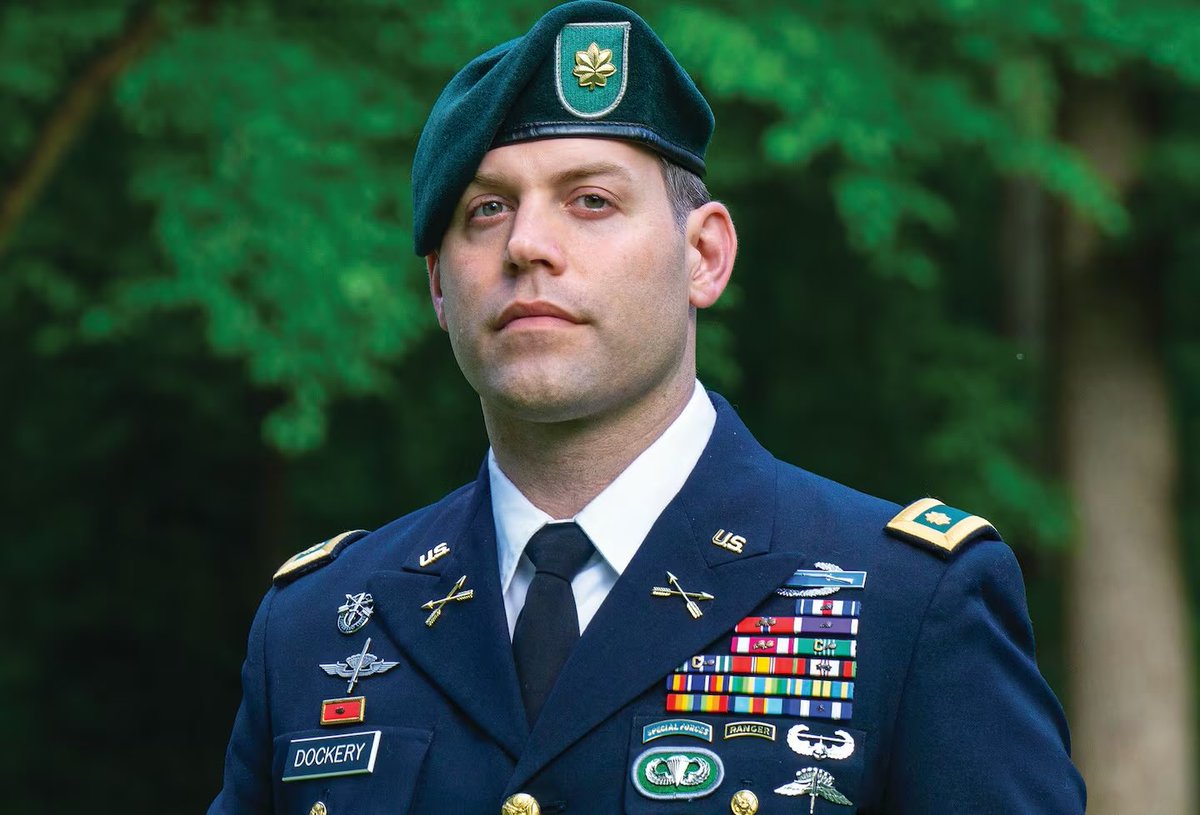
🎖️One of our own is getting the Medal of Honor. MAJ Nicholas Dockery, West Point Class of 2011, was just approved by Congress for the nation’s highest combat valor award.
The short version: Oct. 2, 2012, Afghanistan. Ambushed by Taliban. Nick moves through open ground repeatedly to rally his troops, uses his body to shield a soldier from a grenade, then goes searching for a missing man, finds him being dragged away unconscious by two enemy fighters, charges them, kills them both, performs CPR, then climbs onto an open rooftop to signal gunships and get his guys out alive. Two Silver Stars. White House Fellow. MacArthur Leadership Award. AND Nininger Award in 2017.
Go read the full story. Congratulations, Nick. The Long Gray Line is proud. 🫡 Beat Navy.
On June 17, 1788, Russian and Ottoman fleets tore into each other in the shallow waters near Ochakov on the Black Sea.
Here's the twist almost nobody knows.
One of the Russian squadrons was commanded by John Paul Jones. The father of the American Navy. The same man who said "I have not yet begun to fight."
After the Revolution, he took a job as an admiral for Catherine the Great of Russia.
At the Liman, his ships and a second Russian flotilla trapped the Ottoman fleet inside the estuary. Then they went to work.
They burned and captured ship after ship. Thousands of Ottoman sailors were lost. The disaster helped doom the nearby fortress of Ochakov.
Think about that. An American naval legend. Fighting under a Russian flag. Against the Ottoman Empire.
And almost no one in America has ever heard of it.
On this day in 1885, the Statue of Liberty arrived in New York Harbor.
Not standing tall. Not lit up. She showed up in 214 wooden crates packed into the hull of a French ship called the Isere.
France had built us a 151 foot copper woman, taken her apart piece by piece, and mailed her across the Atlantic with a note that basically said good luck putting her together.
Here's the part nobody remembers: America almost didn't take the gift. France paid for the statue, but the deal was that America had to pay for the pedestal she'd stand on, and we were broke and dragging our feet.
So newspaper man Joseph Pulitzer got angry and started shaming the country in print. He promised to print the name of every single person who donated, no matter how small.
It worked. Over 120,000 people chipped in. Most gave less than a dollar. Schoolkids sent pennies.
Regular broke Americans built the base that holds up the most famous symbol of freedom on earth. That's the part they leave out.
"She climbed into an unarmed fighter jet with orders to ram a hijacked Boeing 757—knowing she wouldn’t survive. She was 26 years old, and she had approximately eight minutes to accept her own death.
Andrews Air Force Base, Maryland. September 11, 2001. 10:00 AM.
First Lieutenant Heather “Lucky” Penney was in the air on a routine training flight when the order came through: return immediately. America is under attack.
When she landed, everything had changed. Both Twin Towers were burning. The Pentagon had been hit. And more hijacked planes were still in the sky.
Then came the worst part—there were no missiles loaded on her F-16. It was a training aircraft. No live weapons. Nothing capable of stopping a passenger jet.
Only one option remained.
“Penney, Sasseville—suit up. NOW.”
Within minutes, she and her commander were sprinting to their jets. Ground crews were still removing safety pins as intelligence came in: another hijacked plane, Flight 93, possibly headed for Washington.
The White House. The Capitol. No one knew which.
But someone had to stop it.
As she climbed into her cockpit, a crew chief looked at her and quietly said, “Good luck, ma’am.” Neither of them said what they both understood.
If they found the aircraft, they might have to ram it.
There would be no second chance. No ejection that could save her. Only impact.
On the radio came the order that defined everything:
“Stop that aircraft by any means necessary.”
She didn’t ask for clarification.
There wasn’t time.
Moments later, her F-16 roared down the runway and lifted into the sky. Within seconds, she was flying over Washington at supersonic speed—sonic booms shaking the city below like distant thunder.
Smoke still rose from the Pentagon.
She searched the sky for a Boeing 757 she might have to destroy with her own jet.
But 200 miles away, something else was happening.
Passengers on Flight 93 had already made their own impossible choice.
They stormed the cockpit.
At 10:03 AM, the plane crashed into a field in Pennsylvania.
All 44 people aboard died—but Washington was saved.
Heather never had to complete her mission.
She circled the capital for hours afterward, protecting a city that had already been spared by strangers who refused to be victims.
When she finally landed, the crew chief was waiting. He looked at her and said quietly, “I didn’t think I’d see you again.”
Neither had she. "
Hunting the Hunters: How the Allies Crushed the U-Boat Wolf Packs 🇬🇧🇩🇪
During the Battle of the Atlantic, German U-boats terrorized the shipping lanes until the Allies took to the skies.
This footage from May 1943, during the period known as “Black May,” captures an Allied patrol bomber hunting a German U-boat with depth charges and strafing attacks in the Atlantic. Escort carriers and radar-equipped patrol bombers transformed these deadly predators into prey, helping close the Atlantic Gap and secure the vital Allied supply lines to Europe.
Digitally restored, enhanced, and presented with sound design to recreate how these moments may have looked and sounded at the time.
It was the summer of 1943, over the oil refineries of Romania.
A 22-year-old American pilot watched gasoline pour out of his bomber's wing as he closed in on his target.
He could have pulled up and tried to crash-land. Instead he flew his leaking bomber straight into a wall of fire, because his crew still had bombs to drop.
This is the story of Pete Hughes..🧵1/6
Two weeks before Gettysburg, the most important question in America was painfully simple.
Where is Lee's army going.
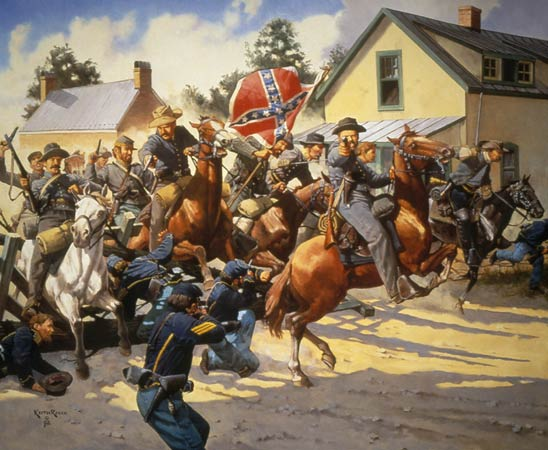
On June 17, 1863, Union cavalry tried to force an answer. They pushed toward Jeb Stuart's screen of horsemen, the human curtain hiding Lee's entire army as it slid north toward Pennsylvania. At a tiny crossroads town called Aldie, Virginia, they hit that curtain hard.
What followed was hours of brutal, close range cavalry fighting.
Men slashed at each other with sabers in the streets, along stone walls, and across open hayfields. Horses went down everywhere. It was loud, personal, and savage, the kind of fight where you can see the other man's face.
Neither side could claim a clean win. But Stuart held the line and kept Lee's movements hidden a little longer.
Aldie was a warning shot. The storm was coming at Gettysburg, and it proved the Union cavalry was finally ready to go toe to toe with the best horsemen the South had.
June 17, 1861. The war was barely two months old and nobody had figured out the rules yet.
A Union force climbed aboard a train on the Loudoun and Hampshire Railroad near Vienna, Virginia. They treated it like a casual ride, men relaxed in open cars, weapons down, no real scouting ahead.
They had no idea Confederates under Maxcy Gregg were waiting for them.
Gregg had rolled artillery into position on a curve and aimed the guns straight down the tracks. When the train eased into view, packed with soldiers, they opened fire directly into the cars.
Chaos. The engineer panicked, threw the train into reverse, and fled, leaving the soldiers stranded under fire. Men poured out of the wreckage and scrambled for cover on foot.
It was one of the first times in history a railroad was turned into a tool of ambush.
The lesson landed hard that day. This war was going to use machines, speed, and surprise in ways nobody was ready for. The whole country was about to find that out.
@LouisvilleGun@_DavidMorrell@codym1917 Absolutely. (Full disclosure though….. this photo was generated by the Grok Imagine thing, after 5-10 minutes of back-and-forth. Told it to make a pic of 20-year-old Teasle after a couple days in the shit.)
@hellbinder36981@_DavidMorrell@codym1917 Korea was cold as a MF. The weather patterns would blow in from Siberia. During the coldest parts of the winter our tank battalion would start & run all of our vehicles multiple times each night. (2000-02 timeframe.)
Workers dredging the Savannah River expected to find mud, but instead uncovered 19 massive cannons that had been hidden beneath the water since the American Revolutionary War.
Recovered between 2021 and 2022, the weapons each weighed more than 1,000 pounds and had rested on the riverbed for nearly 250 years. Some were still loaded, suggesting they sank with a British ship deliberately scuttled in 1779 to block the advancing French fleet during the Siege of Savannah.
After years of conservation at Texas A&M, 17 restored cannons will go on public display for the first time on July 2, 2026, offering one of the most remarkable Revolutionary War discoveries ever made in Georgia and preserving a forgotten chapter of American history.
Credit: Savannah District, U.S. Army Corps of Engineers
As the Wisconsin moved in close to bombard enemy positions, a North Korean artillery crew — whether out of desperation, bravado, or a catastrophic lapse in judgment — opened fire on her. Their shells struck. One punched through the shield of a 40mm gun mount, injured three sailors, and left a scar on the ship's hull.
That was the first and only time in her entire career the Wisconsin was ever hit by an enemy.
She did not take it well.
Within moments, the crew of Big Wisky swung all three of her massive turrets toward the shore. All nine barrels. Nine guns, each one wider than a grown man is tall, each one loaded with a 2,700-pound shell the size of a small car. The order was given. The ship shuddered. The coastline shook. The North Korean battery — along with quite a lot of real estate around it — ceased to exist.
The response had been so fast, so total, and so wildly disproportionate that the officers aboard USS Buck, the destroyer escorting the Wisconsin, could barely believe what they had just witnessed. They reached for their signal lamp and sent a short, dry message blinking across the water toward the battleship:
"TEMPER TEMPER."
Wisconsin's crew, apparently not done, signaled right back:
"But they started it."
And that was that. No North Korean or Chinese force attempted to hit the USS Wisconsin for the remainder of the Korean War. When you fire a full broadside from the most heavily armed battleship in the world in response to a single artillery round, you tend to discourage future attempts.
@_DavidMorrell@codym1917 That by itself is enough material for a movie. (We haven’t had a good one about Korea, Saving Private Ryan style, in….. forever.) And it would be a hell of a lot better than the slop coming out of Hollywood these days. Which is why it would probably never be made.
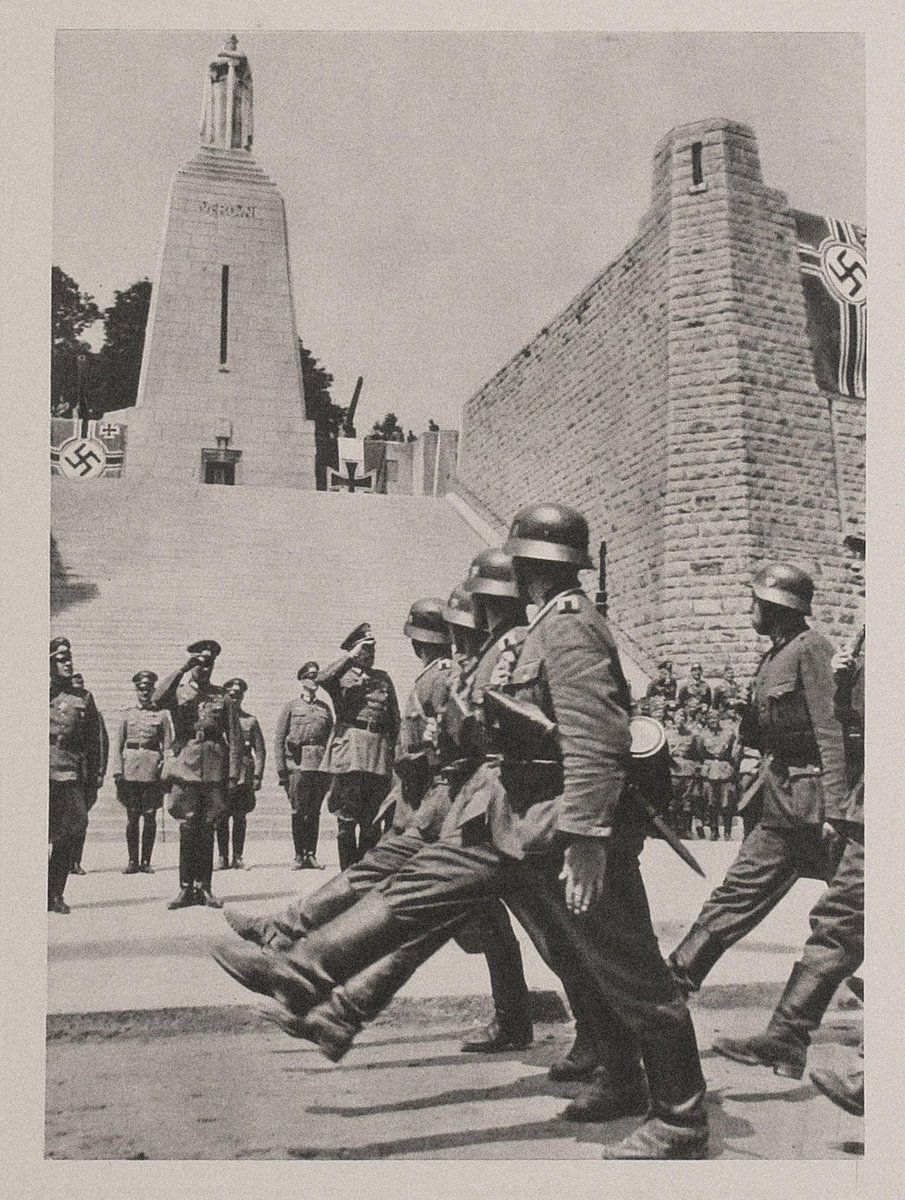
On this day in 1940, German troops captured Verdun, and with it a piece of France's very soul.
To understand why this mattered so much, you have to go back to the First World War. In 1916, Verdun was the site of the longest and one of the bloodiest battles in human history. For nearly ten months the French and Germans fed men into a grinding meat-grinder around the fortress city, and the casualties on both sides ran into the hundreds of thousands. Verdun became sacred ground in France, the symbol of the nation's unbreakable will to endure. The defiant cry associated with its defense, "They shall not pass," became the most famous phrase of French resistance. To hold Verdun was to hold France itself.
That was what made June 15, 1940 so bitter. The city that had cost an ocean of blood to defend over ten months in the last war was overrun by the advancing Germans in the new war almost without a fight. The France of 1940, its armies shattered and in headlong retreat after the breakthrough in the Ardennes, simply could not hold the ground its fathers had died for a generation earlier.
The symbolism was devastating and unmistakable. The same week that Paris fell, the fortress of "They shall not pass" fell too. It captured the whole tragedy of 1940 in a single place. The generation that had bled white to save Verdun in 1916 watched their sons lose it in days, and with it the illusion that the sacrifices of the last war had bought lasting security. On this day, one of the proudest names in French history passed into German hands.
Happy 99th birthday, Harold Bray, the last living survivor of the USS Indianapolis. Of 1,196 men who served with him, just 316 survived the sinking. He is the last breathing. See more https://t.co/EEg00P06y6
Hell in the Hedgerows: Bocage Fighting in Normandy (Summer 1944) 🇺🇸🇩🇪
After D-Day, American forces faced one of their toughest challenges in the dense Normandy bocage. Thick hedgerows turned the countryside into a deadly fortress for German Fallschirmjäger.
U.S. Army troops advanced meter by meter under heavy fire from determined German defenders. Close-quarters combat was brutal and relentless. To overcome the terrain, American forces adapted by modifying tanks to break through the hedgerows and support the advance.
This grueling war of attrition continued until Operation Cobra finally shattered the German lines and opened the road to the liberation of France.
Digitally restored, enhanced, and presented with sound design to recreate how these moments may have looked and sounded at the time.
On this day in 1864, the Union got a second straight chance to seize Petersburg and end the war, found the city still defended by a desperately thin line of outnumbered men, and squandered it all over again. It was the day a war-winning opportunity slowly turned into nine and a half months of trenches.
The setup was almost unbelievable in the Union's favor. The day before, on June 15, Grant's secret march across the James River had landed his army in front of a nearly empty Petersburg, the rail hub that fed Richmond and Lee's whole army. The first attacks had broken through part of the defenses, and then stalled when the lead commander, Baldy Smith, halted in the dusk instead of pushing into the lightly held town. Overnight the chance was still alive. Petersburg was held only by P.G.T. Beauregard with a few thousand men, and Robert E. Lee still had not fully grasped that Grant's entire army was now south of the James.
On June 16 the Union had even more force on hand. Hancock's hard-fighting II Corps had come up, more troops were arriving, and the army commander George Meade was on the field. In the evening they attacked again and managed to capture several of the Confederate strongpoints, more of the works falling into Union hands. On paper it looked like progress. But once again the attacks were not delivered as one overwhelming, coordinated blow. They came in pieces, corps by corps, blow by separate blow, against a defender who kept finding just enough men to plug each new gap.
And that defender was putting on one of the great performances of the war. Beauregard, outnumbered many times over, shuffled his small force back and forth along the line, abandoned his outer works to pull back to a tighter, more defensible position, and bluffed the cautious Union commanders into believing he was far stronger than he actually was. His men were stretched paper-thin, fighting almost without rest, but they held the city through sheer desperation and nerve. All the while Beauregard hammered Lee with urgent messages: the whole Union army is here, Petersburg is about to fall, send help now.
Lee, finally convinced, began pouring the Army of Northern Virginia south. With every hour the odds shifted. The handful of exhausted defenders of June 15 and 16 were steadily replaced by veteran divisions filing into the trenches. By June 18, when the Union mounted its last big assault, they ran into a fully manned, formidable line and were thrown back with heavy losses. The men, remembering the slaughter at Cold Harbor only two weeks earlier, in some places refused to charge again into certain death.
So the window that had been wide open on the evening of the 15th, still cracked open on the 16th, slammed shut for good. Grant stopped attacking and started digging. The Siege of Petersburg settled in, a grinding ordeal of trenches, mines, and misery that would last until the spring of 1865. When Petersburg finally fell in early April 1865, Richmond fell with it, and Lee surrendered at Appomattox a week later. Everything won in that final week had been within reach in the June dusk. June 16 was the day the Union had one more chance to take it cheaply, and let it go.