7 podcasts that can change your life:
1. The School Of Greatness
2. The Mel Robbins Podcast
3. The Diary Of A CEO
4. The Tim Ferriss Show
5. The Happiness Lab
6. Business Made Simple
7. My First Million
One great podcast episode can save you years of mistakes.
Happy New Week, MNR Family!
Let’s keep building the movement together!
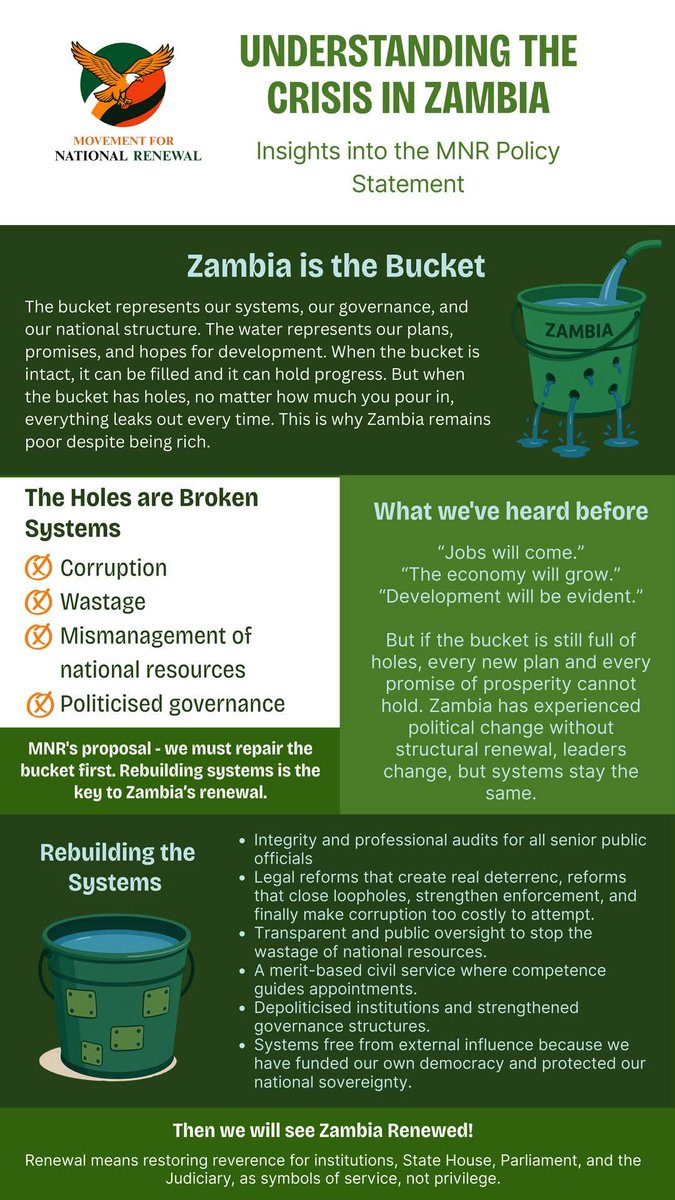
This week, we’re breaking down the MNR Policy Statement. Here’s a quick infographic on Understanding the Crisis in Zambia.
The MNR is calling on 1,000,000 citizens by 31 December 2025 to stand for reflection, responsibility, and renewal to help transform this movement into a people-driven political party founded on truth and national purpose.
Join the call at: https://t.co/bgSW4tKKkv
Drop your thoughts in the comments below.
https://t.co/vz0lyZXpfs
The truth many in the government miss is that life is getting tougher with power cuts, soaring prices, and an economy serving only the top 20%. What happened in Chingola isn’t an isolated incident; it’s a symptom of growing frustration and inequality across the country.
Have you ever stopped to ask who actually drives economic growth in Zambia? Start with the Stanbic Bank Zambia PMI. I have drawn a red line at 50, the threshold that separates expansion from contraction in private sector activity. Now look at the trend from 2015 to 2025. It does not trend upward. It oscillates around 50 with multiple periods of contraction. That pattern matters.
A healthy private sector should break clearly above 50 for sustained periods. That is when firms hire, invest, expand inventories and increase wages. Instead, the PMI shows brief improvements followed by reversals. Over a decade, this has created a flat line of private sector momentum. It suggests an economy that struggles to build enough internal strength to compound growth through households and small firms.
Official projections place growth in 2025 at roughly 5.8 per cent. On paper, that is impressive. But when you trace the drivers, you will find the familiar mix. Mining output and investment. Agriculture recovery after drought. Tourism improvements. Public spending supported by concessional capital. These sectors lift GDP, but they concentrate gains within a narrow band of firms with access to foreign currency, power, inputs and working capital.
Meanwhile, the parts of the economy that touch ordinary households experience slower movement. Retail margins remain thin. Service businesses face rising costs. Access to credit is limited and often collateral-heavy. Power reliability increases input risk. All of these pressures are captured inside the PMI. That is why it regularly dips below 50 even when the headline story sounds positive.
The long-run picture is clear. For ten years, the private sector has hovered near the waterline. Enough to stay afloat, rarely enough to accelerate. You can feel this in wages, in job creation, in household consumption and in the growth of small firms. Strong GDP without a sustained break above 50 means that growth is happening, but it is not spreading widely.
Growth becomes transformative when many firms expand at the same time. That requires diffusion. When the PMI spends this much time near contraction territory, diffusion weakens. Without diffusion, headline growth becomes linear rather than multiplying through the economy.
So let us return to the original question. Who actually drives growth in Zambia today, and what must change for that growth to reach more households and firms over the next decade?
Mwisho, when you mature above 'bakambona shani ku bantu', you would have conquered life
Generational wealth often starts with that one risk taker.
That one family member ready to endure insults, embarrassment and ridicule.
That one fellow on stand by to dig through the dirty jobs and shameful pits of work.
Every affluent family has that individual.
Be that person and rescue your family from the shackles of poverty and lift the veil of indignity.
All poverty is bad.
But urban poverty is more torturous 😰.
Starving at your home when across the street neighbours have excess & pollute the air with aromas of food is unsettling. In the village, if you're hungry, the neighbours are likely also hungry. #Nodignityinpoverty
Listen, if you invest K250,000 in a 15yr Govt bond now, you'll receive about K500,000 in 2037 & about K4600/month for 15yrs. In 4.5 yrs, you get back your investment. Elo you may not even build a house in K250,000 that can be rented at K4600/month in Zambia. #Nodignityinpoverty
Poverty is traumatic.
The constant absence of basic things that should naturally enhance life like food, water, clothes etc is distressing. Adults usually panic. While children always cry, as they can’t understand what’s happening #Nodignityinpoverty#EndPoverty#SDG1#Zambia
One not widely discussed advantage of owning a diversified portfolio is that, if you add money periodically, you'll most likely have opportunities to add at all times
I have recently started adding to two positions that I have not added to in more than a year
“We will create the best fiscal, economic and social policies and legislative environments tailored to support local development efforts which recognize that you cannot borrow beyond your capacity to repay, nor can you spend what you do not have,” Mutati said.