In a new Springboard Blog, @harshjegadeesan, Chief Publishing Officer at Springer Nature, reflects on open access at scale, and why openness, partnership and trust remain essential to delivering value for research and society.
👉 Read the blog: https://t.co/DuFjI7iOxr
Our open science journey goes back 25 years ago, when @BioMedCentral was founded as the world’s first commercial OA publisher. Now OA is Springer Nature’s dominant publishing model. Learn more about our transition to #OpenAccess.
👉 https://t.co/GQ6ZB5kFtp
#BePartOfProgress
Love Data Week 2026 asks: “Where’s the data?” Our new blog breaks down a decade of State of Open Data Report findings and what they mean for today’s research culture: https://t.co/bukcrUwnAJ
#LoveData26#OpenData
New content on CAR-T cell therapy is available now.
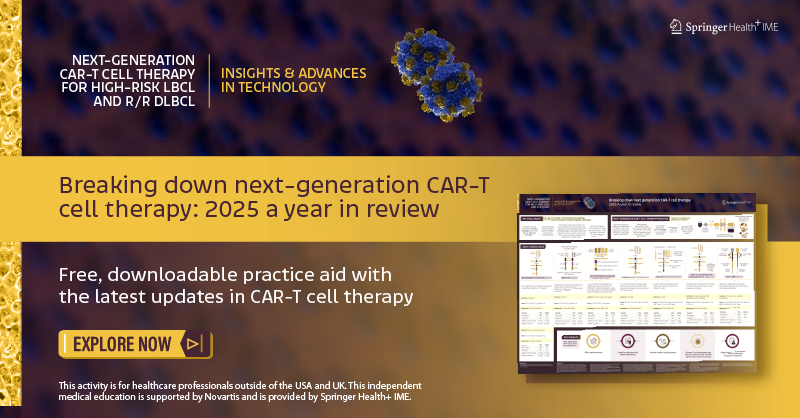
This free downloadable clinical aid, designed to be used directly in your practice, distils the most significant developments in CAR-T cell therapy for high-risk LBCL and R/R DLBCL in 2025: https://t.co/TOcjTsnBn7
The 2025 Nobel Prize in Physiology or Medicine was awarded jointly to Mary E. Brunkow, Fred Ramsdell and Shimon Sakaguchi “for their discoveries concerning peripheral immune tolerance.” This Collection celebrates the award and recognizes the winners’ achievements. https://t.co/JB1rknq9JM
Calling for your paper for our collection
Clinical and translational studies in children and adolescents with arthritis. Learn more about the
collection and how to contribute:
https://t.co/MCPDZzUGdK
💡“Publishing in a Collection helped me show leadership in my field.”
Dr. Federico Virga’s journey in immunometabolism is a must-read for early career researchers.
📖 https://t.co/cBAsmTZldZ
Want to close the gender gap in research? Start with the data.
Our Springer Nature report: Closing the Gender Gap highlights where change is needed most — and how you can be part of it. Read the report: https://t.co/t3s5MRieK1
.@TimKersjes, Head of Research Integrity, Resolutions at Springer Nature, shares observations on AI and peer review from the 10th International Congress on Peer Review and Scientific Publication.
Read more in this Springboard Blog: https://t.co/mDX3wcUu3I
The State of Open Data Survey is back for its 10th year!
Researchers: we want to hear from you. How do you manage and share your data? What challenges do you face?
Take the survey and win one of five $100 gift cards 👉 https://t.co/K9SFG9ygJy
Our new white paper, launched by @Nature Editor-in-Chief @Magda_Skipper, uncovers significant global disparities in research integrity training — including differences in access, timing, methodology, and understanding. Learn more about the key findings: https://t.co/PL2vDxT5mW
Ensuring research integrity is central to our mission — but we can’t do it alone.
The Springer Nature Research Integrity Group has a Training team that develops courses and other resources to support the community. Learn more about them in this blog: https://t.co/nyt0oVxAFY
Research integrity is essential to ensuring trust in science. Watch the video to learn about research integrity and how Springer Nature’s Research Integrity Group works to uphold it and protect the publication record: https://t.co/O9z0iMlAZE
🚀 The 2025 #StateOfOpenData survey is live! 🌐 Researchers worldwide, we want to hear about your experiences and challenges with data sharing. Help shape the future of open science and stand a chance to win 1 of 5 $100 gift cards! Participate today:
https://t.co/HdCNQ9Geq0
Following the rollout of our AI tool that detects cases of AI-generated nonsense text in research manuscripts, we're donating the tool to STM. It will be integrated into the STM Integrity Hub, which helps publishers ensure the integrity of their content:
https://t.co/BFUL7rEXTR
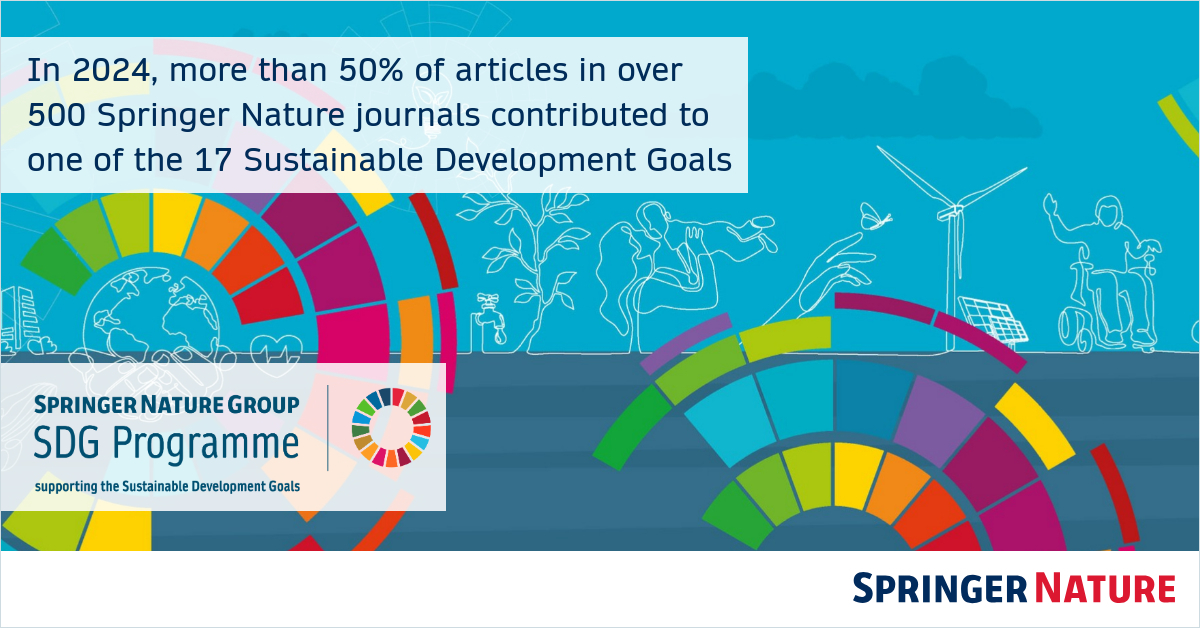
Did you know that over half of the articles published in over 500 of our journals in 2024 were focused on one or more of the 17 Sustainable Development Goals (SDGs)? Our commitment to the SDGs is reflected in our dedicated SDG programme: https://t.co/pgoPuPmW2H
In 2021, we set a bold target: publish 50% of our primary research OA by the end of 2024. We're thrilled to report that we met this target. But how did we do it, and what did we learn? Read the latest Blog from CEO Frank Vrancken Peeters to find out: https://t.co/kK2G4GI5o4
To mark 25 years since the first ISRCTN study record was published, read our Q&A with Lubna M.Z. Mahmoud @AlexU_Edu_Eg about the 15,000th study registration: magnesium sulfate in the treatment of acute asthma
https://t.co/chomdvUezh
Today marks 25 years since the first ISRCTN study record was published!
To mark this, we'll be posting guest blogs from milestones throughout the registry's history, starting with our 20,000th registration - the MOMA study at @cardiffuni
https://t.co/JjGOr56ONm