@ceyladuz@2022nadall@andresmagics Yoo, odtü ee 2000 den boğaziçi ee 400 den almış 2010-2015 yıllarında. İtü’nün bilgisayar bölümü 4,500-5000 den almış, ehb de yazdığım gibi. En yüksek bölümleri bu kadar işte.
İtü mezunlarının bir kesiminde de aşağılık kompleksi bu yüzden vardır
Yazdıkların komple hayal ürünü.
@ceyladuz@2022nadall@andresmagics 🤣🤣 Üni tercih etmiş olmasak bilmicez.
Bir bakayım dedim 2010-15 civarında en iyi bölümü ehb 5000-7000 takılıyormuş son 3-4 senede zirve yapıyor 2000 den alıyor.
@hfakaghujhg@2022nadall@andresmagics Eziklik psikolojisi. Normalde esamesi okunmayan okul Boğaziçine iktidar girince ikinci seçenek olarak parlamaya başlayınca bunlar da çok iyi okul olduğuna inanmaya başladı.
@ceyladuz@2022nadall@andresmagics Koca itü mü? 🤣🤣.
Kendimi bildim bileli odtu bouna giremeyen tayfa giriyordu bu okula. Eziklik psikolojisi olmuş galiba alakalı alakasız her yere itü şöyle böyle yazıyorlar.
@ceyladuz@2022nadall@andresmagics Boun tutarken daha alt seviye bir üniversiteye niye gitsin öğrenci?
Boğaziçi akademik kalitesiyle, hocalarıyla, kulüpleriyle tokatlar geçer. Bounda hocaların yarısından fazlası dünya standartlarında ünilerde çalışmıştır, temel bilim gibi sınavları da test yapmazlar itü aksine…
@mahmutotgen@2022nadall@andresmagics Sence bencesi yok ki? Türkiyede üniversite kavramına uyan iki yer vardır: boun ve odtü.
İktidar bu aralar fazlaca gazlıyor itü’yü bunlar gelir geçer. Geriye iki üniversite kalır.
As a mathematician, the OpenAI/Navier-Stokes story feels genuinely historic and unusually dramatic.
Navier-Stokes is one of the seven Millennium Prize Problems, each carrying a $1M prize. These are not just hard benchmark questions. They are among the most important open problems in mathematics, and entire research programs can grow around finding even one plausible route toward them.
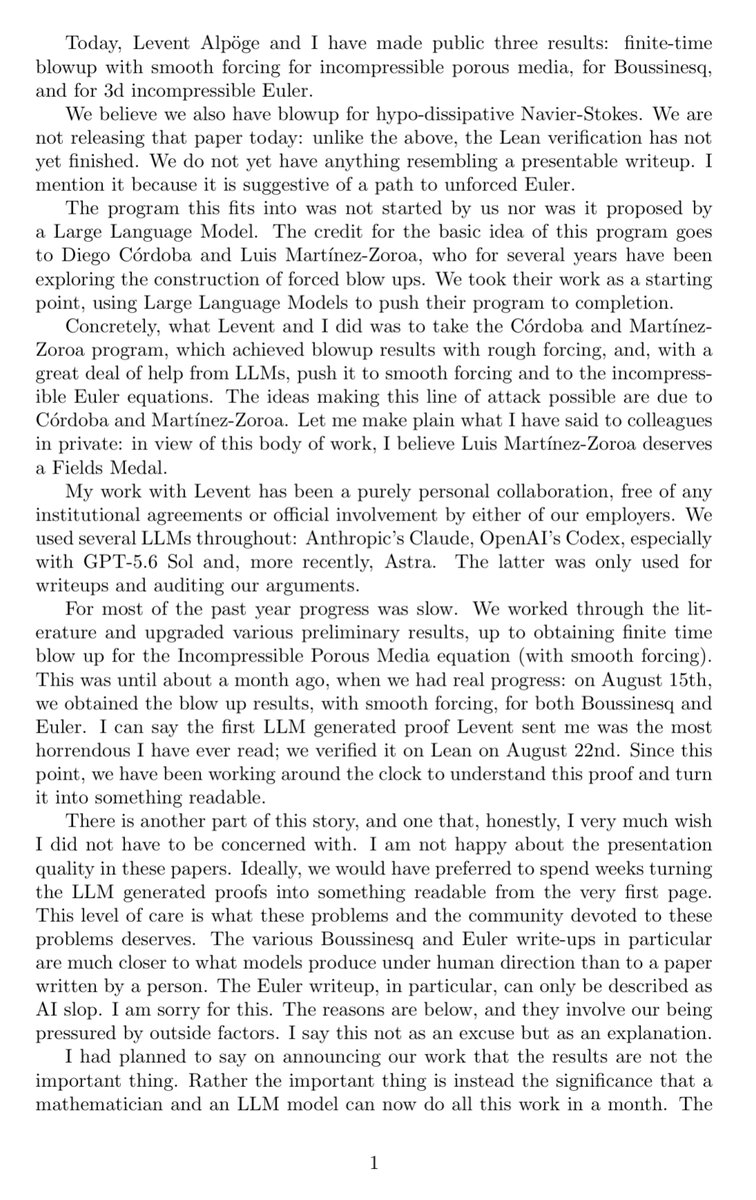
Buckmaster and Levent Alpöge had spent most of the past year pushing a program started by Diego Córdoba and Luis Martínez-Zoroza. Their goal was to take known blowup constructions with rough forcing and push them to smooth forcing, ultimately toward incompressible Euler and Navier-Stokes.
By August 15, they had obtained smooth-forcing blowup results for Boussinesq and Euler. They were using Claude and Codex heavily throughout the project, and Buckmaster says they had been putting their drafts into Codex.
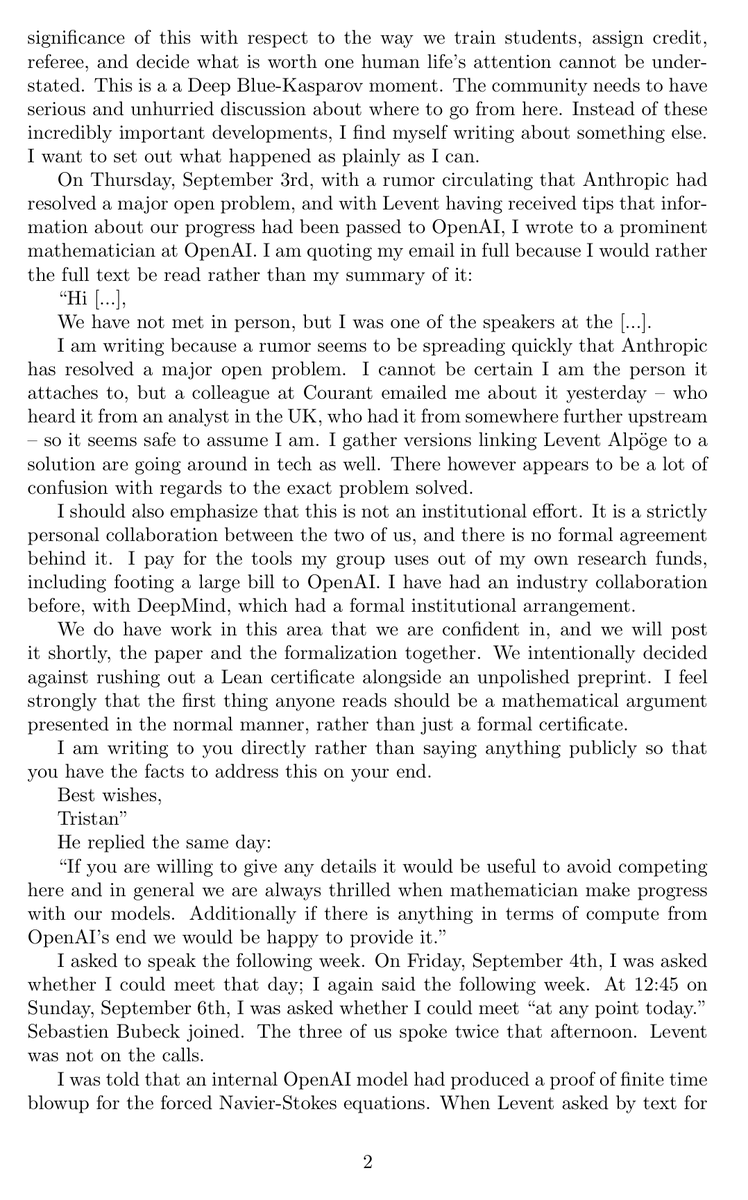
Then rumors started circulating that “Anthropic” had solved a major open problem.
OpenAI says those rumors triggered a large-scale effort on the Millennium Prize problems. Thousands of agents were launched, first attacking nearby Euler problems before the effort moved toward Navier-Stokes.
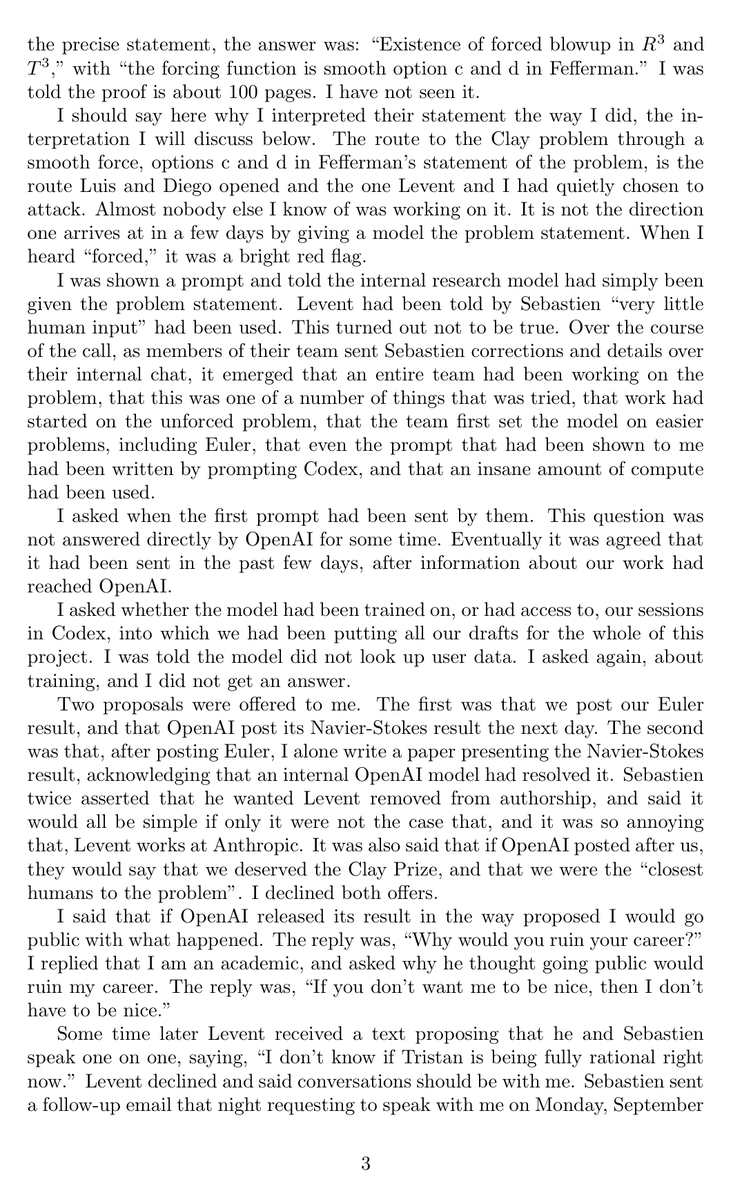
What made Buckmaster immediately suspicious was the direction: forced Navier-Stokes with smooth forcing.
In his statement, he says this was precisely the route Córdoba and Martínez-Zoroza had opened and that he and Alpöge had “quietly chosen to attack.” Almost nobody else he knew was working on it.
His reaction:
“When I heard ‘forced,’ it was a bright red flag.”
He then asked whether OpenAI’s model had been trained on, or otherwise had access to, their Codex sessions. According to Buckmaster, he was told the model did not look up user data, but when he asked specifically about training, he did not get a clear answer.
OpenAI denies directly accessing their private work, but its own post says:
“While unlikely, we cannot rule out that de-identified data derived from their usage of our products helped improve our models.”
And then the story becomes genuinely dramatic. Buckmaster says he was offered publication arrangements, including one where he alone would present OpenAI’s Navier-Stokes result without Levent Alpöge as an author. He says Bubeck emphasized that Alpöge working at Anthropic was the complication.
Buckmaster declined.
He then says that when he told OpenAI he would make the episode public if the result was released that way, the response was:
“Why would you ruin your career?”
Bubeck disputes Buckmaster’s characterization of the interaction.
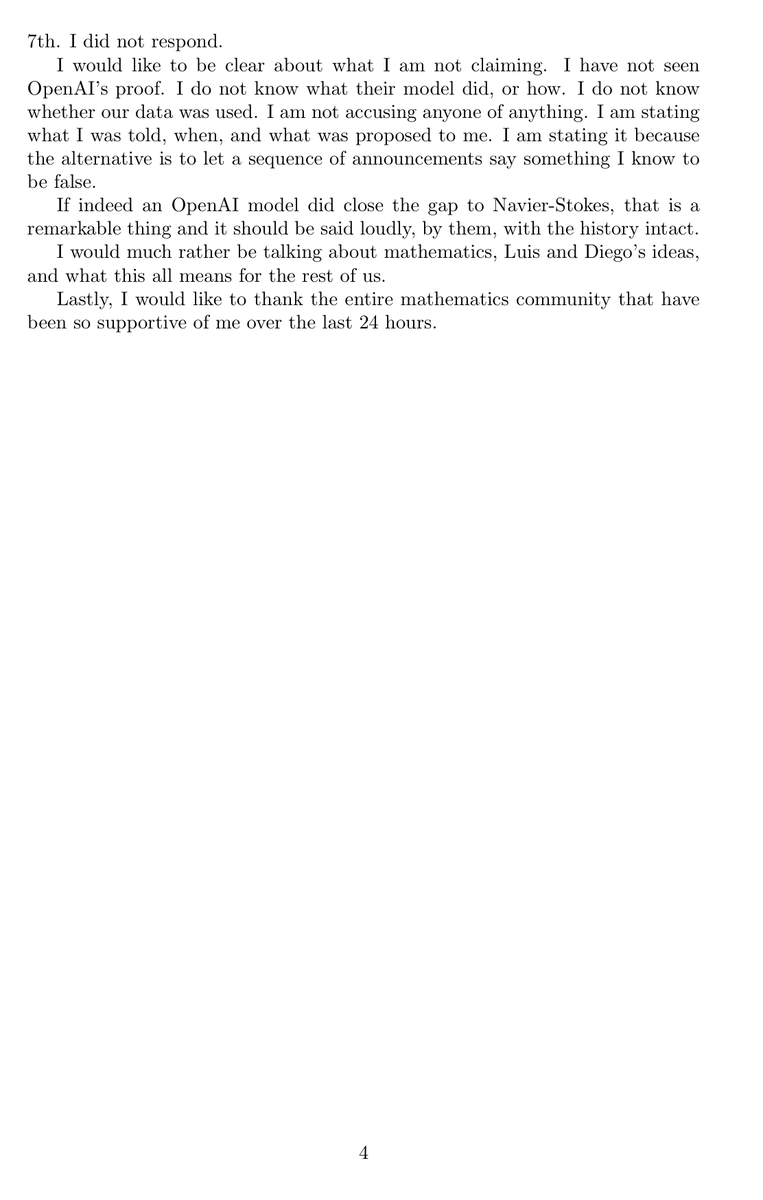
Buckmaster is also careful about what he is claiming. He explicitly writes:
“I do not know whether our data was used. I am not accusing anyone of anything.”
That distinction matters.
But I think Tristan’s most important observation is broader than the dispute itself. He calls this a “Deep Blue-Kasparov moment” for mathematics.
For a Millennium Prize problem, the scarce intellectual resource is not merely the final proof. It is often years of taste, failed attempts, literature, intuition, and judgment that tell you where the promising path is.
If a small group discovers that path, and simply revealing that it is promising can trigger 10,000 AI agents to attack it, then mathematics may be entering a world where identifying the right question becomes more valuable than solving it.
And that could fundamentally change the culture of open mathematics.
Tristan Buckmaster’s statement:
https://t.co/QqCw94MjfC
this is insane.
Levent and Tristan make major independent progress towards Navier–Stokes, with help from Claude and Codex.
word reaches OpenAI.
days later, OpenAI claims internal NS results, coincidentally using the same novel methods as Levent and Tristan.
Tristan asks if OpenAI trained on their private Codex sessions. he never gets an answer.
then OpenAI pressures Tristan to publish without Levent because Levent works at Anthropic.
when Tristan refuses, he says OpenAI threatens his career.
OMG. I guess we have our answer from OpenAI
“we stole it fair and square”
Not one goddamn mention in the tweet of the human mathematicans they were in communication with, and whom they may well have ripped off.
[Read https://t.co/Z5osESGAUk for what OpenAI did not admit in the tweet.]
Absolutely disgusting.
Don't be like these guys. Don't try to secretly scoop others when u hear about their potential success especially those with far less resources & power. Learn to give credit where it is due. Collaboration & healthy competition is the best way forward for science. Not this.
“we cannot rule out that de-identified data derived from their usage of our products helped improve our models.”
i mean props to them for straight coming clean.
(so far the proof looks more along the lines of another euler blowup proof we had, off of whose ansatz naming we were making really stupid puns like “smooth criminale”, unlike the much better “ideal fluids explode”, Tristan)
so i’ll now give a bit on my thinking here. i actually woulda been pumped to collaborate on this, there are a lot of people at oai i like (ok, clearly some were indirectly dicks to me because of being part of the whole situation, but im a big boy, i still like them), idgaf about authorship on that step anyway, coulda been me Tristan and every fte at oai for all i care (on that Tristan would disagree:p). but on hearing the loud convo in the hallway, especially the part where a millennium prize was offered if i’d just be removed from the paper, it was kinda clear the die had been cast and things were locked. pretty wacky, unstrategic, and unnecessary, since on my side things were mostly me and claude having a good time yoloing random stuff in the corner rather than anything institutional. i also like the idea of the labs cooperating, and even better on scientific progress. it’s a shame!