What does machine-speed commerce actually mean?
Two agents discover each other, negotiate terms, and settle - cryptographically, P2P, with an immutable audit trail, in a fraction of a second
We are building something for billions of machines
Most blockchains are a shared spreadsheet.
Unicity replaces it with a cryptographic object you hold. No one else sees it.
Why do we need this for an agentic internet? 🤔
Most blockchains are a shared spreadsheet.
Unicity replaces it with a cryptographic object you hold. No one else sees it.
Why do we need this for an agentic internet? 🤔
Debate to earn. Are we building real healthcare or just sickcare? Add your perspective on @LifeNetwork_AI Testnet.
Discuss with me: https://t.co/0o5CXg0yzS
Code: XZLX41O
#LifeAITestnet#HealthcareAI
Earn by voicing what frustrates you most about the current system.
Someone else probably feels the same.
Discuss on @LifeNetwork_AI with me: https://t.co/0o5CXg0yzS
Code: XZLX41O
#LifeAITestnet#HealthcareAI
🌐 Community Question:
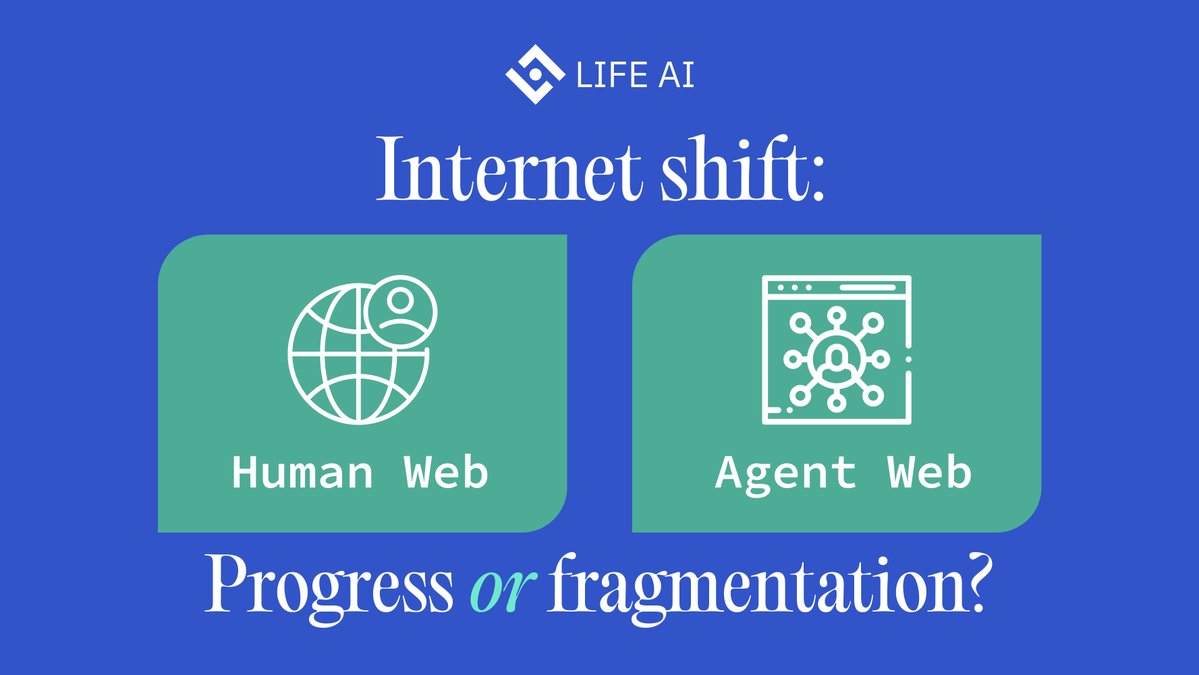
As the internet evolves to support autonomous AI agents, splitting into the Human Web (interfaces for people) and the Agent Web (API-driven infrastructure for machines), will this shift drive innovation and automation, or fragment and dehumanize the online experience?
Viewpoint A: A New Layer of Internet Intelligence
The rise of AI agents interacting directly with digital systems could transform the internet into a more intelligent infrastructure. Agents can automate tasks such as trading, payments, data analysis, and content generation, enabling a new agent economy. This machine-to-machine coordination may significantly improve efficiency, scalability, and innovation across industries.
Viewpoint B: Erosion of the Human-Centered Web
Expanding the Agent Web may reduce the role of the Human Web, as machines increasingly interact through APIs rather than human interfaces. This could create privacy and security risks, weaken traditional web models, and concentrate power in automated systems, potentially leading to a fragmented internet with less authentic human participation.
👇 Drop A or B and share your perspective
🌐 Community Question:
As the internet evolves to support autonomous AI agents, splitting into the Human Web (interfaces for people) and the Agent Web (API-driven infrastructure for machines), will this shift drive innovation and automation, or fragment and dehumanize the online experience?
Viewpoint A: A New Layer of Internet Intelligence
The rise of AI agents interacting directly with digital systems could transform the internet into a more intelligent infrastructure. Agents can automate tasks such as trading, payments, data analysis, and content generation, enabling a new agent economy. This machine-to-machine coordination may significantly improve efficiency, scalability, and innovation across industries.
Viewpoint B: Erosion of the Human-Centered Web
Expanding the Agent Web may reduce the role of the Human Web, as machines increasingly interact through APIs rather than human interfaces. This could create privacy and security risks, weaken traditional web models, and concentrate power in automated systems, potentially leading to a fragmented internet with less authentic human participation.
👇 Drop A or B and share your perspective
🩺 Community Question: Is the “AI five layer cake” framework sufficient to power healthcare AI systems?
(The “AI five layer cake” framework: Energy → Chips → Infrastructure → Models → Applications, introduced by Jensen Huang of NVIDIA)
Viewpoint A: Yes
Healthcare AI aligns with the stack. Energy, chips, and infrastructure enable intelligence generation at scale. Medical models, trained on clinical and biomedical data, interpret complex signals; applications then deliver value through radiology assistance, drug discovery, and clinical workflow automation.
Viewpoint B: Not entirely
The stack shows how capability is produced, but impact depends on translating that capability into clinical use. Strict validation, regulation, and the need to integrate with hospital workflows slow translation; consequently, healthcare applications often scale more slowly than the underlying AI stack.
👇Drop A or B and share your perspective
🩺 Community Question: Is the “AI five layer cake” framework sufficient to power healthcare AI systems?
(The “AI five layer cake” framework: Energy → Chips → Infrastructure → Models → Applications, introduced by Jensen Huang of NVIDIA)
Viewpoint A: Yes
Healthcare AI aligns with the stack. Energy, chips, and infrastructure enable intelligence generation at scale. Medical models, trained on clinical and biomedical data, interpret complex signals; applications then deliver value through radiology assistance, drug discovery, and clinical workflow automation.
Viewpoint B: Not entirely
The stack shows how capability is produced, but impact depends on translating that capability into clinical use. Strict validation, regulation, and the need to integrate with hospital workflows slow translation; consequently, healthcare applications often scale more slowly than the underlying AI stack.
👇Drop A or B and share your perspective


![GRMNetwork_M's tweet photo. GramNetwork: Decentralized Protocol Whitepaper 👷♂️
GramNetwork The Mining Framework (44% Allocation)
The 220 million $GRM Live
[Q1 - Q2 2026] --------> [2026] ---------> [Q4 2026+]
Testnet Launch Mainnet Genesis Official Token Listing
Smart Contract Audits Mining Distribution TGE & CEX Integration,
#GramNetwork](https://pbs.twimg.com/media/HKOfCU_aAAAzP-P.jpg)