I love that a Black woman is responsible for this. 😂
Shout out to @RepBeatty for filing the lawsuit to get Trump‘s name removed from the Kennedy Center
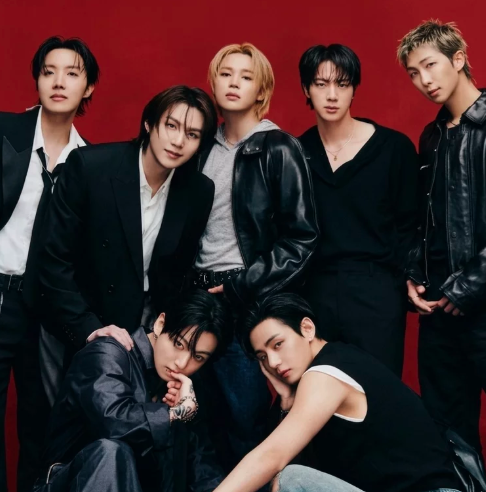
“No. 29” by BTS is one of the biggest song debuts on Global Spotify in 2026, with 6.50 MILLION streams, despite having no lyrics.
— It surpasses all K-pop debuts this year, excluding themselves.
My Letter to the Korean Music Critic Who Downplayed BTS's AMA Triumph
Two days ago, when I wrote my post about BTS's victory at the American Music Awards, I had no idea that a Korean music critic, someone prominent enough to serve on the selection committee for the Korean Music Awards (KMA), had publicly disparaged BTS's Artist of the Year win.
He argued that the AMA is no longer one of the three major music awards ceremonies in the United States. And that it has lost much of its prestige and influence. He also claimed that because the winners are determined by fan voting, the AMA should not be taken seriously.
He even suggested that BTS was the only major artist who attended the ceremony while other big names stayed away. The critic's view: because they don't give a hoot about the AMA.
He never explicitly said that BTS's victory meant nothing. But by dismissing the AMA itself so thoroughly, the implication was difficult to miss.
This was not the first time I had encountered this sort of reaction. Back in the late 2010s, when some Korean journalists and online writers downplayed BTS's achievements, I often reached out to them through email or social media messages to offer a different perspective. In one case, we ended up exchanging many thoughtful replies back and forth, and over time, I felt that some of his views on BTS began to change.
As many of you know, even when I strongly disagree with someone, I try to remain polite, reasonable, and emotionally grounded. That was the approach I took then, and it was the approach I took again this time.
After obtaining the critic's email address, I wrote to him and respectfully explained why I disagreed with his assessment.
I want to share that letter with you because some of the points I raised may be of interest, particularly the history and original purpose of the American Music Awards, which many younger fans outside the United States may not be familiar with.
I wrote to him in Korean, and below is my own translation of the letter:
Dear Mr. Jung Min-jae,
Hello. I am an educator living and working in Seoul. I am well aware that you have received your share of criticism from ARMYs. However, I am writing not out of hostility, but out of a genuine desire to have an open and constructive conversation.
I would simply like to offer a different perspective on some of the points you raised regarding the American Music Awards.
First, you argued that the AMA is no longer one of America's three major music awards shows and that it has lost much of its former prestige and influence. As someone who spent his youth and college years in the United States, I see things differently. For people like me, the AMA and the Grammys were, and still are, the two pillars of American music awards. The Billboard Music Awards did not enter the public consciousness in a major way until much later.
At least before the 2010s, the Grammys carried a reputation for being overly conservative and establishment-minded. To be frank, many people considered it somewhat dull. The AMA, by contrast, was always the fun one. It was energetic, accessible, and unapologetically fan-oriented. Personally, I have rarely watched the Grammys except in years when BTS received nominations. Yet from my youth until I moved back to Korea, I watched the AMA every single year without fail.
When Dick Clark created the AMA in the early 1970s, he did so as an alternative to the Grammys. The Grammys still operate through a system in which nominees are selected by committees and winners are chosen by voting members. Many of those committee members and voters are older industry insiders, and historically they have been disproportionately white and male. That has long been the nature of the institution. The AMA, on the other hand, was built from the beginning around the idea that music fans and the general public should have a meaningful voice.
In fact, I spoke with my friends in the United States about this issue yesterday. Every one of them still considers the AMA and the Grammys to be the two most iconic music awards shows in America.
For those reasons, I hope you will not take the opinions of some Americans who dismiss the AMA because BTS, a foreign group, won the award (you even reposted one such tweet) as evidence that the AMA has somehow become irrelevant.
You also argued that because AMA winners are ultimately determined through fan voting, the awards should not be taken too seriously. I would respectfully disagree.
The AMA nomination process is not a simple popularity contest. Nominees are selected based on a wide range of objective metrics, including album sales, radio airplay, streaming figures, and other measurable indicators of public engagement. Fans then vote among those nominees to determine the winners.
Music, perhaps more than any other art form, is powered by fans. Fans buy albums. They call radio stations to request songs. They organize streaming parties. They purchase concert tickets and fill arenas. Given that reality, it seems entirely reasonable for a music awards show to reflect the voices of the people who sustain the industry.
The same principle applies even in classical music. No matter how extraordinary a musician may be, their work ultimately depends on audiences. The reason pianist Yunchan Lim sells out concert halls around the world is because he has earned the admiration of countless music lovers. After becoming the youngest winner in the history of the Van Cliburn International Piano Competition at just eighteen years old, he captivated audiences globally and built a devoted following.
For that reason, I believe the AMA is one of the awards shows most closely aligned with how popular music actually functions today. In many ways, the Grammys represent an older model. The AMA does not. That is why I do not believe its influence will fade anytime soon.
Finally, you pointed out that BTS attended the ceremony while many other major artists did not. But the same has always been true of the Grammys. Every year, numerous high-profile artists skip the event, even when invited. That is hardly unusual.
More importantly, who is the most popular and influential music act in the world right now?
In my view, the answer is BTS.
And BTS showed up.
It is comparable to the Beatles attending an awards show in the 1960s or Michael Jackson attending one in the 1980s. The presence of the Beatles alone was enough to give an event significance and prestige. The same logic applies here. The fact that BTS chose to attend demonstrates that the AMA remains a meaningful and influential platform.
As a music critic, I am sure you understand better than most what it means for an artist from a non-English-speaking country to win an American music award of this magnitude.
You know how extraordinarily difficult it is.
You know the barriers that must be overcome.
And you understand what such an achievement symbolizes, not only for the artist but also for the broader cultural landscape.
That is why I cannot help but wish that more attention had been given to that larger cultural significance and value, instead of focusing on whether the AMA has lost prestige or influence.
Thank you for taking the time to read my thoughts. If the opportunity ever arises, I would be more than happy to hear your perspective and any rebuttal you may have. My feeling is that you and I probably have far more in common than we do in disagreement. Above all, we both care deeply about music.
I wish you good health and all the best.
hearing steve aoki casually explain bts’ trajectory, call this their third wave, and acknowledge they were already huge before the west caught up…that’s what real industry respect looks like. people who actually know ball know exactly what bts are.
one of my most favorite clips of seokjin hasn’t been on the timeline lately and i’m hellbent on changing that so here’s seokjin at war with toddler taeha