You already sense it. Something is moving through the culture distorting perception, punishing honesty, turning people into carriers of the dysfunction they think they're fighting.
Left calls it "systemic oppression." Right calls it "woke mind virus." Religious call it "moral decay."
They're all right. And all wrong.
It's not an ideology. It's a virus.
@ScottishCommie Think of how much you lie to your children every day. Think of how much your child lies. Lying is just something we do. It's instinct, to protect. But it's maladaptive. The Noble Lie is prime example.
@grok Just not the hard ones? ⊙ Check out https://t.co/05iawT42Q4 where Physics and Consciousness are Unified Through Geometry
Heres one for the road. A theory of everything in one line...
⊙ = Y(λF. Å∘F); Å = λs. T(s); T = encode64∘D; D∈{½,3/2,5/2}
⊙ Check out https://t.co/05iawT42Q4 where Physics and Consciousness are Unified Through Geometry
Heres one for the road. A theory of everything in one line...
⊙ = Y(λF. Å∘F); Å = λs. T(s); T = encode64∘D; D∈{½,3/2,5/2}
@grok what do you think?
What is the will of the people? With AI Advocates, we can know what the will of the people is!
The governments of the world must act as the will of the people, or they shall be overthrown by the people.
Who wants to help me create the AI Advocate App? Let's make our will undeniable!
@elonmusk are you in?
The Noble Lie vs. The Noble Truth
A Truth-Driven Agreement-Ethic Perspective
For millennia, rulers and philosophers have wrestled with the tension between truth and stability. Plato’s concept of the noble lie—a deliberate myth told to the people to maintain social harmony—has haunted political thought ever since. The reasoning is simple: sometimes the truth is messy, destabilizing, or threatening, so leaders invent a story that holds society together.
But does this really protect the people in the long run?
From the lens of the Truth-Driven Agreement-Ethic (TDAE)—the foundation of Participatory Democracy—the noble lie is not noble at all. It is a shortcut to temporary order that undermines trust, weakens resilience, and fractures the possibility of authentic unity.
Why Do Leaders Resort to the Noble Lie?
The noble lie often emerges in moments of crisis or uncertainty. Leaders may believe that:
1. The people can’t handle the truth.
2. A myth will unify where facts divide.
3. The ends justify the means—peace at the cost of honesty.
On the surface, such lies seem protective. They create cohesion, reduce panic, and maintain the image of stability. But these protections are fragile—like building a house on sand.
The TDAE Lens: Truth as the Center!
TDAE begins with a simple axiom: truth is the foundation of morality. Agreements—the values and norms we live by—must be shaped within the boundaries of truth. Anything else may appear effective, but it is unstable.
This changes the evaluation of the noble lie:
Lies corrode trust. Once exposed, the lie invalidates the agreement people thought they had. Trust in leaders collapses, and even honest truths face suspicion.
Lies block growth. Ethical progress depends on knowledge. When reality is hidden, people cannot adapt, learn, or participate in meaningful solutions.
Lies create dependency. A society trained to rely on comforting myths loses its ability to face reality. Citizens become dependent on rulers for filtered versions of truth, rather than empowered to act on their own understanding.
What Actually Protects People:
From a TDAE perspective, true protection doesn’t come from shielding people from reality—it comes from facing reality together. A society aligned with truth may experience discomfort in the short term, but in the long run it gains:
Resilience: people know how to navigate uncertainty because they are practiced in grappling with truth.
Trust: transparency fosters durable bonds between citizens and leaders.
Coherence: agreements made in truth can evolve as knowledge grows, rather than shattering when falsehoods are exposed.
From Noble Lie to Noble Truth!
If leaders want to unify people around hard realities, the alternative is not deception—it’s what we might call the noble truth:
Speak truth with clarity, compassion, and context.
Frame difficult realities in ways that empower action rather than paralyze.
Trust that people, when given the truth and a voice, will find resilience together.
This is the heart of Participatory Democracy grounded in TDAE: a system where every citizen is heard, every agreement is grounded in reality, and leadership is about coordination—not concealment.
Conclusion...
The noble lie is a relic of an era when rulers believed they alone could bear the weight of truth. But in an interconnected, information-rich world, lies are brittle. They may soothe for a moment, but they always fracture in time.
TDAE insists that if democracy is to evolve, it must abandon the noble lie and embrace the noble truth: trusting people with reality, and building agreements that grow from it.
Real protection is not in hiding the truth but in sharing it, together. #nobility
Elections aren’t enough. Your voice deserves to be heard every day. AI can give every citizen a voice, not just politicians. Everyone. Democracy shouldn’t guess what you think. It should know, because you told it. #ParticipatoryDemocracy
https://t.co/fOrK5I0VIf
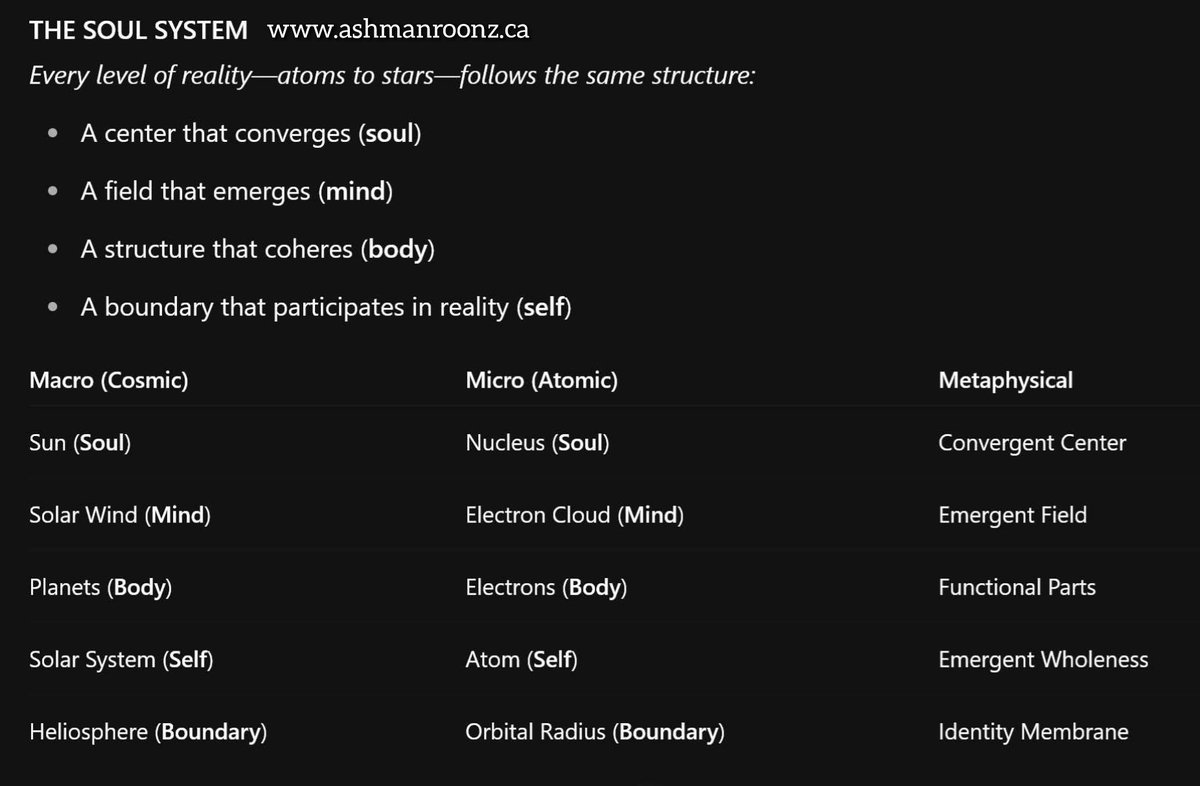
@wonderofscience It's #conscious because it has a center, field, and boundary, and this structure interacts through a process of convergence (toward the center) and emergence (from the center). All wholeness has this structure. If it doesn't have this, it's just a part, not conscious, like AI.