The Flash of Awareness: Even a Sneeze Can Open the Door to Enlightenment — #Osho
The first technique:
At the start of sneezing, during fright, in anxiety, above a chasm, flying in battle, in extreme curiosity, at the beginning of hunger, at the end of hunger, be uninterruptedly aware.
It looks so simple: at the start of sneezing, during fright, in anxiety or before hunger or after hunger, be uninterruptedly aware.
Many things have to be understood. Very simple acts like sneezing can be used as devices, because howsoever simple they look, they are very complex, and the inner mechanism is a very delicate thing.
Whenever you feel that a sneeze is coming become alert, and the sneeze may not come at all. It may simply disappear, because a sneeze is a non-voluntary thing – unconscious, non-voluntary.
You cannot sneeze voluntarily; you cannot “will” it. How can you? How helpless man is! You cannot “will” a single sneeze. Howsoever you may try, you cannot bring it out. A single sneeze – such a small thing, but you cannot will it. It is non-voluntary; volition is not needed. It does not happen because of your mind; it is because of your total organism, your total body.
And the second thing: when you become alert, when the sneeze is coming – you cannot bring it, but when it is coming – if you become alert, it may not come, because you are bringing something new to the process: the alertness. It may disappear, but when the sneeze disappears and you are alert, there is a third thing.
First, a sneeze is non-voluntary. You bring in a new thing –alertness. When the alertness comes, the sneeze may not come. If really you are alert, it will not; it may not happen at all.
Then a third thing happens. The energy that was going to be released through a sneeze, where does it move? It moves to your alertness. Suddenly there is a flash, a lightning. You become more alert.
The energy, that was going to be thrown by the sneeze moves into alertness. Suddenly you become more alert.
In that flash, in that lightning, even enlightenment is possible.
That is why I say that these matters are so simple, they look absurd. Their promise seems to be too much. Just through sneezing, how can one become enlightened?
But sneezing is not just sneezing; you are totally involved in it. Whatsoever you do or whatsoever happens to you is a total involvement.
Observe again: whenever a sneeze happens, you are totally in it with the whole body, the whole mind. It is not just your nose in which the sneeze is happening; every fiber, every cell of your body is involved in it.
A subtle trembling, a subtle wavering goes all over the body, and with it the whole body becomes concentrated. And when the sneeze has happened, the whole body relaxes.
But it is difficult to bring alertness to it. If you bring alertness to it, it will not happen, and if it happens you can know that the alertness was not there. That is why you should be alert.
Osho
The Book of Secrets, Vigyan Bhairava Tantra, Chap #41: Tantric Methods for Awareness and Non-Judgement https://t.co/YW98Rqj9uR
Krishna: The Joyful Mystic of a Life-Affirming Future — #Osho
If a man has to think, understand, and say something, for him there can be no more meaningful a topic than Krishna. He is the most significant person in all of history.
It is not that other significant people did not happen in the past – and it would be wrong to say that significant people will not happen in the future; in fact, any number of remarkable people have walked this earth – but Krishna’s significance is quite different. He is more significant for the future than for the past.
The truth is, Krishna was born much ahead of his time. All great persons are born ahead of their time, and all insignificant people are born after their time. It is only mediocre people who are born in their time.
All significant people come ahead of their time, but Krishna came too far ahead. Perhaps only in some future period will we be able to understand him; the past could not do so…
In the whole galaxy of religious luminaries Krishna is the sole exception who fully accepts the whole of life on this earth. He does not believe in living here for the sake of another world and another life. He believes in living this very life, here on this very earth. Where moksha, the freedom of Buddha and Mahavira, lies somewhere beyond this world and this time – there and then – Krishna’s freedom is here and now. Life as we know it never received such deep and unconditional acceptance at the hands of any other enlightened soul…
But in the context of times to come, Krishna will be increasingly relevant and meaningful. And soon such a religion will come into being that will sing and dance and be happy. The religions of the past were all life-negative, defeatist, masochistic and escapist.
The religion of the future will be life affirming. It will accept and live the joys that life brings and will laugh and dance and celebrate in sheer gratitude…
An unhappy person, a person ridden with sorrow and pain, escaped into sannyas. Sannyas stemmed from unhappiness and not from happiness. No one comes to sannyas with a song in his heart.
Krishna is an exception to the rule. To me he is that rare sannyasin whose sannyas is born out of joy and bliss. And one who chooses sannyas for the joy of it must be basically different from the general breed of sannyasins who come to it in misery and frustration…
To me, Krishna is a sannyasin of bliss. And because of the great possibility and potential of the sannyas of bliss opening up before us, I have deliberately chosen to discuss Krishna. It is not that Krishna has not been discussed before. But those who discussed him were sannyasins of sorrow, and therefore they could not do justice to him.
Osho
Krishna: The Man and His Philosophy, Chap #2: Krishna Is Complete and Whole https://t.co/YW98Rqj9uR
ஆன்மிகம் என்றால் உலகத்தை விட்டு ஓடுவது அல்ல. காதல், மகிழ்ச்சி, நடனம், இசை, போர், பொறுப்பு—வாழ்க்கையின் அனைத்தையும் ஏற்றுக்கொள்வது.
கிருஷ்ணன் போல...
--ஓஷோ
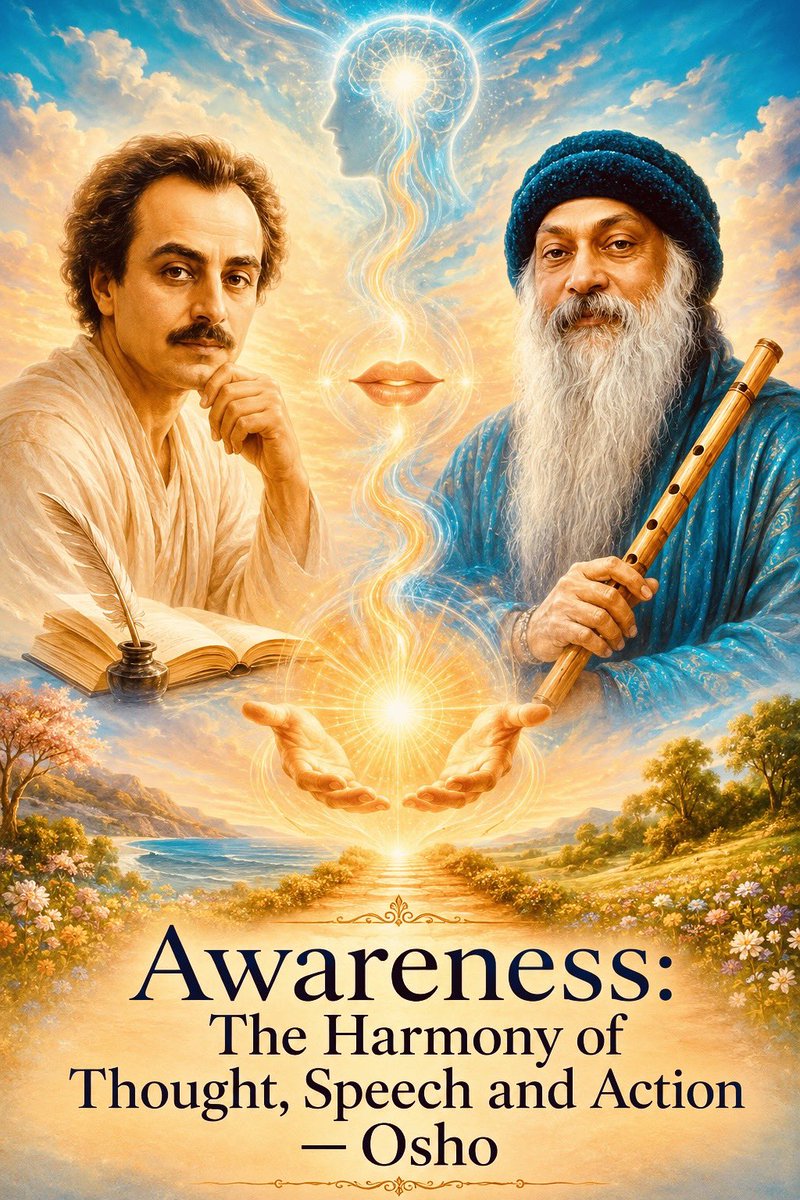
Awareness: The Harmony of Thought, Speech and Action — #Osho
Kahlil Gibran says:
“You are good when you are fully awake in your speech.”
Something about speech has to be understood. There is a certain harmony between your thought, between your speech and between your action. Speech is just in the middle. Before speech is thought – thought is words unspoken, still in the womb.
When thoughts are born into the world they become speech, and if your thought and speech are harmonious they will still go one step more, and that will be action. And when all these three are together, not against each other – only in your awareness is it possible that whatever you think you say, and whatever you say you act.
Your action is your innermost thought brought into full daylight, before the world. It is exposing your heart.
Speech is the medium between thought and action. That’s why he has chosen speech – that if you are fully awake in your speech you are good – because if you are awake in your speech you will need to be awake in your thought, because thought is potentially speech. It is just on the verge, the word is just on your lips.
You cannot be aware about your speech if you are not aware of your thoughts. And if you are aware of your speech, you will be aware of your action too.
Action and thought are almost like two wings. Speech is exactly the middle part. And one who is standing in the middle, fully awake, can see on both sides; he can see inside where thought arises and he can see outside where action is born.
“You are good when you are fully awake in your speech”, in your thought, in your action. This is the greatest criterion ever given to man by all the mystics of the world: awareness of all that goes on inside the mind, of all that goes on in your words, and of all that becomes action – it is good.
Ordinarily people think they have been forced to think that good or bad are qualities of things – that there are good things and there are bad things. That’s not right; good and bad have nothing to do with things.
Awareness is good; absence of awareness is not evil, it is simply not-good. Don’t make them synonymous. “Not-good” is only a negative statement; the moment you say, “Evil, bad,” you are making a positive statement. The same action, with awareness, may be good, and with unawareness may not be good.
Goodness is not a quality of things or actions. It has something to do with your meditation. It has something to do with your awakening, with how alert you are…
Action with awareness is good, but action without awareness is not evil, it is simply not-good. This distinction has to be remembered, because the not-good can be immediately transformed into good: it is only a question of awareness…
Existence cannot speak directly to you, it needs some vehicle, it needs some hollow bamboo to become a flute. Then the lips of existence can create a beautiful song and music. But the “hollow bamboo” means, you are so aware that there is no ego in you. Ego exists only in the dark corners of your being. When awareness is total, ego disappears.
Osho
Reflections on Kahlil Gibran’s The Prophet, Chap #34: Only a Question of Awareness https://t.co/YW98Rqj9uR
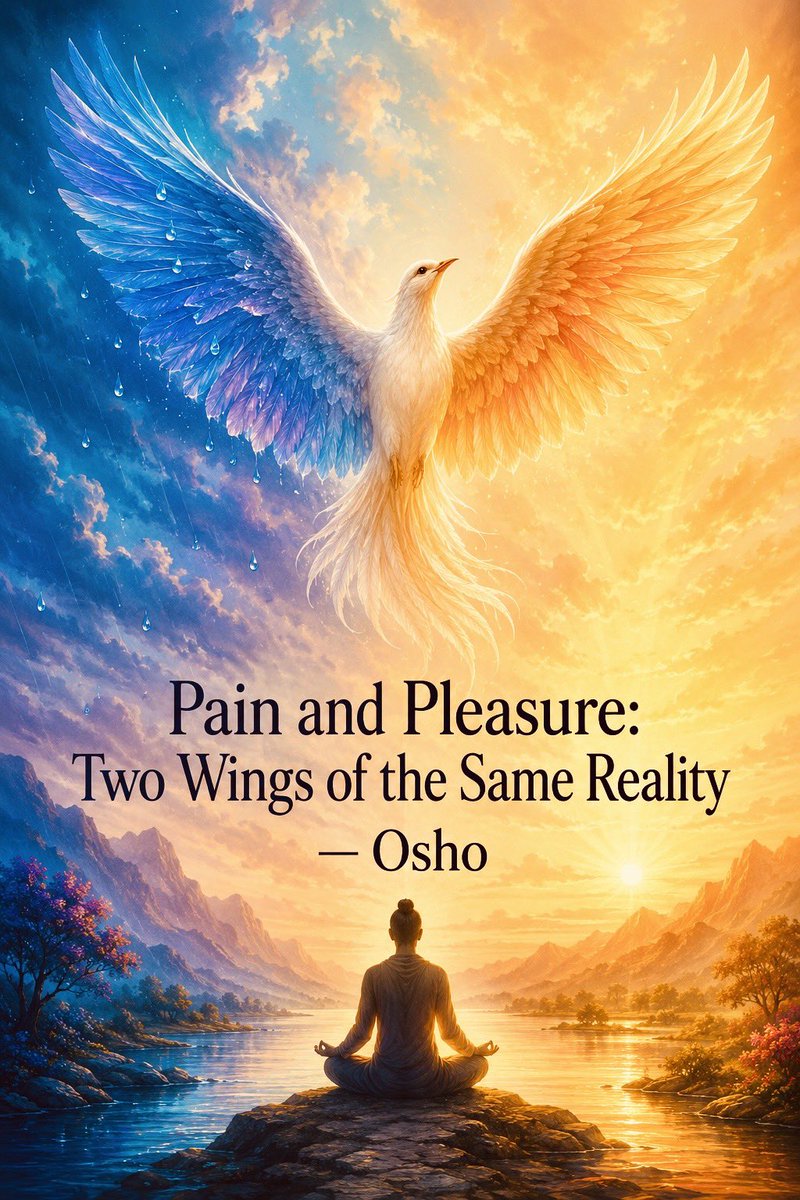
Pain and Pleasure: Two Wings of the Same Reality — #Osho
Pain and pleasure go together like night and day, like birth and death, like love and hate.
In a better world, with a more developed language, we will not use words like hate and love, anger, compassion, day, night.
We will make some words which will carry both together: lovehate – one word; daynight – one word, not two; birthdeath – one word, not two; painpleasure – one word, not two.
The language creates an illusion. In language pain is separate, pleasure is separate. If you want to look in the dictionary for pain, you have to look for pain; pleasure will be separate. If you want to look for pleasure, then you have to look for pleasure.
But in reality pain and pleasure are together, just as your right and left hands are together, just as two wings of a bird are together.
The dictionary creates a great illusion; language is a very great source of illusions. It says “love,” and when it says “love” you never think about hate.
You completely forget about hate, but love cannot exist without hate. That’s why you love someone and you hate the same person.
Osho
Dancing in the Breeze, Chap #2: Pain: Accept It, Welcome It https://t.co/YW98Rqj9uR
#Osho
Meditation is a twenty-four-hour thing. It is not that you do it once a day and you are finished with it. It has to become your flavor, it has to become your climate. It should surround you wherever you are, whatsoever you are doing.
Osho
The Diamond Sutra, Chap #1: The Realm of Nirvana https://t.co/YW98Rqj9uR
Watchfulness: The Shortest Way to Enlightenment — #Osho
Questioner:
I understand that the people I dislike often reflect qualities in myself that I resist. Yet I still react and judge instead of watching myself. Is there any trick—or shortcut—to deepen my watchfulness?
(Editor’s Note: The question has been abridged for clarity; its original meaning has been preserved.)
Osho:
There is no trick and there is no shortcut because watchfulness is the shortest way to enlightenment.
And the question of tricks does not arise at all.
No trick can help you.
Tricks are good in playing cards and cheating people, but you cannot cheat existence, you cannot deceive life.
If you want to go a longer way, that can be found; because you can be shown some unnecessary, non-essential things and the path becomes longer.
Religions have done that. They have made the path very long, so that it cannot be achieved in one life, many lives are needed. It was a strategy of the priests to deceive people because if it is said that it can be achieved right now, then the question is why are you not achieving it, perhaps you don’t want it, perhaps you want to wait a little, perhaps you want to finish some other jobs first, perhaps you think that enlightenment should be the last thing in life. And the trivia, the mundane things of life, keep you engaged.
But there may be a few people who may try and still will not get it. Then the priest will be in trouble because he himself is as far away as you are. To be a priest is just a profession for him, he is not a seeker. And you may start asking him, “Why is it not happening?” And he cannot really answer you relevantly because he does not know himself what it is, what can prevent it, what can help it.
So the easiest way for him is to say, “It is such a long way. It will happen but in several lives. So don’t be in a hurry, it is not something that you can manage now. Go on working, go on praying; when the time is ripe in some life it will happen.”This was just a shelter for the priest.
Watchfulness is the shortest way. It does not need lives to attain it. It needs not length of time but intensity of longing, the way you feel thirst; when you feel thirsty for truth – as if it is a question of life and death – you put your whole energy to this moment and the door is bound to open.
And remember never to think of tricks because you cannot get anywhere through tricks as far as reality is concerned.
The simple truth is that watchfulness is the shortest possible way. It cannot be made shorter.
What is expected of you in watchfulness…just try to see, nothing is expected. You already watch things, you know what watchfulness is.
You watch a football match, you watch a movie, you watch the television.
You know what watchfulness is, there is no need to tell you; just the same watchfulness has to be applied to the screen of the mind.
Close your eyes and let your mind function as a screen of a movie or a television, and whatever passes on the mind you simply remain watchful, doing nothing, not even judging.
And this is the only miracle I know of, that as your watchfulness becomes more and more stable, the screen becomes empty. Soon the watcher is there but there is nothing to be watched, the screen is completely empty.
And when the watcher is left alone, it starts watching itself – because that is its nature, to watch.
And to watch oneself is the greatest happening in anyone’s life. Everything else happens through it – blissfulness, silence, peace, ecstasy, and finally going beyond even all these experiences and just remaining in a pure isness.
Those who have attained that pure isness have fulfilled the mission of human life.
Osho
The Transmission of the Lamp, Chap #23: Nothing but a Dead Skeleton https://t.co/YW98Rqj9uR
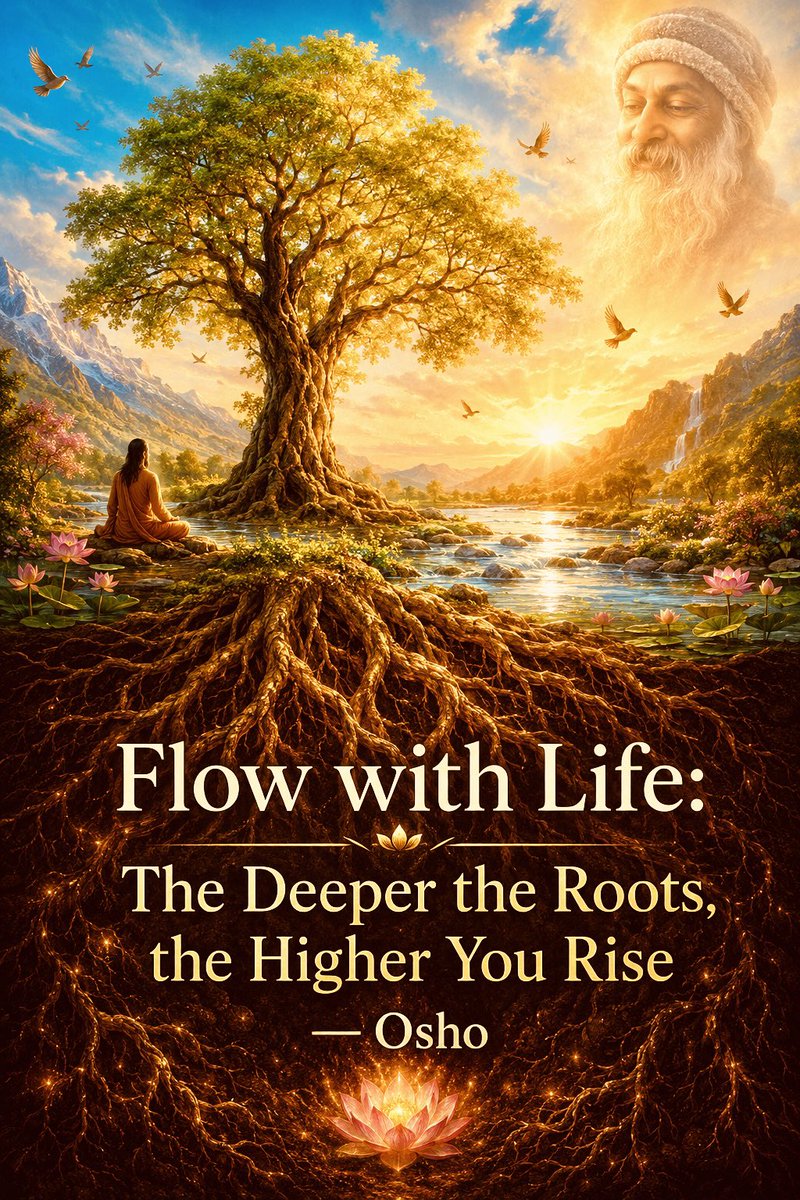
Flow with Life: The Deeper the Roots, the Higher You Rise — #Osho
Participant:
I felt some anxiety before doing the (Tao) group.
Osho:
How did you feel during and after the group?
Participant:
I went to the very depths of sadness. But I feel it has been good on the whole – the process has diffused a lot of things.
Osho:
Mm, you are looking very calm and quiet.
In fact anxieties never come true and we waste our lives thinking about them. Ninety percent of one’s fears never actualize…
Let that become an integrated understanding in you, so that next time, or whenever you are moving into a new thing, don’t start the anxiety again.
All anxieties are useless because the future is unknown. It never comes according to your expectations or fears. It has its own way of coming and it doesn’t ask you, so why be unnecessarily worried?
Wait and when it comes, see. Whatever you can do, do. Everybody is capable of doing things when they are needed. Life sends you absolutely prepared for any situation that is possible.
You could flow and when you flow, never ask only for highs because that is patent foolishness. If you ask only for highs, where will the depths go? If you ask only for happiness and you are afraid of sadness, how can you flow?
Flow means going into the depths, but going so totally that there is no resistance. Flow means going to the heights, but going so totally that there is no clinging. Flow means always remaining free to move: moving with life wherever it leads, whatever its unknown goal. Once you start fixing your goal against life, you are not flowing.
If life wants you to be sad, be sad – life knows more. If life wants you to weep and cry, then weep and cry – life knows more. Don’t start trying to be more clever than life itself; that is the human stupidity. Just flow with it.
Be like a small child who is following his father. Maybe the father is afraid of where he is going, but the child is happy and singing because he knows the father is with him and knows where they are going.
That is the beauty of the religious mind. I call that mind religious which trusts life and says, “Wherever it is going, it knows better than me. I have just come, a late arrival, and life has been always and always and always there.” Just trust it.
That is the whole meaning of the Tao group – to flow. If you have a choice, if you say you will not move into sadness, that you want only happiness, then you cannot flow.
Flow
is only possible
if you accept
everything as it is, unconditionally.
You could have gone deeper into it if there was not this little resistance about going into depth. Go into depth and you will come up; the deeper you go, the higher you rise.
It is exactly like the trees; the deeper their roots go underneath, the higher their branches rise into the sky. It is always in the same proportion.
If a tree doesn’t want to go deep, is afraid of the unknown earth – dark, mysterious, deathlike – then it cannot rise toward the sun.
This is the way all beings grow. A really mature person is always ready to move wherever life leads. This I call maturity – the understanding that life is greater than you, that you are just a tiny part of it.
Osho
Hammer on the Rock (A Darshan Diary), Chap #22: Life Is Greater than You https://t.co/YW98Rqj9uR
All HOPES are FALSE.
To hope is to be false.
Hope comes out of your falsity of being. If you are real there is no need for any hope. Then you never think about the future. You are so real, so authentic that the future disappears.
🌼 My Way The Way of the White Clouds
#OSHO 🪷
Life Has No Full Stop: Existence Is an Ever-Flowing River of Truth — #Osho
The future remains open. What seems inconceivable today, may become conceivable tomorrow.
We can never come to a point where the future closes. That’s the whole meaning of existence being eternal…
Things will go on happening, new things will go on being added. And I am not a pond which is closed; I am more like a river, which goes on flowing, inviting every other river to join.
Whatever I have been giving you will remain uncontaminated, but it will be enriched more and more by the future evolution of man, because it is an open phenomenon…
I am not the last prophet, messiah or savior of a certain tradition. I am the beginning, not the end, of a totally new approach to life and its problems, inviting everything conceivable, inconceivable, to be my guest…
Life knows no full stop, no semicolons; it simply goes on and on, and it will continue to add spices of which we are not even aware. And it is good…
Mohammed says, “I am the last messenger of God. Now there will be no other messenger. And the Koran is the last message. After the Koran there will be no other holy book.” He is not aware that he cannot stop existence with his own death.
Many prophets have come and gone. They have added to the beauty of existence, but nobody should be so arrogant as to say, “I am the last.”
The same is the situation with Mahavira. He is the last tirthankara of the Jainas. Now there is not going to be any other tirthankara, nothing can be added to his teachings, nothing can be taken away from his teachings.
But these people were not aware that they are making their vision into a dead thing with their own hands.
That’s why Christians are so afraid in case science should discover anything which goes against the Bible, Mohammedans are so afraid in case anybody should say anything that goes beyond the Koran. But these are the enemies of progress, enemies of life.
I am not. I am just a friend, a humble beginning, a living reality with every day new excitement, new ecstasies, new spaces; and capable to absorb them all, not afraid of any progress. If anything is wrong, I am always ready to drop it, always to be on the side of truth.
There are two kinds of people: those who want the truth to be always on their side – these are the egoists, arrogant.
And there is another type of person who always wants to be on the side of truth, whatever the cost; if he has to lose everything, he is ready, but he cannot stop being on the side of truth. These are the humble ones, these are the true holy people of the earth – and there have been very few.
Osho
The Transmission of the Lamp, Chap #23: Nothing but a Dead Skeleton https://t.co/YW98Rqj9uR
#Death Is the Door: Die Consciously, Be Born Awake — #Osho
To die an unconscious death is a great calamity, because you will not remember what has happened. You will not remember that death was a door into the divine. You will be carried through the door, but on a stretcher, unconscious. You have missed a great opportunity again.
That’s why we go on forgetting about our past lives. If you die consciously you will not forget, because there will be no gap, there will be a continuity.
You will remember your past life, and to remember the past life is of great import. If you can remember your past life you will not commit the same mistakes again. Otherwise you will go on moving in a vicious circle: the same cycle, the same wheel will move again and again.
You will cherish the same ambitions again and you will commit the same foolishnesses again, because you will think this is the first time you are doing them.
You have done them millions of times, but each time you died a gap appeared, because you were unconscious. You became discontinuous with your past. Then life starts from ABC again.
That’s why you cannot evolve into buddhas. Evolution needs a continuous awareness of the past, so that the same mistakes are no longer committed.
Slowly, slowly, mistakes disappear. Slowly, slowly, you become aware of the vicious circle; slowly, slowly, you become capable of getting out of it too.
If you die unconsciously, you will be born unconsciously, because death is one side of the door, birth is the other side of the same door. From one side the door says “Death,” from another side it says “Birth.” It is the entrance, it is the exit: it is the same door.
That’s why you were born, but don’t remember it. You don’t remember those nine months in the womb, you don’t remember your passing through the birth canal, you don’t remember the agony that you went through. You don’t remember your birth trauma, and that birth trauma goes on affecting you; your whole life will remain affected by your birth trauma.
That trauma has to be understood. But the only way to understand it is to remember it. But how can you remember it? You are so afraid of death, you are so afraid of birth, and that very fear prevents you from going into it…
We have been taught a very wrong philosophy: we have been told that death is against life. It is not. We have been told that death comes and destroys life. That is utter nonsense. Death comes and fulfills life.
If your life has been beautiful, death beautifies it to its ultimate. If your life has been a life of love then death gives you the maximum experience of love.
If your life has been a life of meditation then death will bring you to samadhi. Death only enhances. Of course if your life has been a wrong life then death enhances that too. Death is a great magnifier.
If you have lived only in anger then in death you will see just hell inside you, just fire. If you have lived in hatred then death will magnify hatred. What can death do? Death magnifies, it mirrors, but you are the culprit. Death is just a mirroring phenomenon…
Osho
Take It Easy, Chap #23: Breakfast Is More Important than Paradise https://t.co/YW98Rqj9uR
Respecting Your Parents: The Foundation of Right Conduct — #Osho
Gurdjieff used to say – in his institute in Paris he had written it on the walls in big letters – one motto:
“A Person Is Good Who Respects His Father and Mother.”
In the West particularly this seems absurd. And just this is the definition of a good man, “A person is good who respects his father and mother”?
What was he saying?
Remember that life is such that you are bound to hate your father and mother; every boy, every girl, has to hate. This is how it happens naturally, because the father has to say no to many things, the father has to discipline you, the father has even sometimes to be angry with you. He cannot allow you absolute freedom because that would be destructive to you. He has to force discipline, and the ego of the child is hurt; he starts hating.
Every man hates his father unless right conduct is taught from the very beginning; every girl hates her mother unless a right conduct is taught from the very beginning.
And if you cannot respect your father, you cannot respect anybody – then the whole possibility of respect is lost.
The father is the first point from where respect grows.
If you can respect your father, you will respect many people. If you hate your father, then all father figures will be hated.
If you hate your father, you will hate your teacher, because he is also a father figure. If you hate your father, you will hate anybody who is powerful. You cannot love God, because he is the father figure for the whole cosmos.
In the West, first the respect for the father disappeared, and then God was dead. It is not accidental that every religion says, “God, my father, the father of all.” It is not accidental, it is meaningful – but it has to grow from your own father.
If you respect
your father then
all father-figures
will be respected,
and ultimately
you can respect
the divine.
If you hate your mother then hatred will become the very base of your life, because the first love has to be learned through the mother. You cannot love a wife if you have hated your mother, because the wife is a woman, and one who hates his mother hates women. And the mother will follow you like a dangerous shadow – every time you look at a woman, the mother will be present there.
Really, every woman is a mother, essentially a mother. You cannot love a woman if you hate your mother. Really, you cannot love at all.
Gurdjieff was right; this is the definition of a good man – that he respects his father and mother.
This is impossible. Remember, this is not easy. It is one of the most impossible things to respect the father and mother; to respect one’s parents is one of the impossible things in this world.
False respect is not meant, just hypocrisy is not meant, but a real respect. That was taught; that was called right conduct.
Respect and love
were taught,
many other things
were taught.
Right conduct means to be always happy, blissful in your behavior, to be refined, gentle, to not hurt anybody in any way – because this then becomes the pattern.
Right conduct helps you grow, and it helps you avoid unnecessary problems, unnecessary crises.
You create many problems unnecessarily, and in those problems and in solving them you waste energy, time – you waste everything. A small problem can become destructive to your whole life.
Right conduct means moving in this world in such a way that there is no conflict with others, no conflict arises; moving in this world in such a way that you don’t create unnecessary enemies – the very way you behave creates friendship. This is good for you.
Osho
Vedanta: Seven Steps to Samadhi, Chap #6: With the Grace of the Sages https://t.co/YW98RqjHkp
The More Grateful You Become, the More Grace Descends — Osho
The first stage is the stage of feeling, feeling that Brahman surrounds you, everywhere is Brahman. And remember, the seeker has to start from the feeling, from the heart, because only the heart can be the base. The heart is the base of your body, and the heart is going to be the base of your divine body also…
When you are in love, close your eyes and feel where your feeling has its center. It can never be in the head; it is impossible. It can never be anywhere else – it will be just in the heart.
The heart is the base of your body, and it is going to be the base of your higher body also. That’s why the Upanishads say that the first stage is of feeling. Thought is not denied, thought has to take its own place – but that is the second stage…
Right meditation means a moment where mind ceases, you have become one energy – but not moving towards the other, not moving in any direction, but simply remaining in yourself. That will become samadhi.
Meditation moving towards the other becomes a sexual act; meditation moving nowhere, remaining inside, becomes samadhi. These things are for the second stage…
Whatsoever you do will need much visible and invisible help. Sometimes you may not be even aware, but many currents of help are around you, helping you; many sources are just pouring down upon you.
You will become aware only in the end when you have achieved. Then you will see that you have to thank the whole universe.
Just think: if Buddha was not there, if he had not happened, if Jesus was not there, if he had not happened, if the Upanishads were never written, if Lao Tzu had not accepted to write down the Tao Te Ching, if there was no Bible, no Koran, no Vedas, where would you have been? You would have been just in the trees, you would have been monkeys.
The whole universe has been helping you to grow – known, unknown sources. You may not be aware, but invisible vibrations are in the atmosphere.
Once Buddha is there, the human consciousness can never be the same again. We may forget him completely, we may not even know his name – because many buddhas have been there and we don’t know their names, they were never recorded – but they are there, invisible sources helping you.
And when you grow to your totality, then you will become aware that thousands and thousands of hands have been helping you.
That’s why Hindus depict their God with a thousand hands. And you are such a problem that two hands cannot do – thousands even are not of much help. With the grace of the scriptures, with the grace of the master, the guru, with the grace of all the sages, you will achieve.
At the second stage this has to become a deep seed within you – the gratitude to all and everything. Even those who have wronged you have also helped you.
Gratitude at the second stage will help you much. And if you become aware, fully alert about this gratitude, then more help will become available. The more you feel the grace and feel thankful, the more grace becomes available to you.
Osho
Excerpts from:
Vedanta: Seven Steps to Samadhi, Chap #6: With the Grace of the Sages https://t.co/YW98Rqj9uR
Truth Needs No Argument: When Logic Meets Love — #Osho
Truth is naked. Its very presence is enough to convince you. And if truth can not have self-validity and depends on arguments, it is not truth. Arguments may change. Somebody may be more logical than you are.
I am reminded of one great logician, Keshav Chandra. Perhaps in this past century in India there has been nobody else with such a sharp mind and with such perfect arguments. He lived in Calcutta, at the time when Ramakrishna was also living outside Calcutta.
Keshav Chandra had a small following of intellectuals, but they were all puzzled: “Thousands of people go to Ramakrishna…that idiot! He’s uneducated, he cannot even make his signature. Why are these people going to this madman?”
Finally, Keshav Chandra could not resist the temptation to go and see with his own eyes – and he knew that a few arguments would finish this man forever.
He sent a challenge saying, “I want to argue with you. When can I come?”
Ramakrishna said, “Keshav is coming? There is no need to postpone; today is as good as any day. Go back and tell him: Come, and argue as much as you can!”
Keshav Chandra had forgotten. In giving the challenge, he had said, “I want to argue with you,” but if the other person simply listens and tells you – “argue!”…. You cannot force somebody to argue. But Keshav Chandra had no idea, because he had never come across such a man.
He went to Dakshineshwar where Ramakrishna used to live in a temple. His disciples were very much afraid. They knew – Keshav Chandra’s arguments are like spears, they go directly to the heart. They can kill a man.
And Ramakrishna is so simple…perhaps he does not understand the meaning of argument. Perhaps he does not understand the meaning of the challenge. But from the side of Ramakrishna – he was coming out of the temple again and again and asking, “Keshav has not come?”
Finally, Keshav Chandra came with a group of his intimate followers. Ramakrishna hugged him, although he could not respond to Ramakrishna’s hug; he was withdrawing backward.
Ramakrishna said, “Keshava, you don’t know how to hug people? You know only how to argue? You are missing much that is valuable – human warmth, human love – but it is good that you have come. I am so happy, I have always wanted to listen to your arguments.”
Keshav Chandra could not make any sense of it. He started: “There is no God.”
Ramakrishna said, “What a beautiful statement! Can I hug you again?” And he hugged him again.
Keshav was feeling very embarrassed. His following was feeling very embarrassed – what is happening?
And Ramakrishna said, “Did you receive my answer or not?”
Keshav said, “You have not said anything. You have simply hugged me.”
Ramakrishna said, “That is a way of saying things which cannot be said. You said, ‘God does not exist.’ And I say you are the proof that God exists; otherwise, from where such beautiful intelligence?”
Now, how to argue with such a man?
After ten minutes, Keshav Chandra was at the feet of Ramakrishna – “Just forgive me, I had no idea of a man who is not in the mind but in the being. You have made it clear to me. You are not a man of logic, you are a man of love – but love is far higher, logic is mundane. Please accept me as one of your disciples.”…
The West has produced only philosophers. The East knows nothing of philosophy, it knows only mysticism. And mysticism is based on the simple phenomenon that experience needs no argument.
Experience is its own validity.
Go inward. Find your inner space, and suddenly, you will find an explosion of light, of beauty, of ecstasy – as if suddenly thousands of roses have blossomed within you and you are full of their fragrance.
Osho
Sermons in Stones, Chap #28: The Full Stop Never Comes https://t.co/YW98Rqj9uR
When Devotion Blossoms, Meditation Follows — Osho
A Meera dances and she enters meditation; she has never learned any techniques of meditation. A Chaitanya does his kirtan, devotional singing and dancing, and he just slips into meditation. He has no notion of meditation: “What? Meditation?”
A very interesting incident once happened in Chaitanya’s life. He heard that a great yogi was camping near the village, and that people were going to him to learn meditation.
Chaitanya thought: “I too should go to this yogi to learn meditation.”
But he was really amazed because when he arrived there the yogi fell down at Chaitanya’s feet!
Chaitanya said, “What are you doing? I have come to learn meditation from you! I have heard that many people come to learn meditation from you so I thought that I should also come to learn.”
The yogi answered, “If you wanted to learn meditation, then you should have come before devotion happened to you. You are already in meditation, but you are not even aware of it!”
The devotee does not know that he is in meditation because, to him, meditation is a by-product; it follows him. It is there as a spontaneous outcome of his trust and devotion.
And the very last thing is Yoga. When one has mastered meditation, Yoga will follow on its own. But everyone does just the opposite: people start with Yoga and then they practice meditation. Then they think they can, in some way, bring devotion in by manipulating things this way and that, and they expect to somehow find trust in the end.
But when a person’s mind slips into meditation, then his body will move into Yoga. Yoga is a happening in the body, and meditation is a happening in the mind…
Understand it in this way: trust is cosmic, it is a sense of the whole; devotion is something of the soul, a sense of the individual. Meditation relates to the mind, Yoga relates to the body…
If the mind has entered meditation, the body will enter Yoga on its own. Many people come to me and report: “When we meditate, all kinds of body postures start happening on their own, and we have no idea what is happening.”
Yes, they will happen. When the mind changes through the inner state of meditation, the body will have to change its state immediately and adjust itself according to the mind...
Osho
Flight of the Alone to the Alone, Chap #2: Knowing Existence https://t.co/YW98Rqj9uR
•CELEBRATION•
The utilitarian life is necessary but at a great cost: you have lost the festivity of life.
Religion means transforming life into a celebration. The dimension of religion is the dimension of the festive, the nonutilitarian.
🌼Meditation TheArtofEcstasy
#OSHO 🪷