@AugustinGithaka Evidence is everything. I was once told that the govt steals 50% of the budget. The guy was so sure about it that he flatly refused to justify his allegation. At least give logical evidence.
@elmwangii We shouldn't copy Addis. We should accommodate everyone while staying organized, rather than hiding our challenges to project a false image of development.
@TCAS_ETOPS@Kimuzi_ Look at how China solved their housing problem. Govt undertaking massive housing is not the problem. Housing like any other market runs on demand and supply. High supply will eventually lead to affordable rents.
@mbiti_mwondi Want privacy, mature neighbourhoods & controlled development? Choose Karen. Prefer convenience, amenities & a social lifestyle? Go Redhill. Comfortable with smaller spaces? Try Kileleshwa—but the future of standalone homes there looks limited.
@iQwatson This is the elephant in the room no one wants to talk about. Take low iq countries, give them democracy and hope they grow to become as rich as Singapore. It aint happening. We cannot prosper in a democratic society. Low iq populations need to be told what to do.
@amenya_nelson I doubt. What are the current options in the political arena? Those agitating for real change are not enough to change the trajectory of our politics. The majority will have their way.
For generations, modern farming has relied heavily on energy-intensive synthetic nitrogen fertilizers. But groundbreaking work by one scientist is proving that nature’s own microbes can replace much of that dependence.
Dr. Mariangela Hungria, a Brazilian microbiologist, has been named the 2025 World Food Prize Laureate for her pioneering research on biological nitrogen fixation. Her decades-long work shows how beneficial soil bacteria can naturally deliver nitrogen to crops, dramatically reducing the need for chemical fertilizers.
Nitrogen is vital for plant growth, but producing synthetic versions is costly and emits massive amounts of greenhouse gases. Hungria dedicated more than 40 years to studying rhizobia — bacteria that form symbiotic relationships with legume roots (such as soybeans and beans). These microbes convert atmospheric nitrogen into a form plants can use, in exchange for sugars from the crop.
Her practical innovations have delivered impressive results. Treating soybean seeds with specially selected rhizobia strains has increased yields by up to 8% while cutting fertilizer use. She also advanced the use of Azospirillum brasilense, another bacterium that enhances nitrogen uptake and promotes growth through natural hormone production.
The impact has been transformative. Today, Hungria’s microbial inoculants are applied across more than 99 million acres (40 million hectares) of Brazilian farmland. This approach is estimated to save farmers around $25 billion each year in fertilizer costs and prevent more than 230 million metric tons of CO₂-equivalent emissions annually.
When she began her career, many doubted that microbes could meaningfully compete with industrial fertilizers. Thanks to her persistence, Brazil has become a global leader in sustainable agriculture — proving that tiny bacteria can play a giant role in feeding the world more efficiently and cleanly.
["Dr Mariangela Hungria Named 2025 World Food Prize Laureate." FarmingFirst, 2026]
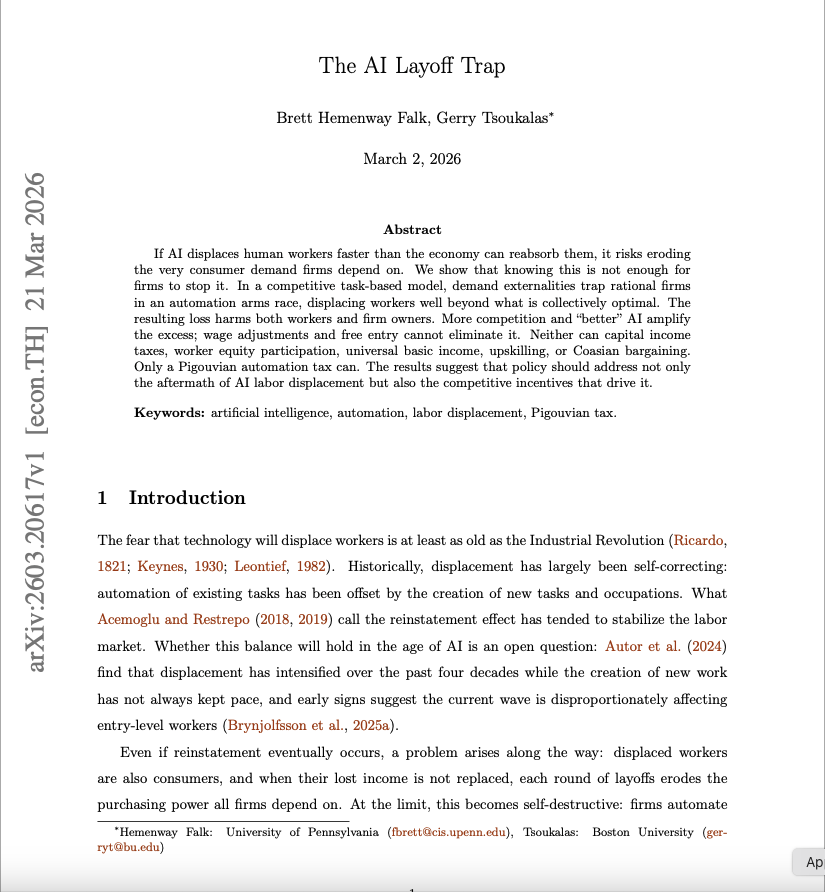
Two economists just published a mathematical proof that AI will destroy the economy.
Not might. Not could. Will — if nothing changes.
The paper is called "The AI Layoff Trap." Published March 2, 2026. Wharton School, University of Pennsylvania. Boston University. Peer reviewed. Mathematically modeled.
The conclusion is one sentence.
"At the limit, firms automate their way to boundless productivity and zero demand."
An economy that produces everything. And sells it to nobody.
Here is how you get there.
A company fires 500 workers and replaces them with AI. A competitor fires 700 to keep up. Another fires 1,000. Every company is behaving rationally. Every company is following the incentives correctly. And every company is building a trap for itself.
Because the workers who were fired were also customers.
When they lose their jobs faster than the economy can absorb them, they stop spending. Consumer demand falls. Companies respond by cutting costs — which means automating more workers — which means less spending — which means more falling demand — which means more automation.
The loop has no natural exit.
The researchers tested every proposed solution. Universal basic income. Capital income taxes. Worker equity participation. Upskilling programs. Corporate coordination agreements.
Every single one failed in the model.
The only intervention that worked: a Pigouvian automation tax — a per-task levy charged every time a company replaces a human with AI, forcing them to price in the demand they are destroying before they pull the trigger.
No government has implemented this. No major economy is seriously discussing it.
Meanwhile the numbers are already tracking the curve. 100,000 tech workers laid off in 2025. 92,000 more in the first months of 2026. Jack Dorsey fired half of Block's workforce and said publicly: "Within the next year, the majority of companies will reach the same conclusion."
Nobody is doing anything wrong. Companies are following their incentives perfectly. That is exactly the problem.
Rational behavior. At scale. Simultaneously. With no mechanism to stop it.
Two economists built the math. The math leads to one place.
Source: Falk & Tsoukalas · Wharton School + Boston University ·
https://t.co/4m8E9jQNYm





![Rainmaker1973's tweet photo. For generations, modern farming has relied heavily on energy-intensive synthetic nitrogen fertilizers. But groundbreaking work by one scientist is proving that nature’s own microbes can replace much of that dependence.
Dr. Mariangela Hungria, a Brazilian microbiologist, has been named the 2025 World Food Prize Laureate for her pioneering research on biological nitrogen fixation. Her decades-long work shows how beneficial soil bacteria can naturally deliver nitrogen to crops, dramatically reducing the need for chemical fertilizers.
Nitrogen is vital for plant growth, but producing synthetic versions is costly and emits massive amounts of greenhouse gases. Hungria dedicated more than 40 years to studying rhizobia — bacteria that form symbiotic relationships with legume roots (such as soybeans and beans). These microbes convert atmospheric nitrogen into a form plants can use, in exchange for sugars from the crop.
Her practical innovations have delivered impressive results. Treating soybean seeds with specially selected rhizobia strains has increased yields by up to 8% while cutting fertilizer use. She also advanced the use of Azospirillum brasilense, another bacterium that enhances nitrogen uptake and promotes growth through natural hormone production.
The impact has been transformative. Today, Hungria’s microbial inoculants are applied across more than 99 million acres (40 million hectares) of Brazilian farmland. This approach is estimated to save farmers around $25 billion each year in fertilizer costs and prevent more than 230 million metric tons of CO₂-equivalent emissions annually.
When she began her career, many doubted that microbes could meaningfully compete with industrial fertilizers. Thanks to her persistence, Brazil has become a global leader in sustainable agriculture — proving that tiny bacteria can play a giant role in feeding the world more efficiently and cleanly.
["Dr Mariangela Hungria Named 2025 World Food Prize Laureate." FarmingFirst, 2026]](https://pbs.twimg.com/media/HIR2BrhXMAAel0Y.jpg)