Higher Vibration Astrology: forecasts and deep dives. Psychic and energetic insights for empaths, energy workers and intuitives. Private readings available.
Astrology of a Shared Near-Death Experience https://t.co/D5tt89EzDh Dr. Scarlett Heinbuch shares the stories of her childhood NDE and how she met her future husband on the other side.
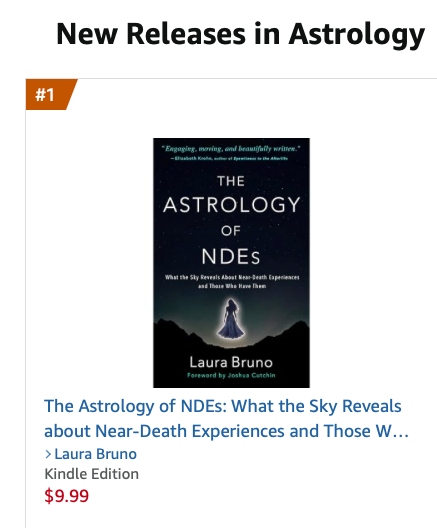
I'm pleased to announce that my book is now available for preorder. "The Astrology of NDEs: What the Sky Reveals about Near-Death Experiences and Those Who Have Them." https://t.co/gnimOZxEEk
Synchronicity as the Bridge between Psychology and Astrology
“Unbeknownst to many, Jung, the founder of analytical psychology, was very interested in astrology. A scholarly and intuitive man, he went to the ancient teachings for his insights, studying alchemy, astrology, the tarot, and the I Ching, as well as the texts of ancient religions and mystery schools. He was also a most modern thinker and was fascinated by the discoveries of modern quantum physics. He and the Nobel laureate Wolfgang Pauli were good friends and often conversed about the complementarity that exists between the fields of depth psychology and quantum physics. However, Jung was also very pragmatic. He wanted his theories to make sense to the public. Therefore, even though it is clear in his writings that he understood and was interested in astrology, he never made it a direct cornerstone of his work.
Instead, Jung made the concept of synchronicity pivotal in his theory. Synchronicity is defined as those strong parallels between interior and exterior events that are emphatically endowed with meaning. It is a phenomenon that everyone can relate to in his or her everyday experience: You dream that a friend whom you have not seen in thirty years has become a grandmother. The next day, you bump into her at the grocery store. She tells you that she is in town for a visit because her daughter has just given birth to her first child. You have just experienced a synchronicity. The meaningfulness of a synchronicity, major or minor, is determined by what associations you connect with the event at a conscious and/or unconscious level.
Jung’s theory of synchronicity was based on the ancient maxim from the Smaragdine Table of Hermes, which stated: Quod est superius est sicut quod est inferius, or ‘That which is above is as that which is below.’ As such, synchronicity is the underlying basis of such diverse phenomena as the I Ching, quantum physics, and, yes, astrology. Each of these approaches to reality assumes that there are meaningful correlations. What is happening below (i.e., on the earth in our everyday lives) is connected with what is happening above (i.e., in the heavens).
Jung also believed that synchronicity was evidence of the acausal relationship between what was happening within a person and what was happening in the universe. Synchronicities defy the laws of causality, and in doing so create tiny cracks in the surface of our rational thinking. Peeking through these cracks, we can experience another dimension of reality that is not related to cause and effect. Recognizing synchronistic patterns forces us to consider a larger worldview. Observing synchronicity sensitizes us to the concepts of harmony, complementarity, and the indivisibility of all consciousness. This deeper reality reveals that all things are interrelated, and, truly, no man is an island.
When synchronicities appear, it is a sign that the psyche, the soul, the deepest part of us, is being awakened to its alignment or misalignment with the universe. This is not a random happening or a mere coincidence. Jung would say that a synchronicity is a marker that indicates that the conscious mind is being given the opportunity to deal with some deep unconscious material.
The unconscious is commonly understood from a personal perspective. When you forget your aunt’s birthday in spite of the fact that you have programmed your Palm Pilot to remind you, some would say that an ‘unconscious’ part of you was in conflict with the part of you that wanted to remember her birthday. The same personal unconscious interferes with your rational control of your behavior when at the church picnic you find yourself saying to the parish priest, ‘This is my neighbor, Mary. She is a Prostitute.’ You meant to acknowledge that she was Protestant. In using the word ‘prostitute,’ you are experiencing the proverbial slip of the tongue that Freud documented so well. A part of your personality is ‘slipping into consciousness’ outside of your usual conscious control.
Jung believed that the unconscious was much more encompassing than our personal unconscious, and he coined the term the collective unconscious. He saw the collective unconscious as a vast reservoir of knowledge shared by all human beings. The collective unconscious contains all things, and the material present in this unconscious reservoir is both active and autonomous. It has a life of its own and impinges on our consciousness whenever necessary. Jung believed that the collective unconscious contained all a priori knowledge. In other words, everything that humankind will ever know was contained first in this vast reservoir of the unconscious.
Our conscious minds gradually become aware of this material through life experience. All of this knowledge is vague in the unconscious state. Our consciousness classifies this vague knowledge into categories that we can recognize. We do this by differentiating one thing from another. Consciously, we know a thing because we can compare it with its opposite. In consciousness, we could not know the color blue if everything that we experienced was blue. We know blue because we can differentiate it from something that is not blue. All the vast knowledge given to us by the unconscious is of little use until differentiated by consciousness into categories we can comprehend.
The Archetypes as Classifiers of the Unconscious
According to Jung, the archetypes accomplish this important task. The archetypes are the classifiers of the unconscious. They divide phenomena into broad or narrow categories and thus bring order out of the unconscious. We can categorize things as good or bad, light or dark, or internal or external, to name a few examples. More narrowly, we could divide phenomena into categories such as father, mother, sage, crone, fool, or child. An important distinction to remember is that the label given to the particular image so classified is not the archetype per se but its cultural adaptation.”
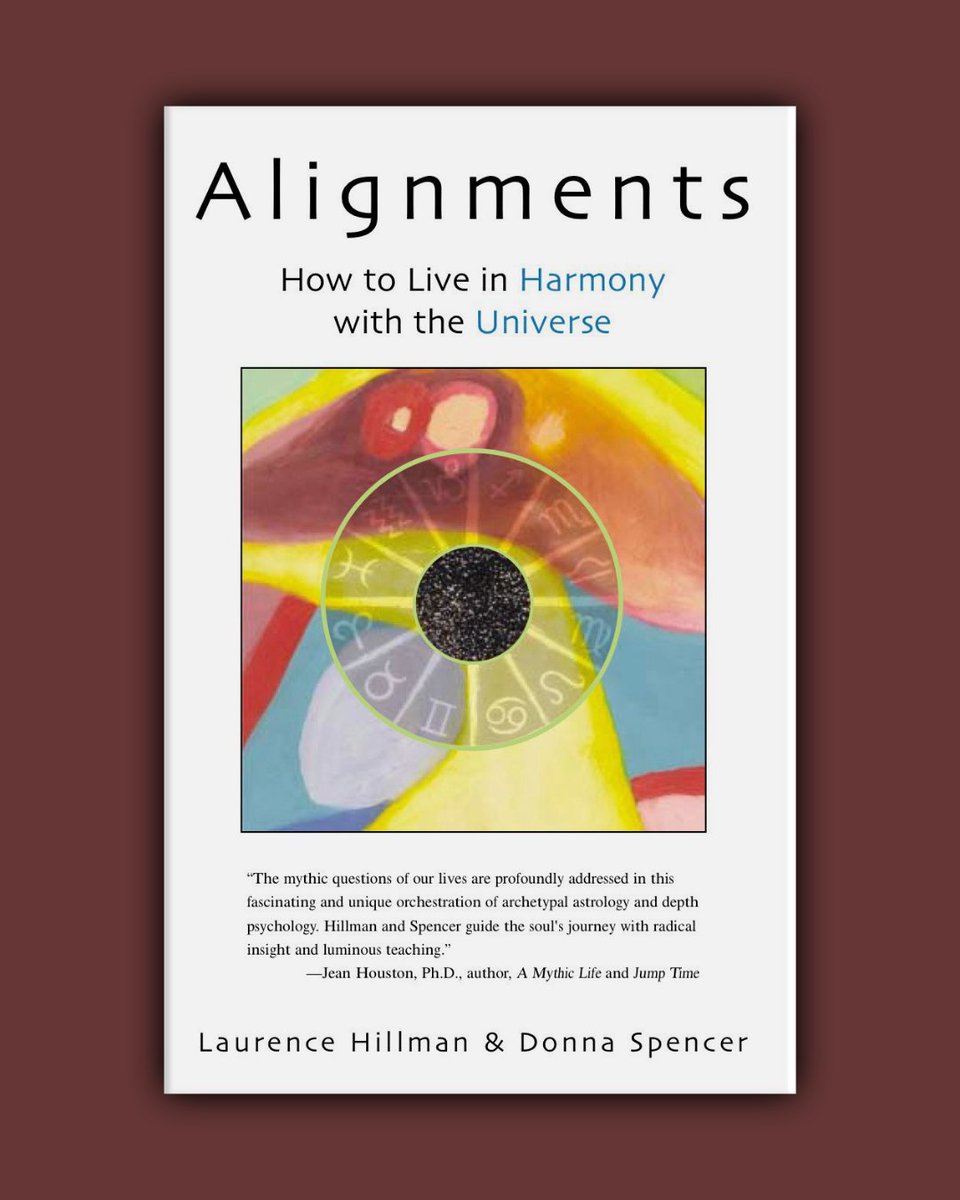
~Laurence Hillman and Donna Spencer, Alignments: How to Live in Harmony with the Universe, pp. 33–36
Coming later this week to Speaking of Jung.
https://t.co/gQhHYsOLrU First Full Moon in Aquarius since the lunar nodes changed signs--innovation, friendships, technology, and authenticity. Where are things headed?
I had some Mercury Retrograde technical difficulties at the beginning, but this was a great discussion about upcoming energies for the next 18 months! https://t.co/qif7gcztkf
Astrologer Laura Bruno on the Aquarius North Node & Leo South Node 18 Mo... https://t.co/R1k8gMTXlb via @YouTube Eric Taylor and I are going live at 7 p.m. Eastern time tonight.