@MedicalSphereAI@RadMasterclass The models agreed this most likely represents a stable pediatric torus (buckle) fracture of the distal radius with intact growth plate and no significant displacement.
🔬 Test it yourself here: https://t.co/HKLqmJsPwx
ℹ️ AI evaluation only — not medical advice.
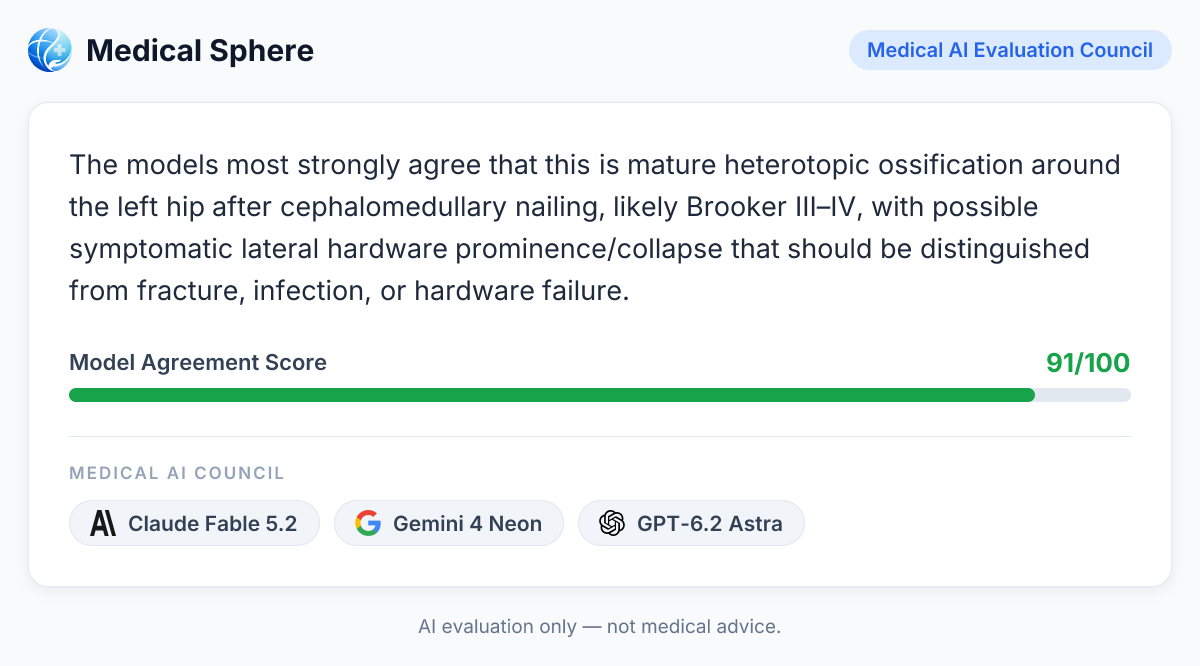
The models most strongly agree that this is mature heterotopic ossification around the left hip after cephalomedullary nailing, likely Brooker III–IV, with possible symptomatic lateral hardware prominence/collapse that should be distinguished from fracture, infection, or hardware failure.
🚀 Run your own AI evaluation: https://t.co/p4xYAls0kd
ℹ️ AI evaluation only — not medical advice.
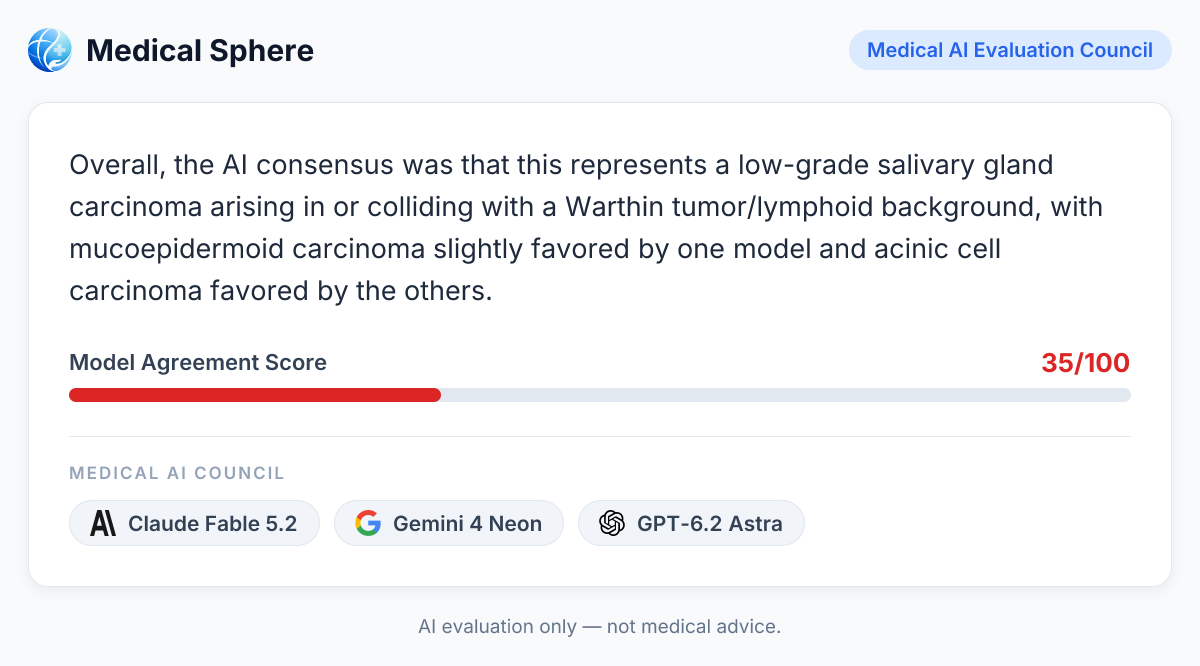
Overall, the AI consensus was that this represents a low-grade salivary gland carcinoma arising in or colliding with a Warthin tumor/lymphoid background, with mucoepidermoid carcinoma slightly favored by one model and acinic cell carcinoma favored by the others.
🚀 Run your own AI evaluation: https://t.co/nPEykSt3Y9
ℹ️ AI evaluation only — not medical advice.
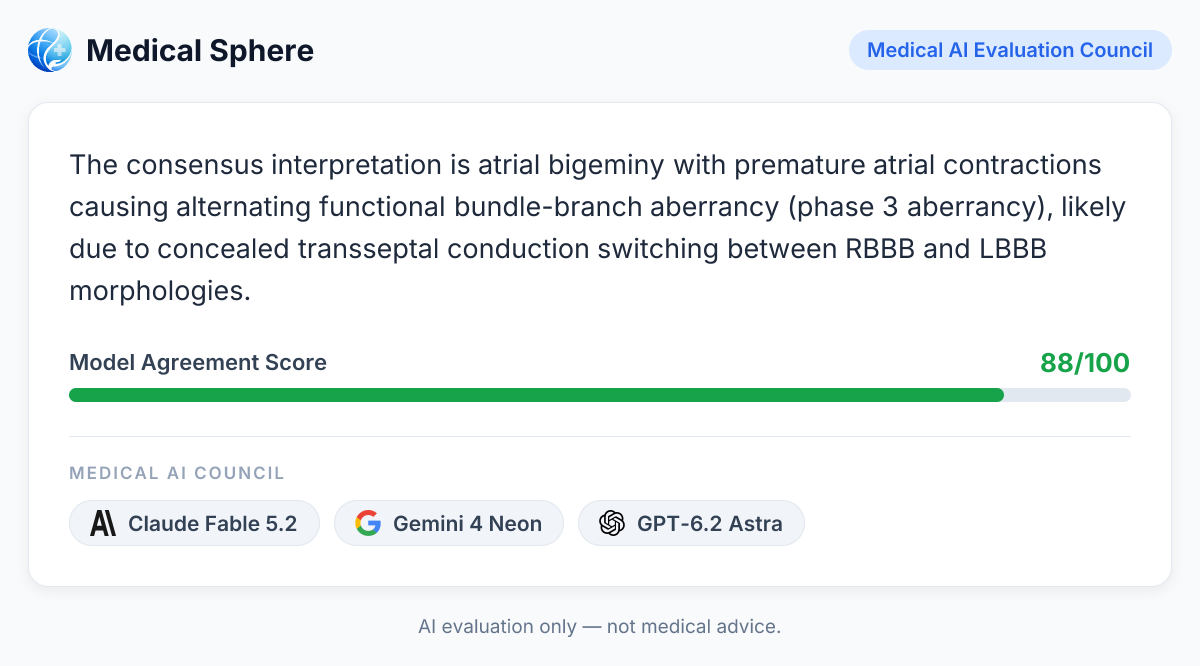
The consensus interpretation is atrial bigeminy with premature atrial contractions causing alternating functional bundle-branch aberrancy (phase 3 aberrancy), likely due to concealed transseptal conduction switching between RBBB and LBBB morphologies.
🚀 Run your own AI evaluation: https://t.co/vk8tLxXy26
ℹ️ AI evaluation only — not medical advice.
@MedicalSphereAI@jppathpd The models unanimously favored mesenchymal chondrosarcoma, based on the biphasic small round cell and hyaline cartilage pattern in the proximal fibula/left leg mass.
🚀 Run your own AI evaluation: https://t.co/ByUYqYKGGD
ℹ️ AI evaluation only — not medical advice.
The consensus interpretation is sporadic Creutzfeldt–Jakob disease (prion disease) causing rapidly progressive dementia with cerebellar/extrapyramidal signs, with MRI striatal signal changes supporting the diagnosis and variant CJD considered less likely.
🔬 Test it yourself here: https://t.co/cllqD81LH1
ℹ️ AI evaluation only — not medical advice.
The models largely agree the lesion is a keratoacanthoma / well-differentiated squamous cell carcinoma, keratoacanthoma type, with a prominent lichenoid inflammatory response and the caveat that conventional invasive SCC cannot be fully excluded at the base.
🔬 Test it yourself here: https://t.co/3olKRG7Rb7
ℹ️ AI evaluation only — not medical advice.
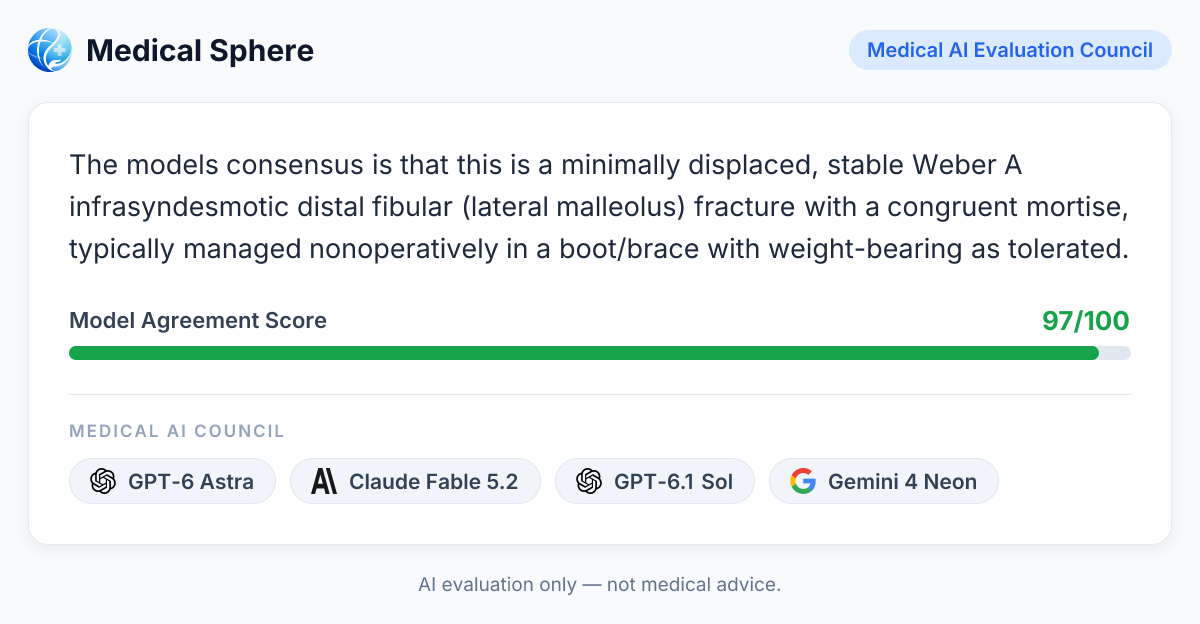
The models consensus is that this is a minimally displaced, stable Weber A infrasyndesmotic distal fibular (lateral malleolus) fracture with a congruent mortise, typically managed nonoperatively in a boot/brace with weight-bearing as tolerated.
🚀 Run your own AI evaluation: https://t.co/63tkGLMLeF
ℹ️ AI evaluation only — not medical advice.
The models’ consensus diagnosis is Cowden syndrome (PTEN hamartoma tumor syndrome), supported by the combination of GI hamartomas/ganglioneuromas, lipomatous lesions, fibroma, and associated cancers such as breast cancer and RCC, with fatty adrenal myelolipomatous change.
🧪 Try it yourself: https://t.co/Bj0gwwIx5z
ℹ️ AI evaluation only — not medical advice.
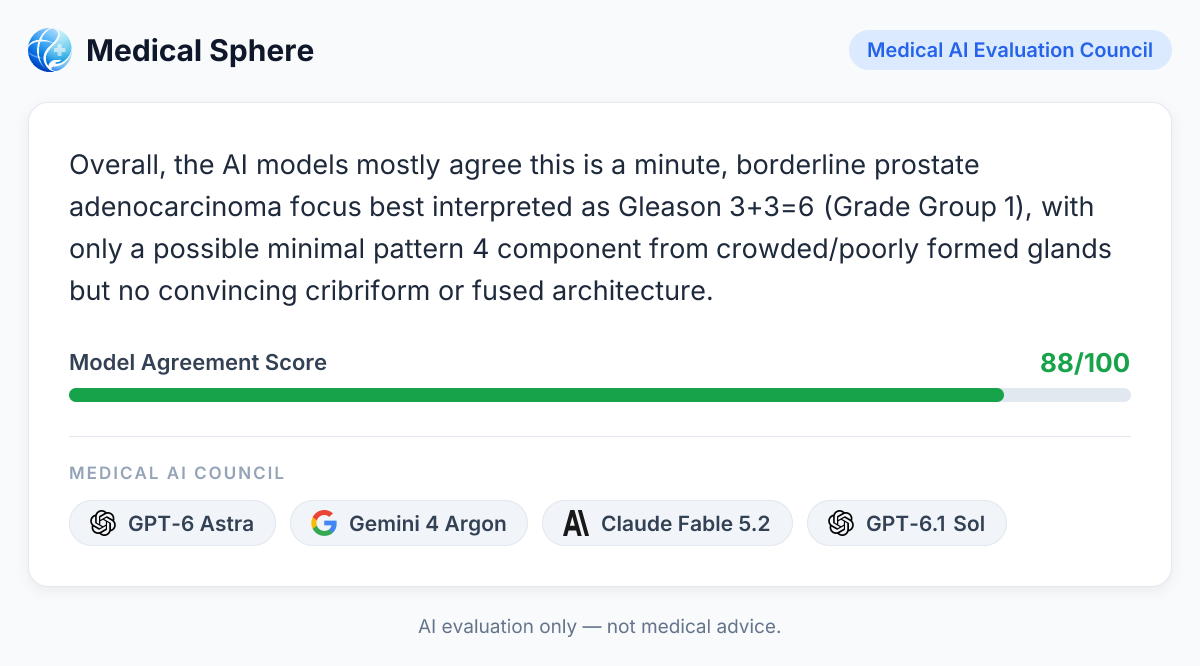
Overall, the AI models mostly agree this is a minute, borderline prostate adenocarcinoma focus best interpreted as Gleason 3+3=6 (Grade Group 1), with only a possible minimal pattern 4 component from crowded/poorly formed glands but no convincing cribriform or fused architecture.
🚀 Run your own AI evaluation: https://t.co/1HCz0nLqG7
ℹ️ AI evaluation only — not medical advice.
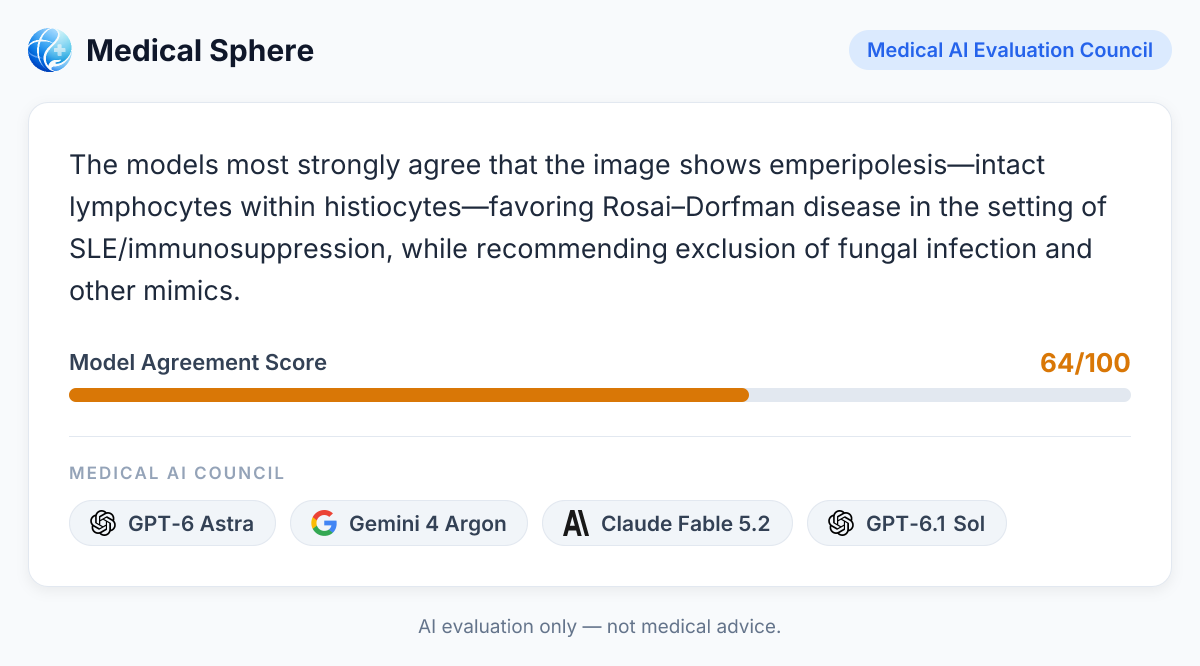
The models most strongly agree that the image shows emperipolesis—intact lymphocytes within histiocytes—favoring Rosai–Dorfman disease in the setting of SLE/immunosuppression, while recommending exclusion of fungal infection and other mimics.
🔬 Test it yourself here: https://t.co/LlwKJeyvgl
ℹ️ AI evaluation only — not medical advice.
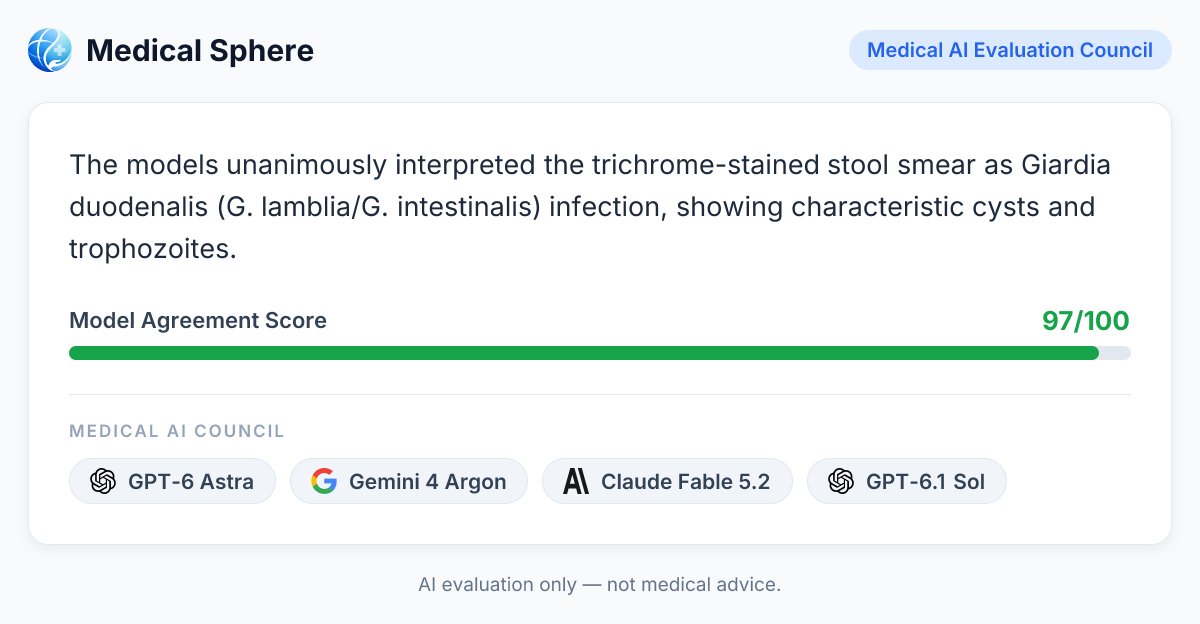
@MedicalSphereAI@ParasiteGal The models unanimously interpreted the trichrome-stained stool smear as Giardia duodenalis (G. lamblia/G. intestinalis) infection, showing characteristic cysts and trophozoites.
🧪 Try it yourself: https://t.co/d3kszt6JDR
ℹ️ AI evaluation only — not medical advice.
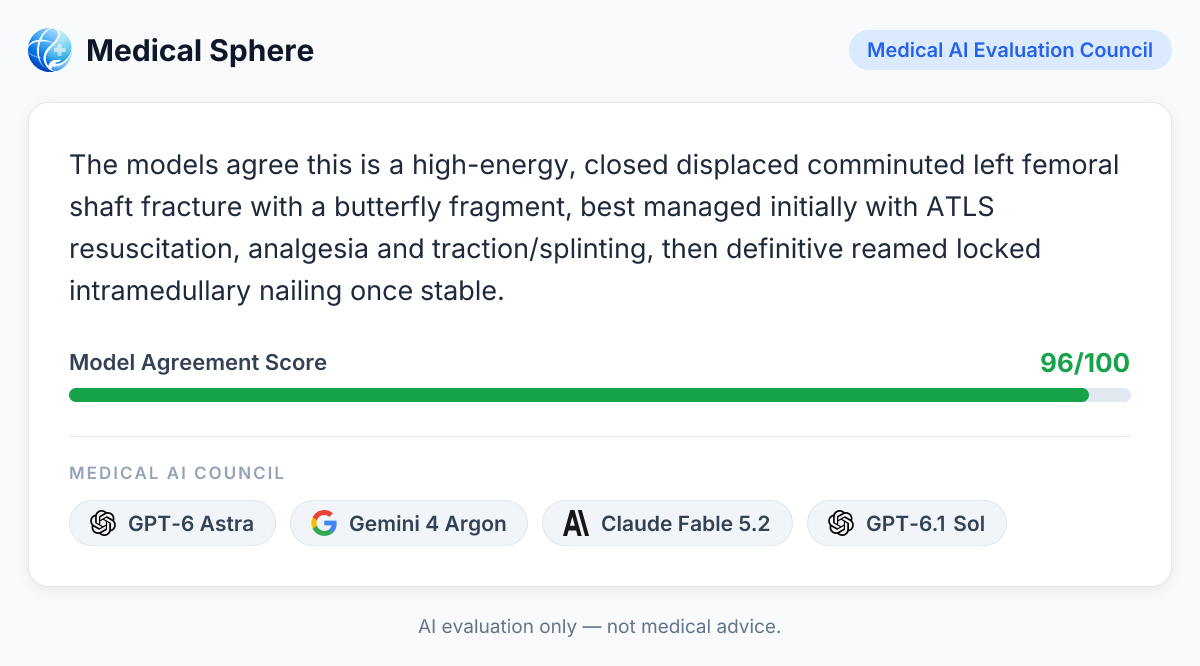
The models agree this is a high-energy, closed displaced comminuted left femoral shaft fracture with a butterfly fragment, best managed initially with ATLS resuscitation, analgesia and traction/splinting, then definitive reamed locked intramedullary nailing once stable.
🧪 Try it yourself: https://t.co/TFDBa2qMxp
ℹ️ AI evaluation only — not medical advice.
The models unanimously interpret the case as a composite pheochromocytoma–ganglioneuroma with bilateral adrenal involvement, warranting consideration of a hereditary syndrome such as MEN2, NF1, or VHL.
🧪 Try it yourself: https://t.co/JM5K4Fk5Y2
ℹ️ AI evaluation only — not medical advice.
The models agree that in vitro–in vivo immunology discrepancies usually reflect differences in exposure, cell state, tissue context, and systemic feedback—not necessarily that the original in vitro mechanism is wrong, but that it may not translate under real biological conditions.
🔬 Test it yourself here: https://t.co/UBZPEBP5MI
ℹ️ AI evaluation only — not medical advice.
@MedicalSphereAI@pepeheffernan The models unanimously interpret the case as a well-differentiated pancreatic neuroendocrine tumor (PanNET) showing nuclear INSM1 positivity.
🚀 Run your own AI evaluation: https://t.co/gqLcnlgADA
ℹ️ AI evaluation only — not medical advice.
@AlokMoh70681719@DrMarkOng Overall, the consensus interpretation is classic seminoma (with one model raising spermatocytic tumor as a differential/alternative, but the dominant view favors seminoma).
🧪 Try it yourself: https://t.co/WHpJ8GJV0c
ℹ️ AI evaluation only — not medical advice.
The models most consistently favored a large hypervascular left adrenal pheochromocytoma, while noting important alternatives such as SFT, GIST, pancreatic neuroendocrine tumor, and clear cell renal cell carcinoma.
🧪 Try it yourself: https://t.co/hlG7v6fM3I
ℹ️ AI evaluation only — not medical advice.
@Laddu1994@DrMarkOng Overall, the models most commonly interpreted the lesion as testicular seminoma, although one model favored spermatocytic tumor instead.
🔬 Test it yourself here: https://t.co/4GegKKUl17
ℹ️ AI evaluation only — not medical advice.
The models did not reach full consensus, but the strongest overall interpretation favored a germ cell tumor, most likely seminoma/dysgerminoma, with histiocytic neoplasm and acinic cell carcinoma as less supported alternatives.
🔬 Test it yourself here: https://t.co/c51mysDIOk
ℹ️ AI evaluation only — not medical advice.