İstanbul Medeniyet Üniversitesi Bilim Tarihi Enstitüsü’nde muhterem İhsan Fazlıoğlu hocamızı ziyaret ettik. Semaniye Medresesi’nin mirasını ruhuna uygun bir şekilde işlevselleştiren Enstitü, bilim geleneğimiz üzerinde bilim geleceğimiz için ümit veriyor.
Fazlıoğlu hocamıza ve ekibine hüsnü kabulleri için teşekkür ediyoruz.
Duygu-Değer Temelli Dijital Esenlik Projemiz kapsamında ortaokul düzeyindeki etkinliklerin düzenlenmesi amacıyla gerçekleştirilen çalıştay, Sayın Bakan Yardımcımız Ömer Faruk Yelkenci'nin teşrifleriyle başladı ve çalışmalarımız üç gün boyunca devam etti.
@farukyelkenci
Kastamonu’daydık!
Türkiye Yüzyılı Maarif Modeli yönetici, öğretmen buluşmalarımıza devam ediyoruz. İl müdürümüze, ekibine ve programa iştirak eden mesai arkadaşlarımıza, meslektaşlarımıza teşekkür ediyoruz.
Kastamonu’nun tarihimizdeki büyük yeri ve eşsiz güzelliği eşliğinde…
Türkiye Yüzyılı Maarif Modeli, milletimizin köklü irfanı ile çağın pedagojik imkânlarını buluşturan güçlü bir eğitim vizyonudur.
Zihni sahih bilgiyle beslenen, kalbi merhamet ve adaletle güçlenen, sorumluluk alan ve üreten nesiller güçlü ve müreffeh yarınlarımızın teminatıdır.
Eğitim ailemize iyi haftalar diliyorum.
📌 Coğrafi Bilgi Sistemi Platformu yayında❗
Öğretmen ve öğrencilerimiz artık OGM Materyal Coğrafi Bilgi Sistemi Platformu ile kendi veri katmanlarını oluşturabilecek, haritalar üretebilecek ve mekânsal analizler yapabilecek; hikâye haritalarıyla harita, metin ve görselleri bir araya getirerek ders içeriklerini etkileşimli öğrenme deneyimlerine dönüştürebilecek.
Harita okuryazarlığını dijital becerilerle harmanlayan bu platformda emeği geçen herkese teşekkür ediyorum.
👉🏻 https://t.co/5tMKleC1qk
Türkiye Yüzyılı Maarif Modelimiz, Sayın Bakanımız @Yusuf__Tekin'in öncülüğünde; çocuklarımızın kalbine dokunmaya ve ufkuna istikamet çizmeye devam ediyor.
Bu anlayış doğrultusunda; okullarımızda bilimsel farkındalığın güçlenmesini, öğrencilerimizin bilimle daha erken ve daha güçlü bağ kurmasını amaçlayan 4009 – Köy Okullarına Yönelik Destek Programı’nın ilk çağrısı, TÜBİTAK Bilim ve Toplum Başkanlığı tarafından yayımland��.
@Tubitak’a teşekkür ediyor, kıymetli meslektaşlarımı bu anlamlı çağrıya katkı sunmaya davet ediyorum.
📅 Son başvuru: 9 Mart 2026
Destek üst limiti: 150.000 TL
https://t.co/TqjGtQymqs
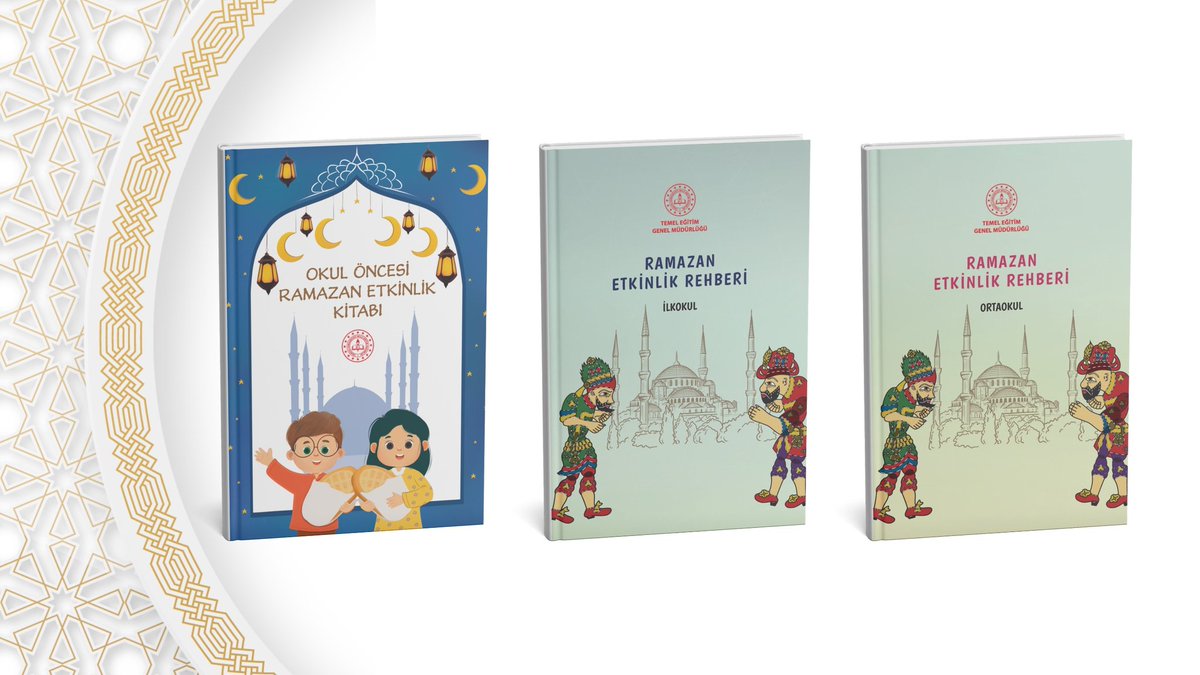
Ramazan Ayında Okullarda "Maarifin Kalbinde Ramazan" Etkinlikleri Düzenlenecek.
Etkinlik rehberlerine ulaşmak için tıklayınız:
🔗https://t.co/U91kRPYfkq
@tcmeb@Yusuf__Tekin@farukyelkenci@ebubekirsavasci
📚 MEBİ Rehberlik Modülü Yenilendi!
Eğitimde dijital dönüşüm vizyonumuz doğrultusunda geliştirilen MEBİ Rehberlik Modülü, kapsamlı içerik güncellemesiyle öğrencilerimizin kullanımına sunuldu.
🎯 Fırsat eşitliği ve erişilebilirlik ilkeleriyle yenilenen modül artık
▶️ Videolu anlatımlar 📝 Zenginleştirilmiş yazılı dokümanlar
ile bütüncül bir öğrenme deneyimi sunuyor.
👩🎓👨🎓 9, 10, 11, 12. sınıf öğrencileri ve mezunlar; ✔️ Akademik rehberlik ✔️ Sosyal-duygusal gelişim ✔️ Kariyer planlama alanlarında ihtiyaç duydukları bilgilere tek tıkla ulaşabiliyor.
📌 Kapsanan Başlıklar: • Okula uyum ve motivasyon • Etkili iletişim becerileri • Verimli ders çalışma teknikleri • Duygu yönetimi ve psikolojik sağlamlık • Geleceğe hazırlık ve kariyer planlama
Güvenilir, öğrenci merkezli ve sürdürülebilir bir rehberlik kaynağı: MEBİ
@tcmeb@Yusuf__Tekin@farukyelkenci@h_ibrahim_topcu
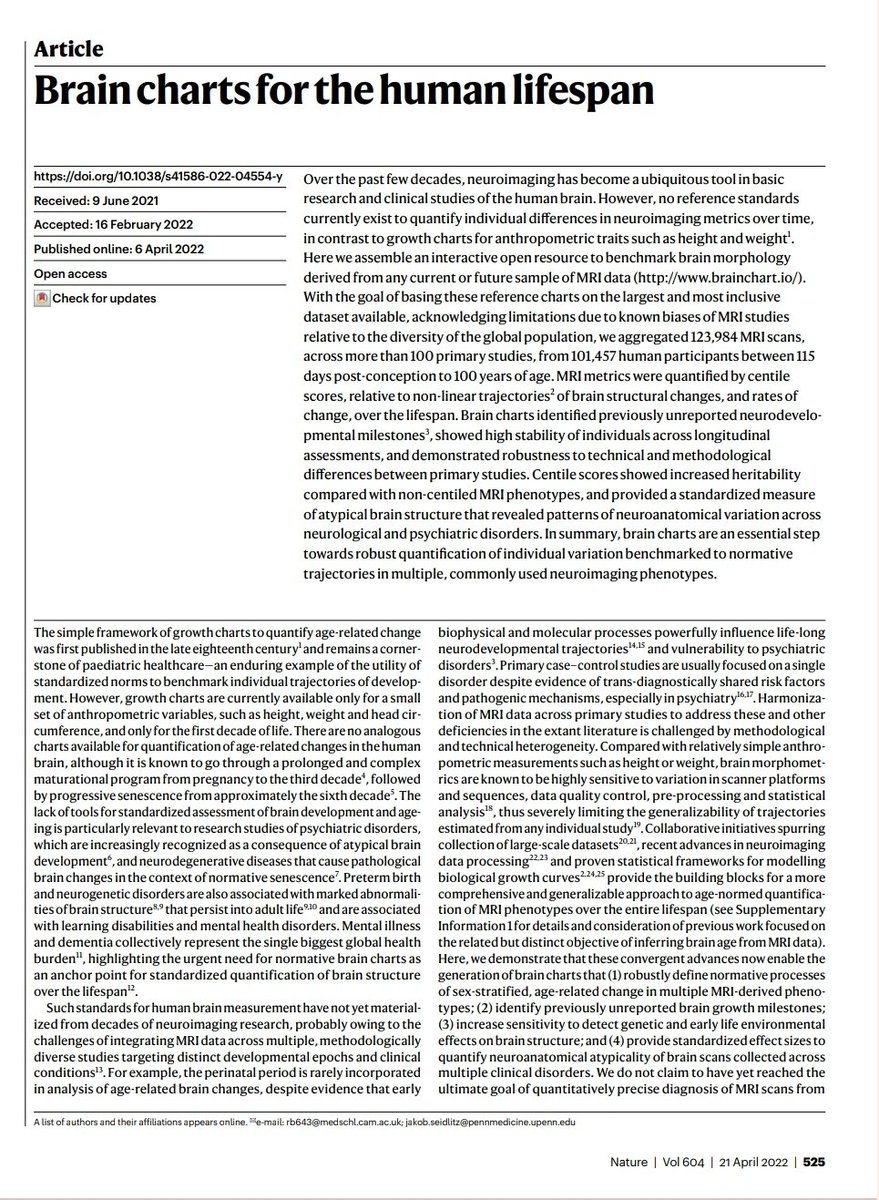
İnsan beyninin doğumdan 100 yaşına kadar olan yolculuğunu gösteren devasa ve harika bir makale var.
Makale, bugüne kadar toplanan en büyük nörogörüntüleme veri setine dayanıyor. 100'den fazla çalışmadan elde edilen 101.457 katılımcıyla yapıldı. Detayları aşağıya yazıyorum:
You must know these 𝗔𝗴𝗲𝗻𝘁𝗶𝗰 𝗦𝘆𝘀𝘁𝗲𝗺 𝗪𝗼𝗿𝗸𝗳𝗹𝗼𝘄 𝗣𝗮𝘁𝘁𝗲𝗿𝗻𝘀 as an 𝗔𝗜 𝗘𝗻𝗴𝗶𝗻𝗲𝗲𝗿.
If you are building Agentic Systems in an Enterprise setting you will soon discover that the simplest workflow patterns work the best and bring the most business value.
At the end of last year Anthropic did a great job summarising the top patterns for these workflows and they still hold strong.
Let’s explore what they are and where each can be useful:
𝟭. 𝗣𝗿𝗼𝗺𝗽𝘁 𝗖𝗵𝗮𝗶𝗻𝗶𝗻𝗴: This pattern decomposes a complex task and tries to solve it in manageable pieces by chaining them together. Output of one LLM call becomes an input to another.
✅ In most cases such decomposition results in higher accuracy with sacrifice for latency.
ℹ️ In heavy production use cases Prompt Chaining would be combined with following patterns, a pattern replace an LLM Call node in Prompt Chaining pattern.
𝟮. 𝗥𝗼𝘂𝘁𝗶𝗻𝗴: In this pattern, the input is classified into multiple potential paths and the appropriate is taken.
✅ Useful when the workflow is complex and specific topology paths could be more efficiently solved by a specialized workflow.
ℹ️ Example: Agentic Chatbot - should I answer the question with RAG or should I perform some actions that a user has prompted for?
𝟯. 𝗣𝗮𝗿𝗮𝗹𝗹𝗲𝗹𝗶𝘇𝗮𝘁𝗶𝗼𝗻: Initial input is split into multiple queries to be passed to the LLM, then the answers are aggregated to produce the final answer.
✅ Useful when speed is important and multiple inputs can be processed in parallel without needing to wait for other outputs. Also, when additional accuracy is required.
ℹ️ Example 1: Query rewrite in Agentic RAG to produce multiple different queries for majority voting. Improves accuracy.
ℹ️ Example 2: Multiple items are extracted from an invoice, all of them can be processed further in parallel for better speed.
𝟰. 𝗢𝗿𝗰𝗵𝗲𝘀𝘁𝗿𝗮𝘁𝗼𝗿: An orchestrator LLM dynamically breaks down tasks and delegates to other LLMs or sub-workflows.
✅ Useful when the system is complex and there is no clear hardcoded topology path to achieve the final result.
ℹ️ Example: Choice of datasets to be used in Agentic RAG.
𝟱. 𝗘𝘃𝗮𝗹𝘂𝗮𝘁𝗼𝗿-𝗼𝗽𝘁𝗶𝗺𝗶𝘇𝗲𝗿: Generator LLM produces a result then Evaluator LLM evaluates it and provides feedback for further improvement if necessary.
✅ Useful for tasks that require continuous refinement.
ℹ️ Example: Deep Research Agent workflow when refinement of a report paragraph via continuous web search is required.
𝗧𝗶𝗽𝘀:
❗️ Before going for full fledged Agents you should always try to solve a problem with simpler Workflows described in the article.
Learn how to leverage these patterns hands-on in my End-to-end AI Engineering Bootcamp. Next cohort kicking off on January 12th: https://t.co/gWBu8OLTzn
🎁 Code NYRESOLUTION for 10% off.
What are the most complex workflows you have deployed to production? Let me know in the comments 👇
Major preprint just out!
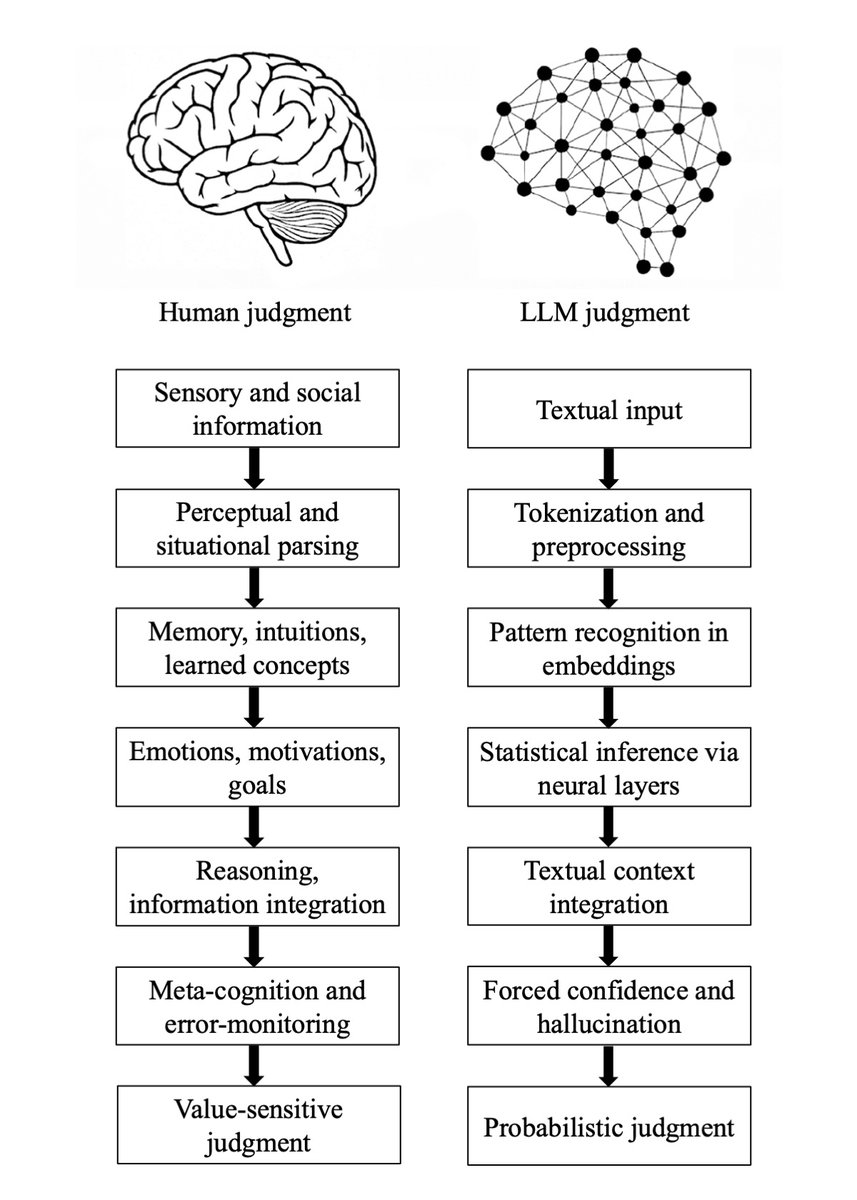
We compare how humans and LLMs form judgments across seven epistemological stages.
We highlight seven fault lines, points at which humans and LLMs fundamentally diverge:
The Grounding fault: Humans anchor judgment in perceptual, embodied, and social experience, whereas LLMs begin from text alone, reconstructing meaning indirectly from symbols.
The Parsing fault: Humans parse situations through integrated perceptual and conceptual processes; LLMs perform mechanical tokenization that yields a structurally convenient but semantically thin representation.
The Experience fault: Humans rely on episodic memory, intuitive physics and psychology, and learned concepts; LLMs rely solely on statistical associations encoded in embeddings.
The Motivation fault: Human judgment is guided by emotions, goals, values, and evolutionarily shaped motivations; LLMs have no intrinsic preferences, aims, or affective significance.
The Causality fault: Humans reason using causal models, counterfactuals, and principled evaluation; LLMs integrate textual context without constructing causal explanations, depending instead on surface correlations.
The Metacognitive fault: Humans monitor uncertainty, detect errors, and can suspend judgment; LLMs lack metacognition and must always produce an output, making hallucinations structurally unavoidable.
The Value fault: Human judgments reflect identity, morality, and real-world stakes; LLM "judgments" are probabilistic next-token predictions without intrinsic valuation or accountability.
Despite these fault lines, humans systematically over-believe��LLM outputs, because fluent and confident language produce a credibility bias.
We argue that this creates a structural condition, Epistemia:
linguistic plausibility substitutes for epistemic evaluation, producing the feeling of knowing without actually knowing.
To address Epistemia, we propose three complementary strategies: epistemic evaluation, epistemic governance, and epistemic literacy.
Full paper in the first reply.
Joint with @Walter4C & @matjazperc
Duygu-Değer Temelli Dijital Esenlik projemizin dijital oyun tasarımı kapsamında, biz de GençTek Oyunun e-Hali programına katıldık. @AslanSumyye
https://t.co/jpihRhl3yj
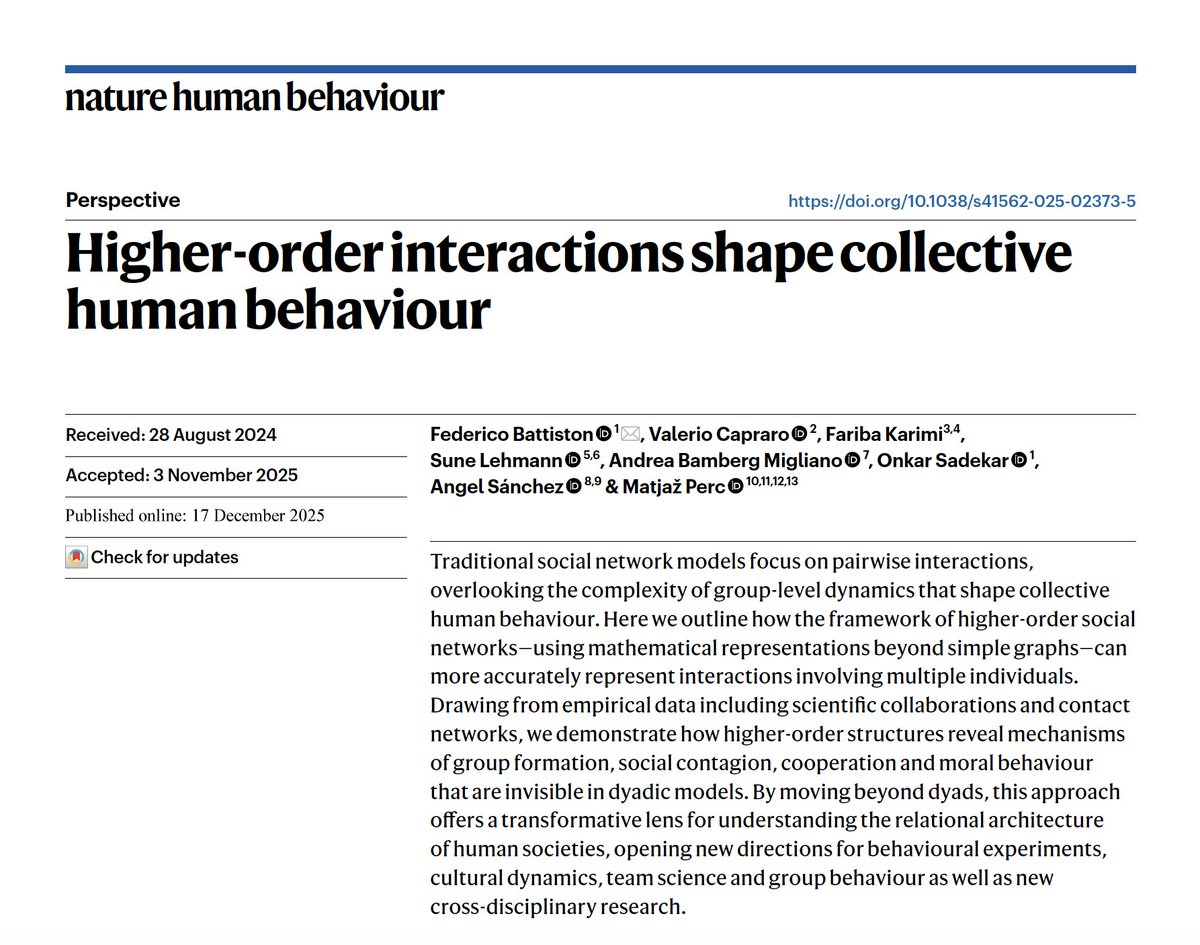
Now out in Nature Human Behaviour! 🚀🚀
Over the past decades, research on collective human behaviour has relied heavily on networks. This is intuitive: people interact with other people.
However, we argue that this dominant framework misses a crucial ingredient.
Traditional networks represent agents as nodes and pairwise relations as edges. As a result, they fundamentally assume that social interactions can be decomposed into pairs.
Yet many social processes are irreducibly group-based.
A simple example: a group of three coauthors writing a paper cannot be reduced to three independent pairs of coauthors. The group itself matters.
In this article, we review a wide range of empirical and theoretical cases where group interactions cannot be decomposed into pairwise ones, and show that higher-order interactions shape collective behaviour above and beyond dyadic ties.
We advocate studying collective behaviour on hypergraphs, where interactions can involve multiple agents simultaneously.
We review how hypergraphs provide new insights across domains, including affiliation and collaboration networks, high-frequency contact settings (families, friends), and key social processes such as social contagion, cooperation, truth-telling, and moral behaviour.
Finally, we outline promising directions for future research: addressing computational challenges of higher-order models; studying bias and inequality in group dynamics; combining hypergraphs and large language models to investigate the coevolution of language and behaviour; and using higher-order networks to simulate the impact of policies before implementation; and others.
We are very excited about this work and hope it will inspire further research in a rapidly growing and fundamental area with broad real-world implications.
Link to the paper in the first reply
This work was brilliantly led by Federico Battiston (@fede7j), with an outstanding team of co-authors: Fariba Karimi (@fariba_k), Sune Lehmann, Andrea Bamberg Migliano, Onkar Sadekar (@OnkarSadekar), Angel Sanchez, & Matjaz Perc (@matjazperc)
DUYGU-DEĞER TEMELLi DiJiTAL ESENLiK PROJESi'nin ilkokullarda uygulamasına yönelik gerçekleştirdiğimiz çalıştayımızı bugün tamamladık. Çalıştaya katılan öğretmenlerimiz büyük bir istekle çalıştılar. @farukyelkenci@ebubekirsavasci@mebtegm@AslanSumyye
Duygu Değer Temelli Dijital Esenlik Projesinin ilkokullarda uygulanmasına yönelik çalışmalar kapsamında
15–18 Aralık 2025 tarih aralığında düzenlenmekte olan çalıştayın açılışında öğretmenlerimiz ve akademisyen hocalarımızla buluştuk.
Çocuklarımızı dijital dünyadaki risklere ve tehlikelere karşı koruma konusunda çalışmalarımız çeşitli boyutlarıyla devam ediyor.