The homie is publishing a new game, with vibes reminiscent to Metro, Fallout and Silent Hill. Earlier dev builds were already awesome, so I'm sure the release will be even better ❤️
Your nightmare begins on October 30 👻
BURIED INSIDE ME is a first-person psychological horror experience where your own mind becomes your prison
Whatever you do… Don’t let yourself catch you 👁️
⬇️ WISHLIST NOW ⬇️
https://t.co/MY2FRPzqvj
#indiegame#indiedev#gamedev#steam
9am me: Time to sit down and work through that 2 hour vector DB tutorial
5 mins later me: Wow my terminal just isn’t aesthetically pleasing enough for this. Must spend the next hour installing Hyper, Oh My Zsh, Spaceship, picking themes, browsing fonts, and installing plugins…
This week's paper is "Categorizing Variants of Goodhart’s Law" by David Manheim and Scott Garrabrant.
Goodhart's law is often stated as "when a measure becomes a target, it ceases to be a good measure". The authors note that there are various ways in which systems can fail when optimized excessively based on specific metrics.
This occurs when a metric, initially useful for system improvement, is pushed to a point where further optimization becomes either ineffective or counterproductive. The paper argues that these failure modes are often misunderstood, partly due to unclear terminology and partly because discussions using this ambiguous language fail to distinguish between different types of failures within this broader category.
Goodhart's law can be observed in action across diverse domains, including public policy, corporate management, and artificial intelligence alignment. In their paper, Manheim and Garrabrant examine several distinct failure modes, providing mathematical explanations to elucidate each type.
Paper: https://t.co/6DjQqzy1G7
What can we remove?
Our bias is to always add more. More rules, more procedures, more code, more features, more stuff. Interdependencies proliferate, and gradually strangle us. Systems want to grow and grow, but without pruning, they collapse. Slowly, then spectacularly.
When a piece of trash drifts across the beach, it is our duty to pick it up so the next person can enjoy a pristine shoreline. When a thousand pieces litter the beach, it is too late. We can only lament the landscape. That’s just how beaches are now.
A good system is designed to be periodically cleared of cruft. It has a built-in counterbalance. Without this pressure, our bias drives us to add band-aid after band-aid, until the only choice is to destroy the whole system and start from scratch.
Why is it so much easier to add than to remove? Maybe because we attach our identity to what is visible. But there is a difference between the ornamentation that defines our style and the vestigial burdens we carry.
Remember those who did the invisible work of removing. Their legacy was not to build a sand castle, but to care for the beautiful beach on which we play.
Software designers of tomorrow should study games like Tiny Glade as they look and behave more like where software will end up:
3D/spatial, adaptive, contextual, high-level abstractions, pleasing
You intentionally invest in craft. You provide an environment where talented people thrive on pushing their own boundaries and then enable and encourage them to explore.
It’s not a sacrifice of velocity - it’s an investment in quality.
@victorcserrano De lejos, es de lo mejor de la carrera. Aunque ya lo valoraba en su momento, cuando vuelves al "mundo real", te das cuenta de la barbaridad de gente que había en el DGIIM. Cada persona era absurdamente increíble en un área u otra.
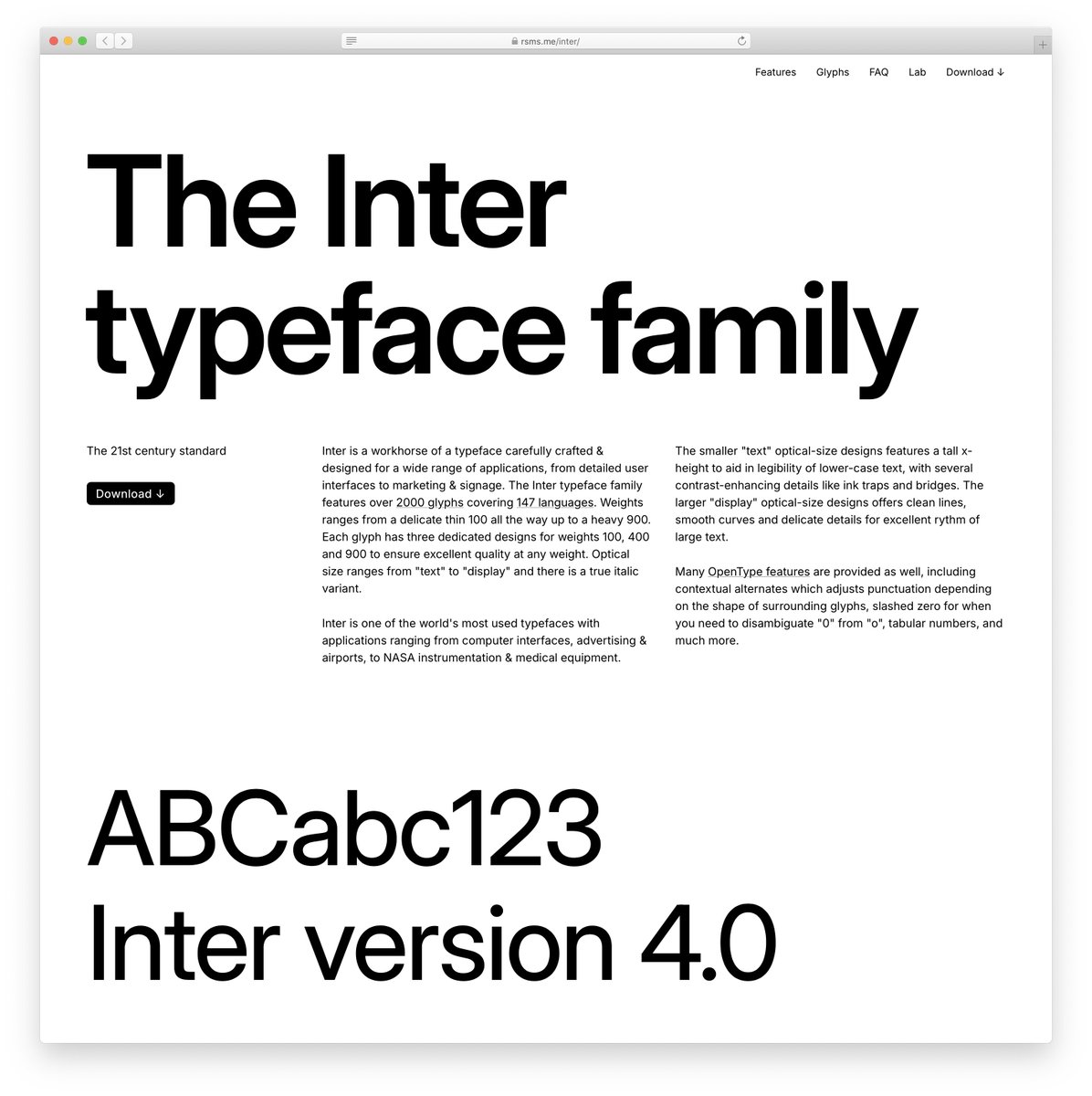
Inter version 4.0 → https://t.co/ULjFmnOO3k
After two years of work on a new version of Inter, I'm so proud that it's finally released. (It's been in beta for the past year)
The changes are vast. Most notably there are six additional "Display" designs for large delicious type
This is a pet peeve of mine. Light and its temperature plays a significant role in how we feel. Putting cold (high color frequency) LED lights on streets is a terrible idea and I surely don’t want to live in a place where there are “blue” lights.
It’s just negligence — we have the technology to make LED light emit lower frequency (warmer) light, but it requires us to become educated on the impact of this and of course care about how we feel.
The free web version of "Physically Based Rendering: From Theory To Practice" is now based on the 4th edition of the book. Enjoy! (Link: https://t.co/N7CroKjKLC)